Intro
PMBOK Guide is not a project management methodology , nor a project
management framework. As PMI describes it; the best practices of project
management.
PMBOK Guide complies with ISO-21500 Project Management
So what is new the PMBOK Guide 7th
edition?
PMBOK guide 7th
edition considers as a revolutionary version as it is totally differ
from the previous version as instead of focusing only on project deliverables, it also
places great importance on the results/value the project brings.
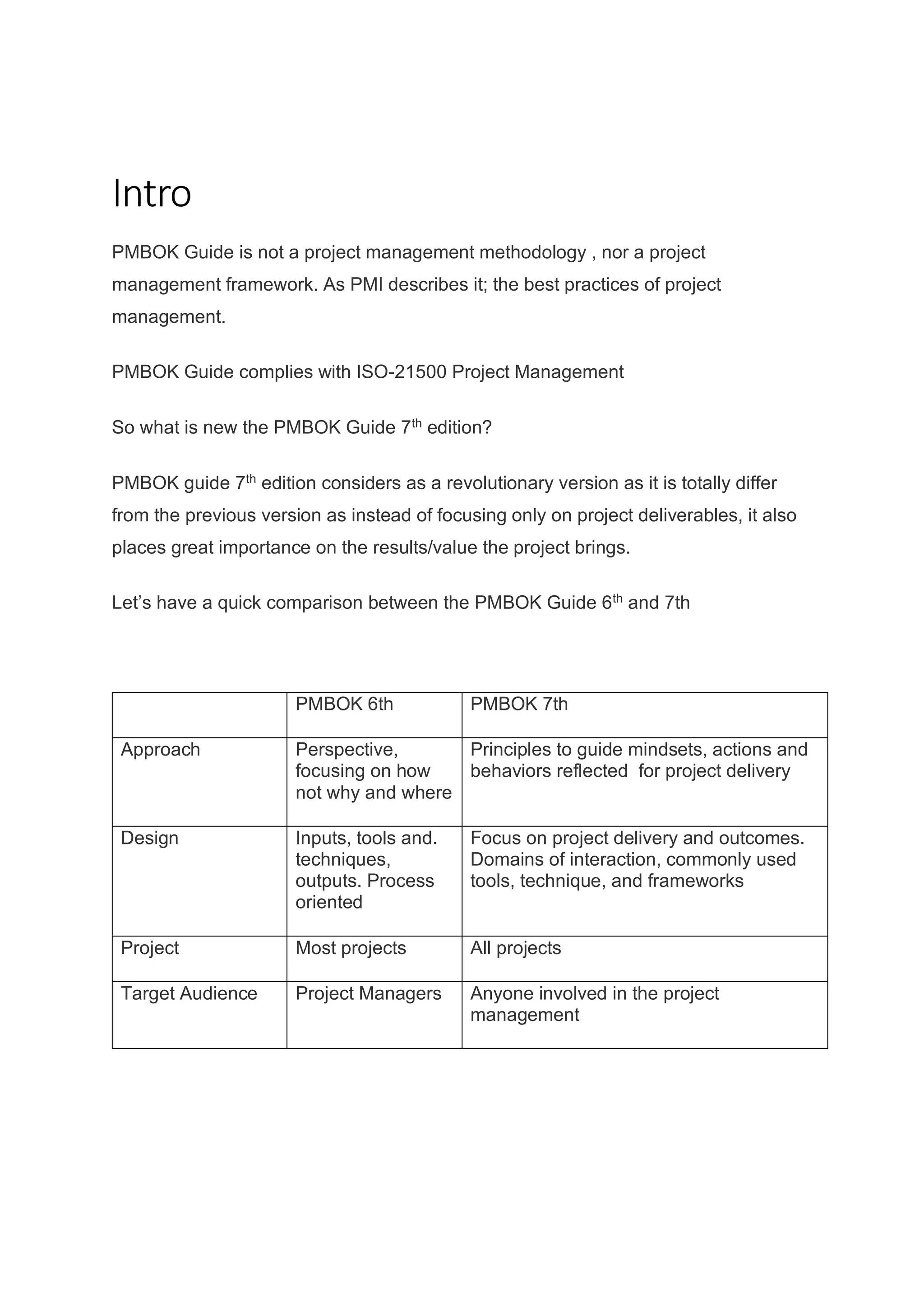
Let’s have a quick comparison between the PMBOK Guide 6th
and 7th
PMBOK 6th PMBOK 7th
Approach Perspective,
focusing on how
not why and where
Principles to guide mindsets, actions and
behaviors reflected for project delivery
Design Inputs, tools and.
techniques,
outputs. Process
oriented
Focus on project delivery and outcomes.
Domains of interaction, commonly used
tools, technique, and frameworks
Project Most projects All projects
Target Audience Project Managers Anyone involved in the project
management
PMBOK Guide 7th
main sections
Deliver Value System
Per PMBOK Guide 7th the purpose of any project is to deliver value, and based on
this definition the guide is developed. There are some many ways to describe
values; customer satisfaction is a value, creation new product is a value, process re-
engineering is as a value, etc.
Without forgetting the importance of the triple constraint triangle that ensure the
success of the project (Scope, Time, Cost), the value of the project is the main
factor, and each project has its own weight according to the values it brings to the
organization/ frim.
The value here is linked closely to value management.
Value management is described as “a management approach that focuses on
motivating people, developing skills, and fostering synergies and innovation with the
ultimate goal of optimizing overall organizational performance.”
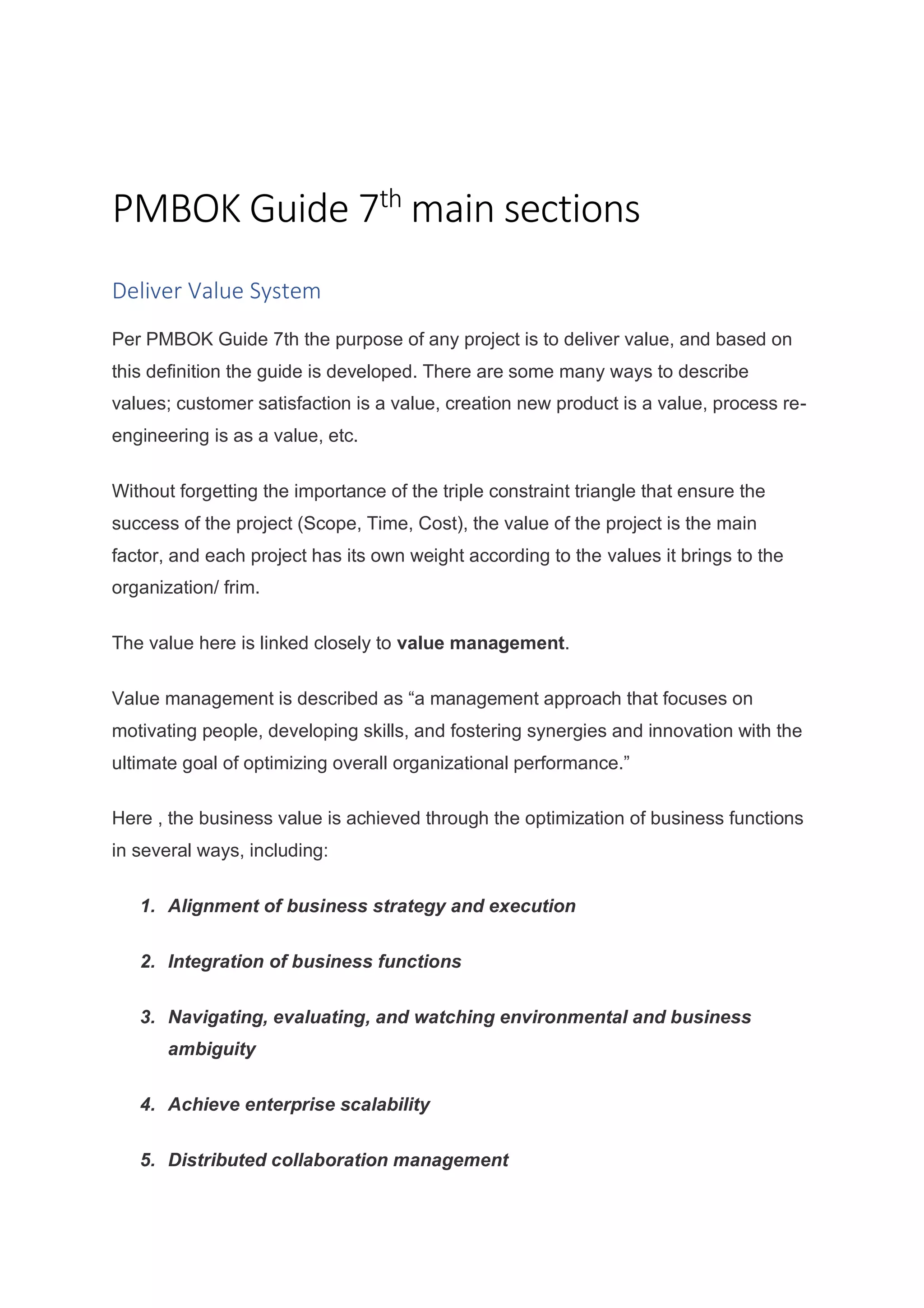
Here , the business value is achieved through the optimization of business functions
in several ways, including:
1. Alignment of business strategy and execution
2. Integration of business functions
3. Navigating, evaluating, and watching environmental and business
ambiguity
4. Achieve enterprise scalability
5. Distributed collaboration management
6. Reduced time to profit
Project Management Principles
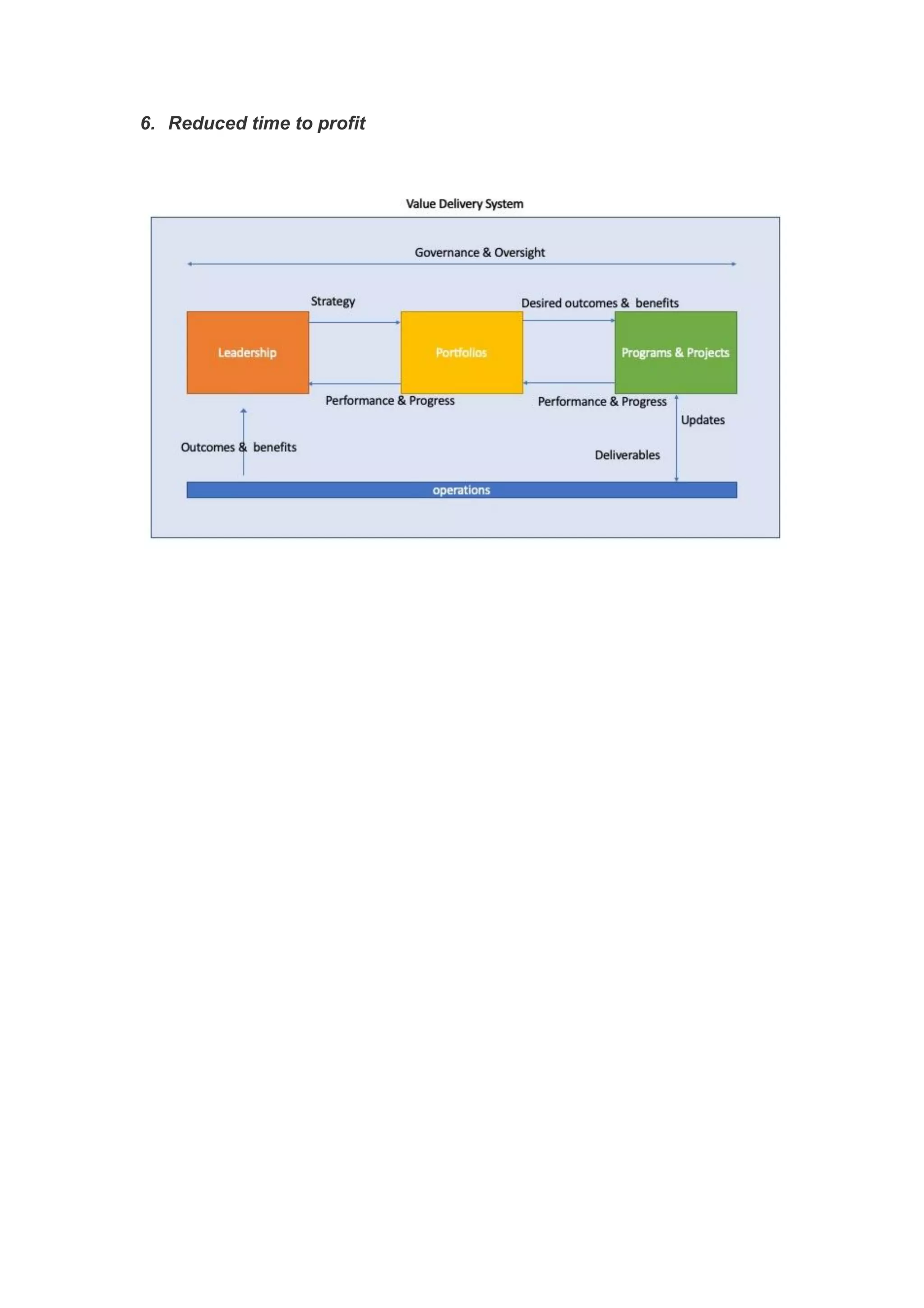
The guide lists and focuses on twelve commonly accepted principles. Our thoughts
and actions are led by our principles, so to ensure delivering the expected result and
outcome, common principles that must be adapted and followed are :
1. Pay Attention / Care ( Stewardship): Be a diligent, respectful, and caring
steward. Carry out activities with integrity, care, and trustworthiness while
maintaining compliance with internal and external guidelines.
2. Team: Create a collaborative project team environment
3. Stakeholders: Engage stakeholders to understand their interests and needs.
4. Value: Focus on value. Align the project with the objectives of the
organization.
PM
Priciples
Value
Team
Statekholders
Care
Resilence &
Adapyability
Risk
Change
Management
Complexity
Tailoring
Quality
Leadership
System thinking
5. System thinking: Recognize, evaluate, and respond to system interactions,
with the aim to respond to the dynamic circumstances within and surrounding
the project in a holistic way to positively affect project performance.
6. Leadership: Motivate, influence, train and learn. Demonstrate leadership
behaviors in areas of honesty, integrity, and ethical conduct and adapting
leadership style to the situation.
7. Tailoring: Adapt the approach of deliveries according to the context.
Adaptability is the key through the use of an iterative approach.
8. Quality: Incorporate quality into processes and results. Maintain a focus on
quality that produces deliverables that meet project objectives and align to the
needs, uses, and acceptance requirements set forth by relevant stakeholders.
9. Complexity: Address complexity using knowledge, experience, and learning.
10.Opportunities and threats (Risk): Optimize responses to opportunities and
threats. Maximize positive impacts and minimize negative impacts to the
project and its outcomes.
11.Adaptability and resilience: Be adaptable and resilient depending on the
context to help the project accommodate change, recover from setbacks, and
advance the work of the project.
12.Change management: Enable change to achieve the expected future state.
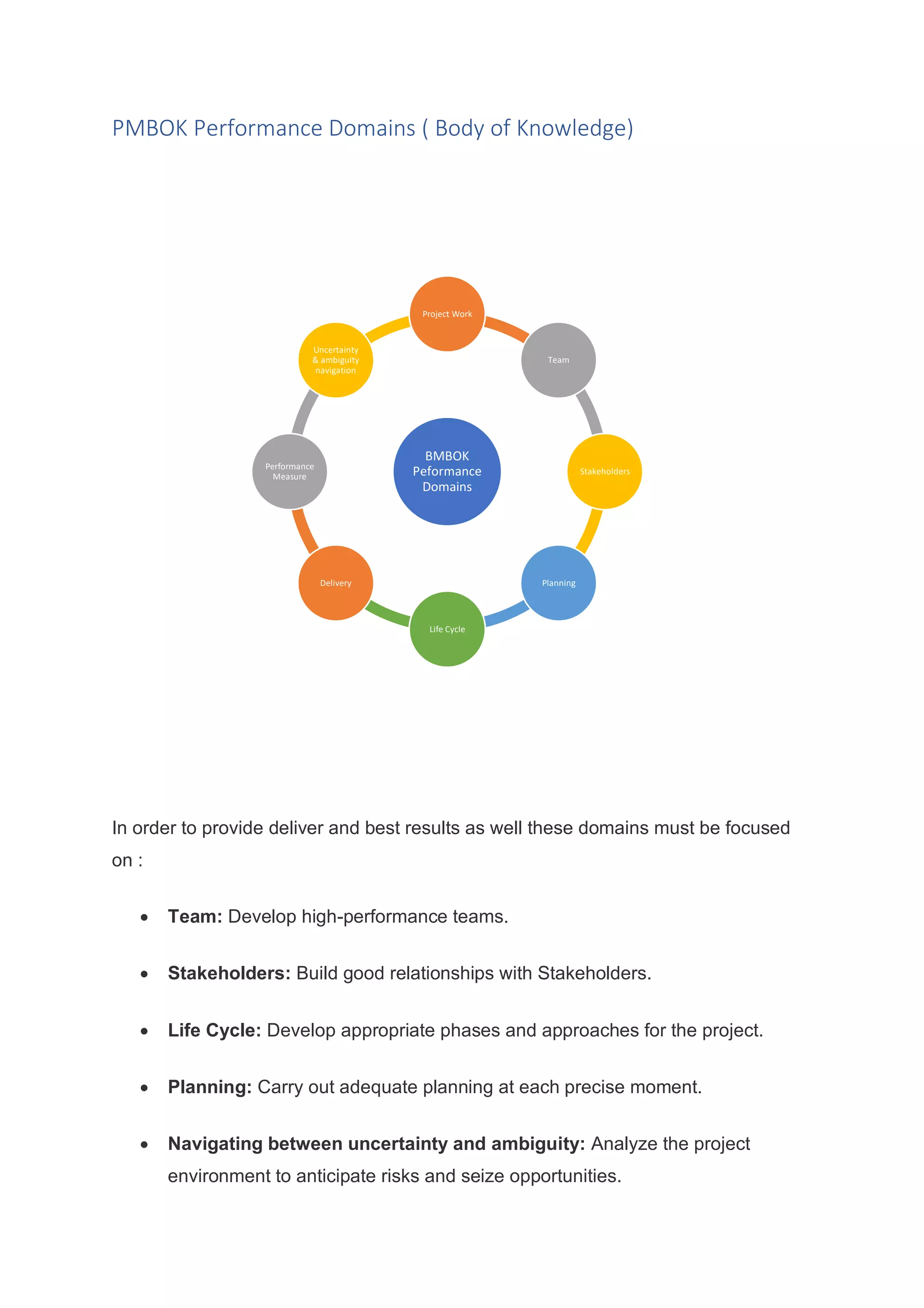
PMBOK Performance Domains ( Body of Knowledge)
In order to provide deliver and best results as well these domains must be focused
on :
• Team: Develop high-performance teams.
• Stakeholders: Build good relationships with Stakeholders.
• Life Cycle: Develop appropriate phases and approaches for the project.
• Planning: Carry out adequate planning at each precise moment.
• Navigating between uncertainty and ambiguity: Analyze the project
environment to anticipate risks and seize opportunities.
BMBOK
Peformance
Domains
Project Work
Team
Stakeholders
Planning
Life Cycle
Delivery
Performance
Measure
Uncertainty
& ambiguity
navigation
• Delivery: Proportionate value
• Performance Measure: Track to ensure results are achieved.
• Project work: Guarantee the activities to facilitate the team the delivery of
results.
Body of Knowledge: Tailoring
New section added , because of technology and the rapidly changed environment a
full section about project management tailoring is added. The guide handles many
methods and framework without preferring one over the other as every project have
its own characteristics. Tailoring can be applied on any such as predictive, agile,
hybrid, or cascading
Body of Knowledge: Models, Methods and Artifacts
Here it includes the group of processes, methods, and artifacts that allow:
1. Initiate: defines and authorizes the project or a phase.
2. Planning: clarifies and refines the objectives, planning the necessary actions
to carry them out.
3. Execute: Integrates people and other resources to produce the deliverables
and performance information of the project.
4. Monitoring and controlling: measures and monitors the progress of the
project in order to identify possible variations and discrepancies with respect
to the original plan and correct them when necessary.
5. Close: completes all activities of all groups of project management processes
to formally complete the project (or a phase) and formalize the acceptance of
the product, service, or result.
The Best PMP exam preparation resources
PMP Prepcast Elite
The PM PrepCast Elite PLUS gives you the “standout factor” you need to succeed on your
PMP exam
You will never find an exam preparation program with these features
• Video-based training
• 2,100+ Realistic PMP Exam Sample Questions
• 11 hours of Agile Training
• PMP Exam Formulas
• PM Study Coach Guidebooks
• Track Your Progress Throughout the Lessons
• Download All Lessons to Your Phone or Tablet
• 90-Day Money-Back Guarantee
• The PM PrepCast Elite comes with 7+ additional bonus items
• Certificate for 35 Contact Hours
PMP exam simulator
Face the latest PMP exam format with confidence and pass comfortably based on practice
tests, reviews, and various exam tips provided in the course material.
• 2,280+ PMP practice exam sample questions
• Five complete exams with 180 questions each
• Separate quiz pool (1,100 questions)
• Questions developed by certified PMP team
• Updated to the current PMP Exam Content Outline (ECO)
Premium PMI-ACP Exam Simulator (90-Day Access)
Over 2,280+ exam-quality PMP® questions and explanations!
PMP® Study Guide
The PMP® Exam Formula Study Guide is a complete kit for learning the formulas that are
tested during the Project Management Professional (PMP)® Exam. Boost your confidence
with this straightforward guide to all the formulas,
This booster course aims to close the gap in your knowledge by covering exactly the topics
you need to feel confident on exam day. You’ll learn agile and hybrid project management
approaches, agile-specific topics, the role and competencies of the project manager in agile
settings, benefits realization, and more
Don’t forget to check pmlead.net.
PMLEAD.net is the best hub for project management and leadership
Success Is Yours,
PMLEAD TEAM

PMBOK GUIDE 7th Summary

  • 1.
    Intro PMBOK Guide isnot a project management methodology , nor a project management framework. As PMI describes it; the best practices of project management. PMBOK Guide complies with ISO-21500 Project Management So what is new the PMBOK Guide 7th edition? PMBOK guide 7th edition considers as a revolutionary version as it is totally differ from the previous version as instead of focusing only on project deliverables, it also places great importance on the results/value the project brings. Let’s have a quick comparison between the PMBOK Guide 6th and 7th PMBOK 6th PMBOK 7th Approach Perspective, focusing on how not why and where Principles to guide mindsets, actions and behaviors reflected for project delivery Design Inputs, tools and. techniques, outputs. Process oriented Focus on project delivery and outcomes. Domains of interaction, commonly used tools, technique, and frameworks Project Most projects All projects Target Audience Project Managers Anyone involved in the project management
  • 2.
    PMBOK Guide 7th mainsections Deliver Value System Per PMBOK Guide 7th the purpose of any project is to deliver value, and based on this definition the guide is developed. There are some many ways to describe values; customer satisfaction is a value, creation new product is a value, process re- engineering is as a value, etc. Without forgetting the importance of the triple constraint triangle that ensure the success of the project (Scope, Time, Cost), the value of the project is the main factor, and each project has its own weight according to the values it brings to the organization/ frim. The value here is linked closely to value management. Value management is described as “a management approach that focuses on motivating people, developing skills, and fostering synergies and innovation with the ultimate goal of optimizing overall organizational performance.” Here , the business value is achieved through the optimization of business functions in several ways, including: 1. Alignment of business strategy and execution 2. Integration of business functions 3. Navigating, evaluating, and watching environmental and business ambiguity 4. Achieve enterprise scalability 5. Distributed collaboration management
  • 3.
    6. Reduced timeto profit
  • 4.
    Project Management Principles Theguide lists and focuses on twelve commonly accepted principles. Our thoughts and actions are led by our principles, so to ensure delivering the expected result and outcome, common principles that must be adapted and followed are : 1. Pay Attention / Care ( Stewardship): Be a diligent, respectful, and caring steward. Carry out activities with integrity, care, and trustworthiness while maintaining compliance with internal and external guidelines. 2. Team: Create a collaborative project team environment 3. Stakeholders: Engage stakeholders to understand their interests and needs. 4. Value: Focus on value. Align the project with the objectives of the organization. PM Priciples Value Team Statekholders Care Resilence & Adapyability Risk Change Management Complexity Tailoring Quality Leadership System thinking
  • 5.
    5. System thinking:Recognize, evaluate, and respond to system interactions, with the aim to respond to the dynamic circumstances within and surrounding the project in a holistic way to positively affect project performance. 6. Leadership: Motivate, influence, train and learn. Demonstrate leadership behaviors in areas of honesty, integrity, and ethical conduct and adapting leadership style to the situation. 7. Tailoring: Adapt the approach of deliveries according to the context. Adaptability is the key through the use of an iterative approach. 8. Quality: Incorporate quality into processes and results. Maintain a focus on quality that produces deliverables that meet project objectives and align to the needs, uses, and acceptance requirements set forth by relevant stakeholders. 9. Complexity: Address complexity using knowledge, experience, and learning. 10.Opportunities and threats (Risk): Optimize responses to opportunities and threats. Maximize positive impacts and minimize negative impacts to the project and its outcomes. 11.Adaptability and resilience: Be adaptable and resilient depending on the context to help the project accommodate change, recover from setbacks, and advance the work of the project. 12.Change management: Enable change to achieve the expected future state.
  • 6.
    PMBOK Performance Domains( Body of Knowledge) In order to provide deliver and best results as well these domains must be focused on : • Team: Develop high-performance teams. • Stakeholders: Build good relationships with Stakeholders. • Life Cycle: Develop appropriate phases and approaches for the project. • Planning: Carry out adequate planning at each precise moment. • Navigating between uncertainty and ambiguity: Analyze the project environment to anticipate risks and seize opportunities. BMBOK Peformance Domains Project Work Team Stakeholders Planning Life Cycle Delivery Performance Measure Uncertainty & ambiguity navigation
  • 7.
    • Delivery: Proportionatevalue • Performance Measure: Track to ensure results are achieved. • Project work: Guarantee the activities to facilitate the team the delivery of results.
  • 8.
    Body of Knowledge:Tailoring New section added , because of technology and the rapidly changed environment a full section about project management tailoring is added. The guide handles many methods and framework without preferring one over the other as every project have its own characteristics. Tailoring can be applied on any such as predictive, agile, hybrid, or cascading Body of Knowledge: Models, Methods and Artifacts Here it includes the group of processes, methods, and artifacts that allow: 1. Initiate: defines and authorizes the project or a phase. 2. Planning: clarifies and refines the objectives, planning the necessary actions to carry them out. 3. Execute: Integrates people and other resources to produce the deliverables and performance information of the project. 4. Monitoring and controlling: measures and monitors the progress of the project in order to identify possible variations and discrepancies with respect to the original plan and correct them when necessary. 5. Close: completes all activities of all groups of project management processes to formally complete the project (or a phase) and formalize the acceptance of the product, service, or result.
  • 9.
    The Best PMPexam preparation resources PMP Prepcast Elite The PM PrepCast Elite PLUS gives you the “standout factor” you need to succeed on your PMP exam You will never find an exam preparation program with these features • Video-based training • 2,100+ Realistic PMP Exam Sample Questions • 11 hours of Agile Training • PMP Exam Formulas • PM Study Coach Guidebooks • Track Your Progress Throughout the Lessons • Download All Lessons to Your Phone or Tablet • 90-Day Money-Back Guarantee • The PM PrepCast Elite comes with 7+ additional bonus items • Certificate for 35 Contact Hours PMP exam simulator Face the latest PMP exam format with confidence and pass comfortably based on practice tests, reviews, and various exam tips provided in the course material. • 2,280+ PMP practice exam sample questions • Five complete exams with 180 questions each • Separate quiz pool (1,100 questions) • Questions developed by certified PMP team • Updated to the current PMP Exam Content Outline (ECO)
  • 10.
    Premium PMI-ACP ExamSimulator (90-Day Access) Over 2,280+ exam-quality PMP® questions and explanations! PMP® Study Guide The PMP® Exam Formula Study Guide is a complete kit for learning the formulas that are tested during the Project Management Professional (PMP)® Exam. Boost your confidence with this straightforward guide to all the formulas,
  • 11.
    This booster courseaims to close the gap in your knowledge by covering exactly the topics you need to feel confident on exam day. You’ll learn agile and hybrid project management approaches, agile-specific topics, the role and competencies of the project manager in agile settings, benefits realization, and more Don’t forget to check pmlead.net. PMLEAD.net is the best hub for project management and leadership Success Is Yours, PMLEAD TEAM