Introduction to
ENTERPRISE
ARCHITECTURE
(EA)
by Fahmie Bahweris
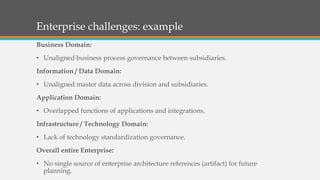
Enterprise challenges: example
Business Domain:
• Unaligned business process governance between subsidiaries.
Information / Data Domain:
• Unaligned master data across division and subsidiaries.
Application Domain:
• Overlapped functions of applications and integrations.
Infrastructure / Technology Domain:
• Lack of technology standardization governance.
Overall entire Enterprise:
• No single source of enterprise architecture references (artifact) for future
planning.
Shared Service Group
External
System from Subsidiary A
FTS FCS
ESS Waybill
PSDS
BI
System from Subsidiary B
FTS FCS
ESS Waybill
PSDS
BI
System from Subsidiary C
FTS FCS
ESS Waybill
PSDS
BI
System from Subsidiary E
FTS FCS
ESS Waybill
PSDS
BI
Ministry Pg Tour
SAP HR SAP Fi SAP MM
SAP PM VPA IXO
System from Subsidiary D
RCMS SAMS ROS
AD
Management Report
Management Dashboard
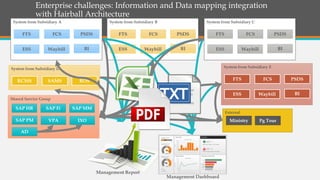
Enterprise challenges: Information and Data mapping integration
with Hairball Architecture
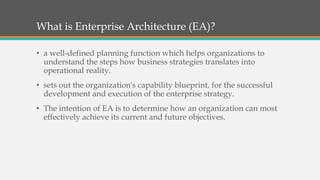
What is Enterprise Architecture (EA)?
• a well-defined planning function which helps organizations to
understand the steps how business strategies translates into
operational reality.
• sets out the organization's capability blueprint, for the successful
development and execution of the enterprise strategy.
• The intention of EA is to determine how an organization can most
effectively achieve its current and future objectives.
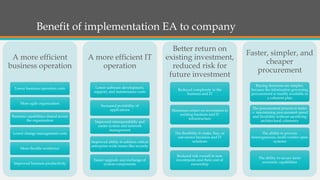
Benefit of implementation EA to company
A more efficient
business operation
Lower business operation costs
More agile organization
Business capabilities shared across
the organization
Lower change management costs
More flexible workforce
Improved business productivity
A more efficient IT
operation
Lower software development,
support, and maintenance costs
Increased portability of
applications
Improved interoperability and
easier system and network
management
Improved ability to address critical
enterprise-wide issues like security
Easier upgrade and exchange of
system components
Better return on
existing investment,
reduced risk for
future investment
Reduced complexity in the
business and IT
Maximum return on investment in
existing business and IT
infrastructure
The flexibility to make, buy, or
out-source business and IT
solutions
Reduced risk overall in new
investments and their cost of
ownership
Faster, simpler, and
cheaper
procurement
Buying decisions are simpler,
because the information governing
procurement is readily available in
a coherent plan
The procurement process is faster
— maximizing procurement speed
and flexibility without sacrificing
architectural coherence
The ability to procure
heterogeneous, multi-vendor open
systems
The ability to secure more
economic capabilities
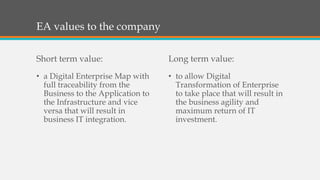
EA values to the company
Short term value:
• a Digital Enterprise Map with
full traceability from the
Business to the Application to
the Infrastructure and vice
versa that will result in
business IT integration.
Long term value:
• to allow Digital
Transformation of Enterprise
to take place that will result in
the business agility and
maximum return of IT
investment.
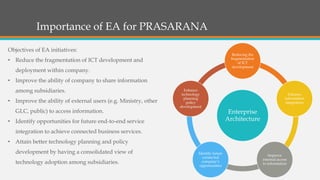
Importance of EA for PRASARANA
Enterprise
Architecture
Reducing the
fragmentation
of ICT
development
Enhance
information
integration
Improve
external access
to information
Identify future
connected
company’s
opportunities
Enhance
technology
planning
policy
development
Objectives of EA initiatives:
• Reduce the fragmentation of ICT development and
deployment within company.
• Improve the ability of company to share information
among subsidiaries.
• Improve the ability of external users (e.g. Ministry, other
GLC, public) to access information.
• Identify opportunities for future end-to-end service
integration to achieve connected business services.
• Attain better technology planning and policy
development by having a consolidated view of
technology adoption among subsidiaries.
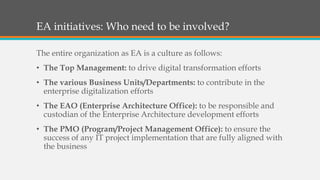
EA initiatives: Who need to be involved?
The entire organization as EA is a culture as follows:
• The Top Management: to drive digital transformation efforts
• The various Business Units/Departments: to contribute in the
enterprise digitalization efforts
• The EAO (Enterprise Architecture Office): to be responsible and
custodian of the Enterprise Architecture development efforts
• The PMO (Program/Project Management Office): to ensure the
success of any IT project implementation that are fully aligned with
the business
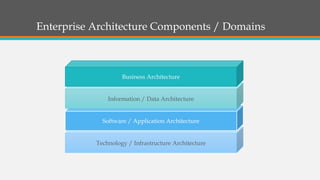
Technology / Infrastructure Architecture
Software / Application Architecture
Information / Data Architecture
Enterprise Architecture Components / Domains
Business Architecture
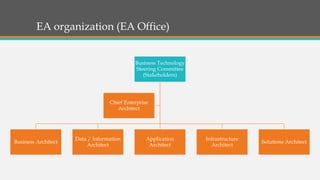
EA organization (EA Office)
Business Technology
Steering Committee
(Stakeholders)
Business Architect
Data / Information
Architect
Application
Architect
Infrastructure
Architect
Solutions Architect
Chief Enterprise
Architect
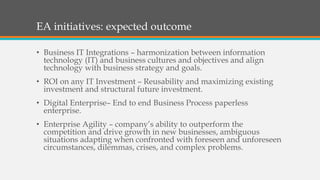
EA initiatives: expected outcome
• Business IT Integrations – harmonization between information
technology (IT) and business cultures and objectives and align
technology with business strategy and goals.
• ROI on any IT Investment – Reusability and maximizing existing
investment and structural future investment.
• Digital Enterprise– End to end Business Process paperless
enterprise.
• Enterprise Agility – company’s ability to outperform the
competition and drive growth in new businesses, ambiguous
situations adapting when confronted with foreseen and unforeseen
circumstances, dilemmas, crises, and complex problems.
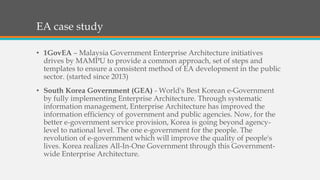
EA case study
• 1GovEA – Malaysia Government Enterprise Architecture initiatives
drives by MAMPU to provide a common approach, set of steps and
templates to ensure a consistent method of EA development in the public
sector. (started since 2013)
• South Korea Government (GEA) - World's Best Korean e-Government
by fully implementing Enterprise Architecture. Through systematic
information management, Enterprise Architecture has improved the
information efficiency of government and public agencies. Now, for the
better e-government service provision, Korea is going beyond agency-
level to national level. The one e-government for the people. The
revolution of e-government which will improve the quality of people's
lives. Korea realizes All-In-One Government through this Government-
wide Enterprise Architecture.
References
• The Open Group: http://www.opengroup.org/
• Why Enterprise Architecture by Gerben Wierda:
https://youtu.be/qDI2oF1bASk
• Government-Wide Enterprise Architecture(GEA) in Korea:
https://youtu.be/VZbRbTdaIdI
• 1GovEA from Malaysia Administrative Modernisation and
Management Planning Unit (MAMPU)
• Aaron Tan Dani from ATD Solution.

Intro to Enterprise Architecture (EA)

  • 1.
  • 2.
    Enterprise challenges: example BusinessDomain: • Unaligned business process governance between subsidiaries. Information / Data Domain: • Unaligned master data across division and subsidiaries. Application Domain: • Overlapped functions of applications and integrations. Infrastructure / Technology Domain: • Lack of technology standardization governance. Overall entire Enterprise: • No single source of enterprise architecture references (artifact) for future planning.
  • 3.
    Shared Service Group External Systemfrom Subsidiary A FTS FCS ESS Waybill PSDS BI System from Subsidiary B FTS FCS ESS Waybill PSDS BI System from Subsidiary C FTS FCS ESS Waybill PSDS BI System from Subsidiary E FTS FCS ESS Waybill PSDS BI Ministry Pg Tour SAP HR SAP Fi SAP MM SAP PM VPA IXO System from Subsidiary D RCMS SAMS ROS AD Management Report Management Dashboard Enterprise challenges: Information and Data mapping integration with Hairball Architecture
  • 4.
    What is EnterpriseArchitecture (EA)? • a well-defined planning function which helps organizations to understand the steps how business strategies translates into operational reality. • sets out the organization's capability blueprint, for the successful development and execution of the enterprise strategy. • The intention of EA is to determine how an organization can most effectively achieve its current and future objectives.
  • 5.
    Benefit of implementationEA to company A more efficient business operation Lower business operation costs More agile organization Business capabilities shared across the organization Lower change management costs More flexible workforce Improved business productivity A more efficient IT operation Lower software development, support, and maintenance costs Increased portability of applications Improved interoperability and easier system and network management Improved ability to address critical enterprise-wide issues like security Easier upgrade and exchange of system components Better return on existing investment, reduced risk for future investment Reduced complexity in the business and IT Maximum return on investment in existing business and IT infrastructure The flexibility to make, buy, or out-source business and IT solutions Reduced risk overall in new investments and their cost of ownership Faster, simpler, and cheaper procurement Buying decisions are simpler, because the information governing procurement is readily available in a coherent plan The procurement process is faster — maximizing procurement speed and flexibility without sacrificing architectural coherence The ability to procure heterogeneous, multi-vendor open systems The ability to secure more economic capabilities
  • 6.
    EA values tothe company Short term value: • a Digital Enterprise Map with full traceability from the Business to the Application to the Infrastructure and vice versa that will result in business IT integration. Long term value: • to allow Digital Transformation of Enterprise to take place that will result in the business agility and maximum return of IT investment.
  • 7.
    Importance of EAfor PRASARANA Enterprise Architecture Reducing the fragmentation of ICT development Enhance information integration Improve external access to information Identify future connected company’s opportunities Enhance technology planning policy development Objectives of EA initiatives: • Reduce the fragmentation of ICT development and deployment within company. • Improve the ability of company to share information among subsidiaries. • Improve the ability of external users (e.g. Ministry, other GLC, public) to access information. • Identify opportunities for future end-to-end service integration to achieve connected business services. • Attain better technology planning and policy development by having a consolidated view of technology adoption among subsidiaries.
  • 8.
    EA initiatives: Whoneed to be involved? The entire organization as EA is a culture as follows: • The Top Management: to drive digital transformation efforts • The various Business Units/Departments: to contribute in the enterprise digitalization efforts • The EAO (Enterprise Architecture Office): to be responsible and custodian of the Enterprise Architecture development efforts • The PMO (Program/Project Management Office): to ensure the success of any IT project implementation that are fully aligned with the business
  • 9.
    Technology / InfrastructureArchitecture Software / Application Architecture Information / Data Architecture Enterprise Architecture Components / Domains Business Architecture
  • 10.
    EA organization (EAOffice) Business Technology Steering Committee (Stakeholders) Business Architect Data / Information Architect Application Architect Infrastructure Architect Solutions Architect Chief Enterprise Architect
  • 11.
    EA initiatives: expectedoutcome • Business IT Integrations – harmonization between information technology (IT) and business cultures and objectives and align technology with business strategy and goals. • ROI on any IT Investment – Reusability and maximizing existing investment and structural future investment. • Digital Enterprise– End to end Business Process paperless enterprise. • Enterprise Agility – company’s ability to outperform the competition and drive growth in new businesses, ambiguous situations adapting when confronted with foreseen and unforeseen circumstances, dilemmas, crises, and complex problems.
  • 12.
    EA case study •1GovEA – Malaysia Government Enterprise Architecture initiatives drives by MAMPU to provide a common approach, set of steps and templates to ensure a consistent method of EA development in the public sector. (started since 2013) • South Korea Government (GEA) - World's Best Korean e-Government by fully implementing Enterprise Architecture. Through systematic information management, Enterprise Architecture has improved the information efficiency of government and public agencies. Now, for the better e-government service provision, Korea is going beyond agency- level to national level. The one e-government for the people. The revolution of e-government which will improve the quality of people's lives. Korea realizes All-In-One Government through this Government- wide Enterprise Architecture.
  • 13.
    References • The OpenGroup: http://www.opengroup.org/ • Why Enterprise Architecture by Gerben Wierda: https://youtu.be/qDI2oF1bASk • Government-Wide Enterprise Architecture(GEA) in Korea: https://youtu.be/VZbRbTdaIdI • 1GovEA from Malaysia Administrative Modernisation and Management Planning Unit (MAMPU) • Aaron Tan Dani from ATD Solution.