Business Architecture Updated: 26-Sept-2011
WHAT is Business Architecture? Printed:  Sep 29, 2011 Business Architecture Overview
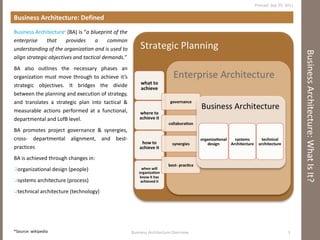
Business Architecture: What Is It? Business Architecture: Defined Business Architecture *  (BA) is “ a blueprint of the enterprise that provides a common understanding of the organization and is used to align strategic objectives and tactical demands. ” BA also outlines the necessary phases an organization must move through to achieve it’s strategic objectives. It bridges the divide between the planning and execution of strategy, and translates a strategic plan into tactical & measurable actions performed at a functional, departmental and LofB level.  BA promotes project governance & synergies, cross- departmental alignment, and best- practices BA is achieved through changes in: organizational design (people) systems architecture (process) technical architecture (technology) Printed:  Sep 29, 2011 Business Architecture Overview *Source: wikipedia
WHY is Business Architecture Necessary? Printed:  Sep 29, 2011 Business Architecture Overview
Business Architecture: Why Do It? Business Architecture: Importance of A 2011 report by  PM Solutions , that surveyed 137 small, medium and larger organizations, with an average project spend of $200 million (USD), had an average project failure rate of 37%.  This translates into a  loss of $74 million . Gartner  suggests  project failure  for business intelligence, a significant component to strategy, is upwards of 70%. The top (reported) reasons for failure include: unclear, ambiguous, poorly prioritized and lack of agreement around  project requirements conflicting & poorly planned  project resourcing unrealistic & conflicting  project timelines insufficiently detailed  project planning unmitigated, unmanaged & missing  project risk management The  Standish Chaos Group , specialties in project success, suggest that despite extensive project training and planning, little change has occurred in project success. This is because most organizations continue to “ jump ”  from strategy planning into project delivery. Mercer Consulting  suggest as many as 80% of projects cost  more  then they realize in benefits. BA ensures the proper translation of strategy into measurable & cross- departmental activities. BA offers a solution to project failure & challenge by: categorizing & integrating projects across departments linking projects to an organization’s strategy ensuring stakeholder engagement removing projects conflicts promoting best- practices/ methodologies ensuring appropriate resourcing Printed:  Sep 29, 2011 Business Architecture Overview *Source:  zdnet *  Projects… 2010 2009 % Change …  over- time 61.1% 35.5% 72.1% …  over- budget 74.4% 51.4% 44.7% …  w. under realized benefits 48.0% 67.0% -28.4% *  Projects… 2002 2004 2009 Succeeded 34% 29% 32% Failed 15% 18% 24% Challenged 51% 53% 44%
HOW Does Business Architecture Work? Printed:  Sep 29, 2011 Business Architecture Overview
Business Architecture: How It Works? Business Architecture: In Practice Business Architecture requires four distinct, sequential and, interdependent phases. Strategy design  outlines  what  the organization is trying to achieve,  where  should it “ play-to-win ” ,  how  will it  “ win ” , and the metrics needed to know  when  it is winning. Increasingly, asking  “ why ”  an organization is trying to achieve it ’ s strategy is under scrutiny, as an organizations face increased competition and service differentiation becomes more important than product differentiation. Target Operating Model  (T.O.M.)  design  answers the question “ what needs to be true, to achieve an organization ’ s strategy? ” . It layouts the  “ to-be-state ”  an organization must achieve, and the necessary  capabilities  across its  organizational ,  operational  and  technological  infrastructure. Once the T.O.M. is designed, a  gap analysis  can be completed, as well as an associated roadmap between the existing operating model and the T.O.M.  Portfolio design  translates the necessary changes to achieve the T.O.M. into various business cases, outlining costs & benefits. It layouts out, at a high level, the necessary project, resources & management. Project scoping , upon portfolio approval, defines the project management, resources, reporting & timelines, at a detailed level, that will lead to a successful T.O.M. Printed:  Sep 29, 2011 Business Architecture Overview
Business Architecture: How It Works? Strategy Design Portfolio Management Target Operating Model (T.O.M.) Project Management Successful project delivery, as by defined by on-time, on-budget, on-deliverable, requires: a dedicated project manager (PM) project management office (PMO) governance, documentation & reporting tools & policies access to business, system & technical architects, organizational designers and, portfolio managers, executive engagement & sponsorship (in the form of time & resource) Before BA can occur, a clear  strategy  must be agreed, which consists of the plan-of-action that will accomplish a specific goal. Strategy will answer: what  is company trying to achieve (the goal) where  should it achieve it, eg. market, geography, customer how  will it succeed, eg. competitive advantage the  metrics to know  when  it has achieved it’s strategy The T.O.M. outlines the “to-be” state of an organization, that will achieve it’s strategic goal(s). It [T.O.M.] defines the number of: distinct  market facing entities ,  unique value propositions , and  capabilities  required. Portfolio (management) balances deliverables needed to achieve a strategy, ensuring appropriate resources, time & scalability. Portfolio ensures: business cases are complete cost- benefit analysis is thorough high- level project management, reporting is complete projects link to organizational, operational or technological changes Business Architecture Overview Printed:  Sep 29, 2011
Appendix Printed:  Sep 29, 2011 Business Architecture Overview
Business Architecture: What is it? What is Business Architecture? Printed:  Sep 29, 2011 Business Architecture Overview
Business Architecture: Why is it Important? How Business Architecture Can Help. Printed:  Sep 29, 2011 Business Architecture Overview
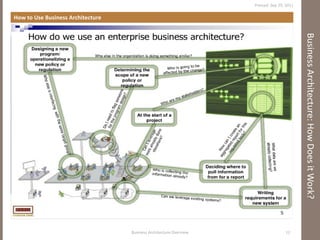
Business Architecture: How Does it Work? How to Use Business Architecture Printed:  Sep 29, 2011 Business Architecture Overview
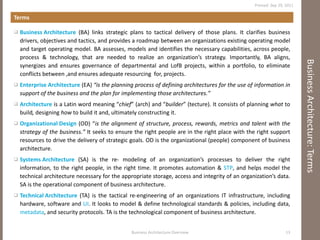
Business Architecture: Terms Terms Business Architecture  (BA) links strategic plans to tactical delivery of those plans. It clarifies business drivers, objectives and tactics, and provides a roadmap between an organizations existing operating model and target operating model. BA assesses, models and identifies the necessary capabilities, across people, process & technology, that are needed to realize an organization’s strategy. Importantly, BA aligns, synergizes and ensures governance of departmental and LofB projects, within a portfolio, to eliminate conflicts between ,and ensures adequate resourcing  for, projects. Enterprise Architecture  (EA)  “ is the planning process of defining architectures for the use of information in support of the business and the plan for implementing those architectures. ” Architecture  is a Latin word meaning “ chief ” (arch) and “ builder ” (tecture). It consists of planning  what  to build ,  designing  how  to build it and, ultimately constructing it. Organizational Design  (OD) “ is the alignment of structure, process, rewards, metrics and talent with the strategy of the business. ”  It seeks to ensure the right people are in the right place with the right support resources to drive the delivery of strategic goals. OD is the organizational (people) component of business architecture. Systems Architecture  (SA) is the re- modeling of an organization’s processes to deliver the right information, to the right people, in the right time. It promotes automation &  STP , and helps model the technical architecture necessary for the appropriate storage, access and integrity of an organization’s data. SA is the operational component of business architecture. Technical Architecture  (TA) is the tactical re-engineering of an organizations IT infrastructure, including hardware, software and  UI . It looks to model & define technological standards & policies, including data,  metadata , and security protocols. TA is the technological component of business architecture. Printed:  Sep 29, 2011 Business Architecture Overview
Business Architecture: Terms Terms Service Oriented Architecture  (SOA) “is a flexible set of design principles used during the phases of systems development and integration in computing. A system based on an SOA will package functionality as a suite of interoperable services that can be used within multiple, separate systems from several business domains.” Capabilities  refer to the potential, and (in relation to BA) the necessary, skills and abilities a department, function or enterprise must develop to deliver upon it’s strategic goals. Project Portfolio Management   “describes methods for analyzing and collectively managing a group of current or proposed projects based on numerous key characteristics. The fundamental objective of PPM is to determine the optimal mix and sequencing of proposed projects to best achieve the organization's overall goals - typically expressed in terms of hard economic measures, business strategy goals, or technical strategy goals - while honouring constraints imposed by management or external real-world factors.” Operating Model   “ is the abstract representation of how an organization operates across process, organization, technology domains in order to deliver value defined by the organization in scope. ”  A  Target Operating Model  is the desired operating model an organization seeks to deliver it ’ s strategic goal(s). Between an existing and target operating model lies Business Architecture. Design Strategy   “ is a discipline which helps firms determine what to make and do, why do it and how to innovate contextually, both immediately and over the long term. ” Strategy   “refers to a plan of action designed to achieve a particular goal. ” (Project)  Governance  refers to the necessary reporting standards, channels and people needed to keep any tactical project change aligned to the projects objectives (deliverables), budgets & timelines. It also provides a framework for  risk  &  issue  identification, management and, mitigation & resolution. Gap analysis   is “ a tool that helps companies compare actual performance with potential performance. At its core are two questions:  ‘ Where are we? ’  and  ‘ Where do we want to be? ’ " Printed:  Sep 29, 2011 Business Architecture Overview
Business Architecture: Views Of Business Architecture Views Strategic view  consists of the strategic goals & objectives, tied to objective metrics. Capabilites  view  consists of the functions & services, performed by various departments & LofB’s categorized by: customer, supplier, execution (eg. origination & fulfillment) and management. Knowledge  view  consists of the shared semantics & relationships, that form the T.O.M. It is the shared vision for, and operations of, people, process & technology. Process view  consists of the activities performed, by whom, using which tools & technologies, and how these activities work with up and down stream activities. Organizational  view  consists of the different capabilities departments fulfill & how they interrelate. Printed:  Sep 29, 2011 Business Architecture Overview
Business Architecture: BI As Key To Components of Business Intelligence Business Architecture Overview Printed:  Sep 29, 2011
Project Status Report Business Architecture: Tools Printed:  Sep 29, 2011 Business Architecture Overview
Business Model Generator Business Architecture: Tools Printed:  Sep 29, 2011 Business Architecture Overview
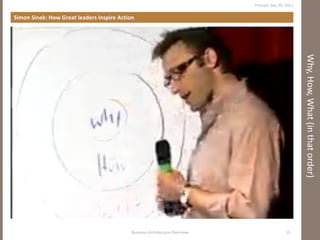
Why, How, What (in that order) Simon Sinek: How Great leaders inspire Action Business Architecture Overview Printed:  Sep 29, 2011
Thank You. Business Architecture Overview Printed:  Sep 29, 2011

Business Architecture Defined

  • 1.
  • 2.
    WHAT is BusinessArchitecture? Printed: Sep 29, 2011 Business Architecture Overview
  • 3.
    Business Architecture: WhatIs It? Business Architecture: Defined Business Architecture * (BA) is “ a blueprint of the enterprise that provides a common understanding of the organization and is used to align strategic objectives and tactical demands. ” BA also outlines the necessary phases an organization must move through to achieve it’s strategic objectives. It bridges the divide between the planning and execution of strategy, and translates a strategic plan into tactical & measurable actions performed at a functional, departmental and LofB level. BA promotes project governance & synergies, cross- departmental alignment, and best- practices BA is achieved through changes in: organizational design (people) systems architecture (process) technical architecture (technology) Printed: Sep 29, 2011 Business Architecture Overview *Source: wikipedia
  • 4.
    WHY is BusinessArchitecture Necessary? Printed: Sep 29, 2011 Business Architecture Overview
  • 5.
    Business Architecture: WhyDo It? Business Architecture: Importance of A 2011 report by PM Solutions , that surveyed 137 small, medium and larger organizations, with an average project spend of $200 million (USD), had an average project failure rate of 37%. This translates into a loss of $74 million . Gartner suggests project failure for business intelligence, a significant component to strategy, is upwards of 70%. The top (reported) reasons for failure include: unclear, ambiguous, poorly prioritized and lack of agreement around project requirements conflicting & poorly planned project resourcing unrealistic & conflicting project timelines insufficiently detailed project planning unmitigated, unmanaged & missing project risk management The Standish Chaos Group , specialties in project success, suggest that despite extensive project training and planning, little change has occurred in project success. This is because most organizations continue to “ jump ” from strategy planning into project delivery. Mercer Consulting suggest as many as 80% of projects cost more then they realize in benefits. BA ensures the proper translation of strategy into measurable & cross- departmental activities. BA offers a solution to project failure & challenge by: categorizing & integrating projects across departments linking projects to an organization’s strategy ensuring stakeholder engagement removing projects conflicts promoting best- practices/ methodologies ensuring appropriate resourcing Printed: Sep 29, 2011 Business Architecture Overview *Source: zdnet * Projects… 2010 2009 % Change … over- time 61.1% 35.5% 72.1% … over- budget 74.4% 51.4% 44.7% … w. under realized benefits 48.0% 67.0% -28.4% * Projects… 2002 2004 2009 Succeeded 34% 29% 32% Failed 15% 18% 24% Challenged 51% 53% 44%
  • 6.
    HOW Does BusinessArchitecture Work? Printed: Sep 29, 2011 Business Architecture Overview
  • 7.
    Business Architecture: HowIt Works? Business Architecture: In Practice Business Architecture requires four distinct, sequential and, interdependent phases. Strategy design outlines what the organization is trying to achieve, where should it “ play-to-win ” , how will it “ win ” , and the metrics needed to know when it is winning. Increasingly, asking “ why ” an organization is trying to achieve it ’ s strategy is under scrutiny, as an organizations face increased competition and service differentiation becomes more important than product differentiation. Target Operating Model (T.O.M.) design answers the question “ what needs to be true, to achieve an organization ’ s strategy? ” . It layouts the “ to-be-state ” an organization must achieve, and the necessary capabilities across its organizational , operational and technological infrastructure. Once the T.O.M. is designed, a gap analysis can be completed, as well as an associated roadmap between the existing operating model and the T.O.M. Portfolio design translates the necessary changes to achieve the T.O.M. into various business cases, outlining costs & benefits. It layouts out, at a high level, the necessary project, resources & management. Project scoping , upon portfolio approval, defines the project management, resources, reporting & timelines, at a detailed level, that will lead to a successful T.O.M. Printed: Sep 29, 2011 Business Architecture Overview
  • 8.
    Business Architecture: HowIt Works? Strategy Design Portfolio Management Target Operating Model (T.O.M.) Project Management Successful project delivery, as by defined by on-time, on-budget, on-deliverable, requires: a dedicated project manager (PM) project management office (PMO) governance, documentation & reporting tools & policies access to business, system & technical architects, organizational designers and, portfolio managers, executive engagement & sponsorship (in the form of time & resource) Before BA can occur, a clear strategy must be agreed, which consists of the plan-of-action that will accomplish a specific goal. Strategy will answer: what is company trying to achieve (the goal) where should it achieve it, eg. market, geography, customer how will it succeed, eg. competitive advantage the metrics to know when it has achieved it’s strategy The T.O.M. outlines the “to-be” state of an organization, that will achieve it’s strategic goal(s). It [T.O.M.] defines the number of: distinct market facing entities , unique value propositions , and capabilities required. Portfolio (management) balances deliverables needed to achieve a strategy, ensuring appropriate resources, time & scalability. Portfolio ensures: business cases are complete cost- benefit analysis is thorough high- level project management, reporting is complete projects link to organizational, operational or technological changes Business Architecture Overview Printed: Sep 29, 2011
  • 9.
    Appendix Printed: Sep 29, 2011 Business Architecture Overview
  • 10.
    Business Architecture: Whatis it? What is Business Architecture? Printed: Sep 29, 2011 Business Architecture Overview
  • 11.
    Business Architecture: Whyis it Important? How Business Architecture Can Help. Printed: Sep 29, 2011 Business Architecture Overview
  • 12.
    Business Architecture: HowDoes it Work? How to Use Business Architecture Printed: Sep 29, 2011 Business Architecture Overview
  • 13.
    Business Architecture: TermsTerms Business Architecture (BA) links strategic plans to tactical delivery of those plans. It clarifies business drivers, objectives and tactics, and provides a roadmap between an organizations existing operating model and target operating model. BA assesses, models and identifies the necessary capabilities, across people, process & technology, that are needed to realize an organization’s strategy. Importantly, BA aligns, synergizes and ensures governance of departmental and LofB projects, within a portfolio, to eliminate conflicts between ,and ensures adequate resourcing for, projects. Enterprise Architecture (EA) “ is the planning process of defining architectures for the use of information in support of the business and the plan for implementing those architectures. ” Architecture is a Latin word meaning “ chief ” (arch) and “ builder ” (tecture). It consists of planning what to build , designing how to build it and, ultimately constructing it. Organizational Design (OD) “ is the alignment of structure, process, rewards, metrics and talent with the strategy of the business. ” It seeks to ensure the right people are in the right place with the right support resources to drive the delivery of strategic goals. OD is the organizational (people) component of business architecture. Systems Architecture (SA) is the re- modeling of an organization’s processes to deliver the right information, to the right people, in the right time. It promotes automation & STP , and helps model the technical architecture necessary for the appropriate storage, access and integrity of an organization’s data. SA is the operational component of business architecture. Technical Architecture (TA) is the tactical re-engineering of an organizations IT infrastructure, including hardware, software and UI . It looks to model & define technological standards & policies, including data, metadata , and security protocols. TA is the technological component of business architecture. Printed: Sep 29, 2011 Business Architecture Overview
  • 14.
    Business Architecture: TermsTerms Service Oriented Architecture (SOA) “is a flexible set of design principles used during the phases of systems development and integration in computing. A system based on an SOA will package functionality as a suite of interoperable services that can be used within multiple, separate systems from several business domains.” Capabilities refer to the potential, and (in relation to BA) the necessary, skills and abilities a department, function or enterprise must develop to deliver upon it’s strategic goals. Project Portfolio Management “describes methods for analyzing and collectively managing a group of current or proposed projects based on numerous key characteristics. The fundamental objective of PPM is to determine the optimal mix and sequencing of proposed projects to best achieve the organization's overall goals - typically expressed in terms of hard economic measures, business strategy goals, or technical strategy goals - while honouring constraints imposed by management or external real-world factors.” Operating Model “ is the abstract representation of how an organization operates across process, organization, technology domains in order to deliver value defined by the organization in scope. ” A Target Operating Model is the desired operating model an organization seeks to deliver it ’ s strategic goal(s). Between an existing and target operating model lies Business Architecture. Design Strategy “ is a discipline which helps firms determine what to make and do, why do it and how to innovate contextually, both immediately and over the long term. ” Strategy “refers to a plan of action designed to achieve a particular goal. ” (Project) Governance refers to the necessary reporting standards, channels and people needed to keep any tactical project change aligned to the projects objectives (deliverables), budgets & timelines. It also provides a framework for risk & issue identification, management and, mitigation & resolution. Gap analysis is “ a tool that helps companies compare actual performance with potential performance. At its core are two questions: ‘ Where are we? ’ and ‘ Where do we want to be? ’ " Printed: Sep 29, 2011 Business Architecture Overview
  • 15.
    Business Architecture: ViewsOf Business Architecture Views Strategic view consists of the strategic goals & objectives, tied to objective metrics. Capabilites view consists of the functions & services, performed by various departments & LofB’s categorized by: customer, supplier, execution (eg. origination & fulfillment) and management. Knowledge view consists of the shared semantics & relationships, that form the T.O.M. It is the shared vision for, and operations of, people, process & technology. Process view consists of the activities performed, by whom, using which tools & technologies, and how these activities work with up and down stream activities. Organizational view consists of the different capabilities departments fulfill & how they interrelate. Printed: Sep 29, 2011 Business Architecture Overview
  • 16.
    Business Architecture: BIAs Key To Components of Business Intelligence Business Architecture Overview Printed: Sep 29, 2011
  • 17.
    Project Status ReportBusiness Architecture: Tools Printed: Sep 29, 2011 Business Architecture Overview
  • 18.
    Business Model GeneratorBusiness Architecture: Tools Printed: Sep 29, 2011 Business Architecture Overview
  • 19.
    Why, How, What(in that order) Simon Sinek: How Great leaders inspire Action Business Architecture Overview Printed: Sep 29, 2011
  • 20.
    Thank You. BusinessArchitecture Overview Printed: Sep 29, 2011