Prepared by: Ahmed Gamil
 What is TOGAF – History
 What is Enterprise – Architecture – Enterprise
Architecture – Architecture Domains
 TOGAF Topics
 Architecture Development Method
 Architecture Repository
 Architecture Continuum
 TOGAF Certification
 TOGAF is an architecture framework
The Open Group Architecture Framework
 A tool for assisting in the acceptance,
production, use, and maintenance of enterprise
architectures.
 It is based on an iterative process model
supported by best practices and a re-usable set
of existing architectural assets.
 The Open Group is comprised of more than
500 memberships from organizations all over
the world, which range from major
corporations, government organizations and
consortia, to universities and individuals.
 1980s - Technical Architecture Framework for Information
Management (TAFIM), developed by the US Department of Defense
 1990s - TOGAF was initiated as methodology for the development of
technical architecture.
 1995 – TOGAF was developed - First version of TOGAF (TOGAF 1.0) was
presented .
 December 2001 - TOGAF 7, the "Technical Edition", was published.
 December 2002 - TOGAF 8 ("Enterprise Edition") was first published
 December 2003 - Republished in updated form as TOGAF 8.1.
 November 2006 - The Open Group released TOGAF 8.1.1.
 January 2009 - TOGAF 9 was first published in The latest version is
 December 2011 – version TOGAF 9.1.
 Any collection of organizations that has a
common set of goals
◦ An enterprise could be a government agency
◦ A whole corporation
◦ A division of a corporation
◦ A single department
◦ A chain of geographically distant organizations
linked together by common ownership.
 The fundamental organization of a system,
embodied in its components, their
relationships to each other and the
environment, and the principles governing its
design and evolution.
 “The organizing logic for business processes and
IT infrastructure reflecting the integration
and standardization requirements of the firm’s
operating model”.
“A conceptual blueprint that defines the structure
and operation of an organization”.
 The intent of an enterprise architecture is to
determine how an organization can most
effectively achieve its current and future
objectives.
 A more efficient IT operation:
- Lower software development, support, and maintenance costs
- Increased portability of applications
- Improved interoperability and easier system and network management
- Improved ability to address critical enterprise-wide issues, such as
security
 Better return on existing investment, reduced risk for future investment:
- Reduced complexity in IT infrastructure
- Maximum return on investment in existing IT infrastructure
- The flexibility to make, buy, or out-source IT solutions
- Reduced risk overall in new investment, and the costs of IT ownership
 Faster, simpler, and cheaper procurement:
- Buying decisions are simpler, because the information governing
procurement is readily available in a coherent plan.
- The procurement process is faster, maximizing procurement speed
and flexibility without sacrificing architectural coherence.
- The ability to procure heterogeneous, multi-vendor open systems.
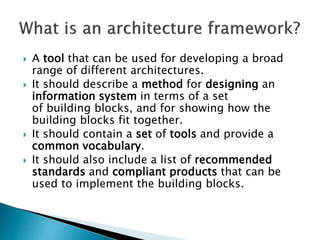
 A tool that can be used for developing a broad
range of different architectures.
 It should describe a method for designing an
information system in terms of a set
of building blocks, and for showing how the
building blocks fit together.
 It should contain a set of tools and provide a
common vocabulary.
 It should also include a list of recommended
standards and compliant products that can be
used to implement the building blocks.
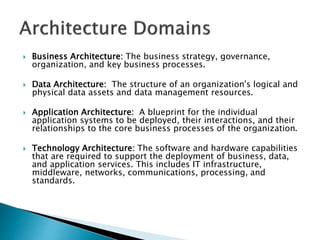
 Business Architecture: The business strategy, governance,
organization, and key business processes.
 Data Architecture: The structure of an organization's logical and
physical data assets and data management resources.
 Application Architecture: A blueprint for the individual
application systems to be deployed, their interactions, and their
relationships to the core business processes of the organization.
 Technology Architecture: The software and hardware capabilities
that are required to support the deployment of business, data,
and application services. This includes IT infrastructure,
middleware, networks, communications, processing, and
standards.
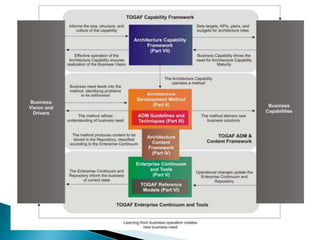
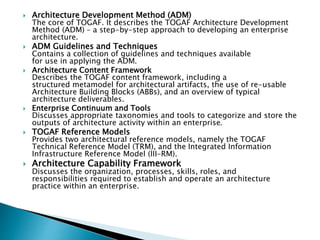
 Architecture Development Method (ADM)
The core of TOGAF. It describes the TOGAF Architecture Development
Method (ADM) – a step-by-step approach to developing an enterprise
architecture.
 ADM Guidelines and Techniques
Contains a collection of guidelines and techniques available
for use in applying the ADM.
 Architecture Content Framework
Describes the TOGAF content framework, including a
structured metamodel for architectural artifacts, the use of re-usable
Architecture Building Blocks (ABBs), and an overview of typical
architecture deliverables.
 Enterprise Continuum and Tools
Discusses appropriate taxonomies and tools to categorize and store the
outputs of architecture activity within an enterprise.
 TOGAF Reference Models
Provides two architectural reference models, namely the TOGAF
Technical Reference Model (TRM), and the Integrated Information
Infrastructure Reference Model (III-RM).
 Architecture Capability Framework
Discusses the organization, processes, skills, roles, and
responsibilities required to establish and operate an architecture
practice within an enterprise.
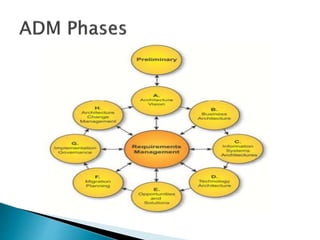
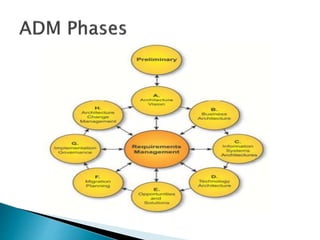
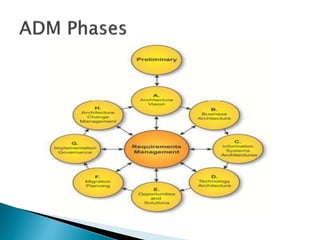
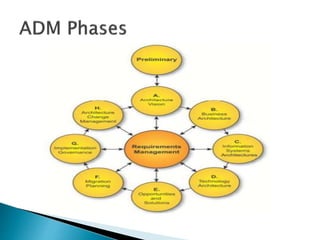
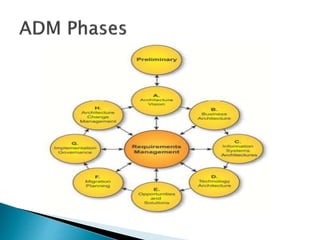
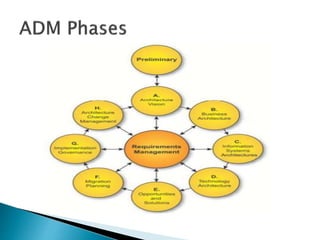
 ADM describes a process for deriving an
organization-specific enterprise architecture
that addresses business requirements.
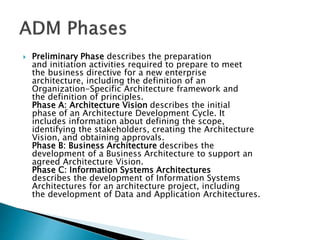
 Preliminary Phase describes the preparation
and initiation activities required to prepare to meet
the business directive for a new enterprise
architecture, including the definition of an
Organization-Specific Architecture framework and
the definition of principles.
Phase A: Architecture Vision describes the initial
phase of an Architecture Development Cycle. It
includes information about defining the scope,
identifying the stakeholders, creating the Architecture
Vision, and obtaining approvals.
Phase B: Business Architecture describes the
development of a Business Architecture to support an
agreed Architecture Vision.
Phase C: Information Systems Architectures
describes the development of Information Systems
Architectures for an architecture project, including
the development of Data and Application Architectures.
 Phase D: Technology Architecture describes the development of
the Technology Architecture for an architecture project.
Phase E: Opportunities and Solutions conducts initial
implementation planning and the identification of delivery
vehicles for the architecture defined in the previous phases.
Phase F: Migration Planning addresses the formulation of a set of
detailed sequence of Transition Architectures with a supporting
Implementation and Migration Plan.
Phase G: Implementation Governance provides an architectural
oversight of the implementation.
Phase H: Architecture Change Management establishes
procedures for managing change to the new architecture.
 Requirements Management examines the process of managing
architecture requirements throughout the ADM.
describes the preparation and initiation activities
required to prepare to meet the business directive
for a new enterprise architecture, including the
definition of an Organization-Specific Architecture
framework and the definition of principles.
 Understand the business environment
 Ensure high-level management commitment
 Obtain agreement on scope
 Establish principles
 Establish governance structure
 Agree architecture method to be adopted
 Review the organizational context for conducting enterprise architecture
 To identify the stakeholders, their requirements, and priorities
 To confirm the commitment of the stakeholders
 To identify and scope the elements of the enterprise organizations
affected and define the constraints and assumptions.
 To define an organization's “architecture footprint”; that is, the people
responsible for performing the architecture work, where they are
located, and their responsibilities
 To define the framework and detailed methodologies that are going to
be used to develop the enterprise architecture in the organization;
 To set up a governance and support framework to provide business
process and Architecture Governance through the ADM cycle;
 To select and implement supporting tools and other infrastructure to
support the architecture activity
 To define the constraining architecture principles
 Defining the enterprise
 Identifying key drivers and elements in the
organizational context
 Defining the requirements for architecture work
 Defining the architecture principles that will
inform any architecture work
 Defining the framework to be used
 Defining the relationships between management
frameworks
 Evaluating the enterprise architecture’s maturity
 The initial phase of an Architecture
Development Cycle.
 It includes information about defining the
scope, identifying the stakeholders, creating
the Architecture Vision, and obtaining
approvals.
 Project establishment and initiates an
iteration of the Architecture Development
Cycle, setting the scope, constraints, and
expectations for the iteration.
 Obtain management commitment for this particular cycle of
the ADM
 Define and organize an Architecture Development Cycle
 Validate business principles, goals, drivers, and Key Performance
Indicators (KPIs)
 Define, scope, and prioritize architecture tasks
 Identify stakeholders, their concerns, and objectives
 Define business requirements and constraints
 Articulate an Architecture Vision and value proposition to
respond to the requirements and constraints
 Create a comprehensive plan in line with the project
management frameworks adopted by the enterprise
 Obtain formal approval to proceed
 Understand the impact on, and of, other parallel Architecture
Development Cycles
 Phase A starts with receipt of a Request for
Architecture Work from the sponsoring
organization to the architecture organization.
 A key objective is to ensure proper
recognition and endorsement from corporate
management, and the support and
commitment of line management for this
evolution of the ADM cycle.
 Architecture Vision is a key activity in this
phase.
 Development of a Business Architecture to
support an agreed Architecture Vision.
 This describes the fundamental organization
of a business embodied in:
• Its business process and people
• Their relationships to each other and the
people
• The principles governing its design and
evolution
 Describe the Baseline Business Architecture
 Develop a Target Business Architecture
 Analyze the gaps between the Baseline and
Target Architectures
 Developing the Baseline Description
 Business Modeling
 Using the Architecture Repository
 Documenting the fundamental organization of an
organization’s IT systems, embodied in the major
types of information and the application systems
that process them, and their relationships to
each other and the environment.
 There are two steps in this phase, which may be
developed either sequentially or concurrently:
• Data Architecture
• Application Architecture
 Data Architecture: Define the types and
sources of data needed to support the
business, in a way that can be understood by
the stakeholders.
 Application Architecture: Define the kind of
application systems needed to process the
data and support the business.
 Data Management
 Data Migration
 Data Governance
 Using the Architecture Repository
 Documenting the fundamental organization
of the IT systems:
• Embodied in the hardware, software, and
communications technology
• Their relationships to each other and the
environment
• The principles governing its design and
evolution
 Objectives:
◦ To develop a Target Technology Architecture that will form the
basis of the subsequent implementation and migration planning.
 Approach:
◦ Using the Architecture Repository
◦ Existing IT services
• The TOGAF Technical Reference Model (TRM)
• Generic technology models relevant to the organization's
industry “vertical” sector;
◦ for example, in the telecommunications industry such models
have been developed by the TeleManagement Forum (TMF)
• Technology models relevant to Common Systems Architectures;
for example, the III-RM.
 The first phase which is directly concerned with implementation.
 It describes the process of identifying delivery vehicles (projects,
programs, or portfolios) that deliver the Target Architecture
identified in previous phases.
 Key activities are as follows:
• Perform initial implementation planning
• Identify the major implementation projects
• Group projects into Transition Architectures
• Decide on approach:
— Make versus buy versus re-use
— Outsource
— COTS
— Open Source
• Assess priorities
• Identify dependencies
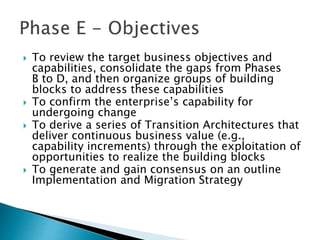
 To review the target business objectives and
capabilities, consolidate the gaps from Phases
B to D, and then organize groups of building
blocks to address these capabilities
 To confirm the enterprise’s capability for
undergoing change
 To derive a series of Transition Architectures that
deliver continuous business value (e.g.,
capability increments) through the exploitation of
opportunities to realize the building blocks
 To generate and gain consensus on an outline
Implementation and Migration Strategy
 Concentrates on how to deliver the architecture.
 It takes both a corporate business and technical
perspective to rationalize the IT activities, and
logically group them into project work
packages within the IT portfolio and any other
portfolios that depend on IT.
 This is a collaborative effort between the enterprise
stakeholders from business and IT in order to assess
the organization's business transformation readiness,
identify opportunities and solutions, and
identify all implementation constraints. The key is to
focus on business value, flexibility, coordination, and
compromise.
 Addresses migration planning; that is, how to
move from the Baseline to the Target
Architectures.
 To ensure that the Implementation and Migration Plan is
coordinated with the various management frameworks in use
within the enterprise
 To prioritize all work packages, projects, and building blocks by
assigning business value to each and conducting a cost/benefit
analysis
 To finalize the Architecture Vision and Architecture Definition
Documents, in line with the agreed implementation approach
 To confirm the Transition Architectures defined in Phase E with
the relevant stakeholders
 To create, evolve, and monitor the detailed Implementation and
Migration Plan, providing necessary resources to enable the
realization of the Transition Architectures, as defined in
Phase E
 Creation of an Implementation and Migration
Plan
 Defines how the architecture constrains the
implementation projects, monitors it while
building it, and produces a signed
Architecture Contract.
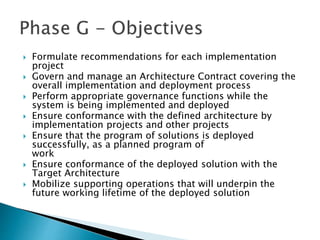
 Formulate recommendations for each implementation
project
 Govern and manage an Architecture Contract covering the
overall implementation and deployment process
 Perform appropriate governance functions while the
system is being implemented and deployed
 Ensure conformance with the defined architecture by
implementation projects and other projects
 Ensure that the program of solutions is deployed
successfully, as a planned program of
work
 Ensure conformance of the deployed solution with the
Target Architecture
 Mobilize supporting operations that will underpin the
future working lifetime of the deployed solution
 Establish an implementation program that will
enable the delivery of the agreed Transition
Architectures
 Adopt a phased deployment schedule that
reflects the business priorities embodied in the
Architecture Roadmap
 Follow the organization's standard for corporate,
IT, and Architecture Governance
 Use the organization's established
portfolio/program management approach, where
this exists
 Define an operations framework to ensure the
effective long life of the deployed solution
 Ensures that changes to the architecture are
managed in a controlled manner.
 Ensure that Baseline Architectures continue to be fit-
for-purpose
 Assess the performance of the architecture and make
recommendations for change
 Assess changes to the framework and principles set
up in previous phases
 Establish an architecture change management
process for the new enterprise architecture
baseline that is achieved with completion of Phase G
 Maximize the business value from the architecture
and ongoing operations
 Operate the Governance Framework
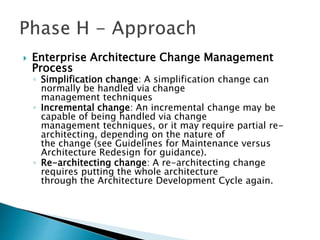
 Enterprise Architecture Change Management
Process
◦ Simplification change: A simplification change can
normally be handled via change
management techniques
◦ Incremental change: An incremental change may be
capable of being handled via change
management techniques, or it may require partial re-
architecting, depending on the nature of
the change (see Guidelines for Maintenance versus
Architecture Redesign for guidance).
◦ Re-architecting change: A re-architecting change
requires putting the whole architecture
through the Architecture Development Cycle again.
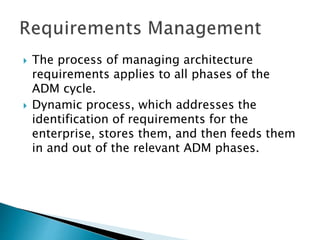
 The process of managing architecture
requirements applies to all phases of the
ADM cycle.
 Dynamic process, which addresses the
identification of requirements for the
enterprise, stores them, and then feeds them
in and out of the relevant ADM phases.
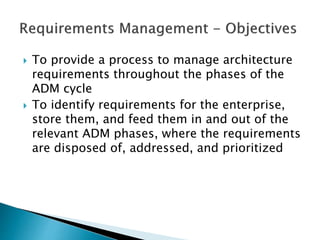
 To provide a process to manage architecture
requirements throughout the phases of the
ADM cycle
 To identify requirements for the enterprise,
store them, and feed them in and out of the
relevant ADM phases, where the requirements
are disposed of, addressed, and prioritized
 Business Scenarios
 Volere Requirements Specification Template
 Other Requirements Tools
 Deliverable
◦ A work product that is contractually specified and in turn
formally reviewed, agreed, and signed off by the
stakeholders
 Artifact
◦ More granular architectural work product that
describes an architecture from a specific viewpoint.
 Building block
◦ Re-usable component of business, IT, or architectural
capability that can be combined with other building
blocks to deliver architectures and solutions.
 Used to store different classes of architectural
output at different levels of abstraction,
created by the ADM.
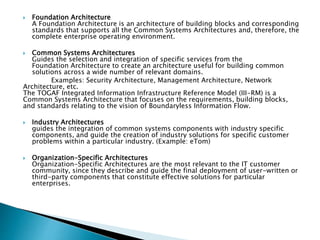
 Foundation Architecture
A Foundation Architecture is an architecture of building blocks and corresponding
standards that supports all the Common Systems Architectures and, therefore, the
complete enterprise operating environment.
 Common Systems Architectures
Guides the selection and integration of specific services from the
Foundation Architecture to create an architecture useful for building common
solutions across a wide number of relevant domains.
Examples: Security Architecture, Management Architecture, Network
Architecture, etc.
The TOGAF Integrated Information Infrastructure Reference Model (III-RM) is a
Common Systems Architecture that focuses on the requirements, building blocks,
and standards relating to the vision of Boundaryless Information Flow.
 Industry Architectures
guides the integration of common systems components with industry specific
components, and guide the creation of industry solutions for specific customer
problems within a particular industry. (Example: eTom)
 Organization-Specific Architectures
Organization-Specific Architectures are the most relevant to the IT customer
community, since they describe and guide the final deployment of user-written or
third-party components that constitute effective solutions for particular
enterprises.
 View of the Architecture Repository that
provides methods for classifying
architecture and solution artifacts as they
evolve from generic Foundation Architectures
to Organization-Specific Architectures.
 Architecture Metamodel describes the organizationally tailored
application of an architecture framework, including a metamodel
for architecture content
 Architecture Capability defines the parameters, structures, and
processes that support governance of the Architecture
Repository.
 Architecture Landscape shows an architectural view of the
building blocks that are in use within the organization today
(e.g., a list of the live applications). The landscape is likely to
exist at multiple levels of abstraction to suit different
architecture objectives.
 Standards Information Base (SIB) captures the standards with
which new architectures must comply, which may include
industry standards, selected products and services from
suppliers, or shared services already deployed within the
organization.
 Reference Library provides guidelines, templates, patterns, and
other forms of reference material that can be leveraged in order
to accelerate the creation of new architectures for the enterprise.
 Governance Log provides a record of governance activity across
the enterprise.
 The Architecture Continuum:
◦ Shows relationships among foundational frameworks
(such as TOGAF), common system architectures (such as
the III-RM), industry architectures, and enterprise
architectures.
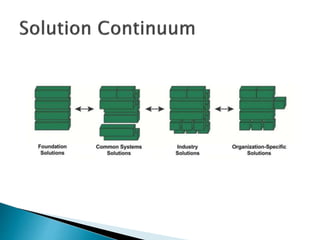
 The Solutions Continuum
◦ Provides a consistent way to describe and understand
the implementation of the assets defined in the
Architecture Continuum. The Solutions Continuum
defines what is available in the organizational
environment as re-usable Solution Building Blocks
(SBBs).
 TOGAF 9 Foundation (40 Questions MCQ -
60 minutes - 55% Passing Score)
 TOGAF 9 Certified (8 essay questions – 90
minutes - 60% Passing Score)
Thank You

TOGAF

  • 1.
  • 2.
     What isTOGAF – History  What is Enterprise – Architecture – Enterprise Architecture – Architecture Domains  TOGAF Topics  Architecture Development Method  Architecture Repository  Architecture Continuum  TOGAF Certification
  • 3.
     TOGAF isan architecture framework The Open Group Architecture Framework  A tool for assisting in the acceptance, production, use, and maintenance of enterprise architectures.  It is based on an iterative process model supported by best practices and a re-usable set of existing architectural assets.
  • 4.
     The OpenGroup is comprised of more than 500 memberships from organizations all over the world, which range from major corporations, government organizations and consortia, to universities and individuals.
  • 5.
     1980s -Technical Architecture Framework for Information Management (TAFIM), developed by the US Department of Defense  1990s - TOGAF was initiated as methodology for the development of technical architecture.  1995 – TOGAF was developed - First version of TOGAF (TOGAF 1.0) was presented .  December 2001 - TOGAF 7, the "Technical Edition", was published.  December 2002 - TOGAF 8 ("Enterprise Edition") was first published  December 2003 - Republished in updated form as TOGAF 8.1.  November 2006 - The Open Group released TOGAF 8.1.1.  January 2009 - TOGAF 9 was first published in The latest version is  December 2011 – version TOGAF 9.1.
  • 6.
     Any collectionof organizations that has a common set of goals ◦ An enterprise could be a government agency ◦ A whole corporation ◦ A division of a corporation ◦ A single department ◦ A chain of geographically distant organizations linked together by common ownership.
  • 7.
     The fundamentalorganization of a system, embodied in its components, their relationships to each other and the environment, and the principles governing its design and evolution.
  • 8.
     “The organizinglogic for business processes and IT infrastructure reflecting the integration and standardization requirements of the firm’s operating model”. “A conceptual blueprint that defines the structure and operation of an organization”.  The intent of an enterprise architecture is to determine how an organization can most effectively achieve its current and future objectives.
  • 9.
     A moreefficient IT operation: - Lower software development, support, and maintenance costs - Increased portability of applications - Improved interoperability and easier system and network management - Improved ability to address critical enterprise-wide issues, such as security  Better return on existing investment, reduced risk for future investment: - Reduced complexity in IT infrastructure - Maximum return on investment in existing IT infrastructure - The flexibility to make, buy, or out-source IT solutions - Reduced risk overall in new investment, and the costs of IT ownership  Faster, simpler, and cheaper procurement: - Buying decisions are simpler, because the information governing procurement is readily available in a coherent plan. - The procurement process is faster, maximizing procurement speed and flexibility without sacrificing architectural coherence. - The ability to procure heterogeneous, multi-vendor open systems.
  • 10.
     A toolthat can be used for developing a broad range of different architectures.  It should describe a method for designing an information system in terms of a set of building blocks, and for showing how the building blocks fit together.  It should contain a set of tools and provide a common vocabulary.  It should also include a list of recommended standards and compliant products that can be used to implement the building blocks.
  • 11.
     Business Architecture:The business strategy, governance, organization, and key business processes.  Data Architecture: The structure of an organization's logical and physical data assets and data management resources.  Application Architecture: A blueprint for the individual application systems to be deployed, their interactions, and their relationships to the core business processes of the organization.  Technology Architecture: The software and hardware capabilities that are required to support the deployment of business, data, and application services. This includes IT infrastructure, middleware, networks, communications, processing, and standards.
  • 13.
     Architecture DevelopmentMethod (ADM) The core of TOGAF. It describes the TOGAF Architecture Development Method (ADM) – a step-by-step approach to developing an enterprise architecture.  ADM Guidelines and Techniques Contains a collection of guidelines and techniques available for use in applying the ADM.  Architecture Content Framework Describes the TOGAF content framework, including a structured metamodel for architectural artifacts, the use of re-usable Architecture Building Blocks (ABBs), and an overview of typical architecture deliverables.  Enterprise Continuum and Tools Discusses appropriate taxonomies and tools to categorize and store the outputs of architecture activity within an enterprise.  TOGAF Reference Models Provides two architectural reference models, namely the TOGAF Technical Reference Model (TRM), and the Integrated Information Infrastructure Reference Model (III-RM).  Architecture Capability Framework Discusses the organization, processes, skills, roles, and responsibilities required to establish and operate an architecture practice within an enterprise.
  • 14.
     ADM describesa process for deriving an organization-specific enterprise architecture that addresses business requirements.
  • 16.
     Preliminary Phasedescribes the preparation and initiation activities required to prepare to meet the business directive for a new enterprise architecture, including the definition of an Organization-Specific Architecture framework and the definition of principles. Phase A: Architecture Vision describes the initial phase of an Architecture Development Cycle. It includes information about defining the scope, identifying the stakeholders, creating the Architecture Vision, and obtaining approvals. Phase B: Business Architecture describes the development of a Business Architecture to support an agreed Architecture Vision. Phase C: Information Systems Architectures describes the development of Information Systems Architectures for an architecture project, including the development of Data and Application Architectures.
  • 17.
     Phase D:Technology Architecture describes the development of the Technology Architecture for an architecture project. Phase E: Opportunities and Solutions conducts initial implementation planning and the identification of delivery vehicles for the architecture defined in the previous phases. Phase F: Migration Planning addresses the formulation of a set of detailed sequence of Transition Architectures with a supporting Implementation and Migration Plan. Phase G: Implementation Governance provides an architectural oversight of the implementation. Phase H: Architecture Change Management establishes procedures for managing change to the new architecture.  Requirements Management examines the process of managing architecture requirements throughout the ADM.
  • 18.
    describes the preparationand initiation activities required to prepare to meet the business directive for a new enterprise architecture, including the definition of an Organization-Specific Architecture framework and the definition of principles.  Understand the business environment  Ensure high-level management commitment  Obtain agreement on scope  Establish principles  Establish governance structure  Agree architecture method to be adopted
  • 19.
     Review theorganizational context for conducting enterprise architecture  To identify the stakeholders, their requirements, and priorities  To confirm the commitment of the stakeholders  To identify and scope the elements of the enterprise organizations affected and define the constraints and assumptions.  To define an organization's “architecture footprint”; that is, the people responsible for performing the architecture work, where they are located, and their responsibilities  To define the framework and detailed methodologies that are going to be used to develop the enterprise architecture in the organization;  To set up a governance and support framework to provide business process and Architecture Governance through the ADM cycle;  To select and implement supporting tools and other infrastructure to support the architecture activity  To define the constraining architecture principles
  • 20.
     Defining theenterprise  Identifying key drivers and elements in the organizational context  Defining the requirements for architecture work  Defining the architecture principles that will inform any architecture work  Defining the framework to be used  Defining the relationships between management frameworks  Evaluating the enterprise architecture’s maturity
  • 22.
     The initialphase of an Architecture Development Cycle.  It includes information about defining the scope, identifying the stakeholders, creating the Architecture Vision, and obtaining approvals.  Project establishment and initiates an iteration of the Architecture Development Cycle, setting the scope, constraints, and expectations for the iteration.
  • 23.
     Obtain managementcommitment for this particular cycle of the ADM  Define and organize an Architecture Development Cycle  Validate business principles, goals, drivers, and Key Performance Indicators (KPIs)  Define, scope, and prioritize architecture tasks  Identify stakeholders, their concerns, and objectives  Define business requirements and constraints  Articulate an Architecture Vision and value proposition to respond to the requirements and constraints  Create a comprehensive plan in line with the project management frameworks adopted by the enterprise  Obtain formal approval to proceed  Understand the impact on, and of, other parallel Architecture Development Cycles
  • 24.
     Phase Astarts with receipt of a Request for Architecture Work from the sponsoring organization to the architecture organization.  A key objective is to ensure proper recognition and endorsement from corporate management, and the support and commitment of line management for this evolution of the ADM cycle.  Architecture Vision is a key activity in this phase.
  • 26.
     Development ofa Business Architecture to support an agreed Architecture Vision.  This describes the fundamental organization of a business embodied in: • Its business process and people • Their relationships to each other and the people • The principles governing its design and evolution
  • 27.
     Describe theBaseline Business Architecture  Develop a Target Business Architecture  Analyze the gaps between the Baseline and Target Architectures
  • 28.
     Developing theBaseline Description  Business Modeling  Using the Architecture Repository
  • 30.
     Documenting thefundamental organization of an organization’s IT systems, embodied in the major types of information and the application systems that process them, and their relationships to each other and the environment.  There are two steps in this phase, which may be developed either sequentially or concurrently: • Data Architecture • Application Architecture
  • 31.
     Data Architecture:Define the types and sources of data needed to support the business, in a way that can be understood by the stakeholders.  Application Architecture: Define the kind of application systems needed to process the data and support the business.
  • 32.
     Data Management Data Migration  Data Governance  Using the Architecture Repository
  • 34.
     Documenting thefundamental organization of the IT systems: • Embodied in the hardware, software, and communications technology • Their relationships to each other and the environment • The principles governing its design and evolution
  • 35.
     Objectives: ◦ Todevelop a Target Technology Architecture that will form the basis of the subsequent implementation and migration planning.  Approach: ◦ Using the Architecture Repository ◦ Existing IT services • The TOGAF Technical Reference Model (TRM) • Generic technology models relevant to the organization's industry “vertical” sector; ◦ for example, in the telecommunications industry such models have been developed by the TeleManagement Forum (TMF) • Technology models relevant to Common Systems Architectures; for example, the III-RM.
  • 37.
     The firstphase which is directly concerned with implementation.  It describes the process of identifying delivery vehicles (projects, programs, or portfolios) that deliver the Target Architecture identified in previous phases.  Key activities are as follows: • Perform initial implementation planning • Identify the major implementation projects • Group projects into Transition Architectures • Decide on approach: — Make versus buy versus re-use — Outsource — COTS — Open Source • Assess priorities • Identify dependencies
  • 38.
     To reviewthe target business objectives and capabilities, consolidate the gaps from Phases B to D, and then organize groups of building blocks to address these capabilities  To confirm the enterprise’s capability for undergoing change  To derive a series of Transition Architectures that deliver continuous business value (e.g., capability increments) through the exploitation of opportunities to realize the building blocks  To generate and gain consensus on an outline Implementation and Migration Strategy
  • 39.
     Concentrates onhow to deliver the architecture.  It takes both a corporate business and technical perspective to rationalize the IT activities, and logically group them into project work packages within the IT portfolio and any other portfolios that depend on IT.  This is a collaborative effort between the enterprise stakeholders from business and IT in order to assess the organization's business transformation readiness, identify opportunities and solutions, and identify all implementation constraints. The key is to focus on business value, flexibility, coordination, and compromise.
  • 41.
     Addresses migrationplanning; that is, how to move from the Baseline to the Target Architectures.
  • 42.
     To ensurethat the Implementation and Migration Plan is coordinated with the various management frameworks in use within the enterprise  To prioritize all work packages, projects, and building blocks by assigning business value to each and conducting a cost/benefit analysis  To finalize the Architecture Vision and Architecture Definition Documents, in line with the agreed implementation approach  To confirm the Transition Architectures defined in Phase E with the relevant stakeholders  To create, evolve, and monitor the detailed Implementation and Migration Plan, providing necessary resources to enable the realization of the Transition Architectures, as defined in Phase E
  • 43.
     Creation ofan Implementation and Migration Plan
  • 45.
     Defines howthe architecture constrains the implementation projects, monitors it while building it, and produces a signed Architecture Contract.
  • 46.
     Formulate recommendationsfor each implementation project  Govern and manage an Architecture Contract covering the overall implementation and deployment process  Perform appropriate governance functions while the system is being implemented and deployed  Ensure conformance with the defined architecture by implementation projects and other projects  Ensure that the program of solutions is deployed successfully, as a planned program of work  Ensure conformance of the deployed solution with the Target Architecture  Mobilize supporting operations that will underpin the future working lifetime of the deployed solution
  • 47.
     Establish animplementation program that will enable the delivery of the agreed Transition Architectures  Adopt a phased deployment schedule that reflects the business priorities embodied in the Architecture Roadmap  Follow the organization's standard for corporate, IT, and Architecture Governance  Use the organization's established portfolio/program management approach, where this exists  Define an operations framework to ensure the effective long life of the deployed solution
  • 49.
     Ensures thatchanges to the architecture are managed in a controlled manner.
  • 50.
     Ensure thatBaseline Architectures continue to be fit- for-purpose  Assess the performance of the architecture and make recommendations for change  Assess changes to the framework and principles set up in previous phases  Establish an architecture change management process for the new enterprise architecture baseline that is achieved with completion of Phase G  Maximize the business value from the architecture and ongoing operations  Operate the Governance Framework
  • 51.
     Enterprise ArchitectureChange Management Process ◦ Simplification change: A simplification change can normally be handled via change management techniques ◦ Incremental change: An incremental change may be capable of being handled via change management techniques, or it may require partial re- architecting, depending on the nature of the change (see Guidelines for Maintenance versus Architecture Redesign for guidance). ◦ Re-architecting change: A re-architecting change requires putting the whole architecture through the Architecture Development Cycle again.
  • 53.
     The processof managing architecture requirements applies to all phases of the ADM cycle.  Dynamic process, which addresses the identification of requirements for the enterprise, stores them, and then feeds them in and out of the relevant ADM phases.
  • 54.
     To providea process to manage architecture requirements throughout the phases of the ADM cycle  To identify requirements for the enterprise, store them, and feed them in and out of the relevant ADM phases, where the requirements are disposed of, addressed, and prioritized
  • 55.
     Business Scenarios Volere Requirements Specification Template  Other Requirements Tools
  • 57.
     Deliverable ◦ Awork product that is contractually specified and in turn formally reviewed, agreed, and signed off by the stakeholders  Artifact ◦ More granular architectural work product that describes an architecture from a specific viewpoint.  Building block ◦ Re-usable component of business, IT, or architectural capability that can be combined with other building blocks to deliver architectures and solutions.
  • 59.
     Used tostore different classes of architectural output at different levels of abstraction, created by the ADM.
  • 61.
     Foundation Architecture AFoundation Architecture is an architecture of building blocks and corresponding standards that supports all the Common Systems Architectures and, therefore, the complete enterprise operating environment.  Common Systems Architectures Guides the selection and integration of specific services from the Foundation Architecture to create an architecture useful for building common solutions across a wide number of relevant domains. Examples: Security Architecture, Management Architecture, Network Architecture, etc. The TOGAF Integrated Information Infrastructure Reference Model (III-RM) is a Common Systems Architecture that focuses on the requirements, building blocks, and standards relating to the vision of Boundaryless Information Flow.  Industry Architectures guides the integration of common systems components with industry specific components, and guide the creation of industry solutions for specific customer problems within a particular industry. (Example: eTom)  Organization-Specific Architectures Organization-Specific Architectures are the most relevant to the IT customer community, since they describe and guide the final deployment of user-written or third-party components that constitute effective solutions for particular enterprises.
  • 62.
     View ofthe Architecture Repository that provides methods for classifying architecture and solution artifacts as they evolve from generic Foundation Architectures to Organization-Specific Architectures.
  • 64.
     Architecture Metamodeldescribes the organizationally tailored application of an architecture framework, including a metamodel for architecture content  Architecture Capability defines the parameters, structures, and processes that support governance of the Architecture Repository.  Architecture Landscape shows an architectural view of the building blocks that are in use within the organization today (e.g., a list of the live applications). The landscape is likely to exist at multiple levels of abstraction to suit different architecture objectives.  Standards Information Base (SIB) captures the standards with which new architectures must comply, which may include industry standards, selected products and services from suppliers, or shared services already deployed within the organization.  Reference Library provides guidelines, templates, patterns, and other forms of reference material that can be leveraged in order to accelerate the creation of new architectures for the enterprise.  Governance Log provides a record of governance activity across the enterprise.
  • 65.
     The ArchitectureContinuum: ◦ Shows relationships among foundational frameworks (such as TOGAF), common system architectures (such as the III-RM), industry architectures, and enterprise architectures.  The Solutions Continuum ◦ Provides a consistent way to describe and understand the implementation of the assets defined in the Architecture Continuum. The Solutions Continuum defines what is available in the organizational environment as re-usable Solution Building Blocks (SBBs).
  • 68.
     TOGAF 9Foundation (40 Questions MCQ - 60 minutes - 55% Passing Score)  TOGAF 9 Certified (8 essay questions – 90 minutes - 60% Passing Score)
  • 70.