TOGAF – A SummaryReference Models
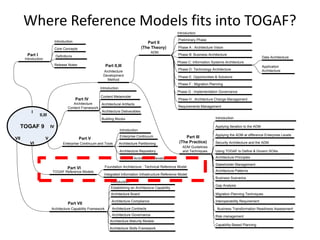
Where Reference Models fits into TOGAF?
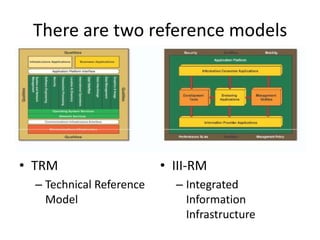
There are two reference modelsTRMTechnical Reference ModelIII-RMIntegrated Information Infrastructure
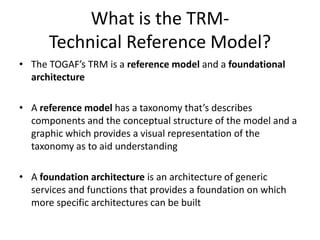
What is the TRM- Technical Reference Model?The TOGAF’s TRM is a reference model and a foundational architectureA reference model has a taxonomy that’s describes components and the conceptual structure of the model and a graphic which provides a visual representation of the taxonomy as to aid understandingA foundation architecture is an architecture of generic services and functions that provides a foundation on which more specific architectures can be built
Uses of TRMObjective of TRM is to enable structured definition of the standardized application platform and its associated interfaces.Provides a starting point or reference for organisation to develop their own reference models by extending or adapting the TRMProvides a consistent taxonomy to aid a means of communication between stakeholdersCan be used as a taxonomy to develop a standards information base within an organisation.
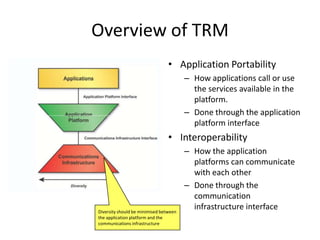
Overview of TRMApplication PortabilityHow applications call or use the services available in the platform.Done through the application platform interfaceInteroperabilityHow the application platforms can communicate with each otherDone through the communication infrastructure interfaceDiversity should be minimised between the application platform and the communications infrastructure
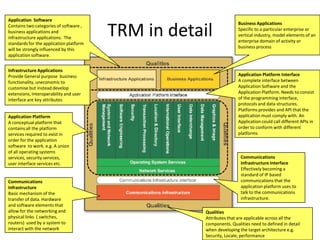
TRM in detailApplication  SoftwareContains two categories of software , business applications and infrastructure applications.  The standards for the application platform will be strongly influenced by this application software.Business ApplicationsSpecific to a particular enterprise or vertical industry, model elements of an enterprise domain of activity or business processInfrastructure ApplicationsProvide General purpose  business functionality, uneconomic to  customise but instead develop extensions, Interoperability and user interface are key attributesApplication Platform InterfaceA complete interface between Application Software and the Application Platform. Needs to consist of the programming interface, protocols and data structures. Platforms provides and API that the application must comply with. An Application could call different APIs in order to conform with different platformsApplication PlatformA conceptual platform that contains all the platform services required to exist in order for the application software  to work. e.g. A union of all operating systems services, security services, user interface services etc.Communications Infrastructure InterfaceEffectively becoming a standard of IP based communications that the application platform uses to talk to the communications infrastructure.Communications InfrastructureBasic mechanism of the transfer of data. Hardware and software elements that allow for the networking and physical links  ( switches, routers)  used by a system to interact with the networkQualitiesAttributes that are applicable across all the components. Qualities need to defined in detail when developing the target architecture e.g. Security, Locale, performance
What is III-RM ?The TRM focuses on the Application Platform space, III-RM main focus is the Applications space particularly the “Common Systems Architecture” Like the TRM it is a reference model with a taxonomy and a graphic however it is a subset of the scope of TRM but expands on certain partsHelps provide a solution to the common problem called the Boundaryless information flow Foundation Architecture  that can be adapted be organisations as architecture building blocks
What is the Boundaryless Information Flow?Getting the right information to the right people in the right time in a secure, reliable manner, in order to support the operations that are core to the extended enterpriseThe problem is that departments are siloed with their own processes, their own systems, their own data. The trends in business now requires faster and better integration between these silos in to be responsive  to changing markets, which requires access to systems and data across these silos.Cross functional teams help but how do they get access to the information to help them solve a business problem or to exploit a business opportunity
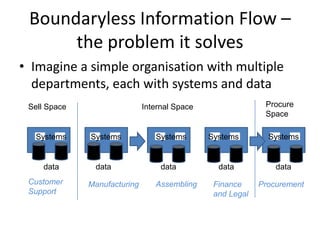
Boundaryless Information Flow – the problem it solvesImagine a simple organisation with multiple departments, each with systems and dataProcure SpaceInternal SpaceSell SpaceSystemsSystemsSystemsSystemsSystemsdatadatadatadatadataCustomer SupportAssemblingManufacturingProcurementFinance and Legal
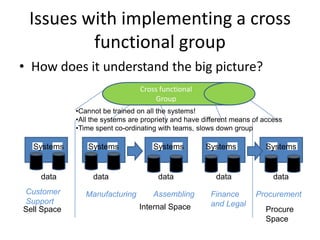
Issues with implementing a cross functional groupHow does it understand the big picture?Cross functional GroupCannot be trained on all the systems!
All the systems are propriety and have different means of access
Time spent co-ordinating with teams, slows down groupSystemsSystemsSystemsSystemsSystemsdatadatadatadatadataCustomer SupportAssemblingManufacturingProcurementFinance and LegalInternal SpaceProcure SpaceSell Space
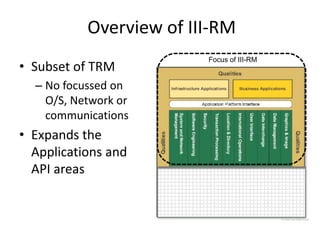
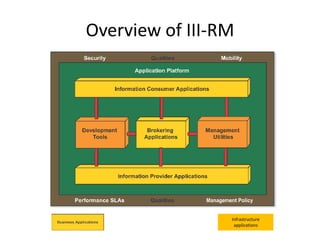
Overview of III-RMFocus of III-RMSubset of TRMNo focussed on O/S, Network or communicationsExpands the Applications and API areas
Overview of III-RMInfrastructure applications
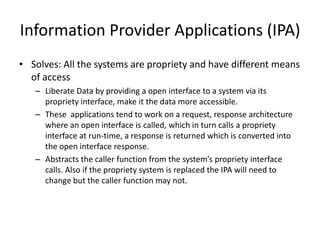
Information Provider Applications (IPA)Solves: All the systems are propriety and have different means of accessLiberate Data by providing a open interface to a system via its propriety interface, make it the data more accessible.These  applications tend to work on a request, response architecture where an open interface is called, which in turn calls a propriety interface at run-time, a response is returned which is converted into the open interface response.Abstracts the caller function from the system’s propriety interface calls. Also if the propriety system is replaced the IPA will need to change but the caller function may not.
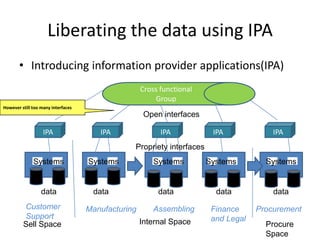
Liberating the data using IPAIntroducing information provider applications(IPA)Cross functional GroupHowever still too many interfaces Open interfacesIPAIPAIPAIPAIPAPropriety interfacesSystemsSystemsSystemsSystemsSystemsdatadatadatadatadataCustomer SupportAssemblingManufacturingProcurementFinance and LegalInternal SpaceProcure SpaceSell Space
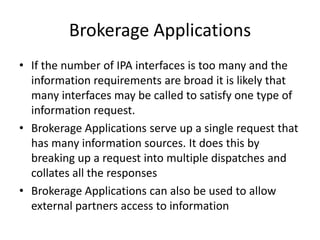
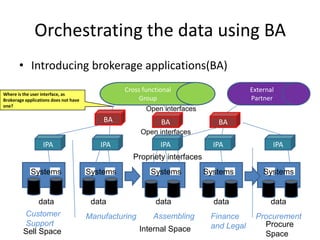
Brokerage ApplicationsIf the number of IPA interfaces is too many and the information requirements are broad it is likely that many interfaces may be called to satisfy one type of information request. Brokerage Applications serve up a single request that has many information sources. It does this by breaking up a request into multiple dispatches and collates all the responsesBrokerage Applications can also be used to allow external partners access to information
Orchestrating the data using BAIntroducing brokerage applications(BA)Cross functional GroupExternal PartnerWhere is the user interface, as Brokerage applications does not have one?Open interfacesBABABAOpen interfacesIPAIPAIPAIPAIPAPropriety interfacesSystemsSystemsSystemsSystemsSystemsdatadatadatadatadataCustomer SupportAssemblingManufacturingProcurementFinance and LegalProcure SpaceInternal SpaceSell Space
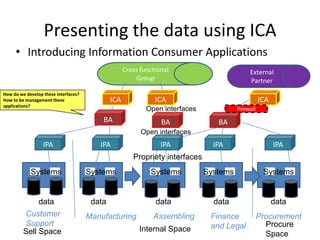
Information Consumer Applications (ICA) Provides the information to the end user in the format that they need it, in a secure mannerCommunicates with the BA or IPA via open interfaces, in some cases via a firewall.An example of a ICA is an UI components of an Enterprise Portal
Presenting the data using ICAIntroducing Information Consumer ApplicationsCross functional GroupExternal PartnerICAICAICAHow do we develop these interfaces? How to be management these applications?Open interfacesfirewallBABABAOpen interfacesIPAIPAIPAIPAIPAPropriety interfacesSystemsSystemsSystemsSystemsSystemsdatadatadatadatadataCustomer SupportAssemblingManufacturingProcurementFinance and LegalProcure SpaceInternal SpaceSell Space

TOGAF Reference Models

  • 1.
    TOGAF – ASummaryReference Models
  • 2.
    Where Reference Modelsfits into TOGAF?
  • 3.
    There are tworeference modelsTRMTechnical Reference ModelIII-RMIntegrated Information Infrastructure
  • 4.
    What is theTRM- Technical Reference Model?The TOGAF’s TRM is a reference model and a foundational architectureA reference model has a taxonomy that’s describes components and the conceptual structure of the model and a graphic which provides a visual representation of the taxonomy as to aid understandingA foundation architecture is an architecture of generic services and functions that provides a foundation on which more specific architectures can be built
  • 5.
    Uses of TRMObjectiveof TRM is to enable structured definition of the standardized application platform and its associated interfaces.Provides a starting point or reference for organisation to develop their own reference models by extending or adapting the TRMProvides a consistent taxonomy to aid a means of communication between stakeholdersCan be used as a taxonomy to develop a standards information base within an organisation.
  • 6.
    Overview of TRMApplicationPortabilityHow applications call or use the services available in the platform.Done through the application platform interfaceInteroperabilityHow the application platforms can communicate with each otherDone through the communication infrastructure interfaceDiversity should be minimised between the application platform and the communications infrastructure
  • 7.
    TRM in detailApplication SoftwareContains two categories of software , business applications and infrastructure applications. The standards for the application platform will be strongly influenced by this application software.Business ApplicationsSpecific to a particular enterprise or vertical industry, model elements of an enterprise domain of activity or business processInfrastructure ApplicationsProvide General purpose business functionality, uneconomic to customise but instead develop extensions, Interoperability and user interface are key attributesApplication Platform InterfaceA complete interface between Application Software and the Application Platform. Needs to consist of the programming interface, protocols and data structures. Platforms provides and API that the application must comply with. An Application could call different APIs in order to conform with different platformsApplication PlatformA conceptual platform that contains all the platform services required to exist in order for the application software to work. e.g. A union of all operating systems services, security services, user interface services etc.Communications Infrastructure InterfaceEffectively becoming a standard of IP based communications that the application platform uses to talk to the communications infrastructure.Communications InfrastructureBasic mechanism of the transfer of data. Hardware and software elements that allow for the networking and physical links ( switches, routers) used by a system to interact with the networkQualitiesAttributes that are applicable across all the components. Qualities need to defined in detail when developing the target architecture e.g. Security, Locale, performance
  • 8.
    What is III-RM?The TRM focuses on the Application Platform space, III-RM main focus is the Applications space particularly the “Common Systems Architecture” Like the TRM it is a reference model with a taxonomy and a graphic however it is a subset of the scope of TRM but expands on certain partsHelps provide a solution to the common problem called the Boundaryless information flow Foundation Architecture that can be adapted be organisations as architecture building blocks
  • 9.
    What is theBoundaryless Information Flow?Getting the right information to the right people in the right time in a secure, reliable manner, in order to support the operations that are core to the extended enterpriseThe problem is that departments are siloed with their own processes, their own systems, their own data. The trends in business now requires faster and better integration between these silos in to be responsive to changing markets, which requires access to systems and data across these silos.Cross functional teams help but how do they get access to the information to help them solve a business problem or to exploit a business opportunity
  • 10.
    Boundaryless Information Flow– the problem it solvesImagine a simple organisation with multiple departments, each with systems and dataProcure SpaceInternal SpaceSell SpaceSystemsSystemsSystemsSystemsSystemsdatadatadatadatadataCustomer SupportAssemblingManufacturingProcurementFinance and Legal
  • 11.
    Issues with implementinga cross functional groupHow does it understand the big picture?Cross functional GroupCannot be trained on all the systems!
  • 12.
    All the systemsare propriety and have different means of access
  • 13.
    Time spent co-ordinatingwith teams, slows down groupSystemsSystemsSystemsSystemsSystemsdatadatadatadatadataCustomer SupportAssemblingManufacturingProcurementFinance and LegalInternal SpaceProcure SpaceSell Space
  • 14.
    Overview of III-RMFocusof III-RMSubset of TRMNo focussed on O/S, Network or communicationsExpands the Applications and API areas
  • 15.
  • 16.
    Information Provider Applications(IPA)Solves: All the systems are propriety and have different means of accessLiberate Data by providing a open interface to a system via its propriety interface, make it the data more accessible.These applications tend to work on a request, response architecture where an open interface is called, which in turn calls a propriety interface at run-time, a response is returned which is converted into the open interface response.Abstracts the caller function from the system’s propriety interface calls. Also if the propriety system is replaced the IPA will need to change but the caller function may not.
  • 17.
    Liberating the datausing IPAIntroducing information provider applications(IPA)Cross functional GroupHowever still too many interfaces Open interfacesIPAIPAIPAIPAIPAPropriety interfacesSystemsSystemsSystemsSystemsSystemsdatadatadatadatadataCustomer SupportAssemblingManufacturingProcurementFinance and LegalInternal SpaceProcure SpaceSell Space
  • 18.
    Brokerage ApplicationsIf thenumber of IPA interfaces is too many and the information requirements are broad it is likely that many interfaces may be called to satisfy one type of information request. Brokerage Applications serve up a single request that has many information sources. It does this by breaking up a request into multiple dispatches and collates all the responsesBrokerage Applications can also be used to allow external partners access to information
  • 19.
    Orchestrating the datausing BAIntroducing brokerage applications(BA)Cross functional GroupExternal PartnerWhere is the user interface, as Brokerage applications does not have one?Open interfacesBABABAOpen interfacesIPAIPAIPAIPAIPAPropriety interfacesSystemsSystemsSystemsSystemsSystemsdatadatadatadatadataCustomer SupportAssemblingManufacturingProcurementFinance and LegalProcure SpaceInternal SpaceSell Space
  • 20.
    Information Consumer Applications(ICA) Provides the information to the end user in the format that they need it, in a secure mannerCommunicates with the BA or IPA via open interfaces, in some cases via a firewall.An example of a ICA is an UI components of an Enterprise Portal
  • 21.
    Presenting the datausing ICAIntroducing Information Consumer ApplicationsCross functional GroupExternal PartnerICAICAICAHow do we develop these interfaces? How to be management these applications?Open interfacesfirewallBABABAOpen interfacesIPAIPAIPAIPAIPAPropriety interfacesSystemsSystemsSystemsSystemsSystemsdatadatadatadatadataCustomer SupportAssemblingManufacturingProcurementFinance and LegalProcure SpaceInternal SpaceSell Space
  • 22.
    Infrastructure ApplicationsThere aretwo infrastructure applications:-Development ToolsProvides all the necessary modelling, design and construction capabilities to develop and deploy applications that require access to the integrated information infrastructure in a manner that is consistent with the environmentManagement utilitiesTune and manage the run-time environment in order to meet the demands of the ever changing business environment
  • 23.
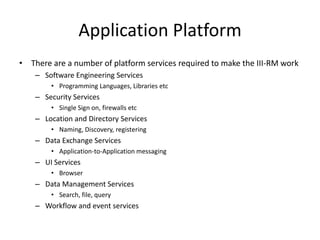
    Application PlatformThere area number of platform services required to make the III-RM workSoftware Engineering Services Programming Languages, Libraries etcSecurity ServicesSingle Sign on, firewalls etcLocation and Directory ServicesNaming, Discovery, registeringData Exchange ServicesApplication-to-Application messagingUI ServicesBrowserData Management ServicesSearch, file, queryWorkflow and event services