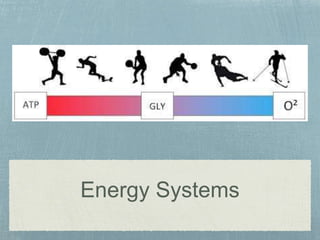
Energy Systems
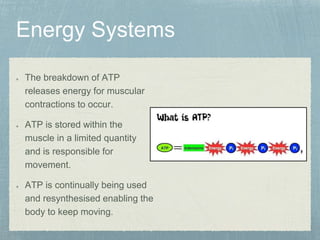
The breakdown of ATP
releases energy for muscular
contractions to occur.
ATP is stored within the
muscle in a limited quantity
and is responsible for
movement.
ATP is continually being used
and resynthesised enabling the
body to keep moving.
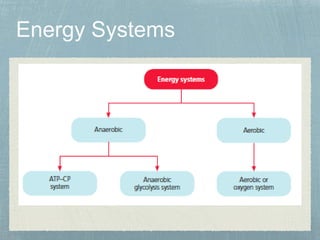
There are three energy systems responsible for manufacturing
ATP and there are two essential ways for ATP to be produced:
The Aerobic Pathway- Aerobic literally means with oxygen
The Anaerobic Pathways- Anaerobic literally means without
oxygen
There are two types of anaerobic systems:
The ATP-PC System
The anaerobic glycolysis system
ANAEROBIC PATHWAYS
• Produce ATP quickly &
powerfully
• Produce small amounts
ATP
• Operate for short duration
• Result in by-products
associated with muscle
fatigue
AEROBIC PATHWAY
• Used at 60-85% Max HR
• Body can meet the demand
for O2
• Produces large amounts
ATP for long duration
• Cannot be produced quickly
or for high intensity
• Has no by-products
associated with fatigue
The The energy system used will depend on
the following:
– Activity duration
– Activity intensity
– Level of aerobic fitness
– Recovery between efforts
Powerful, explosive efforts
Uses chemical fuel- Creatine phosphate
Lasts for 10 Seconds
95-100%Max HR
High intensity (85-95% max
HR) repeated efforts
(insufficient recovery) 10-
30 secs up to 60 secs
Breaks down glycogen
stores anaerobically
Accumulation of by-
products associated with
muscle fatigue
Used at rest and sub-max (<85% max HR)
Dominant supplier energy after 30 secs
No fatiguing by-products
Assist the anaerobic systems during recovery
Uses glycogen, triglycerides and proteins (last resort)
Slow supplier energy because requires O2
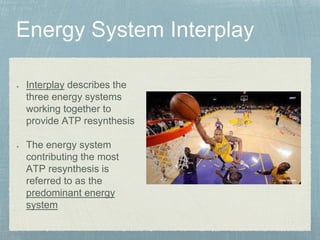
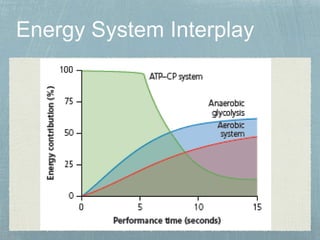
Interplay describes the
three energy systems
working together to
provide ATP resynthesis
The energy system
contributing the most
ATP resynthesis is
referred to as the
predominant energy
system
Type 1 Type 2A Type 2B
• Slow twitch
• Red
• Rich blood supply
• Fatigue resistant
• Low force
• Use Aerobic
pathways
• Larger fibres
• Poor blood supply
• High force
• Fatigue quickly
• Red
• Fast contraction speed
• Repeat efforts
• Use both Aerobic &
Anaerobic pathways
• Largest fibres
• Poor blood supply
• High force
• Fatigue quickly
• White
• Fast contraction
speed
• Large force
Use Anaerobic
pathways
Energy systems
Energy systems

Energy systems

  • 1.
  • 2.
    The breakdown ofATP releases energy for muscular contractions to occur. ATP is stored within the muscle in a limited quantity and is responsible for movement. ATP is continually being used and resynthesised enabling the body to keep moving.
  • 3.
    There are threeenergy systems responsible for manufacturing ATP and there are two essential ways for ATP to be produced: The Aerobic Pathway- Aerobic literally means with oxygen The Anaerobic Pathways- Anaerobic literally means without oxygen There are two types of anaerobic systems: The ATP-PC System The anaerobic glycolysis system
  • 4.
    ANAEROBIC PATHWAYS • ProduceATP quickly & powerfully • Produce small amounts ATP • Operate for short duration • Result in by-products associated with muscle fatigue AEROBIC PATHWAY • Used at 60-85% Max HR • Body can meet the demand for O2 • Produces large amounts ATP for long duration • Cannot be produced quickly or for high intensity • Has no by-products associated with fatigue
  • 6.
    The The energysystem used will depend on the following: – Activity duration – Activity intensity – Level of aerobic fitness – Recovery between efforts
  • 7.
    Powerful, explosive efforts Useschemical fuel- Creatine phosphate Lasts for 10 Seconds 95-100%Max HR
  • 8.
    High intensity (85-95%max HR) repeated efforts (insufficient recovery) 10- 30 secs up to 60 secs Breaks down glycogen stores anaerobically Accumulation of by- products associated with muscle fatigue
  • 9.
    Used at restand sub-max (<85% max HR) Dominant supplier energy after 30 secs No fatiguing by-products Assist the anaerobic systems during recovery Uses glycogen, triglycerides and proteins (last resort) Slow supplier energy because requires O2
  • 11.
    Interplay describes the threeenergy systems working together to provide ATP resynthesis The energy system contributing the most ATP resynthesis is referred to as the predominant energy system
  • 14.
    Type 1 Type2A Type 2B • Slow twitch • Red • Rich blood supply • Fatigue resistant • Low force • Use Aerobic pathways • Larger fibres • Poor blood supply • High force • Fatigue quickly • Red • Fast contraction speed • Repeat efforts • Use both Aerobic & Anaerobic pathways • Largest fibres • Poor blood supply • High force • Fatigue quickly • White • Fast contraction speed • Large force Use Anaerobic pathways