Nutritional consideration for
performance and
rehabilitation
Prepared
By Dr.Navaid us
Saba
The optimal balance of energy and nutrients
delivered at the right time, has a range of
potential benefits for the athlete.
Fundamentals of nutrition
Energy balance
Managing the energy balance
To maintain weight and body composition at the optimal level of
sport, athletes must therefore maintain both the amount of energy
the consume and the amount the expend.
• The estimated average energy intakes required in healthy adults are
• For males 2250 Kcal/day
• For females 1940 Kcal/day
Nutrients
Micro – nutrients Macro – nutrients
Carbohydrates
• Primary fuel source for high intensity exercise(above 60 % of VO2 max)
• Single most important source of energy for athletes.
• Provides approximately 4 Kcal/ gm
Simple carbohydrates
Complex carbohydrates
It is a measure of the extend to which a certain food
raises blood glucose.
Protein
• Maintain all body function
• Contain approximately 4Kcal/gm
• Supply 5- 10% of energy expenditure
• The recommended intake of protein for a healthy sedentary person
is 0.75g/kg.bw/dy or approximately 15% of the diet.
Amino acid
Non – essential
(12)
Essential (8)
Fats
Saturated
Unsaturated
• Contains approximately 9kcal/gm
• In healthy diet recommend on more than 30% of energy intake as
total fat and less than 10% as saturated fats
Iron
Found in two forms
Haem iron and non – haem iron
Haem iron is generally found in animal
foods and has greater bioavailability
Non – haem iron, generally found in plant
foods, has low bioavailability (2- 10%)
Water
Energy requirements for specific sport/
training activity
• Energy requirements for athlete are determine
by
• Size
• Basal metabolic rate
• Extra energy (activities performed throughout the
day)
• Recovery and adaptation from training and
competition
Carbohydrate requirements for performance
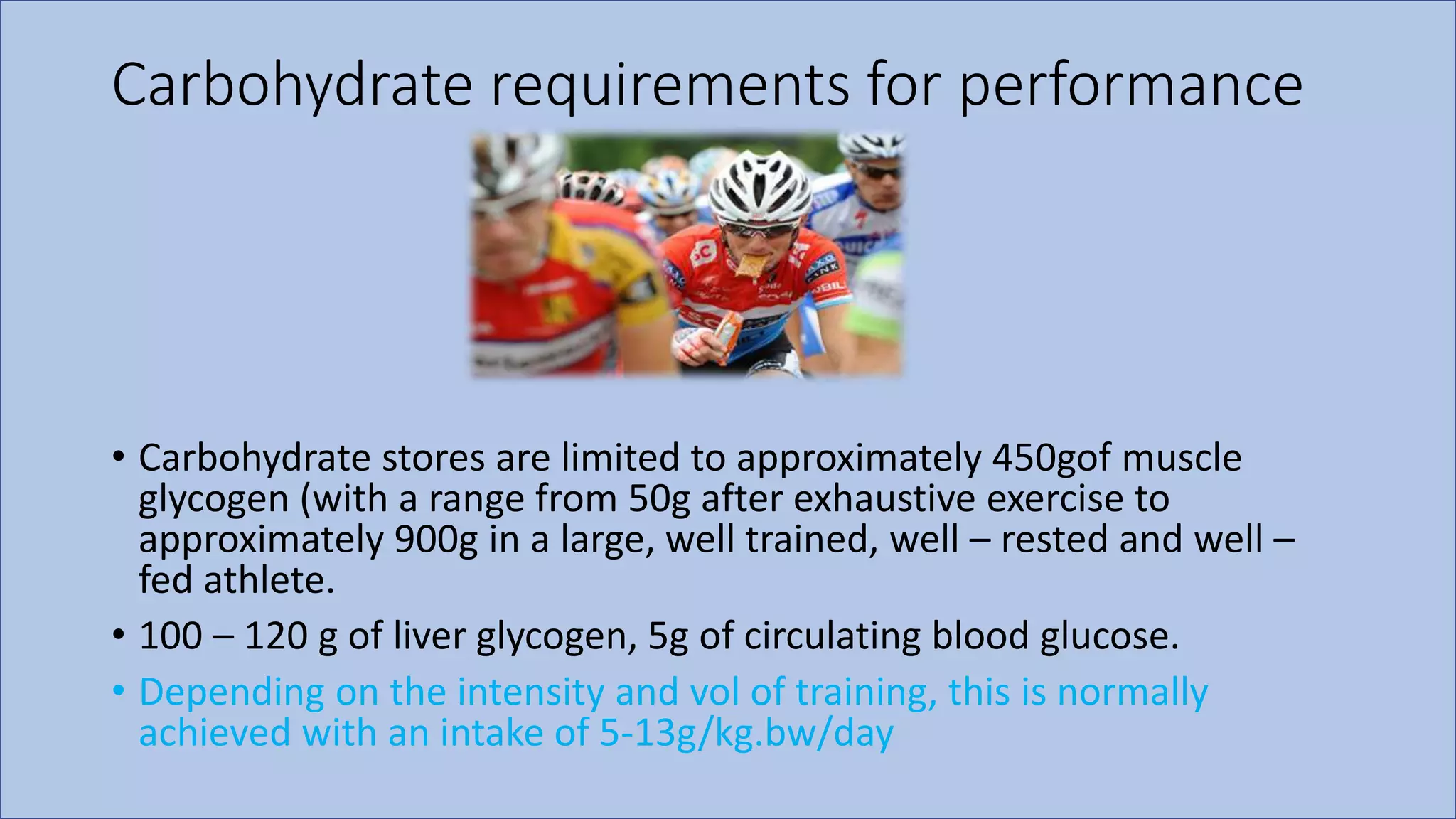
• Carbohydrate stores are limited to approximately 450gof muscle
glycogen (with a range from 50g after exhaustive exercise to
approximately 900g in a large, well trained, well – rested and well –
fed athlete.
• 100 – 120 g of liver glycogen, 5g of circulating blood glucose.
• Depending on the intensity and vol of training, this is normally
achieved with an intake of 5-13g/kg.bw/day
Pre - exercise
• Glycogen stores must be sufficient
to allow completion of event
• Important to distinguish between
max and optimal storage of
glycogen
• Athlete should only seek to cardo
load for sport where glycogen
depletion may become limiting
factor.
Pre – event meal should be high in carbohydrate, non – greasy and readily digestible
The meal should be served 3- 4 hours before event
Provide 150 – 350 g of carbohydrate(1.5 g /lb/bw)
Add small amount of protein can aid In regulating energy levels by slowing down carbohydrate absorption.
Pay attention to salty craving, if competing in hot/humid climate, make sure to replace electrolyte losses.
Carbohydrate – loading
During exercise
Benefits of pre – competition carbohydrate
loading are well established, there is clear
evidence for an ergogenic effect of
carbohydrate feeding during event.
Sports drinks typically contain around 60g of
carbohydrate/liter. Which is lose to the
maximum amount of exogenous carbohydrate
that the body can absorb and oxidise per
hour(1 – 1.1g/min)
• Depending on the priority (fluid delivery or carbohydrate
delivery) athletes can vary the concentration of carbohydrate in
the sport drink
• Eg: 5% solution will be more appropriate for those wishing to replenish
both water and carbohydrate.
• A 10% solution will be more suited to carbohydrate delivery at the
expense of gastric emptying.
• Isotonic carbohydrate – base drink – during any stoppages, time –
outs, injury breaks and half time as these break provide the perfect
opportunity to consume.
Post exercise
• Athlete must restore their muscle glycogen stores as soon as possible
post exercise
• The rate and extend of glycogen re – synthesizes is depends on the
quantity, timing and type of carbohydrate ingestion and on the nature
of recovery.
• Glycogen re- synthesis depends on the quantity of the dietary
carbohydrate consumed.
• To replenish glycogen stores athletes should consume at least
1g/kg.bw immediately post exercise or a minimum of 1 – 1.85g/kg.bw
of carbohydrate/hour in the first few hours post – exercise.
• If you can not consume solid food within 30 of exercise, try 2 – 4 cups
of sport drink and incorporate solid food 2 and 4 hours after exercise .
Fat as fuel for exercise
• Low intensities, or late in prolonged exercise, fat becomes
increasingly important.
• Fat stores are large, with an average person storing over 100,000 kcal
of energy as fat, mainly as subcutaneous adipose tissue.
• The relative contribution of fat for fuel depends on both the intensity
and duration of exercise and whether carbohydrate has been
consumed.
Intensity
• At rest the majority of our fuel requirements come from fat.
• As exercise intensity rises, the rate of lipolysis and oxidation increase
to a maximum at approximately 64% VO2 max
• At higher intensities(86% – 89% of VO2 max) the contribution of fat
oxidation to energy expenditure is negligible.
Duration
• As exercise progresses, fat oxidation plays an increasing
important role.
• The body’s ability to oxidize carbohydrate is depleted and fat
becomes the dominate fuel, with an associated drop in
exercise intensity( not ideal during competition)
• Fat oxidation increase with exercise intensity up to 60 – 65% VO2
max. At higher intensities fat oxidation is restricted.
• Endurance training is the most effective, increasing the rate of lipid
metabolism through increased size and no of muscle mitochondria,
increase activity of lipid oxidizing enzymes, and increase intra –
muscular triacylglycerol stores.
Protein requirements for performance
• Protein requirement vary depending
on the sport, training, and the
individual.
• There are several mechanisms by
which athlete could require more
protein than non – athlete person.
These include:
• Increase oxidation of amino acids during
exercise
• Increase proteolysis as an acute
response to exercise
• Increase protein synthesis as an
adaptation to training
• For endurance and intermittent sprint sports, protein requirements
may be increase due to increased content of mitochondrial proteins
and increased involvement in oxidative metabolism.
• An intake of 1.2 – 1.4g/kg.bw/day is generally recommended for
endurance athletes
• Consistent levels of high intensity/high vol training where high levels
of amino acid oxidation occur may increase protein requirement for
endurance athletes to 1.6g.kg.bw/day with extreme endurance
athletes requiring up to 2.0g/kg.bw/day
(eat small quantities at each meal, not all in one go)
• Athletes should consume protein from a
variety of sources to ensure they achieve
a balance between the essential and non
– essential amino acids (complete protein
from animal sources will provide all of
the essential amino acids)
• Immediately post resistance training
consume a protein – base snack.
Timing of protein intake
• Pre – exercise: create an anti - catabolic
environment prior to exercise
• For resistance training, an increase in
net amino acid uptake when essential
amino acid plus carbohydrate were
ingested pre – exercise versus post –
exercise – seems prudent for athletes to
consume a protein – base snack(approx.
10g) prior to resistance training.
Fluid for performance
• It is possible to lose up to 2.5 liters/hour during intense activity.
• The loss of fluid in sweat and associated dehydration contributes to
fatigue and hyperthermia during exercise.
• Carry fluids. This will encourage voluntary fluid consumption.
• Clear (pale yellow) urine is a sign that the athlete is well hydrate; dark
urine, that the athlete is under – hydration.
• Avoid foods and drink that may have a diuretic effective
• Estimate sweat loss for each athlete by measuring body weight loss
during training.
• During exercise, aim to drink sufficient fluid to match sweat loss.
• Combine carbohydrate with fluid ingestion to help replenish glycogen
stores.
Fluid intake during exercise
• Prevent dehydration
• Maintain blood vol
• Osmolality and viscosity
• Maintenance of skin blood flow and sweat rate
• Thirst is a sign of dehydration but, because it is possible to dehydrate
by 2 % of body weight before thirst occurs, athlete must drink before
getting thirsty.
Factors affecting fluid intake
• Availability of fluid
• Thirst
• Awareness of sweat losses
• Opportunity to drink
• The palatability of fluid
Ideal fluid for exercise
• Initially fluids should be cool (10 - 12◦C)
• Not acidic or gassy
• Not cause gastrointestinal distress
Prior to exercise
To avoid dehydration, drink about 500 – 600 ml in the hours before a race/match and
200 – 300 ml 10 – 20 mints beforehand. Drink regularly throughout exercise (100 –
300 ml every 10 – 15 min)
For longer events, where dehydration may inhibit performance, athletes should drink
an additional 400 – 600 ml of water (sport drink) immediately before exercise
During exercise
• Drink 100 – 300ml of water every 15 mints as tolerated
After exercise
• Fluid intake needs to be about 150% of the weight lost during exercise
to achieve normal hydration within 6 hours post exercise.
• Adding sodium 60 – 80 mmol/lit) will reduce urinary water loss,
aiding fluid retention and the recovery of fluid balance.
Vitamin and mineral requirement for athlete
• During exercise it is likely that
micronutrient requirements will increase.
• Vit B plays an essential role in the release
of energy from carbohydrate, fat and
protein and information of hemoglobin.
• Its deficiency can have serious
consequences for the athlete, leading to
fatigue and decreases in VO2 max and
power.
Nutrition for injury prevention
• Fatigue - carbohydrate and water
• Iron – reduce work capacity

Nutrition and performance

  • 1.
    Nutritional consideration for performanceand rehabilitation Prepared By Dr.Navaid us Saba
  • 2.
    The optimal balanceof energy and nutrients delivered at the right time, has a range of potential benefits for the athlete.
  • 3.
  • 4.
    Managing the energybalance To maintain weight and body composition at the optimal level of sport, athletes must therefore maintain both the amount of energy the consume and the amount the expend.
  • 5.
    • The estimatedaverage energy intakes required in healthy adults are • For males 2250 Kcal/day • For females 1940 Kcal/day
  • 6.
    Nutrients Micro – nutrientsMacro – nutrients
  • 7.
    Carbohydrates • Primary fuelsource for high intensity exercise(above 60 % of VO2 max) • Single most important source of energy for athletes. • Provides approximately 4 Kcal/ gm Simple carbohydrates Complex carbohydrates
  • 8.
    It is ameasure of the extend to which a certain food raises blood glucose.
  • 10.
    Protein • Maintain allbody function • Contain approximately 4Kcal/gm • Supply 5- 10% of energy expenditure • The recommended intake of protein for a healthy sedentary person is 0.75g/kg.bw/dy or approximately 15% of the diet. Amino acid Non – essential (12) Essential (8)
  • 11.
  • 12.
    • Contains approximately9kcal/gm • In healthy diet recommend on more than 30% of energy intake as total fat and less than 10% as saturated fats
  • 16.
    Iron Found in twoforms Haem iron and non – haem iron Haem iron is generally found in animal foods and has greater bioavailability Non – haem iron, generally found in plant foods, has low bioavailability (2- 10%)
  • 17.
  • 18.
    Energy requirements forspecific sport/ training activity • Energy requirements for athlete are determine by • Size • Basal metabolic rate • Extra energy (activities performed throughout the day) • Recovery and adaptation from training and competition
  • 19.
    Carbohydrate requirements forperformance • Carbohydrate stores are limited to approximately 450gof muscle glycogen (with a range from 50g after exhaustive exercise to approximately 900g in a large, well trained, well – rested and well – fed athlete. • 100 – 120 g of liver glycogen, 5g of circulating blood glucose. • Depending on the intensity and vol of training, this is normally achieved with an intake of 5-13g/kg.bw/day
  • 20.
    Pre - exercise •Glycogen stores must be sufficient to allow completion of event • Important to distinguish between max and optimal storage of glycogen • Athlete should only seek to cardo load for sport where glycogen depletion may become limiting factor.
  • 21.
    Pre – eventmeal should be high in carbohydrate, non – greasy and readily digestible The meal should be served 3- 4 hours before event Provide 150 – 350 g of carbohydrate(1.5 g /lb/bw) Add small amount of protein can aid In regulating energy levels by slowing down carbohydrate absorption. Pay attention to salty craving, if competing in hot/humid climate, make sure to replace electrolyte losses.
  • 22.
  • 24.
    During exercise Benefits ofpre – competition carbohydrate loading are well established, there is clear evidence for an ergogenic effect of carbohydrate feeding during event. Sports drinks typically contain around 60g of carbohydrate/liter. Which is lose to the maximum amount of exogenous carbohydrate that the body can absorb and oxidise per hour(1 – 1.1g/min)
  • 25.
    • Depending onthe priority (fluid delivery or carbohydrate delivery) athletes can vary the concentration of carbohydrate in the sport drink • Eg: 5% solution will be more appropriate for those wishing to replenish both water and carbohydrate. • A 10% solution will be more suited to carbohydrate delivery at the expense of gastric emptying.
  • 26.
    • Isotonic carbohydrate– base drink – during any stoppages, time – outs, injury breaks and half time as these break provide the perfect opportunity to consume.
  • 27.
    Post exercise • Athletemust restore their muscle glycogen stores as soon as possible post exercise • The rate and extend of glycogen re – synthesizes is depends on the quantity, timing and type of carbohydrate ingestion and on the nature of recovery.
  • 28.
    • Glycogen re-synthesis depends on the quantity of the dietary carbohydrate consumed. • To replenish glycogen stores athletes should consume at least 1g/kg.bw immediately post exercise or a minimum of 1 – 1.85g/kg.bw of carbohydrate/hour in the first few hours post – exercise. • If you can not consume solid food within 30 of exercise, try 2 – 4 cups of sport drink and incorporate solid food 2 and 4 hours after exercise .
  • 29.
    Fat as fuelfor exercise • Low intensities, or late in prolonged exercise, fat becomes increasingly important. • Fat stores are large, with an average person storing over 100,000 kcal of energy as fat, mainly as subcutaneous adipose tissue. • The relative contribution of fat for fuel depends on both the intensity and duration of exercise and whether carbohydrate has been consumed.
  • 30.
    Intensity • At restthe majority of our fuel requirements come from fat. • As exercise intensity rises, the rate of lipolysis and oxidation increase to a maximum at approximately 64% VO2 max • At higher intensities(86% – 89% of VO2 max) the contribution of fat oxidation to energy expenditure is negligible.
  • 31.
    Duration • As exerciseprogresses, fat oxidation plays an increasing important role. • The body’s ability to oxidize carbohydrate is depleted and fat becomes the dominate fuel, with an associated drop in exercise intensity( not ideal during competition)
  • 32.
    • Fat oxidationincrease with exercise intensity up to 60 – 65% VO2 max. At higher intensities fat oxidation is restricted. • Endurance training is the most effective, increasing the rate of lipid metabolism through increased size and no of muscle mitochondria, increase activity of lipid oxidizing enzymes, and increase intra – muscular triacylglycerol stores.
  • 33.
    Protein requirements forperformance • Protein requirement vary depending on the sport, training, and the individual. • There are several mechanisms by which athlete could require more protein than non – athlete person. These include: • Increase oxidation of amino acids during exercise • Increase proteolysis as an acute response to exercise • Increase protein synthesis as an adaptation to training
  • 34.
    • For enduranceand intermittent sprint sports, protein requirements may be increase due to increased content of mitochondrial proteins and increased involvement in oxidative metabolism. • An intake of 1.2 – 1.4g/kg.bw/day is generally recommended for endurance athletes • Consistent levels of high intensity/high vol training where high levels of amino acid oxidation occur may increase protein requirement for endurance athletes to 1.6g.kg.bw/day with extreme endurance athletes requiring up to 2.0g/kg.bw/day (eat small quantities at each meal, not all in one go)
  • 35.
    • Athletes shouldconsume protein from a variety of sources to ensure they achieve a balance between the essential and non – essential amino acids (complete protein from animal sources will provide all of the essential amino acids) • Immediately post resistance training consume a protein – base snack.
  • 37.
    Timing of proteinintake • Pre – exercise: create an anti - catabolic environment prior to exercise • For resistance training, an increase in net amino acid uptake when essential amino acid plus carbohydrate were ingested pre – exercise versus post – exercise – seems prudent for athletes to consume a protein – base snack(approx. 10g) prior to resistance training.
  • 38.
    Fluid for performance •It is possible to lose up to 2.5 liters/hour during intense activity. • The loss of fluid in sweat and associated dehydration contributes to fatigue and hyperthermia during exercise. • Carry fluids. This will encourage voluntary fluid consumption.
  • 39.
    • Clear (paleyellow) urine is a sign that the athlete is well hydrate; dark urine, that the athlete is under – hydration. • Avoid foods and drink that may have a diuretic effective • Estimate sweat loss for each athlete by measuring body weight loss during training. • During exercise, aim to drink sufficient fluid to match sweat loss. • Combine carbohydrate with fluid ingestion to help replenish glycogen stores.
  • 40.
    Fluid intake duringexercise • Prevent dehydration • Maintain blood vol • Osmolality and viscosity • Maintenance of skin blood flow and sweat rate
  • 41.
    • Thirst isa sign of dehydration but, because it is possible to dehydrate by 2 % of body weight before thirst occurs, athlete must drink before getting thirsty.
  • 42.
    Factors affecting fluidintake • Availability of fluid • Thirst • Awareness of sweat losses • Opportunity to drink • The palatability of fluid
  • 43.
    Ideal fluid forexercise • Initially fluids should be cool (10 - 12◦C) • Not acidic or gassy • Not cause gastrointestinal distress
  • 44.
    Prior to exercise Toavoid dehydration, drink about 500 – 600 ml in the hours before a race/match and 200 – 300 ml 10 – 20 mints beforehand. Drink regularly throughout exercise (100 – 300 ml every 10 – 15 min) For longer events, where dehydration may inhibit performance, athletes should drink an additional 400 – 600 ml of water (sport drink) immediately before exercise
  • 45.
    During exercise • Drink100 – 300ml of water every 15 mints as tolerated
  • 46.
    After exercise • Fluidintake needs to be about 150% of the weight lost during exercise to achieve normal hydration within 6 hours post exercise. • Adding sodium 60 – 80 mmol/lit) will reduce urinary water loss, aiding fluid retention and the recovery of fluid balance.
  • 47.
    Vitamin and mineralrequirement for athlete • During exercise it is likely that micronutrient requirements will increase. • Vit B plays an essential role in the release of energy from carbohydrate, fat and protein and information of hemoglobin. • Its deficiency can have serious consequences for the athlete, leading to fatigue and decreases in VO2 max and power.
  • 48.
    Nutrition for injuryprevention • Fatigue - carbohydrate and water • Iron – reduce work capacity