Energy Systems (P7, M4, D2)
Name callum boyes
What is energy?
• the strength and vitality required for sustained physical or mental
activity. In football energy is important as you are able to run, jog,
walk and kick the ball around the pitch. However the more we do
these actions the more energy we will be using.
https://www.google.co.uk/search?q=definition+of+energy&rlz=1C1GCE
A_enGB769GB769&oq=definition+of+en&aqs=chrome.2.69i57j0l5.192
59j0j7&sourceid=chrome&ie=UTF-8
Where do we get energy from?
• Energy is produced from the sun. the sun contains chemicals which
are then passed on to the plants and the chemicals help the plant
grow. Once the plant has grown the animals will start eating the
plants as the chemicals in the plant give the animal energy. However
once the animal has died we end up taking the chemicals from the
animal so we can gain energy. Humans need energy for muscular
contractions and movement, circulation, transmissions of nerve
impulses, digestion of food and repairing and replacing tissue. If
humans didn’t have any energy they would not be able to perform
these actions which means they would die.
ATP(Adenosine triphosphate)
• Atp is a complex organic chemical that participates in many
processes. Found in all forms of life, ATP is often referred to as the
"molecular unit of currency" of intracellular energy transfer. When
consumed in metabolic processes, it converts to either the di- or
monophosphates, respectively ADP and AMP. Other processes
regenerate ATP such that the human body recycles its own body
weight equivalent in ATP each day. Atp is very important as it helps
the muscles contract so without this then the human isn’t able to do
any of the activity's such as run or even kick the ball.
• https://en.wikipedia.org/wiki/Adenosine_triphosphate
The energy systems
There are 3 energy systems.
• Atp-cp
• Anaerobic energy system
• Aerobic energy system
• With out these energy systems we would not be able to do any actions
ATP-PC System
• What is it?
ATP-PC system consists of adenosine triphosphate (ATP) and phosphocreatine (PC). This energy system provides immediate energy through the
breakdown of these stored high energy phosphates.
• How is energy made?
Phosphocreatine, which is stored in muscle cells, contains a high energy bond. When creatine phosphate is broken down during muscular contraction, a
large amount of energy is released. The energy released is coupled with the energy requirement to resynthesize ATP.
• How much ATP is produced?
Overall there are 38 atp molecules however they are split up there are 2 from glycolysis, 2 from the Krebs cycle and 34 from the electron transport
system.
• Examples of sports that predominantly use this system
A 100 meter sprint would need this system more than the others as they require a faster energy transfer due to faster muscle contractions
• Recovery Time
1-4 seconds in the mucles
https://www.google.co.uk/search?rlz=1C1GCEA_enGB769GB769&ei=ewsLWqvpJuKWgAb9rLeIAg&q=how+long+does+it+take+to+recover+form+atp&oq=
how+long+does+it+take+to+recover+form+atp&gs_l=psy-
ab.3..33i22i29i30k1l2.649820.665228.0.666411.45.43.2.0.0.0.115.2333.42j1.43.0....0...1.1.64.psy-
ab..0.45.2336...0j0i67k1j0i131k1j0i10i3k1j0i10k1j0i22i30k1.0.5j6vB3bgfSI
Lactic Acid System
• What is it?
The lactic acid system is an anaerobic energy
system in which the high-energy compound
adenosintriphosphate (ATP) is manufactured
from the breakdown of glucose to pyruvic acid
in the muscle cells.
• How is energy made?
During high-intensity activities, such as sprint
races, lasting up to about two minutes or for the
first 40 seconds or so of less intensive exercise
• How much ATP is produced?
The body has a limited store of about 85 grms of ATP and would use it up very quickly if we did not have ways of resynthesising it.
• Examples of sports that predominantly use this system
400 meters and 1500 meters
• Recovery Time
Around 45 – 120 seconds
Aerobic Energy System
• What is it?
The aerobic system produces far more ATP than either of the other energy systems but it produces the ATP much more slowly, therefore it cannot fuel intense exercise
that demands the fast production of ATP.
• How is energy made?
The energy is made through 3 stages called Aerobic glycolysis, Krebs cycle and Electron transport chain.
• How much ATP is produced?
• 38 atp
• Examples of sports that predominantly use this system
Long distance running and footballers so then they are able to last the whole 90 minutes
• Recovery Time
Around 240-600 seconds
100 metre race
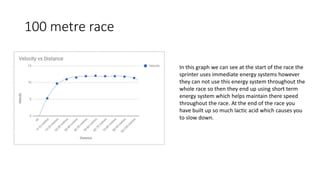
In this graph we can see at the start of the race the
sprinter uses immediate energy systems however
they can not use this energy system throughout the
whole race so then they end up using short term
energy system which helps maintain there speed
throughout the race. At the end of the race you
have built up so much lactic acid which causes you
to slow down.
1500 metre race
• At the start the race the runner will use the immediate energy system
as he will want to get a good position in the race. He will use the
immediate energy system for around 100 meters. From 100 – 1100
meters the runner will start to use his long energy system throughout
this time he is keeping up with the other racers and saving his energy
for the last part of the race. The last 400 meters of the race are
important as this is where the pace starts to pick up so the runners
will use the short term effects. Finally for the last 100 meters they will
use the immediate system as throughout the race this system has
been restored and will use everything that is left to try and win the
race

Energy systems

  • 1.
    Energy Systems (P7,M4, D2) Name callum boyes
  • 2.
    What is energy? •the strength and vitality required for sustained physical or mental activity. In football energy is important as you are able to run, jog, walk and kick the ball around the pitch. However the more we do these actions the more energy we will be using. https://www.google.co.uk/search?q=definition+of+energy&rlz=1C1GCE A_enGB769GB769&oq=definition+of+en&aqs=chrome.2.69i57j0l5.192 59j0j7&sourceid=chrome&ie=UTF-8
  • 3.
    Where do weget energy from? • Energy is produced from the sun. the sun contains chemicals which are then passed on to the plants and the chemicals help the plant grow. Once the plant has grown the animals will start eating the plants as the chemicals in the plant give the animal energy. However once the animal has died we end up taking the chemicals from the animal so we can gain energy. Humans need energy for muscular contractions and movement, circulation, transmissions of nerve impulses, digestion of food and repairing and replacing tissue. If humans didn’t have any energy they would not be able to perform these actions which means they would die.
  • 4.
    ATP(Adenosine triphosphate) • Atpis a complex organic chemical that participates in many processes. Found in all forms of life, ATP is often referred to as the "molecular unit of currency" of intracellular energy transfer. When consumed in metabolic processes, it converts to either the di- or monophosphates, respectively ADP and AMP. Other processes regenerate ATP such that the human body recycles its own body weight equivalent in ATP each day. Atp is very important as it helps the muscles contract so without this then the human isn’t able to do any of the activity's such as run or even kick the ball. • https://en.wikipedia.org/wiki/Adenosine_triphosphate
  • 5.
    The energy systems Thereare 3 energy systems. • Atp-cp • Anaerobic energy system • Aerobic energy system • With out these energy systems we would not be able to do any actions
  • 6.
    ATP-PC System • Whatis it? ATP-PC system consists of adenosine triphosphate (ATP) and phosphocreatine (PC). This energy system provides immediate energy through the breakdown of these stored high energy phosphates. • How is energy made? Phosphocreatine, which is stored in muscle cells, contains a high energy bond. When creatine phosphate is broken down during muscular contraction, a large amount of energy is released. The energy released is coupled with the energy requirement to resynthesize ATP. • How much ATP is produced? Overall there are 38 atp molecules however they are split up there are 2 from glycolysis, 2 from the Krebs cycle and 34 from the electron transport system. • Examples of sports that predominantly use this system A 100 meter sprint would need this system more than the others as they require a faster energy transfer due to faster muscle contractions • Recovery Time 1-4 seconds in the mucles https://www.google.co.uk/search?rlz=1C1GCEA_enGB769GB769&ei=ewsLWqvpJuKWgAb9rLeIAg&q=how+long+does+it+take+to+recover+form+atp&oq= how+long+does+it+take+to+recover+form+atp&gs_l=psy- ab.3..33i22i29i30k1l2.649820.665228.0.666411.45.43.2.0.0.0.115.2333.42j1.43.0....0...1.1.64.psy- ab..0.45.2336...0j0i67k1j0i131k1j0i10i3k1j0i10k1j0i22i30k1.0.5j6vB3bgfSI
  • 7.
    Lactic Acid System •What is it? The lactic acid system is an anaerobic energy system in which the high-energy compound adenosintriphosphate (ATP) is manufactured from the breakdown of glucose to pyruvic acid in the muscle cells. • How is energy made? During high-intensity activities, such as sprint races, lasting up to about two minutes or for the first 40 seconds or so of less intensive exercise • How much ATP is produced? The body has a limited store of about 85 grms of ATP and would use it up very quickly if we did not have ways of resynthesising it. • Examples of sports that predominantly use this system 400 meters and 1500 meters • Recovery Time Around 45 – 120 seconds
  • 8.
    Aerobic Energy System •What is it? The aerobic system produces far more ATP than either of the other energy systems but it produces the ATP much more slowly, therefore it cannot fuel intense exercise that demands the fast production of ATP. • How is energy made? The energy is made through 3 stages called Aerobic glycolysis, Krebs cycle and Electron transport chain. • How much ATP is produced? • 38 atp • Examples of sports that predominantly use this system Long distance running and footballers so then they are able to last the whole 90 minutes • Recovery Time Around 240-600 seconds
  • 9.
    100 metre race Inthis graph we can see at the start of the race the sprinter uses immediate energy systems however they can not use this energy system throughout the whole race so then they end up using short term energy system which helps maintain there speed throughout the race. At the end of the race you have built up so much lactic acid which causes you to slow down.
  • 10.
    1500 metre race •At the start the race the runner will use the immediate energy system as he will want to get a good position in the race. He will use the immediate energy system for around 100 meters. From 100 – 1100 meters the runner will start to use his long energy system throughout this time he is keeping up with the other racers and saving his energy for the last part of the race. The last 400 meters of the race are important as this is where the pace starts to pick up so the runners will use the short term effects. Finally for the last 100 meters they will use the immediate system as throughout the race this system has been restored and will use everything that is left to try and win the race