Energy Systems (P7, M4, D2)
Finn Brown
What is energy?
• The strength and vitality required for sustained physical or mental
activity.
https://www.google.co.uk/search?q=definition+of+energy&rlz=1C1GCEA_enGB771GB771&oq=definition+of+energy&aqs=chrome..69i57j0l5.4647j0j7&sourceid=chro
me&ie=UTF-8
• In football energy helps us to perform at a high level physically and
mentally.
Where do we get energy from?
• Energy mainly comes from the sun which then contributes to
photosynthesis which grows grass for animals like cows which will
then be eaten by us providing us with energy.
• We need energy for muscular contractions and movements,
carbohydrates are important for this. Circulation, transmissions of
nerve impulses, digestion of food which is assisted by fibre and for
repairing and replacing bodily tissues which is assisted by protein.
• If we didn’t have energy in our bodies we wouldn’t be able to
function properly.
ATP
• ATP – or Adenosine Triphosphate – is the primary energy carrier in all living organisms on earth.
Microorganisms capture and store energy metabolized from food and light sources in the form of ATP.
• When the cell requires energy, ATP is broken down through hydrolysis. The high energy bond is broken and a
phosphoryl group is removed. The energy released from this process is used to drive various cellular
processes. ATP is constantly formed and broken down as it participates in biological reactions and it is central
to the health and growth of all life. Without it, cells could not transfer energy from one location to another,
making it impossible for organisms to grow and reproduce.
• https://www.luminultra.com/what-is-atp-and-what-does-it-do/
• For low intensity activities, for example sleeping, working and jogging, and more intense however sustained
activities such as marathon running, the ATP required for muscle contraction is produced primarily by the
aerobic pathway. The rate that ATP is supplied by the aerobic processes is relatively slow, and therefore the
rate of work output is also slow.
• http://www.topendsports.com/medicine/systems.htm
The energy systems
Phosphagen
This system uses creatine phosphate (CP) and has a very rapid rate of ATP production. The creatine phosphate is used to reconstitute
ATP after it’s broken down to release its energy. The total amount of CP and ATP stored in muscles is small, so there is limited energy
available for muscular contraction. It is, however, instantaneously available and is essential at the onset of activity, as well as during
short-term high-intensity activities lasting about 1 to 30 seconds in duration, such as sprinting, weight-lifting or throwing a ball.
Anaerobic Glycolysis
Anaerobic glycolysis does not require oxygen and uses the energy contained in glucose for the formation of ATP. This pathway occurs
within the cytoplasm and breaks glucose down into a simpler component called pyruvate. As an intermediate pathway between the
phosphagen and aerobic system, anaerobic glycolysis can produce ATP quite rapidly for use during activities requiring large bursts of
energy over somewhat longer periods of time (30 seconds to three minutes max, or during endurance activities prior to steady state
being achieved).
Aerobic Glycolysis
This pathway requires oxygen to produce ATP, because carbohydrates and fats are only burned in the presence of oxygen. This
pathway occurs in the mitochondria of the cell and is used for activities requiring sustained energy production. Aerobic glycolysis has
a slow rate of ATP production and is predominantly utilized during longer-duration, lower-intensity activities after the phosphagen
and anaerobic systems have fatigued.
It is important to remember that all three of these systems contribute to the energy needs of the body during physical activity. These
systems do not work independently of each other, but rather dominate at different times, depending on the duration and the
intensity of the activity.
https://www.acefitness.org/fitness-certifications/resource-center/exam-preparation-blog/3256/the-three-primary-energy-pathways-
explained
ATP-PC System
• The ATP-PC system consists of adenosine triphosphate (ATP) and phosphocreatine (PC). This energy system provides
immediate energy through the breakdown of these stored high energy phosphates, if this system becomes full of energy it
will provide energy in maximum intensity, however it will only be for a short period of time (10-15 seconds) before it
fatigues.
1. Initially ATP stored in the myosin cross-bridges (microscopic contractile parts of muscle) is broken down to release
energy for muscle contraction. This leaves the by-products of ATP breakdown: adenosine diphosphate (ADP) and one single
phosphate (Pi) all on its own.
2. Phosphocreatine (PC) is then broken down by the enzyme creatine kinase into Creatine and Pi
3. The energy released in the breakdown of PC allows ADP and Pi to re-join forming more ATP. This newly formed ATP can
now be broken down to release energy to fuel activity.
• Complete oxidation of glucose via glycolysis, the Krebs cycle and the electron transport chain produces 36 molecules of
ATP for every molecule of glucose broken down (Robergs & Roberts 1997).
• The ATP-PC system provides an immediate and intense short burst of energy useful in sports such as 100m sprints,
Powerlifting or throwing events such as the Javelin, Shot Put or Discus throw.
• Once we have depleted our ATP (through a 1 rep max attempt, for example), it takes at least 3 minutes of rest for muscles
to recover the maximum amount possible of ATP and creatine phosphate. After at least 3 minutes have elapsed, your ATP-
PC system will be ready for explosive movements again.
http://www.ptdirect.com/training-design/anatomy-and-physiology/the-atp-pc-system
Lactic Acid System
• The lactic acid system is an anaerobic energy system in which the high-energy compound
adenosintriphosphate (ATP) is manufactured from the breakdown of glucose to pyruvic acid in the
muscle cells.
• The lactic acid system is an anaerobic energy system in which the high-energy compound
adenosintriphosphate (ATP) is manufactured from the breakdown of glucose to pyruvic acid in the
muscle cells. The end product of glycolysis under aerobic conditions is pyruvate, a salt or ester of
pyruvic acid.
• The anaerobic glycolysis (lactic acid) system is dominant from about 10–30 seconds during a
maximal effort. It replenishes very quickly over this period and produces 2 ATP molecules per
glucose molecule, or about 5% of glucose's energy potential (38 ATP molecules).
• The main sport that uses this system is sprints, for example a 100m and 200m sprinter will have
high levels of lactic acid because of how hard they push themselves anaerobically.
• Duration that the system can operate – The lactic acid system lasts between 30 seconds and 3
minutes depending on the intensity.
http://www.ptdirect.com/training-design/anatomy-and-physiology/the-anaerobic-glycolytic
system-fast-glycolysis
Aerobic Energy System
• The aerobic energy system utilises fats, carbohydrate and sometimes proteins for re-synthesising
ATP for energy use. The aerobic system produces a lot more ATP than any other energy systems
but it produces ATP at a much slower rate therefore it cannot fuel intense exercise that requires
the fast production of ATP.
• It produces 34 molecules of ATP for every molecule of glucose that is used.
• The aerobic energy system is used in any kind of activity that we take part in, for example we use
this system when we walk because it puts great stress on our muscles if we can not pump oxygen
through our bodies to aid the muscles in use to enable us to do activities such as walking.
• The recovery time of this system varies on the type of exercise that we have taken part in, for
example if we walked 100 metres it would only take roughly 20 seconds to recover depending on
if we are healthy or not.
http://www.ptdirect.com/training-design/anatomy-and-physiology/the-aerobic-system
100 metre race
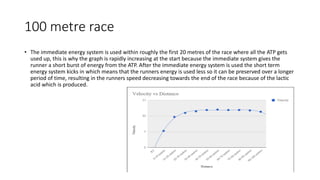
• The immediate energy system is used within roughly the first 20 metres of the race where all the ATP gets
used up, this is why the graph is rapidly increasing at the start because the immediate system gives the
runner a short burst of energy from the ATP. After the immediate energy system is used the short term
energy system kicks in which means that the runners energy is used less so it can be preserved over a longer
period of time, resulting in the runners speed decreasing towards the end of the race because of the lactic
acid which is produced.
1500 metre race
Http://olympicstrackandfield.com/events/1500m
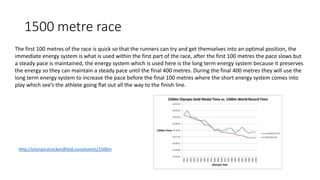
The first 100 metres of the race is quick so that the runners can try and get themselves into an optimal position, the
immediate energy system is what is used within the first part of the race, after the first 100 metres the pace slows but
a steady pace is maintained, the energy system which is used here is the long term energy system because it preserves
the energy so they can maintain a steady pace until the final 400 metres. During the final 400 metres they will use the
long term energy system to increase the pace before the final 100 metres where the short energy system comes into
play which see’s the athlete going flat out all the way to the finish line.
References and Bibliography
• http://www.ptdirect.com/
• http://www.topendsports.com/
• https://www.acefitness.org/
• https://www.luminultra.com/
• http://olympicstrackandfield.com/

Energy systems (p7 m4 d2)

  • 1.
    Energy Systems (P7,M4, D2) Finn Brown
  • 2.
    What is energy? •The strength and vitality required for sustained physical or mental activity. https://www.google.co.uk/search?q=definition+of+energy&rlz=1C1GCEA_enGB771GB771&oq=definition+of+energy&aqs=chrome..69i57j0l5.4647j0j7&sourceid=chro me&ie=UTF-8 • In football energy helps us to perform at a high level physically and mentally.
  • 3.
    Where do weget energy from? • Energy mainly comes from the sun which then contributes to photosynthesis which grows grass for animals like cows which will then be eaten by us providing us with energy. • We need energy for muscular contractions and movements, carbohydrates are important for this. Circulation, transmissions of nerve impulses, digestion of food which is assisted by fibre and for repairing and replacing bodily tissues which is assisted by protein. • If we didn’t have energy in our bodies we wouldn’t be able to function properly.
  • 4.
    ATP • ATP –or Adenosine Triphosphate – is the primary energy carrier in all living organisms on earth. Microorganisms capture and store energy metabolized from food and light sources in the form of ATP. • When the cell requires energy, ATP is broken down through hydrolysis. The high energy bond is broken and a phosphoryl group is removed. The energy released from this process is used to drive various cellular processes. ATP is constantly formed and broken down as it participates in biological reactions and it is central to the health and growth of all life. Without it, cells could not transfer energy from one location to another, making it impossible for organisms to grow and reproduce. • https://www.luminultra.com/what-is-atp-and-what-does-it-do/ • For low intensity activities, for example sleeping, working and jogging, and more intense however sustained activities such as marathon running, the ATP required for muscle contraction is produced primarily by the aerobic pathway. The rate that ATP is supplied by the aerobic processes is relatively slow, and therefore the rate of work output is also slow. • http://www.topendsports.com/medicine/systems.htm
  • 5.
    The energy systems Phosphagen Thissystem uses creatine phosphate (CP) and has a very rapid rate of ATP production. The creatine phosphate is used to reconstitute ATP after it’s broken down to release its energy. The total amount of CP and ATP stored in muscles is small, so there is limited energy available for muscular contraction. It is, however, instantaneously available and is essential at the onset of activity, as well as during short-term high-intensity activities lasting about 1 to 30 seconds in duration, such as sprinting, weight-lifting or throwing a ball. Anaerobic Glycolysis Anaerobic glycolysis does not require oxygen and uses the energy contained in glucose for the formation of ATP. This pathway occurs within the cytoplasm and breaks glucose down into a simpler component called pyruvate. As an intermediate pathway between the phosphagen and aerobic system, anaerobic glycolysis can produce ATP quite rapidly for use during activities requiring large bursts of energy over somewhat longer periods of time (30 seconds to three minutes max, or during endurance activities prior to steady state being achieved). Aerobic Glycolysis This pathway requires oxygen to produce ATP, because carbohydrates and fats are only burned in the presence of oxygen. This pathway occurs in the mitochondria of the cell and is used for activities requiring sustained energy production. Aerobic glycolysis has a slow rate of ATP production and is predominantly utilized during longer-duration, lower-intensity activities after the phosphagen and anaerobic systems have fatigued. It is important to remember that all three of these systems contribute to the energy needs of the body during physical activity. These systems do not work independently of each other, but rather dominate at different times, depending on the duration and the intensity of the activity. https://www.acefitness.org/fitness-certifications/resource-center/exam-preparation-blog/3256/the-three-primary-energy-pathways- explained
  • 6.
    ATP-PC System • TheATP-PC system consists of adenosine triphosphate (ATP) and phosphocreatine (PC). This energy system provides immediate energy through the breakdown of these stored high energy phosphates, if this system becomes full of energy it will provide energy in maximum intensity, however it will only be for a short period of time (10-15 seconds) before it fatigues. 1. Initially ATP stored in the myosin cross-bridges (microscopic contractile parts of muscle) is broken down to release energy for muscle contraction. This leaves the by-products of ATP breakdown: adenosine diphosphate (ADP) and one single phosphate (Pi) all on its own. 2. Phosphocreatine (PC) is then broken down by the enzyme creatine kinase into Creatine and Pi 3. The energy released in the breakdown of PC allows ADP and Pi to re-join forming more ATP. This newly formed ATP can now be broken down to release energy to fuel activity. • Complete oxidation of glucose via glycolysis, the Krebs cycle and the electron transport chain produces 36 molecules of ATP for every molecule of glucose broken down (Robergs & Roberts 1997). • The ATP-PC system provides an immediate and intense short burst of energy useful in sports such as 100m sprints, Powerlifting or throwing events such as the Javelin, Shot Put or Discus throw. • Once we have depleted our ATP (through a 1 rep max attempt, for example), it takes at least 3 minutes of rest for muscles to recover the maximum amount possible of ATP and creatine phosphate. After at least 3 minutes have elapsed, your ATP- PC system will be ready for explosive movements again. http://www.ptdirect.com/training-design/anatomy-and-physiology/the-atp-pc-system
  • 7.
    Lactic Acid System •The lactic acid system is an anaerobic energy system in which the high-energy compound adenosintriphosphate (ATP) is manufactured from the breakdown of glucose to pyruvic acid in the muscle cells. • The lactic acid system is an anaerobic energy system in which the high-energy compound adenosintriphosphate (ATP) is manufactured from the breakdown of glucose to pyruvic acid in the muscle cells. The end product of glycolysis under aerobic conditions is pyruvate, a salt or ester of pyruvic acid. • The anaerobic glycolysis (lactic acid) system is dominant from about 10–30 seconds during a maximal effort. It replenishes very quickly over this period and produces 2 ATP molecules per glucose molecule, or about 5% of glucose's energy potential (38 ATP molecules). • The main sport that uses this system is sprints, for example a 100m and 200m sprinter will have high levels of lactic acid because of how hard they push themselves anaerobically. • Duration that the system can operate – The lactic acid system lasts between 30 seconds and 3 minutes depending on the intensity. http://www.ptdirect.com/training-design/anatomy-and-physiology/the-anaerobic-glycolytic system-fast-glycolysis
  • 8.
    Aerobic Energy System •The aerobic energy system utilises fats, carbohydrate and sometimes proteins for re-synthesising ATP for energy use. The aerobic system produces a lot more ATP than any other energy systems but it produces ATP at a much slower rate therefore it cannot fuel intense exercise that requires the fast production of ATP. • It produces 34 molecules of ATP for every molecule of glucose that is used. • The aerobic energy system is used in any kind of activity that we take part in, for example we use this system when we walk because it puts great stress on our muscles if we can not pump oxygen through our bodies to aid the muscles in use to enable us to do activities such as walking. • The recovery time of this system varies on the type of exercise that we have taken part in, for example if we walked 100 metres it would only take roughly 20 seconds to recover depending on if we are healthy or not. http://www.ptdirect.com/training-design/anatomy-and-physiology/the-aerobic-system
  • 9.
    100 metre race •The immediate energy system is used within roughly the first 20 metres of the race where all the ATP gets used up, this is why the graph is rapidly increasing at the start because the immediate system gives the runner a short burst of energy from the ATP. After the immediate energy system is used the short term energy system kicks in which means that the runners energy is used less so it can be preserved over a longer period of time, resulting in the runners speed decreasing towards the end of the race because of the lactic acid which is produced.
  • 10.
    1500 metre race Http://olympicstrackandfield.com/events/1500m Thefirst 100 metres of the race is quick so that the runners can try and get themselves into an optimal position, the immediate energy system is what is used within the first part of the race, after the first 100 metres the pace slows but a steady pace is maintained, the energy system which is used here is the long term energy system because it preserves the energy so they can maintain a steady pace until the final 400 metres. During the final 400 metres they will use the long term energy system to increase the pace before the final 100 metres where the short energy system comes into play which see’s the athlete going flat out all the way to the finish line.
  • 11.
    References and Bibliography •http://www.ptdirect.com/ • http://www.topendsports.com/ • https://www.acefitness.org/ • https://www.luminultra.com/ • http://olympicstrackandfield.com/