Energy Systems for Exercise
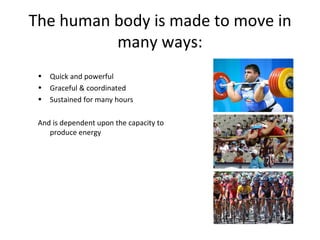
The human body is made to move in many ways: Quick and powerful Graceful & coordinated Sustained for many hours And is dependent upon the capacity to produce energy
Bioenergetics  or the study of energy flow through living systems
No matter what sport you play, your body needs energy for top performance. Energy is supplied to your muscles from the food you eat.  Your body breaks the food down into usable blocks of energy called Adenosine Triphosphate (ATP). ATP is the immediate source of energy for muscle contraction.  Your body makes ATP available for muscle contraction through three main energy systems that are located within the muscle fibres. The energy system used depends on the intensity and duration of the activity.
We have a great amount of diversity Quick movements-lasts a few seconds Reduced speed-lasts for several minutes Reduced intensity(50%)-lasts for several hours The body uses different energy systems for each activity
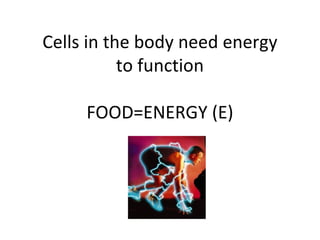
Cells in the body need energy to function FOOD=ENERGY (E)
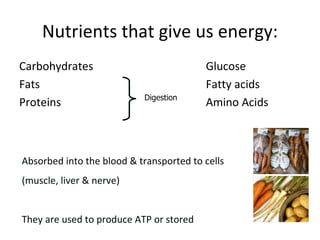
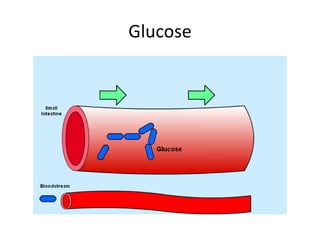
Nutrients that give us energy: Carbohydrates Fats Proteins Glucose Fatty acids Amino Acids Digestion Absorbed into the blood & transported to cells  (muscle, liver & nerve) They are used to produce ATP or stored
Glucose
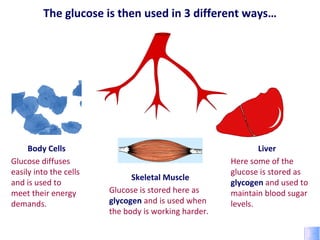
The glucose is then used in 3 different ways… Here some of the glucose is stored as  glycogen  and used to maintain blood sugar levels. Glucose is stored here as  glycogen  and is used when the body is working harder. Glucose diffuses easily into the cells and is used to meet their energy demands. Skeletal Muscle Liver Body Cells
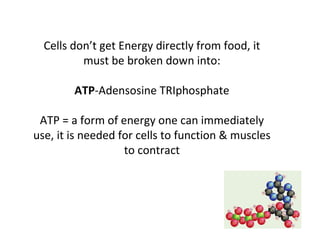
Cells don’t get Energy directly from food, it must be broken down into: ATP -Adensosine TRIphosphate ATP = a form of energy one can immediately use, it is needed for cells to function & muscles to contract
However the body only has enough ATP for 1 explosive act After this there is no ATP left. Muscle Contraction cannot take place. Therefore physical activity can no longer continue.
ATP is stored in small amounts, therefore the rest is stored as: Glucose = Glycogen (muscle & liver) Fatty Acids = Body fat Amino Acids = Growth, repair or excreted as waste
D. Matthews and E. Fox, in their revolutionary book, "The Physiological Basis of Physical Education and Athletics", divided the running requirements of various sports into the following "energy pathways": ATP-CP and LA, LA-02, and 02. ATP - Adenosine Triphosphate : a complex chemical compound formed with the energy released from food and stored in all cells, particularly muscles. Only from the energy released by the breakdown of this compound can the cells perform work. The breakdown of ATP produces energy and ADP. CP - Creatine Phosphate:  a chemical compound stored in muscle, which when broken down aids in the manufacture of ATP. The combination of ADP and CP produces ATP.
3. LA - Lactic acid : a fatiguing metabolite of the lactic acid system resulting from the incomplete breakdown of glucose. However Noakes in South Africa has discovered that although excessive lactate production is part of the extreme fatigue process, it is the protons produced at the same time that restrict further performance 4 .  O2  means aerobic running in which ATP is manufactured from food mainly sugar and fat. This system produces ATP copiously and is the prime energy source during endurance activities
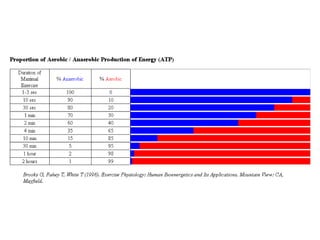
The 4 Systems 1. ATP-PCr System The ATP-PCr (Adenosine Triphosphate Phospho-Creatine) system is predominant in maximal or super-maximal activities lasting up to 20 seconds.  As the duration of activity increases the ATP-PCr system provides a smaller portion of total energy.   The ATP-PCr system is utilized during the transition from rest to exercise, and also during the transition from one exercise intensity to a higher intensity.  A period of 30 seconds to 3 minutes is needed to replenish the energy in this system, however, during aerobic exercise ATP-PCr reserves can be restored.    
2. Anaerobic Glycolysis As the ATP-PCr system begins to fade after around ten seconds, a process known as Anaerobic Glycolysis begins to occur.  Anaerobic Glycolysis is the primary energy source in activities lasting between 20 seconds and two minutes.   Anaerobic Glycolysis continues to supply energy during exercise lasting up to ten minutes.  This system breaks down muscle and liver glycogen stores without the use of oxygen.  The byproduct of this system is lactic acid. After about five minutes of exercise, Aerobic Glycolysis is the dominant energy system.  Aerobic Glycolysis produces energy by breaking down muscle and liver glycogen stores with oxygen present.  Because oxygen is present when this system is in use, there is no build up of lactic acid.  This system does not produce energy as fast as the ATP-PCr system or  Anaerobic Glycolysis thus the intensity of exercise cannot be as high.  This system has the capacity to produce energy for an hour or more.
So... There are two types of anaerobic energy systems, the ATP-CP energy system, which uses creatine phosphate as the main energy source, and the lactic acid (or anaerobic glycolysis) system that uses glucose (or glycogen) in the absence of oxygen. Events or activity that last up to about thirty seconds rely primarily on the former, phosphagen, system. Beyond this time aerobic and anaerobic glycolysis begin to predominate.  Anaerobic glycolysis uses glucose inefficiently, and produces by-products such as lactic acid that are thought to be detrimental to muscle function; this limits activity based predominantly on anaerobic glycolysis to about 2 minutes.
Lactate threshold (LIP or Lactate Inflection Point) The lactate threshold (LT) is the exercise intensity at which lactic acid starts to accumulate in the blood stream. This happens when it is produced faster than it can be removed (metabolized). This point is sometimes referred to as the anaerobic threshold (AT), or the onset of blood lactate accumulation (OBLA).  When exercising below the LT intensity any lactate produced by the muscles is removed by the body without it building up. The lactate threshold is a useful measure for deciding exercise intensity for training and racing in endurance sports (e.g. long distance running, cycling, rowing, swimming, motocross, and cross country skiing), and can be increased greatly with training.
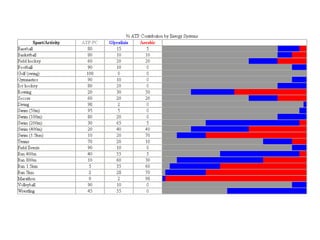
3. Oxidative Phosphorylation Oxidative Phosphorylation provides the body with energy during exercise of long duration and moderate to low intensity.  This system breaks down the bodies fat stores to supply energy to working muscles.   As the intensity of exercise decreases, the body relies more on this energy system.  This energy system can supply virtually unlimited supplies of energy.  Endurance sports such as cross-country running, swimming, soccer and lacrosse all rely heavily on this system. However, speed and power can often be the determining factor in winning and losing. Therefore careful attention must be paid to developing both energy systems to achieve top performance.
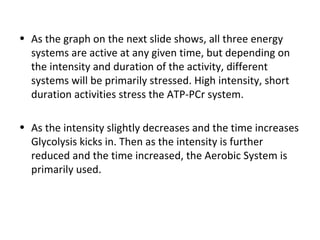
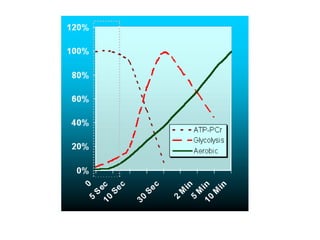
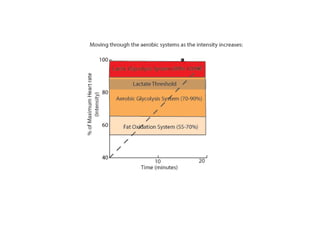
As the graph on the next slide shows, all three energy systems are active at any given time, but depending on the intensity and duration of the activity, different systems will be primarily stressed. High intensity, short duration activities stress the ATP-PCr system.  As the intensity slightly decreases and the time increases Glycolysis kicks in. Then as the intensity is further reduced and the time increased, the Aerobic System is primarily used.


ATP-CP Energy System ATP is stored in the muscle & liver for “Quick Energy” Nerve impulses trigger breakdown of ATP into ADP ADP = Adenosine Diphosphate & 1 Phosphate The splitting of the Phosphate bond = Energy for work Ex.  Muscle Contraction, Moving hand from a hot stove, Jumping & Throwing
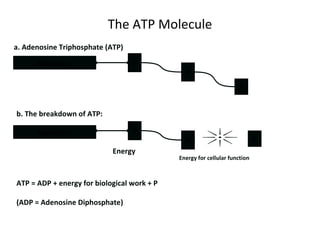
The ATP Molecule Adenosine Adenosine Energy a. Adenosine Triphosphate (ATP) b. The breakdown of ATP: P P P P P P ATP = ADP + energy for biological work + P (ADP = Adenosine Diphosphate) Energy for cellular function
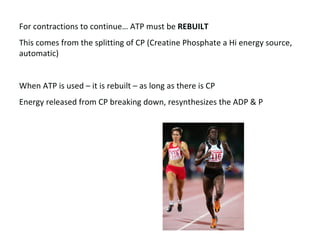
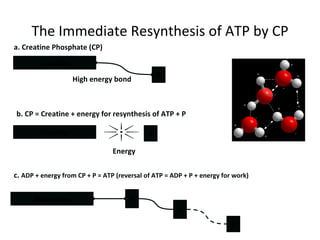
For contractions to continue… ATP must be  REBUILT   This comes from the splitting of CP (Creatine Phosphate a Hi energy source, automatic)  When ATP is used – it is rebuilt – as long as there is CP Energy released from CP breaking down, resynthesizes the ADP & P
REMEMBER – only small amounts of ATP are stored = only 2-3 sec. of Energy ATP-CP = 8-10 sec. of Energy The usefulness isn’t the  AMOUNT  of Energy but the  QUICK & POWERFUL  movements For longer periods of work  = The Aerobic & Anaerobic Energy System must be utilized
The Immediate Resynthesis of ATP by CP Creatine P Creatine P Energy High energy bond a. Creatine Phosphate (CP) b. CP = Creatine + energy for resynthesis of ATP +   P Adenosine P P P c.  ADP + energy from CP + P = ATP (reversal of ATP = ADP + P + energy for work)
Anaerobic Energy System Without oxygen = Activities that require a large burst of energy over a short period of time Anaerobic Glycolysis = Production of ATP from Carbohydrates without oxygen (breakdown of glucose)
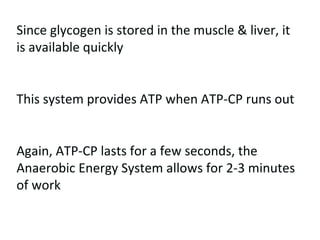
Since glycogen is stored in the muscle & liver, it is available quickly This system provides ATP when ATP-CP runs out Again, ATP-CP lasts for a few seconds, the Anaerobic Energy System allows for 2-3 minutes of work
The process to produce ATP is not as fast as ATP-CP, which makes muscle contraction slower When oxygen is not present the end product of glycolisis is  lactic acid,  which causes the muscles to fatigue Anaerobic Glycolisis is less efficient in producing ATP than Aerobic Glycolisis, BUT is needed for a large burst of energy lasting a few minutes
Oxygen Deficit  = The body can not supply enough O2 to the muscles that the muscles demand When the muscle does not get enough oxygen, exhaustion is reached causing immediate and involuntary reduction in intensity Oxygen Debt  = “pays back” the deficit   recovery time
Aerobic Energy System With Oxygen = Using large muscle groups continuously over a period of time Aerobic Glycolisis & Fatty Acid Oxidation = The production of ATP from Carbohydrates & Fat
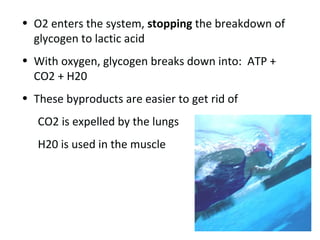
O2 enters the system,  stopping  the breakdown of glycogen to lactic acid  With oxygen, glycogen breaks down into:  ATP + CO2 + H20 These byproducts are easier to get rid of  CO2 is expelled by the lungs H20 is used in the muscle
4. Anaerobic Energy System =  Carbohydrates are the only fuel source 5. With prolonged exercise, Carbohydrates are the first fuel choice, as exercise continues, FAT becomes predominant 6. Protein is not a main fuel source except  in an emergency
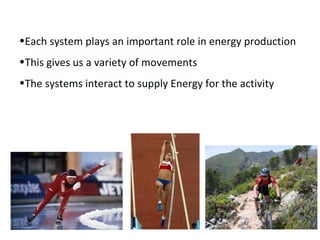
Each system plays an important role in energy production This gives us a variety of movements The systems interact to supply Energy for the activity
 
 
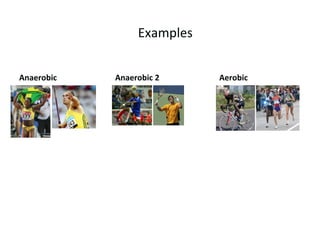
Examples Anaerobic Anaerobic 2    Aerobic
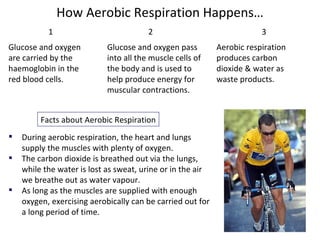
Facts about Aerobic Respiration How Aerobic Respiration Happens… Glucose and oxygen are carried by the haemoglobin in the  red blood cells. Glucose and oxygen pass into all the muscle cells of the body and is used to help produce energy for muscular contractions. Aerobic respiration produces carbon dioxide & water as waste products.   During aerobic respiration, the heart and lungs supply the muscles with plenty of oxygen. The carbon dioxide is breathed out via the lungs, while the water is lost as sweat, urine or in the air we breathe out as water vapour. As long as the muscles are supplied with enough oxygen, exercising aerobically can be carried out for a long period of time. 1 2 3
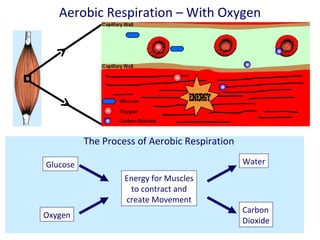
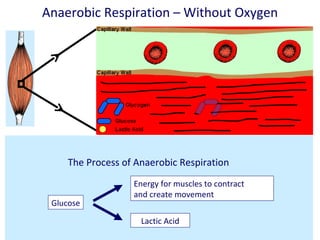
Aerobic Respiration – With Oxygen 1. Glucose  and  oxygen  are transported to the working muscles by the blood. Aerobic respiration involves the release of energy from the   slow   breakdown of glucose   using   oxygen,   inside the cells. 2. Glucose and oxygen are then used by the muscles of the body to produce energy. 3. This process creates  carbon dioxide  and  water. 4. The carbon dioxide passes back into the blood for removal. The Process of Aerobic Respiration  Energy for Muscles to contract and create Movement Water Carbon Dioxide Glucose Oxygen
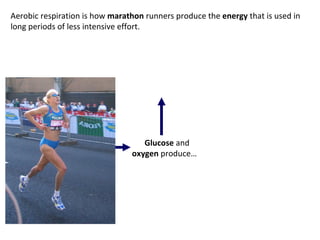
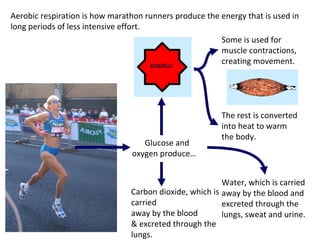
Aerobic respiration is how  marathon  runners produce the  energy  that is used in long periods of less intensive effort. Glucose  and  oxygen  produce…
Aerobic respiration is how  marathon  runners produce the  energy  that is used in long periods of less intensive effort. Glucose  and  oxygen  produce… Some is used for muscle contractions, creating movement.
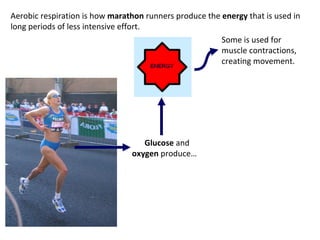
Aerobic respiration is how marathon runners produce the energy that is used in long periods of less intensive effort. Glucose and  oxygen produce… Carbon dioxide, which is carried away by the blood & excreted through the lungs. Water, which is carried away by the blood and excreted through the lungs, sweat and urine.  Some is used for muscle contractions, creating movement. The rest is converted  into heat to warm the body.
Anaerobic respiration involves the release of a little energy, very quickly from the incomplete breakdown of glucose without using   oxygen,   inside the cells. 1. Glucose is made available by the breakdown of glycogen stored in the working muscles. 2.  The glucose is used by the muscles of the body to produce energy, without the use of oxygen. 3.  This process creates lactic acid, which passes back into the blood for removal. Anaerobic Respiration – Without Oxygen The Process of Anaerobic Respiration Glucose Energy for muscles to contract and create movement Lactic Acid
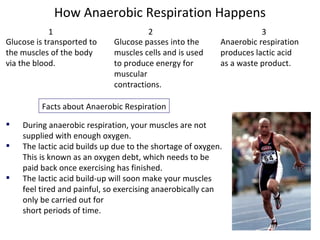
Glucose is transported to the muscles of the body via the blood. How Anaerobic Respiration Happens Glucose passes into the muscles cells and is used to produce energy for muscular contractions. Anaerobic respiration produces lactic acid as a waste product. Facts about Anaerobic Respiration During anaerobic respiration, your muscles are not supplied with enough oxygen. The lactic acid builds up due to the shortage of oxygen. This is known as an oxygen debt, which needs to be paid back once exercising has finished. The lactic acid build-up will soon make your muscles feel tired and painful, so exercising anaerobically can only be carried out for short periods of time. 1 2 3
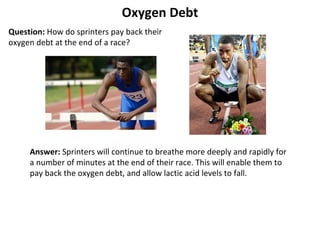
Oxygen Debt Question:  How do sprinters pay back their oxygen debt at the end of a race? Answer:  Sprinters will continue to breathe more deeply and rapidly for a number of minutes at the end of their race. This will enable them to pay back the oxygen debt, and allow lactic acid levels to fall.
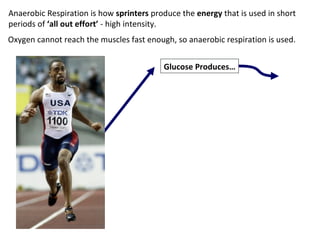
Anaerobic Respiration is how  sprinters  produce the  energy  that is used in short periods of  ‘all   out   effort’  - high intensity. Glucose Produces… Oxygen cannot reach the muscles fast enough, so anaerobic respiration is used.
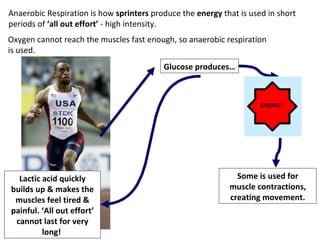
Anaerobic Respiration is how  sprinters  produce the  energy  that is used in short periods of  ‘all   out   effort’  - high intensity. Glucose produces… Lactic acid quickly builds up & makes the muscles feel tired & painful. ‘All out effort’ cannot last for very long!  Oxygen cannot reach the muscles fast enough, so anaerobic respiration is used. Some is used for muscle contractions, creating movement.
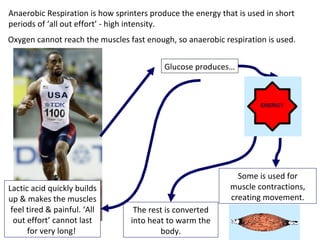
Anaerobic Respiration is how sprinters produce the energy that is used in short periods of ‘all out effort’ - high intensity. Glucose produces… Lactic acid quickly builds up & makes the muscles feel tired & painful. ‘All out effort’ cannot last for very long!  The rest is converted into heat to warm the body. Oxygen cannot reach the muscles fast enough, so anaerobic respiration is used. Some is used for muscle contractions, creating movement.

Lesson 11[1 St Dec 2008]

  • 1.
  • 2.
    The human bodyis made to move in many ways: Quick and powerful Graceful & coordinated Sustained for many hours And is dependent upon the capacity to produce energy
  • 3.
    Bioenergetics orthe study of energy flow through living systems
  • 4.
    No matter whatsport you play, your body needs energy for top performance. Energy is supplied to your muscles from the food you eat. Your body breaks the food down into usable blocks of energy called Adenosine Triphosphate (ATP). ATP is the immediate source of energy for muscle contraction. Your body makes ATP available for muscle contraction through three main energy systems that are located within the muscle fibres. The energy system used depends on the intensity and duration of the activity.
  • 5.
    We have agreat amount of diversity Quick movements-lasts a few seconds Reduced speed-lasts for several minutes Reduced intensity(50%)-lasts for several hours The body uses different energy systems for each activity
  • 6.
    Cells in thebody need energy to function FOOD=ENERGY (E)
  • 7.
    Nutrients that giveus energy: Carbohydrates Fats Proteins Glucose Fatty acids Amino Acids Digestion Absorbed into the blood & transported to cells (muscle, liver & nerve) They are used to produce ATP or stored
  • 8.
  • 9.
    The glucose isthen used in 3 different ways… Here some of the glucose is stored as glycogen and used to maintain blood sugar levels. Glucose is stored here as glycogen and is used when the body is working harder. Glucose diffuses easily into the cells and is used to meet their energy demands. Skeletal Muscle Liver Body Cells
  • 10.
    Cells don’t getEnergy directly from food, it must be broken down into: ATP -Adensosine TRIphosphate ATP = a form of energy one can immediately use, it is needed for cells to function & muscles to contract
  • 11.
    However the bodyonly has enough ATP for 1 explosive act After this there is no ATP left. Muscle Contraction cannot take place. Therefore physical activity can no longer continue.
  • 12.
    ATP is storedin small amounts, therefore the rest is stored as: Glucose = Glycogen (muscle & liver) Fatty Acids = Body fat Amino Acids = Growth, repair or excreted as waste
  • 13.
    D. Matthews andE. Fox, in their revolutionary book, "The Physiological Basis of Physical Education and Athletics", divided the running requirements of various sports into the following "energy pathways": ATP-CP and LA, LA-02, and 02. ATP - Adenosine Triphosphate : a complex chemical compound formed with the energy released from food and stored in all cells, particularly muscles. Only from the energy released by the breakdown of this compound can the cells perform work. The breakdown of ATP produces energy and ADP. CP - Creatine Phosphate: a chemical compound stored in muscle, which when broken down aids in the manufacture of ATP. The combination of ADP and CP produces ATP.
  • 14.
    3. LA -Lactic acid : a fatiguing metabolite of the lactic acid system resulting from the incomplete breakdown of glucose. However Noakes in South Africa has discovered that although excessive lactate production is part of the extreme fatigue process, it is the protons produced at the same time that restrict further performance 4 . O2 means aerobic running in which ATP is manufactured from food mainly sugar and fat. This system produces ATP copiously and is the prime energy source during endurance activities
  • 15.
    The 4 Systems1. ATP-PCr System The ATP-PCr (Adenosine Triphosphate Phospho-Creatine) system is predominant in maximal or super-maximal activities lasting up to 20 seconds.  As the duration of activity increases the ATP-PCr system provides a smaller portion of total energy.  The ATP-PCr system is utilized during the transition from rest to exercise, and also during the transition from one exercise intensity to a higher intensity.  A period of 30 seconds to 3 minutes is needed to replenish the energy in this system, however, during aerobic exercise ATP-PCr reserves can be restored.    
  • 16.
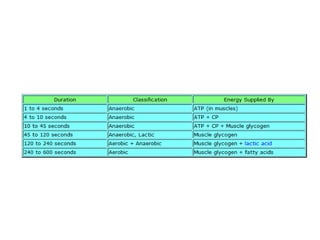
    2. Anaerobic GlycolysisAs the ATP-PCr system begins to fade after around ten seconds, a process known as Anaerobic Glycolysis begins to occur.  Anaerobic Glycolysis is the primary energy source in activities lasting between 20 seconds and two minutes.  Anaerobic Glycolysis continues to supply energy during exercise lasting up to ten minutes.  This system breaks down muscle and liver glycogen stores without the use of oxygen.  The byproduct of this system is lactic acid. After about five minutes of exercise, Aerobic Glycolysis is the dominant energy system.  Aerobic Glycolysis produces energy by breaking down muscle and liver glycogen stores with oxygen present.  Because oxygen is present when this system is in use, there is no build up of lactic acid.  This system does not produce energy as fast as the ATP-PCr system or Anaerobic Glycolysis thus the intensity of exercise cannot be as high.  This system has the capacity to produce energy for an hour or more.
  • 17.
    So... There aretwo types of anaerobic energy systems, the ATP-CP energy system, which uses creatine phosphate as the main energy source, and the lactic acid (or anaerobic glycolysis) system that uses glucose (or glycogen) in the absence of oxygen. Events or activity that last up to about thirty seconds rely primarily on the former, phosphagen, system. Beyond this time aerobic and anaerobic glycolysis begin to predominate. Anaerobic glycolysis uses glucose inefficiently, and produces by-products such as lactic acid that are thought to be detrimental to muscle function; this limits activity based predominantly on anaerobic glycolysis to about 2 minutes.
  • 18.
    Lactate threshold (LIPor Lactate Inflection Point) The lactate threshold (LT) is the exercise intensity at which lactic acid starts to accumulate in the blood stream. This happens when it is produced faster than it can be removed (metabolized). This point is sometimes referred to as the anaerobic threshold (AT), or the onset of blood lactate accumulation (OBLA). When exercising below the LT intensity any lactate produced by the muscles is removed by the body without it building up. The lactate threshold is a useful measure for deciding exercise intensity for training and racing in endurance sports (e.g. long distance running, cycling, rowing, swimming, motocross, and cross country skiing), and can be increased greatly with training.
  • 19.
    3. Oxidative PhosphorylationOxidative Phosphorylation provides the body with energy during exercise of long duration and moderate to low intensity.  This system breaks down the bodies fat stores to supply energy to working muscles.  As the intensity of exercise decreases, the body relies more on this energy system.  This energy system can supply virtually unlimited supplies of energy.  Endurance sports such as cross-country running, swimming, soccer and lacrosse all rely heavily on this system. However, speed and power can often be the determining factor in winning and losing. Therefore careful attention must be paid to developing both energy systems to achieve top performance.
  • 20.
    As the graphon the next slide shows, all three energy systems are active at any given time, but depending on the intensity and duration of the activity, different systems will be primarily stressed. High intensity, short duration activities stress the ATP-PCr system. As the intensity slightly decreases and the time increases Glycolysis kicks in. Then as the intensity is further reduced and the time increased, the Aerobic System is primarily used.
  • 21.
  • 22.
  • 23.
  • 24.
    ATP-CP Energy SystemATP is stored in the muscle & liver for “Quick Energy” Nerve impulses trigger breakdown of ATP into ADP ADP = Adenosine Diphosphate & 1 Phosphate The splitting of the Phosphate bond = Energy for work Ex. Muscle Contraction, Moving hand from a hot stove, Jumping & Throwing
  • 25.
    The ATP MoleculeAdenosine Adenosine Energy a. Adenosine Triphosphate (ATP) b. The breakdown of ATP: P P P P P P ATP = ADP + energy for biological work + P (ADP = Adenosine Diphosphate) Energy for cellular function
  • 26.
    For contractions tocontinue… ATP must be REBUILT This comes from the splitting of CP (Creatine Phosphate a Hi energy source, automatic) When ATP is used – it is rebuilt – as long as there is CP Energy released from CP breaking down, resynthesizes the ADP & P
  • 27.
    REMEMBER – onlysmall amounts of ATP are stored = only 2-3 sec. of Energy ATP-CP = 8-10 sec. of Energy The usefulness isn’t the AMOUNT of Energy but the QUICK & POWERFUL movements For longer periods of work = The Aerobic & Anaerobic Energy System must be utilized
  • 28.
    The Immediate Resynthesisof ATP by CP Creatine P Creatine P Energy High energy bond a. Creatine Phosphate (CP) b. CP = Creatine + energy for resynthesis of ATP + P Adenosine P P P c. ADP + energy from CP + P = ATP (reversal of ATP = ADP + P + energy for work)
  • 29.
    Anaerobic Energy SystemWithout oxygen = Activities that require a large burst of energy over a short period of time Anaerobic Glycolysis = Production of ATP from Carbohydrates without oxygen (breakdown of glucose)
  • 30.
    Since glycogen isstored in the muscle & liver, it is available quickly This system provides ATP when ATP-CP runs out Again, ATP-CP lasts for a few seconds, the Anaerobic Energy System allows for 2-3 minutes of work
  • 31.
    The process toproduce ATP is not as fast as ATP-CP, which makes muscle contraction slower When oxygen is not present the end product of glycolisis is lactic acid, which causes the muscles to fatigue Anaerobic Glycolisis is less efficient in producing ATP than Aerobic Glycolisis, BUT is needed for a large burst of energy lasting a few minutes
  • 32.
    Oxygen Deficit = The body can not supply enough O2 to the muscles that the muscles demand When the muscle does not get enough oxygen, exhaustion is reached causing immediate and involuntary reduction in intensity Oxygen Debt = “pays back” the deficit recovery time
  • 33.
    Aerobic Energy SystemWith Oxygen = Using large muscle groups continuously over a period of time Aerobic Glycolisis & Fatty Acid Oxidation = The production of ATP from Carbohydrates & Fat
  • 34.
    O2 enters thesystem, stopping the breakdown of glycogen to lactic acid With oxygen, glycogen breaks down into: ATP + CO2 + H20 These byproducts are easier to get rid of CO2 is expelled by the lungs H20 is used in the muscle
  • 35.
    4. Anaerobic EnergySystem = Carbohydrates are the only fuel source 5. With prolonged exercise, Carbohydrates are the first fuel choice, as exercise continues, FAT becomes predominant 6. Protein is not a main fuel source except in an emergency
  • 36.
    Each system playsan important role in energy production This gives us a variety of movements The systems interact to supply Energy for the activity
  • 37.
  • 38.
  • 39.
  • 40.
    Facts about AerobicRespiration How Aerobic Respiration Happens… Glucose and oxygen are carried by the haemoglobin in the red blood cells. Glucose and oxygen pass into all the muscle cells of the body and is used to help produce energy for muscular contractions. Aerobic respiration produces carbon dioxide & water as waste products. During aerobic respiration, the heart and lungs supply the muscles with plenty of oxygen. The carbon dioxide is breathed out via the lungs, while the water is lost as sweat, urine or in the air we breathe out as water vapour. As long as the muscles are supplied with enough oxygen, exercising aerobically can be carried out for a long period of time. 1 2 3
  • 41.
    Aerobic Respiration –With Oxygen 1. Glucose and oxygen are transported to the working muscles by the blood. Aerobic respiration involves the release of energy from the slow breakdown of glucose using oxygen, inside the cells. 2. Glucose and oxygen are then used by the muscles of the body to produce energy. 3. This process creates carbon dioxide and water. 4. The carbon dioxide passes back into the blood for removal. The Process of Aerobic Respiration Energy for Muscles to contract and create Movement Water Carbon Dioxide Glucose Oxygen
  • 42.
    Aerobic respiration ishow marathon runners produce the energy that is used in long periods of less intensive effort. Glucose and oxygen produce…
  • 43.
    Aerobic respiration ishow marathon runners produce the energy that is used in long periods of less intensive effort. Glucose and oxygen produce… Some is used for muscle contractions, creating movement.
  • 44.
    Aerobic respiration ishow marathon runners produce the energy that is used in long periods of less intensive effort. Glucose and oxygen produce… Carbon dioxide, which is carried away by the blood & excreted through the lungs. Water, which is carried away by the blood and excreted through the lungs, sweat and urine. Some is used for muscle contractions, creating movement. The rest is converted into heat to warm the body.
  • 45.
    Anaerobic respiration involvesthe release of a little energy, very quickly from the incomplete breakdown of glucose without using oxygen, inside the cells. 1. Glucose is made available by the breakdown of glycogen stored in the working muscles. 2. The glucose is used by the muscles of the body to produce energy, without the use of oxygen. 3. This process creates lactic acid, which passes back into the blood for removal. Anaerobic Respiration – Without Oxygen The Process of Anaerobic Respiration Glucose Energy for muscles to contract and create movement Lactic Acid
  • 46.
    Glucose is transportedto the muscles of the body via the blood. How Anaerobic Respiration Happens Glucose passes into the muscles cells and is used to produce energy for muscular contractions. Anaerobic respiration produces lactic acid as a waste product. Facts about Anaerobic Respiration During anaerobic respiration, your muscles are not supplied with enough oxygen. The lactic acid builds up due to the shortage of oxygen. This is known as an oxygen debt, which needs to be paid back once exercising has finished. The lactic acid build-up will soon make your muscles feel tired and painful, so exercising anaerobically can only be carried out for short periods of time. 1 2 3
  • 47.
    Oxygen Debt Question: How do sprinters pay back their oxygen debt at the end of a race? Answer: Sprinters will continue to breathe more deeply and rapidly for a number of minutes at the end of their race. This will enable them to pay back the oxygen debt, and allow lactic acid levels to fall.
  • 48.
    Anaerobic Respiration ishow sprinters produce the energy that is used in short periods of ‘all out effort’ - high intensity. Glucose Produces… Oxygen cannot reach the muscles fast enough, so anaerobic respiration is used.
  • 49.
    Anaerobic Respiration ishow sprinters produce the energy that is used in short periods of ‘all out effort’ - high intensity. Glucose produces… Lactic acid quickly builds up & makes the muscles feel tired & painful. ‘All out effort’ cannot last for very long! Oxygen cannot reach the muscles fast enough, so anaerobic respiration is used. Some is used for muscle contractions, creating movement.
  • 50.
    Anaerobic Respiration ishow sprinters produce the energy that is used in short periods of ‘all out effort’ - high intensity. Glucose produces… Lactic acid quickly builds up & makes the muscles feel tired & painful. ‘All out effort’ cannot last for very long! The rest is converted into heat to warm the body. Oxygen cannot reach the muscles fast enough, so anaerobic respiration is used. Some is used for muscle contractions, creating movement.