New Stage 6
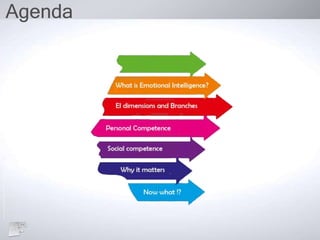
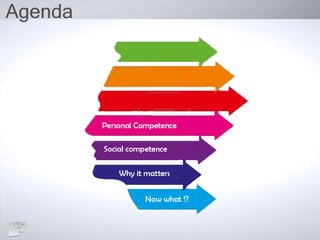
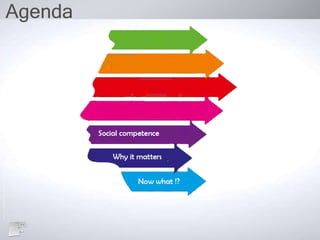
Agenda
What is intelligence ?
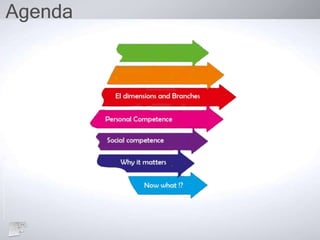
Agenda
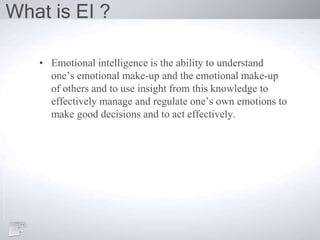
What is EI ?
• Emotional intelligence is the ability to understand
one’s emotional make-up and the emotional make-up
of others and to use insight from this knowledge to
effectively manage and regulate one’s own emotions to
make good decisions and to act effectively.
Agenda
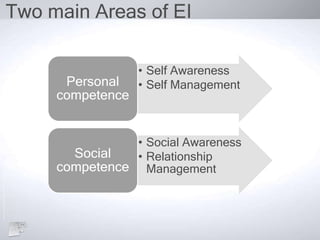
Two main Areas of EI
• Self Awareness
• Self ManagementPersonal
competence
• Social Awareness
• Relationship
Management
Social
competence
Agenda
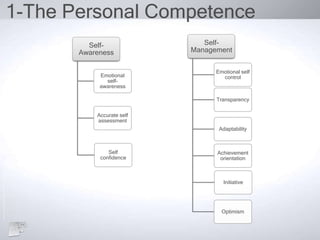
1-The Personal Competence
Self-
Awareness
Emotional
self-
awareness
Accurate self
assessment
Self
confidence
Self-
Management
Emotional self
control
Transparency
Adaptability
Achievement
orientation
Initiative
Optimism
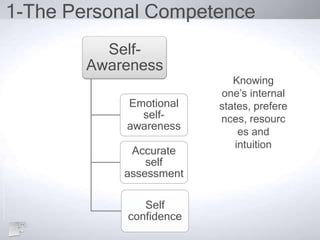
1-The Personal Competence
Self-
Awareness
Emotional
self-
awareness
Accurate
self
assessment
Self
confidence
Knowing
one’s internal
states, prefere
nces, resourc
es and
intuition
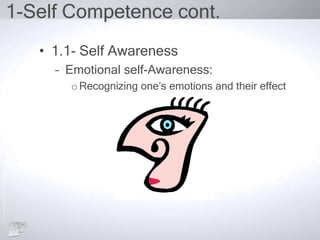
1-Self Competence cont.
• 1.1- Self Awareness
– Emotional self-Awareness:
oRecognizing one’s emotions and their effect
1-Self Competence cont.
• 1.1- Self Awareness
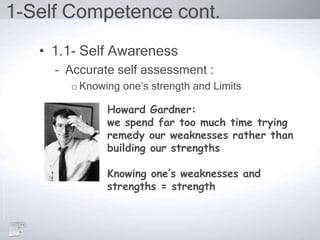
– Accurate self assessment :
oKnowing one’s strength and Limits
Howard Gardner:
we spend far too much time trying
remedy our weaknesses rather than
building our strengths
Knowing one’s weaknesses and
strengths = strength
1-Self Competence cont.
• 1.1- Self Awareness
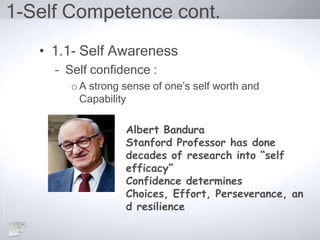
– Self confidence :
oA strong sense of one’s self worth and
Capability
Albert Bandura
Stanford Professor has done
decades of research into “self
efficacy”
Confidence determines
Choices, Effort, Perseverance, an
d resilience
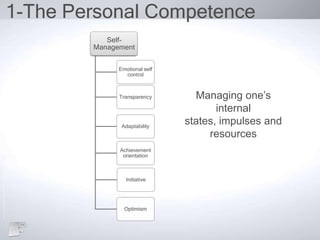
1-The Personal Competence
Self-
Management
Emotional self
control
Transparency
Adaptability
Achievement
orientation
Initiative
Optimism
Managing one’s
internal
states, impulses and
resources
1-Self Competence cont.
• 1.2- Self Management
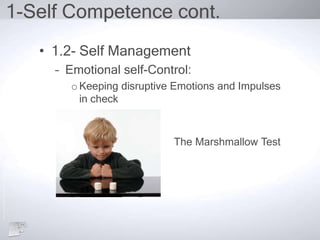
– Emotional self-Control:
oKeeping disruptive Emotions and Impulses
in check
The Marshmallow Test
1-Self Competence cont.
• 1.2- Self Management
– Transparency:
oMaintaining integrity .
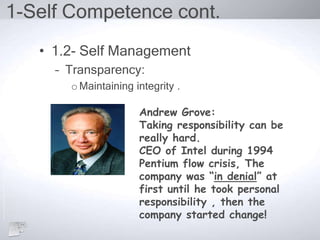
Andrew Grove:
Taking responsibility can be
really hard.
CEO of Intel during 1994
Pentium flow crisis, The
company was “in denial” at
first until he took personal
responsibility , then the
company started change!
1-Self Competence cont.
• 1.2- Self Management
– Adaptability
oFlexibility in Handling change
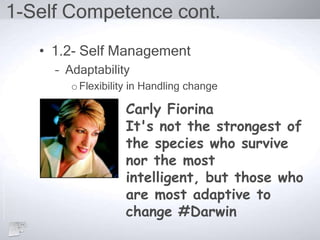
Carly Fiorina
It's not the strongest of
the species who survive
nor the most
intelligent, but those who
are most adaptive to
change #Darwin
1-Self Competence cont.
• 1.2- Self Management
– Achievement Drive
o Set challenging goals and take calculated risks
1-Self Competence cont.
• 1.2- Self Management
– Initiative
oReadiness to act upon opportunity
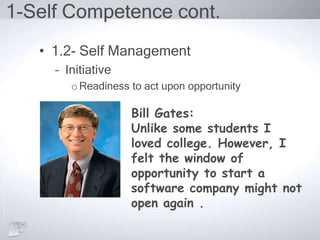
Bill Gates:
Unlike some students I
loved college. However, I
felt the window of
opportunity to start a
software company might not
open again .
1-Self Competence cont.
• 1.2- Self Management
– Optimism
oPersistence in pursuing goals despite
obstacles and setbacks
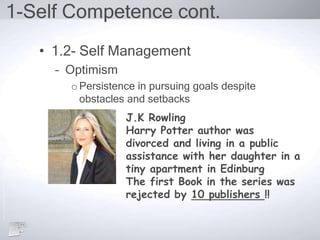
J.K Rowling
Harry Potter author was
divorced and living in a public
assistance with her daughter in a
tiny apartment in Edinburg
The first Book in the series was
rejected by 10 publishers !!
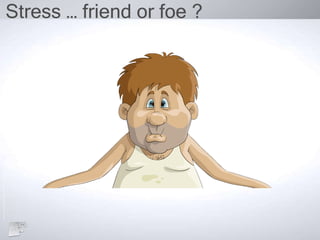
Stress … friend or foe ?
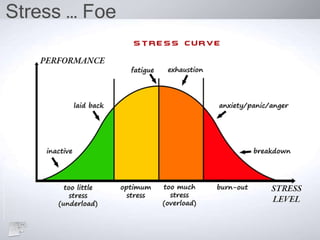
Stress … Foe
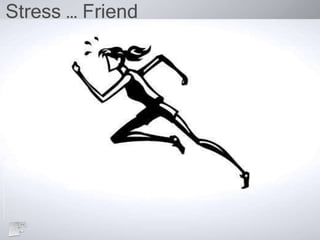
Stress … Friend
Agenda
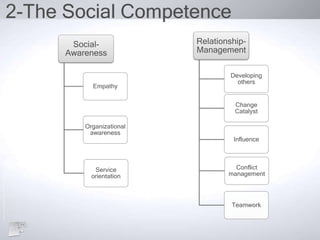
2-The Social Competence
Social-
Awareness
Empathy
Organizational
awareness
Service
orientation
Relationship-
Management
Developing
others
Change
Catalyst
Influence
Conflict
management
Teamwork
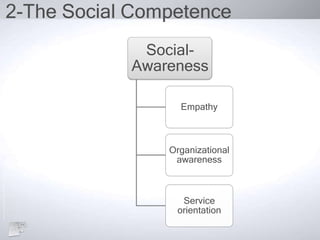
2-The Social Competence
Social-
Awareness
Empathy
Organizational
awareness
Service
orientation
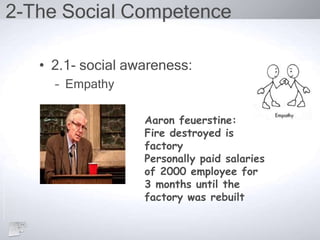
2-The Social Competence
• 2.1- social awareness:
– Empathy
Aaron feuerstine:
Fire destroyed is
factory
Personally paid salaries
of 2000 employee for
3 months until the
factory was rebuilt
2-The Social Competence
• 2.1- social awareness:
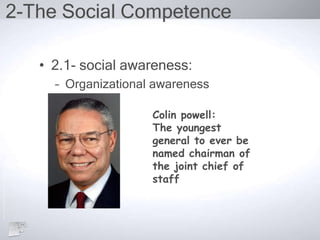
– Organizational awareness
Colin powell:
The youngest
general to ever be
named chairman of
the joint chief of
staff
2-The Social Competence
• 2.1- social awareness:
– Service orientation: Anticipating and
recognizing client needs.
2-The Social Competence
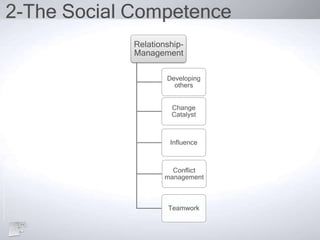
Relationship-
Management
Developing
others
Change
Catalyst
Influence
Conflict
management
Teamwork
2-The Social Competence
• 2.2- Relationship management:
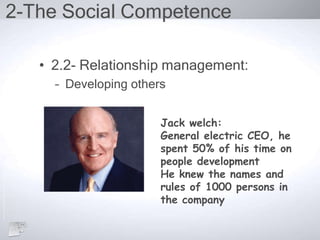
– Developing others
Jack welch:
General electric CEO, he
spent 50% of his time on
people development
He knew the names and
rules of 1000 persons in
the company
2-The Social Competence
• 2.2- Relationship management:
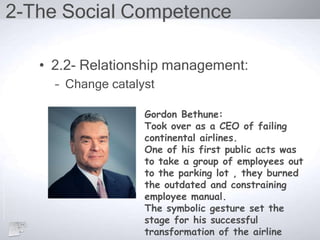
– Change catalyst
Gordon Bethune:
Took over as a CEO of failing
continental airlines.
One of his first public acts was
to take a group of employees out
to the parking lot , they burned
the outdated and constraining
employee manual.
The symbolic gesture set the
stage for his successful
transformation of the airline
2-The Social Competence
• 2.2- Relationship management:
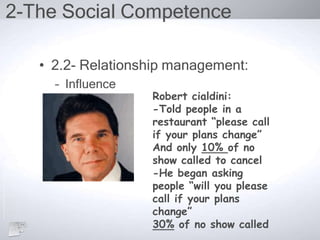
– Influence
Robert cialdini:
-Told people in a
restaurant “please call
if your plans change”
And only 10% of no
show called to cancel
-He began asking
people “will you please
call if your plans
change”
30% of no show called
2-The Social Competence
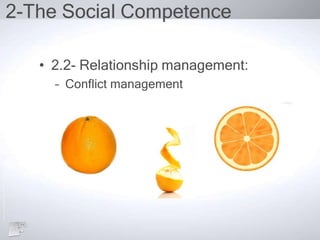
• 2.2- Relationship management:
– Conflict management
2-The Social Competence
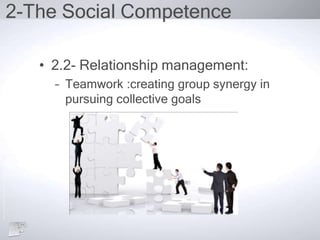
• 2.2- Relationship management:
– Teamwork :creating group synergy in
pursuing collective goals
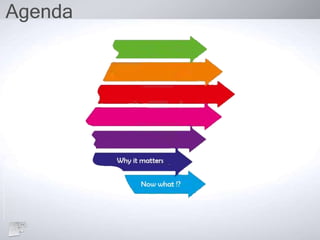
Agenda
Why would it matter?
• Emotion related dysfunction:
– all or nothing thinking
– excessive worrying
– worrying as magical thinking
– disqualifying the position
– jumping to negative conclusions
– “should” statements
– labeling & mislabeling
– personalization
– stonewalling
– criticism contempt
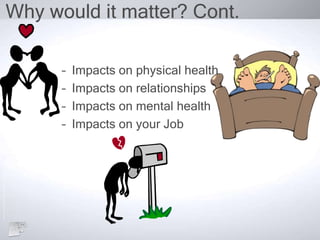
Why would it matter? Cont.
– Impacts on physical health
– Impacts on relationships
– Impacts on mental health
– Impacts on your Job
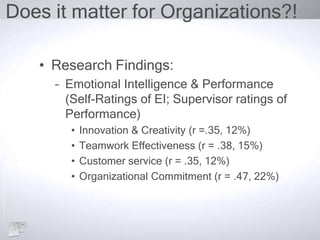
Does it matter for Organizations?!
• Research Findings:
– Emotional Intelligence & Performance
(Self-Ratings of EI; Supervisor ratings of
Performance)
• Innovation & Creativity (r =.35, 12%)
• Teamwork Effectiveness (r = .38, 15%)
• Customer service (r = .35, 12%)
• Organizational Commitment (r = .47, 22%)
Does it matter for Organizations?!
• Research Findings:
– The higher you go, the more EI
matters, the more social competencies
matters
Agenda
So what do I do now?!
• Develop a strategy on your own !!
– Tried strategy:
– Taking the time for mindfulness
– Recognizing and naming emotions
– Understanding the causes of feelings
– Preventing depression through “learned optimism”
– Managing anger through learned behavior or distraction techniques
– Using “gut feelings” in decision making
– Developing listening skills
Assignment ;)
• List at least 5 points of weakness and 5
points of strength
• Pick 5 random moments in your and
describe How you felt, why you felt that
way and how did it affect your action
• develop 3 different techniques to manage
your moments of anger or depression.
Quote
• Anyone can be angry – that is
easy…But to Be angry with the
right person, to the right
degree, at the right time, for
the right purpose and in the
right way – that is not easy!!
Any Questions?

Emotional Intelligence

  • 1.
  • 2.
  • 3.
  • 4.
  • 5.
  • 6.
    What is EI? • Emotional intelligence is the ability to understand one’s emotional make-up and the emotional make-up of others and to use insight from this knowledge to effectively manage and regulate one’s own emotions to make good decisions and to act effectively.
  • 7.
  • 8.
    Two main Areasof EI • Self Awareness • Self ManagementPersonal competence • Social Awareness • Relationship Management Social competence
  • 9.
  • 10.
    1-The Personal Competence Self- Awareness Emotional self- awareness Accurateself assessment Self confidence Self- Management Emotional self control Transparency Adaptability Achievement orientation Initiative Optimism
  • 11.
  • 12.
    1-Self Competence cont. •1.1- Self Awareness – Emotional self-Awareness: oRecognizing one’s emotions and their effect
  • 13.
    1-Self Competence cont. •1.1- Self Awareness – Accurate self assessment : oKnowing one’s strength and Limits Howard Gardner: we spend far too much time trying remedy our weaknesses rather than building our strengths Knowing one’s weaknesses and strengths = strength
  • 14.
    1-Self Competence cont. •1.1- Self Awareness – Self confidence : oA strong sense of one’s self worth and Capability Albert Bandura Stanford Professor has done decades of research into “self efficacy” Confidence determines Choices, Effort, Perseverance, an d resilience
  • 15.
    1-The Personal Competence Self- Management Emotionalself control Transparency Adaptability Achievement orientation Initiative Optimism Managing one’s internal states, impulses and resources
  • 16.
    1-Self Competence cont. •1.2- Self Management – Emotional self-Control: oKeeping disruptive Emotions and Impulses in check The Marshmallow Test
  • 17.
    1-Self Competence cont. •1.2- Self Management – Transparency: oMaintaining integrity . Andrew Grove: Taking responsibility can be really hard. CEO of Intel during 1994 Pentium flow crisis, The company was “in denial” at first until he took personal responsibility , then the company started change!
  • 18.
    1-Self Competence cont. •1.2- Self Management – Adaptability oFlexibility in Handling change Carly Fiorina It's not the strongest of the species who survive nor the most intelligent, but those who are most adaptive to change #Darwin
  • 19.
    1-Self Competence cont. •1.2- Self Management – Achievement Drive o Set challenging goals and take calculated risks
  • 20.
    1-Self Competence cont. •1.2- Self Management – Initiative oReadiness to act upon opportunity Bill Gates: Unlike some students I loved college. However, I felt the window of opportunity to start a software company might not open again .
  • 21.
    1-Self Competence cont. •1.2- Self Management – Optimism oPersistence in pursuing goals despite obstacles and setbacks J.K Rowling Harry Potter author was divorced and living in a public assistance with her daughter in a tiny apartment in Edinburg The first Book in the series was rejected by 10 publishers !!
  • 22.
  • 23.
  • 24.
  • 25.
  • 26.
  • 27.
  • 28.
    2-The Social Competence •2.1- social awareness: – Empathy Aaron feuerstine: Fire destroyed is factory Personally paid salaries of 2000 employee for 3 months until the factory was rebuilt
  • 29.
    2-The Social Competence •2.1- social awareness: – Organizational awareness Colin powell: The youngest general to ever be named chairman of the joint chief of staff
  • 30.
    2-The Social Competence •2.1- social awareness: – Service orientation: Anticipating and recognizing client needs.
  • 31.
  • 32.
    2-The Social Competence •2.2- Relationship management: – Developing others Jack welch: General electric CEO, he spent 50% of his time on people development He knew the names and rules of 1000 persons in the company
  • 33.
    2-The Social Competence •2.2- Relationship management: – Change catalyst Gordon Bethune: Took over as a CEO of failing continental airlines. One of his first public acts was to take a group of employees out to the parking lot , they burned the outdated and constraining employee manual. The symbolic gesture set the stage for his successful transformation of the airline
  • 34.
    2-The Social Competence •2.2- Relationship management: – Influence Robert cialdini: -Told people in a restaurant “please call if your plans change” And only 10% of no show called to cancel -He began asking people “will you please call if your plans change” 30% of no show called
  • 35.
    2-The Social Competence •2.2- Relationship management: – Conflict management
  • 36.
    2-The Social Competence •2.2- Relationship management: – Teamwork :creating group synergy in pursuing collective goals
  • 37.
  • 38.
    Why would itmatter? • Emotion related dysfunction: – all or nothing thinking – excessive worrying – worrying as magical thinking – disqualifying the position – jumping to negative conclusions – “should” statements – labeling & mislabeling – personalization – stonewalling – criticism contempt
  • 39.
    Why would itmatter? Cont. – Impacts on physical health – Impacts on relationships – Impacts on mental health – Impacts on your Job
  • 40.
    Does it matterfor Organizations?! • Research Findings: – Emotional Intelligence & Performance (Self-Ratings of EI; Supervisor ratings of Performance) • Innovation & Creativity (r =.35, 12%) • Teamwork Effectiveness (r = .38, 15%) • Customer service (r = .35, 12%) • Organizational Commitment (r = .47, 22%)
  • 41.
    Does it matterfor Organizations?! • Research Findings: – The higher you go, the more EI matters, the more social competencies matters
  • 42.
  • 43.
    So what doI do now?! • Develop a strategy on your own !! – Tried strategy: – Taking the time for mindfulness – Recognizing and naming emotions – Understanding the causes of feelings – Preventing depression through “learned optimism” – Managing anger through learned behavior or distraction techniques – Using “gut feelings” in decision making – Developing listening skills
  • 44.
    Assignment ;) • Listat least 5 points of weakness and 5 points of strength • Pick 5 random moments in your and describe How you felt, why you felt that way and how did it affect your action • develop 3 different techniques to manage your moments of anger or depression.
  • 45.
    Quote • Anyone canbe angry – that is easy…But to Be angry with the right person, to the right degree, at the right time, for the right purpose and in the right way – that is not easy!!
  • 46.

Editor's Notes

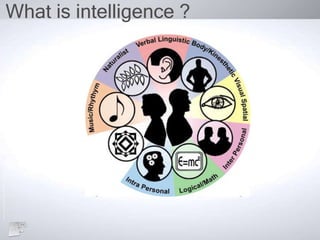
  • #5 Linguistic and verbal intelligence: good with wordsLogical intelligence: good with math and logicSpatial intelligence: good with picturesBody/movement intelligence: good with activitiesMusical intelligence: good with rhythmInterpersonal intelligence: good with communicationIntrapersonal intelligence: good with analyzing thingsNaturalist intelligence: good with understanding natural worldExistential IntelligenceSensitivity and capacity to tackle deep questions about human existence, such as the meaning of life, why do we die, and how did we get here
  • #30  This is the ability to understand the “power” relationship in one’s own group or organization. This includes the ability to identify the real decision makers and who can influence them. It is also about recognizing the values and cultures of organizations and how those affect the way people act and behave.
  • #42 Emotional Intelligence and other workplace variables:Absenteeism (r = -.54, 29%)Job Satisfaction (r = .49, 24%)Index of Occupational Stress (r = -.43, 18%)
  • #44 Taking the time for mindfulnessRecognizing and naming emotionsUnderstanding the causes of feelingsPreventing depression through “learned optimism”Managing anger through learned behavior or distraction techniquesListening for the lessons of feelingsUsing “gut feelings” in decision makingDeveloping listening skills