UNDERSTANDING EMOTIONAL
INTELLIGENCE
Prepared by:
Mohie Ismil
Agenda
• Introduction
• Definition of “EI”
• The importance of “EI”
• Why “EI” matters in the workplace
• Models of “EI”
• Self-Awareness
• Social-Awareness
• Social skills
• Questions
Introduction
• Over time, scientists have begun to study why standard intelligence
along isn’t enough to predict performance in an individual.
• They realized that there is another type of intelligence that isn’t
related to the standard cognitive intelligence called Emotional
Intelligence.
• The study of emotional intelligence has its roots in the work of
Darwin, who posited that emotional expression was essential for
survival.
Emotional Intelligence :
People who have high level of “EI” are able to understand the physical, mental,
and social impact the negative emotions have on their bodies, minds,
relationships, and ability to pressure and achieve goals.
Then they are able to moderate their own emotions s that their emotions
support their activities and enhance their quality of life.
People with highly developed EI are proven to be successful in the workplace;
they are good in crisis strong in communicating and successful where others
fail.
Emotional Intelligence involves a combination of
competencies which allow a person to a aware of, to
understand, and to be in control of their own emotions, to
recognize and understand the emotions of others, and to
use this knowledge to foster their success and the success
of others.
The importance of Emotions 1/2
Emotions serve a biological purpose -
they tell us when our needs are not
being met.
• Ignoring of emotions can lead to unhappiness; physical illness and
even early death.
• It has been found that not only people with high level of EI more
successful in their careers but they are also healthier; happier
and enjoy better relationships with others.
The importance of Emotions 2/2
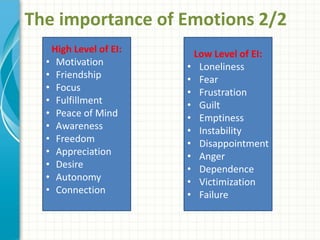
High Level of EI:
• Motivation
• Friendship
• Focus
• Fulfillment
• Peace of Mind
• Awareness
• Freedom
• Appreciation
• Desire
• Autonomy
• Connection
Low Level of EI:
• Loneliness
• Fear
• Frustration
• Guilt
• Emptiness
• Instability
• Disappointment
• Anger
• Dependence
• Victimization
• Failure
Why “EI” matters in the workplace
"In the last decade or so, science has discovered a tremendous
amount about the role emotions play in our lives.
Researchers have found that even more than IQ, your emotional
awareness and abilities to handle feelings will determine
your success and happiness in all walks of life…”
- John Gottman
Companies have realized that IQ alone cannot
predict an individual’s performance or success.
Why “EI” matters in the workplace
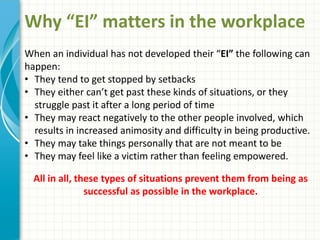
When an individual has not developed their “EI” the following can
happen:
• They tend to get stopped by setbacks
• They either can’t get past these kinds of situations, or they
struggle past it after a long period of time
• They may react negatively to the other people involved, which
results in increased animosity and difficulty in being productive.
• They may take things personally that are not meant to be
• They may feel like a victim rather than feeling empowered.
All in all, these types of situations prevent them from being as
successful as possible in the workplace.
Why “EI” matters in the workplace
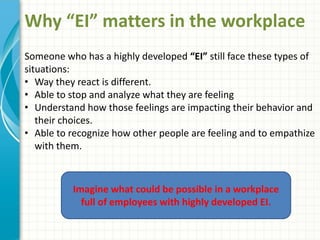
Someone who has a highly developed “EI” still face these types of
situations:
• Way they react is different.
• Able to stop and analyze what they are feeling
• Understand how those feelings are impacting their behavior and
their choices.
• Able to recognize how other people are feeling and to empathize
with them.
Imagine what could be possible in a workplace
full of employees with highly developed EI.
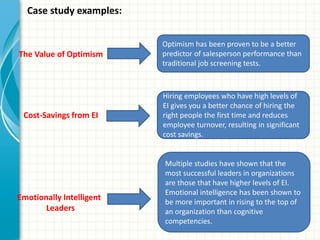
Case study examples:
The Value of Optimism
Optimism has been proven to be a better
predictor of salesperson performance than
traditional job screening tests.
Cost-Savings from EI
Hiring employees who have high levels of
EI gives you a better chance of hiring the
right people the first time and reduces
employee turnover, resulting in significant
cost savings.
Emotionally Intelligent
Leaders
Multiple studies have shown that the
most successful leaders in organizations
are those that have higher levels of EI.
Emotional intelligence has been shown to
be more important in rising to the top of
an organization than cognitive
competencies.
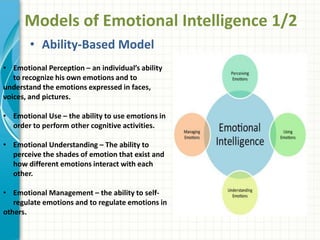
Models of Emotional Intelligence 1/2
• Ability-Based Model
• Emotional Perception – an individual’s ability
to recognize his own emotions and to
understand the emotions expressed in faces,
voices, and pictures.
• Emotional Use – the ability to use emotions in
order to perform other cognitive activities.
• Emotional Understanding – The ability to
perceive the shades of emotion that exist and
how different emotions interact with each
other.
• Emotional Management – the ability to self-
regulate emotions and to regulate emotions in
others.
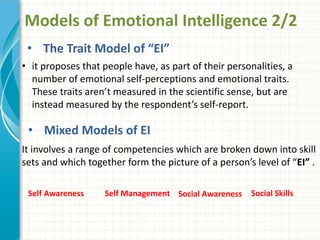
Models of Emotional Intelligence 2/2
• The Trait Model of “EI”
• it proposes that people have, as part of their personalities, a
number of emotional self-perceptions and emotional traits.
These traits aren’t measured in the scientific sense, but are
instead measured by the respondent’s self-report.
• Mixed Models of EI
It involves a range of competencies which are broken down into skill
sets and which together form the picture of a person’s level of “EI” .
Self Awareness Self Management Social Awareness Social Skills
SELF-AWARENESS
Self-awareness is the building block of all the others. Without
recognizing what you are feeling, you cannot proceed to the
other competencies.
Self-awareness involves three skills:
• Emotional self-awareness
• Accurate self-assessment
• Self-confidence
Emotional Self-Awareness
When we are not aware of our feelings and the causes of them,
leading a happy, productive life is difficult if not impossible.
Increasing Self-Awareness
• “Check-in” with yourself
• Label your emotions
• Be in the moment
• Get to the ‘Root’ of the emotion
Accurate Self-Assessment
• How your emotions are affecting your performance, your
behavior, and your relationships. you’ll want to assess how
your emotions are affecting the other people in the
workplace.
• This is particularly important for leaders, who need to
understand how they could be sabotaging the success of
their entire team if they are not aware of the impact of
their emotions.
Self-Confidence
• Recognizing and acknowledging your feelings and their
impact is not always comfortable – especially at first.
But those who have a highly developed level of self-
confidence understand that what they learn about their
strengths and weaknesses is not an indicator of their
value or worth as a person
• Self-confidence is another name for personal
power.
Here are some tips for helping to build your self-confidence.
• Make a ‘Strengths & Weaknesses’ List.
• See Failures as Learning Experiences.
SELF-MANAGEMENT
• The act of taking responsibility for our emotions. It gives us a
tool for making decisions that are the most supportive for our
mental and emotional health, It lets us experience emotions
without being controlled by them and rewarding relationships –
both in and out of the workplace.
The competency of self-management has 6 different skill
attributes:
• Self-Control • Trustworthiness
• Conscientiousness • Adaptability
• Achievement Orientation • Initiative
Self-Control
It is the ability to stop and think before acting
The tools designed to help you focus on what the best choice to
make is – not necessarily the immediate one.
Reflection
“Is this situation really a threat?, What action would be best in
this situation?, What do I need in order to be able to take that
action?”
Reframing
• I can’t believe I did that – I’m so stupid
• I made an honest mistake. That’s frustrating, but I can
certainly fix it
• I’m never going to get this done – I’m going to be in trouble
• I need to focus on the priorities and ask for help
Rehearsal
Trustworthiness
Acting in a way that is aligned with your values
• Staying committed to the process of emotional self-management
and that you take full responsibility for your emotions.
• They made me so angry, He really upset me, She just really
irritated me.
• I am angry, I am upset, I am irritated.
• The other person might have been the impetus for the reaction,
but only you are responsible for what happens next.
Conscientiousness
Adaptability
Don’t let your feelings about change become the source of
emotional and performance roadblocks.
Achievement Orientation
When you are successful at self-management, you can choose
the actions that will help move you towards your goals.
Initiative
Looking for ways to continually develop yourself and
recognizing that true happiness comes from taking full
responsibility for your life.
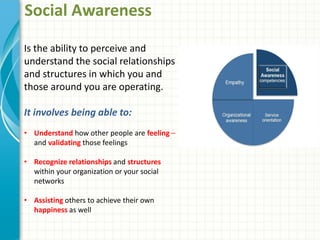
Social Awareness
Is the ability to perceive and
understand the social relationships
and structures in which you and
those around you are operating.
It involves being able to:
• Understand how other people are feeling –
and validating those feelings
• Recognize relationships and structures
within your organization or your social
networks
• Assisting others to achieve their own
happiness as well
Empathy
Is the ability to understand someone else’s feelings and re-
experience them.
• Showing empathy is a core “EI” social awareness skill .
• It allows you to get in the place of another person and see
the argument or situation from their side
• understanding of why a person feels or behaves the way
they do and what is motivating that feeling or behavior.
• Acknowledge another person feelings doesn’t have to
mean agreement , it means that you are recognizing the
other person’s position and empathizing with it.
Service orientation
• Builds on the empathy you have with others by helping
you assist their personal development and satisfaction.
• People with this competence:
• Are able through careful questioning to identify issues that
are affecting an individual’s performance.
• Identify or adapt situations so that they provide an
opportunity to improve their productivity and satisfaction.
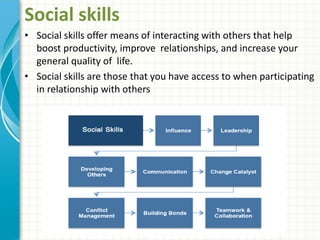
Social skills
• Social skills offer means of interacting with others that help
boost productivity, improve relationships, and increase your
general quality of life.
• Social skills are those that you have access to when participating
in relationship with others
• Influence
Is the ability to have an impact on others and their decision-
making.
• Influence in the light of emotional intelligence is that you use
your influence to help others help themselves. You are not
trying to ‘get’ something out of someone by influencing them
Service orientation
Builds on the empathy you have with others by helping you assist
their personal development and satisfaction.
People with this competence:
• Are able through careful questioning to identify issues that
are affecting an individual’s performance.
• Identify or adapt situations so that they provide an
opportunity to improve their productivity and satisfaction.
Developing Others
Is the ability to observe and provide opportunities to fully develop
others.
One of the best EI indicators .
• Helping others to achieve their goals is a win-win situation
• Those who have this aspect of “EI” are confident enough in
themselves and their own abilities.
QUESTIONS?

Understanding emotional intelligende

  • 1.
  • 2.
    Agenda • Introduction • Definitionof “EI” • The importance of “EI” • Why “EI” matters in the workplace • Models of “EI” • Self-Awareness • Social-Awareness • Social skills • Questions
  • 3.
    Introduction • Over time,scientists have begun to study why standard intelligence along isn’t enough to predict performance in an individual. • They realized that there is another type of intelligence that isn’t related to the standard cognitive intelligence called Emotional Intelligence. • The study of emotional intelligence has its roots in the work of Darwin, who posited that emotional expression was essential for survival.
  • 4.
    Emotional Intelligence : Peoplewho have high level of “EI” are able to understand the physical, mental, and social impact the negative emotions have on their bodies, minds, relationships, and ability to pressure and achieve goals. Then they are able to moderate their own emotions s that their emotions support their activities and enhance their quality of life. People with highly developed EI are proven to be successful in the workplace; they are good in crisis strong in communicating and successful where others fail. Emotional Intelligence involves a combination of competencies which allow a person to a aware of, to understand, and to be in control of their own emotions, to recognize and understand the emotions of others, and to use this knowledge to foster their success and the success of others.
  • 5.
    The importance ofEmotions 1/2 Emotions serve a biological purpose - they tell us when our needs are not being met. • Ignoring of emotions can lead to unhappiness; physical illness and even early death. • It has been found that not only people with high level of EI more successful in their careers but they are also healthier; happier and enjoy better relationships with others.
  • 6.
    The importance ofEmotions 2/2 High Level of EI: • Motivation • Friendship • Focus • Fulfillment • Peace of Mind • Awareness • Freedom • Appreciation • Desire • Autonomy • Connection Low Level of EI: • Loneliness • Fear • Frustration • Guilt • Emptiness • Instability • Disappointment • Anger • Dependence • Victimization • Failure
  • 7.
    Why “EI” mattersin the workplace "In the last decade or so, science has discovered a tremendous amount about the role emotions play in our lives. Researchers have found that even more than IQ, your emotional awareness and abilities to handle feelings will determine your success and happiness in all walks of life…” - John Gottman Companies have realized that IQ alone cannot predict an individual’s performance or success.
  • 8.
    Why “EI” mattersin the workplace When an individual has not developed their “EI” the following can happen: • They tend to get stopped by setbacks • They either can’t get past these kinds of situations, or they struggle past it after a long period of time • They may react negatively to the other people involved, which results in increased animosity and difficulty in being productive. • They may take things personally that are not meant to be • They may feel like a victim rather than feeling empowered. All in all, these types of situations prevent them from being as successful as possible in the workplace.
  • 9.
    Why “EI” mattersin the workplace Someone who has a highly developed “EI” still face these types of situations: • Way they react is different. • Able to stop and analyze what they are feeling • Understand how those feelings are impacting their behavior and their choices. • Able to recognize how other people are feeling and to empathize with them. Imagine what could be possible in a workplace full of employees with highly developed EI.
  • 10.
    Case study examples: TheValue of Optimism Optimism has been proven to be a better predictor of salesperson performance than traditional job screening tests. Cost-Savings from EI Hiring employees who have high levels of EI gives you a better chance of hiring the right people the first time and reduces employee turnover, resulting in significant cost savings. Emotionally Intelligent Leaders Multiple studies have shown that the most successful leaders in organizations are those that have higher levels of EI. Emotional intelligence has been shown to be more important in rising to the top of an organization than cognitive competencies.
  • 11.
    Models of EmotionalIntelligence 1/2 • Ability-Based Model • Emotional Perception – an individual’s ability to recognize his own emotions and to understand the emotions expressed in faces, voices, and pictures. • Emotional Use – the ability to use emotions in order to perform other cognitive activities. • Emotional Understanding – The ability to perceive the shades of emotion that exist and how different emotions interact with each other. • Emotional Management – the ability to self- regulate emotions and to regulate emotions in others.
  • 12.
    Models of EmotionalIntelligence 2/2 • The Trait Model of “EI” • it proposes that people have, as part of their personalities, a number of emotional self-perceptions and emotional traits. These traits aren’t measured in the scientific sense, but are instead measured by the respondent’s self-report. • Mixed Models of EI It involves a range of competencies which are broken down into skill sets and which together form the picture of a person’s level of “EI” . Self Awareness Self Management Social Awareness Social Skills
  • 13.
    SELF-AWARENESS Self-awareness is thebuilding block of all the others. Without recognizing what you are feeling, you cannot proceed to the other competencies. Self-awareness involves three skills: • Emotional self-awareness • Accurate self-assessment • Self-confidence
  • 14.
    Emotional Self-Awareness When weare not aware of our feelings and the causes of them, leading a happy, productive life is difficult if not impossible. Increasing Self-Awareness • “Check-in” with yourself • Label your emotions • Be in the moment • Get to the ‘Root’ of the emotion
  • 15.
    Accurate Self-Assessment • Howyour emotions are affecting your performance, your behavior, and your relationships. you’ll want to assess how your emotions are affecting the other people in the workplace. • This is particularly important for leaders, who need to understand how they could be sabotaging the success of their entire team if they are not aware of the impact of their emotions.
  • 16.
    Self-Confidence • Recognizing andacknowledging your feelings and their impact is not always comfortable – especially at first. But those who have a highly developed level of self- confidence understand that what they learn about their strengths and weaknesses is not an indicator of their value or worth as a person • Self-confidence is another name for personal power. Here are some tips for helping to build your self-confidence. • Make a ‘Strengths & Weaknesses’ List. • See Failures as Learning Experiences.
  • 17.
    SELF-MANAGEMENT • The actof taking responsibility for our emotions. It gives us a tool for making decisions that are the most supportive for our mental and emotional health, It lets us experience emotions without being controlled by them and rewarding relationships – both in and out of the workplace. The competency of self-management has 6 different skill attributes: • Self-Control • Trustworthiness • Conscientiousness • Adaptability • Achievement Orientation • Initiative
  • 18.
    Self-Control It is theability to stop and think before acting The tools designed to help you focus on what the best choice to make is – not necessarily the immediate one. Reflection “Is this situation really a threat?, What action would be best in this situation?, What do I need in order to be able to take that action?” Reframing • I can’t believe I did that – I’m so stupid • I made an honest mistake. That’s frustrating, but I can certainly fix it • I’m never going to get this done – I’m going to be in trouble • I need to focus on the priorities and ask for help Rehearsal
  • 19.
    Trustworthiness Acting in away that is aligned with your values • Staying committed to the process of emotional self-management and that you take full responsibility for your emotions. • They made me so angry, He really upset me, She just really irritated me. • I am angry, I am upset, I am irritated. • The other person might have been the impetus for the reaction, but only you are responsible for what happens next. Conscientiousness
  • 20.
    Adaptability Don’t let yourfeelings about change become the source of emotional and performance roadblocks. Achievement Orientation When you are successful at self-management, you can choose the actions that will help move you towards your goals. Initiative Looking for ways to continually develop yourself and recognizing that true happiness comes from taking full responsibility for your life.
  • 21.
    Social Awareness Is theability to perceive and understand the social relationships and structures in which you and those around you are operating. It involves being able to: • Understand how other people are feeling – and validating those feelings • Recognize relationships and structures within your organization or your social networks • Assisting others to achieve their own happiness as well
  • 22.
    Empathy Is the abilityto understand someone else’s feelings and re- experience them. • Showing empathy is a core “EI” social awareness skill . • It allows you to get in the place of another person and see the argument or situation from their side • understanding of why a person feels or behaves the way they do and what is motivating that feeling or behavior. • Acknowledge another person feelings doesn’t have to mean agreement , it means that you are recognizing the other person’s position and empathizing with it.
  • 23.
    Service orientation • Buildson the empathy you have with others by helping you assist their personal development and satisfaction. • People with this competence: • Are able through careful questioning to identify issues that are affecting an individual’s performance. • Identify or adapt situations so that they provide an opportunity to improve their productivity and satisfaction.
  • 24.
    Social skills • Socialskills offer means of interacting with others that help boost productivity, improve relationships, and increase your general quality of life. • Social skills are those that you have access to when participating in relationship with others
  • 25.
    • Influence Is theability to have an impact on others and their decision- making. • Influence in the light of emotional intelligence is that you use your influence to help others help themselves. You are not trying to ‘get’ something out of someone by influencing them
  • 26.
    Service orientation Builds onthe empathy you have with others by helping you assist their personal development and satisfaction. People with this competence: • Are able through careful questioning to identify issues that are affecting an individual’s performance. • Identify or adapt situations so that they provide an opportunity to improve their productivity and satisfaction.
  • 27.
    Developing Others Is theability to observe and provide opportunities to fully develop others. One of the best EI indicators . • Helping others to achieve their goals is a win-win situation • Those who have this aspect of “EI” are confident enough in themselves and their own abilities.
  • 28.