An Introduction to Emotional
Intelligence
Contents
A little bit more about the next two hours
A definition and why EI is important
Physiological aspects of EI
Psychological aspects of EI
EI Development
EI Assessment
2
What’s going to happen in these 2 hours?
• We will briefly introduce the concept of EI and its basic
elements
• You will learn how EI’s physiological nature influences
behaviour in addition to its psychological.
• You are hopefully going to learn from some interesting guest
speakers and actors!
• You will be tested on what you have learned about EI
3
A Definition
The term emotional intelligence was officially coined in 1990
by Salovey and Mayer
Emotional Intelligence/Quotient is “the capacity for
recognizing our own feelings and those of others, for
motivating ourselves, and for managing emotions well in
ourselves and in our relationships. Emotional intelligence
describes abilities distinct from, but complementary to,
academic intelligence.”
- Daniel Goleman (1998)
4
So what’s EI and why is it important?
• Some research shows that
IQ can help you to be
successful to the extent of
20 percent only in life.
The rest of 80 percent
success depends on your
EQ.
20%
IQ
80%
EQ
5
6
Fariselli, L. & Freedman, j. ‘Stress, Emotional
Intelligence and Performance in Healthcare’ (2008)
Importance of EI to Organizations, too
• 50% of work satisfaction is determined by the relationship a
worker has with… his/her boss.
• A large hospital reduced turnover of critical-care nurses from
65 to 15 percent within 18 months of instituting an emotional
intelligence screening assessment.
(http://jamesdambrosio.com/2011/01/31/evidence-suggests-emotional-intelligence-increases-
productivity/)
• EI is a prerequisite for effective leadership across borders.
– Requires a high level of self-mastery and people skills;
ability to put yourself into the positions of others.
7
Where we want to be…the Goal
EQ
Thinking
Part
Feeling
Part
8
EQ/EI refers to emotional management skills which provide competence to
balance emotions and reason, so as to maximize long term effectiveness &
happiness.
TWO VIEW POINTS ABOUT EQ
Traditionalists
say that emotions
High performers
say that emotions
Distract us
Increase our
vulnerability
Cloud our judgment
Inhibit free flow of data
Must be controlled
Motivate us
Increase our confidence
Speed our analysis
Build trust
Provide vital feedback
Must be managed
9
Is EI something new?
No…it has always been there…we just have been better at
defining it…
“That man is disciplined and happy who can prevail over the turmoil that
springs from desire and anger, here on earth …” Hindu text Bhagavad-Gita,
1000 B.C.E
There are TWO dimensions of emotions:
Physiological side: ‘Emotion’ is a complex state of human mind,
involving bodily changes of widespread character such as
breathing, pounding heart, flushed face, sweating palms, pulse
rate, gland secretions, etc.
Psychological side, a state of excitement or perturbation marked
by strong feelings.
10
Physiology & Emotion
Why are we spending time on this?
• Its important to understand how our brains process basic
and higher level emotions.
• This will increase your awareness of why we react the way
we sometimes do.
• Emotion and your body have a big relationship!
12
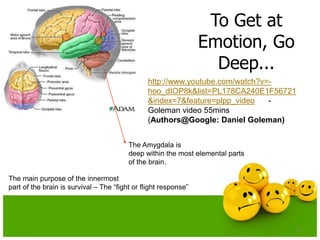
The main purpose of the innermost
part of the brain is survival – The “fight or flight response”
To Get at
Emotion, Go
Deep...
The Amygdala is
deep within the most elemental parts
of the brain.
13
http://www.youtube.com/watch?v=-
hoo_dIOP8k&list=PL178CA240E1F56721
&index=7&feature=plpp_video -
Goleman video 55mins
(Authors@Google: Daniel Goleman)
An Amygdala Hijack in
Action!
• For example:
– WRITING AN ANGRY
EMAIL IN “CAPS”…AND
THEN SENDING IT!
– http://www.youtube.c
om/watch?v=qXY4wnr
vUOI
14
Therefore…Basic Emotions--presumed to
be hard wired and physiologically
distinctive
• Joy
• Surprise
• Sadness
• Anger
• Disgust
• Fear
• Empathy (Not necessarily)
15
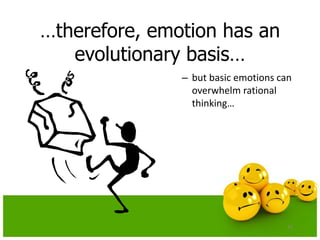
…therefore, emotion has an
evolutionary basis…
– but basic emotions can
overwhelm rational
thinking…
16
High Stress Context
• A hospital can at times be a complex
and stressful environment where
interpersonal interactions to both
patients and staff are of paramount
importance. Some people thrive on
this (e.g. some ER), some are
overwhelmed by it.
• EI mitigates the effects of stress.
Fariselli, L. & Freedman, j. ‘Stress, Emotional Intelligence and
Performance in Healthcare’ (2008)
• Both Physiological & Psychological
aspects at work here.
Source: Six Seconds (www.6seconds.org)
17
The Psychological side of
Emotion
The 4 Components of EI
18
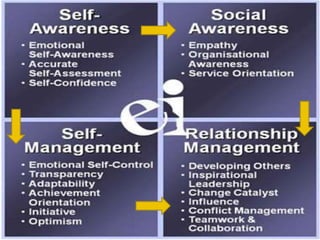
1. Self Awareness
2. Self Management
3. Social Awareness
4. Relationship Management
http://www.youtube.com/watch?v=zVxdUqLJT6s&list=PL178CA240E
1F56721&index=33&feature=plpp_video - Emotional Intelligence
Part 1 8 minutes
19
The 4 Components of EI
Self-
Awareness
20
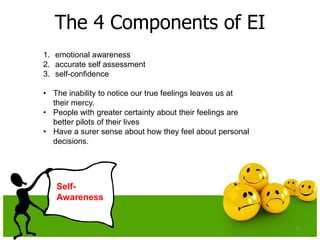
1. emotional awareness
2. accurate self assessment
3. self-confidence
• The inability to notice our true feelings leaves us at
their mercy.
• People with greater certainty about their feelings are
better pilots of their lives
• Have a surer sense about how they feel about personal
decisions.
The 4 Components of EI
Self-
Awareness
21
http://www.youtube.com/watch?v=bQ3HZ6DFFrM&list=PL178CA240
E1F56721&index=22&feature=plpp_video – Universe and self
awareness 1.30 mins
http://www.youtube.com/watch?v=0KhawDYJ9Eg&noredirect
Accurate Self Assessment 3.06 mins
• Kolbe & Unique ability later
The 4 Components of EI
Self
Management
22
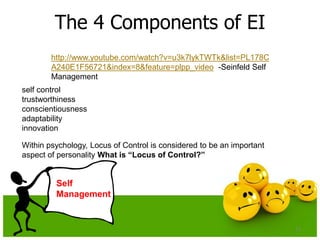
self control
trustworthiness
conscientiousness
adaptability
innovation
Within psychology, Locus of Control is considered to be an important
aspect of personality What is “Locus of Control?”
http://www.youtube.com/watch?v=u3k7lykTWTk&list=PL178C
A240E1F56721&index=8&feature=plpp_video -Seinfeld Self
Management
The 4 Components of EI
Social
Awareness
23
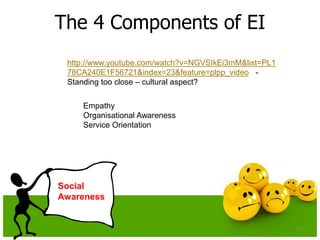
Empathy
Organisational Awareness
Service Orientation
http://www.youtube.com/watch?v=NGVSIkEi3mM&list=PL1
78CA240E1F56721&index=23&feature=plpp_video -
Standing too close – cultural aspect?
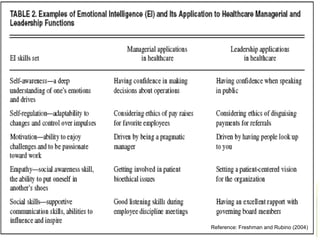
The 4 Components of EI
24
Relationship
Management
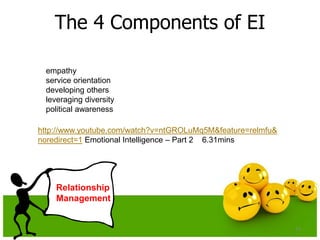
empathy
service orientation
developing others
leveraging diversity
political awareness
http://www.youtube.com/watch?v=ntGROLuMq5M&feature=relmfu&
noredirect=1 Emotional Intelligence – Part 2 6.31mins
25Reference: Freshman and Rubino (2004)
Emotional development
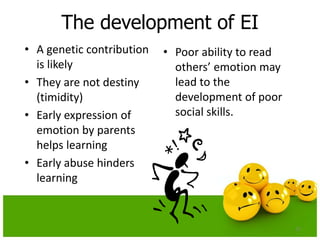
The development of EI
• A genetic contribution
is likely
• They are not destiny
(timidity)
• Early expression of
emotion by parents
helps learning
• Early abuse hinders
learning
• Poor ability to read
others’ emotion may
lead to the
development of poor
social skills.
27
Value of taking time for self-
awareness requires abilities
• to recognize appropriate body cues and emotions
• to label cues and emotions accurately
• to stay open to unpleasant as well as pleasant
emotions
• includes the capacity for experiencing and
recognizing multiple and conflicting emotions
28
Using emotions to maximize intellectual
processing and decision making
• Self Awareness is the foundation for EI development
in everybody
• “Gut feeling” can be used to effectively guide
decisions- a neurological understanding of how
unconscious and conscious gut feelings guide
decisions, e.g., when prioritizing, emotions help move
the decisions.
• Harness emotions to promote or hinder motivation.
(Anxiety, hostility, sadness)
29
Developing empathy
• Empathy is a feeling different from sympathy. When one is sympathetic,
one implies pity but maintains distance from another person’s feelings.
Empathy is more a sense that one can truly understand or imagine the
depth of another person’s feelings. It implies feeling with a person, rather
than feeling sorry for a person.
• Empathy is a translation of the German term Einfühlung, meaning to feel
at one with. It implies sharing the load, or “walking a mile in someone
else’s shoes,” in order to appropriately understand that person’s
perspective.
• In research on married couples, empathy appears to include matching the
physiological changes of the other person.
social
awareness
30
Developing empathy links to
• Greater emotional
stability
• Greater interpersonal
sensitivity
• Greater affiliation.
Developing empathy31
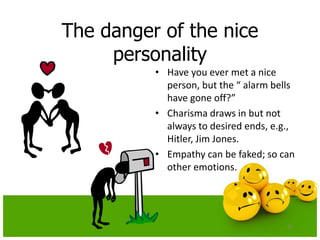
The danger of the nice
personality
• Have you ever met a nice
person, but the “ alarm bells
have gone off?”
• Charisma draws in but not
always to desired ends, e.g.,
Hitler, Jim Jones.
• Empathy can be faked; so can
other emotions.
32
The art of social relationships--
managing emotions in others
• To excel at people skills means having and using the competencies to be
an effective friend, negotiator, and leader. One should be able to guide an
interaction, inspire others, make others comfortable in social situations,
and influence and persuade others.
social
skills
33
The subtle and complex abilities which
underlie people skills
• Being attuned to others’
emotions
• Promoting comfort in
others through the
proper use of display
rules
• Using own emotional
display to establish a
sense of rapport
34
Emotion related dysfunction
• all or nothing thinking
• overgeneralization
• excessive worrying
• worrying as magical thinking
• disqualifying the position
• jumping to negative
conclusions
• “should” statements
• labeling & mislabeling
• personalization
• stonewalling
• criticism; contempt
• Impacts on physical health
– cardiovascular disease
– progression of diabetes
– progression of cancer
– onset of hypertension
– Stress related illness
• Impacts on relationships
• Impacts on mental health
35
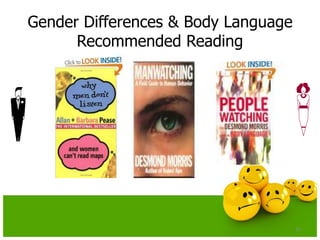
Gender Differences & Body Language
Recommended Reading
36
Recommended EI Journal
Articles
• Habib, S, Riaz, M, & Akram, M 2012, 'Emotional Intelligence as Predictor of Life Satisfaction
among Nurses: Mediating Role of Spiritual Wellness', FWU Journal Of Social Sciences, 6, 1,
pp. 73-78, Academic Search Complete, EBSCOhost, viewed 25 September 2012.
• Heffernan, M, Griffin, M, McNulty, S, & Fitzpatrick, J 2010, 'Self-compassion and emotional
intelligence in nurses', International Journal Of Nursing Practice, 16, 4, pp. 366-373, CINAHL
Plus, EBSCOhost, viewed 25 September 2012.
• Batool, S, & Khalid, R 2009, 'LOW EMOTIONAL INTELLIGENCE: A RISK FACTOR FOR
DEPRESSION', Journal Of Pakistan Psychiatric Society, 6, 2, pp. 65-72, Academic Search
Complete, EBSCOhost, viewed 25 September 2012.
• Freshman, B, & Rubino, L 2004, 'Emotional Intelligence Skills for Maintaining Social
Networks in Healthcare Organizations', Hospital Topics, 82, pp. 2-9, British Library
Document Supply Centre Inside Serials & Conference Proceedings, EBSCOhost, viewed 25
September 2012.
• Cadman, C. and Brewer, J. (2001), Emotional intelligence: a vital prerequisite for
recruitment in nursing. Journal of Nursing Management, 9: 321–324.
37
38
THANK YOU !!!

Emotional intelligence

  • 1.
    An Introduction toEmotional Intelligence
  • 2.
    Contents A little bitmore about the next two hours A definition and why EI is important Physiological aspects of EI Psychological aspects of EI EI Development EI Assessment 2
  • 3.
    What’s going tohappen in these 2 hours? • We will briefly introduce the concept of EI and its basic elements • You will learn how EI’s physiological nature influences behaviour in addition to its psychological. • You are hopefully going to learn from some interesting guest speakers and actors! • You will be tested on what you have learned about EI 3
  • 4.
    A Definition The termemotional intelligence was officially coined in 1990 by Salovey and Mayer Emotional Intelligence/Quotient is “the capacity for recognizing our own feelings and those of others, for motivating ourselves, and for managing emotions well in ourselves and in our relationships. Emotional intelligence describes abilities distinct from, but complementary to, academic intelligence.” - Daniel Goleman (1998) 4
  • 5.
    So what’s EIand why is it important? • Some research shows that IQ can help you to be successful to the extent of 20 percent only in life. The rest of 80 percent success depends on your EQ. 20% IQ 80% EQ 5
  • 6.
    6 Fariselli, L. &Freedman, j. ‘Stress, Emotional Intelligence and Performance in Healthcare’ (2008)
  • 7.
    Importance of EIto Organizations, too • 50% of work satisfaction is determined by the relationship a worker has with… his/her boss. • A large hospital reduced turnover of critical-care nurses from 65 to 15 percent within 18 months of instituting an emotional intelligence screening assessment. (http://jamesdambrosio.com/2011/01/31/evidence-suggests-emotional-intelligence-increases- productivity/) • EI is a prerequisite for effective leadership across borders. – Requires a high level of self-mastery and people skills; ability to put yourself into the positions of others. 7
  • 8.
    Where we wantto be…the Goal EQ Thinking Part Feeling Part 8 EQ/EI refers to emotional management skills which provide competence to balance emotions and reason, so as to maximize long term effectiveness & happiness.
  • 9.
    TWO VIEW POINTSABOUT EQ Traditionalists say that emotions High performers say that emotions Distract us Increase our vulnerability Cloud our judgment Inhibit free flow of data Must be controlled Motivate us Increase our confidence Speed our analysis Build trust Provide vital feedback Must be managed 9
  • 10.
    Is EI somethingnew? No…it has always been there…we just have been better at defining it… “That man is disciplined and happy who can prevail over the turmoil that springs from desire and anger, here on earth …” Hindu text Bhagavad-Gita, 1000 B.C.E There are TWO dimensions of emotions: Physiological side: ‘Emotion’ is a complex state of human mind, involving bodily changes of widespread character such as breathing, pounding heart, flushed face, sweating palms, pulse rate, gland secretions, etc. Psychological side, a state of excitement or perturbation marked by strong feelings. 10
  • 11.
  • 12.
    Why are wespending time on this? • Its important to understand how our brains process basic and higher level emotions. • This will increase your awareness of why we react the way we sometimes do. • Emotion and your body have a big relationship! 12
  • 13.
    The main purposeof the innermost part of the brain is survival – The “fight or flight response” To Get at Emotion, Go Deep... The Amygdala is deep within the most elemental parts of the brain. 13 http://www.youtube.com/watch?v=- hoo_dIOP8k&list=PL178CA240E1F56721 &index=7&feature=plpp_video - Goleman video 55mins (Authors@Google: Daniel Goleman)
  • 14.
    An Amygdala Hijackin Action! • For example: – WRITING AN ANGRY EMAIL IN “CAPS”…AND THEN SENDING IT! – http://www.youtube.c om/watch?v=qXY4wnr vUOI 14
  • 15.
    Therefore…Basic Emotions--presumed to behard wired and physiologically distinctive • Joy • Surprise • Sadness • Anger • Disgust • Fear • Empathy (Not necessarily) 15
  • 16.
    …therefore, emotion hasan evolutionary basis… – but basic emotions can overwhelm rational thinking… 16
  • 17.
    High Stress Context •A hospital can at times be a complex and stressful environment where interpersonal interactions to both patients and staff are of paramount importance. Some people thrive on this (e.g. some ER), some are overwhelmed by it. • EI mitigates the effects of stress. Fariselli, L. & Freedman, j. ‘Stress, Emotional Intelligence and Performance in Healthcare’ (2008) • Both Physiological & Psychological aspects at work here. Source: Six Seconds (www.6seconds.org) 17
  • 18.
    The Psychological sideof Emotion The 4 Components of EI 18 1. Self Awareness 2. Self Management 3. Social Awareness 4. Relationship Management http://www.youtube.com/watch?v=zVxdUqLJT6s&list=PL178CA240E 1F56721&index=33&feature=plpp_video - Emotional Intelligence Part 1 8 minutes
  • 19.
  • 20.
    The 4 Componentsof EI Self- Awareness 20 1. emotional awareness 2. accurate self assessment 3. self-confidence • The inability to notice our true feelings leaves us at their mercy. • People with greater certainty about their feelings are better pilots of their lives • Have a surer sense about how they feel about personal decisions.
  • 21.
    The 4 Componentsof EI Self- Awareness 21 http://www.youtube.com/watch?v=bQ3HZ6DFFrM&list=PL178CA240 E1F56721&index=22&feature=plpp_video – Universe and self awareness 1.30 mins http://www.youtube.com/watch?v=0KhawDYJ9Eg&noredirect Accurate Self Assessment 3.06 mins • Kolbe & Unique ability later
  • 22.
    The 4 Componentsof EI Self Management 22 self control trustworthiness conscientiousness adaptability innovation Within psychology, Locus of Control is considered to be an important aspect of personality What is “Locus of Control?” http://www.youtube.com/watch?v=u3k7lykTWTk&list=PL178C A240E1F56721&index=8&feature=plpp_video -Seinfeld Self Management
  • 23.
    The 4 Componentsof EI Social Awareness 23 Empathy Organisational Awareness Service Orientation http://www.youtube.com/watch?v=NGVSIkEi3mM&list=PL1 78CA240E1F56721&index=23&feature=plpp_video - Standing too close – cultural aspect?
  • 24.
    The 4 Componentsof EI 24 Relationship Management empathy service orientation developing others leveraging diversity political awareness http://www.youtube.com/watch?v=ntGROLuMq5M&feature=relmfu& noredirect=1 Emotional Intelligence – Part 2 6.31mins
  • 25.
  • 26.
  • 27.
    The development ofEI • A genetic contribution is likely • They are not destiny (timidity) • Early expression of emotion by parents helps learning • Early abuse hinders learning • Poor ability to read others’ emotion may lead to the development of poor social skills. 27
  • 28.
    Value of takingtime for self- awareness requires abilities • to recognize appropriate body cues and emotions • to label cues and emotions accurately • to stay open to unpleasant as well as pleasant emotions • includes the capacity for experiencing and recognizing multiple and conflicting emotions 28
  • 29.
    Using emotions tomaximize intellectual processing and decision making • Self Awareness is the foundation for EI development in everybody • “Gut feeling” can be used to effectively guide decisions- a neurological understanding of how unconscious and conscious gut feelings guide decisions, e.g., when prioritizing, emotions help move the decisions. • Harness emotions to promote or hinder motivation. (Anxiety, hostility, sadness) 29
  • 30.
    Developing empathy • Empathyis a feeling different from sympathy. When one is sympathetic, one implies pity but maintains distance from another person’s feelings. Empathy is more a sense that one can truly understand or imagine the depth of another person’s feelings. It implies feeling with a person, rather than feeling sorry for a person. • Empathy is a translation of the German term Einfühlung, meaning to feel at one with. It implies sharing the load, or “walking a mile in someone else’s shoes,” in order to appropriately understand that person’s perspective. • In research on married couples, empathy appears to include matching the physiological changes of the other person. social awareness 30
  • 31.
    Developing empathy linksto • Greater emotional stability • Greater interpersonal sensitivity • Greater affiliation. Developing empathy31
  • 32.
    The danger ofthe nice personality • Have you ever met a nice person, but the “ alarm bells have gone off?” • Charisma draws in but not always to desired ends, e.g., Hitler, Jim Jones. • Empathy can be faked; so can other emotions. 32
  • 33.
    The art ofsocial relationships-- managing emotions in others • To excel at people skills means having and using the competencies to be an effective friend, negotiator, and leader. One should be able to guide an interaction, inspire others, make others comfortable in social situations, and influence and persuade others. social skills 33
  • 34.
    The subtle andcomplex abilities which underlie people skills • Being attuned to others’ emotions • Promoting comfort in others through the proper use of display rules • Using own emotional display to establish a sense of rapport 34
  • 35.
    Emotion related dysfunction •all or nothing thinking • overgeneralization • excessive worrying • worrying as magical thinking • disqualifying the position • jumping to negative conclusions • “should” statements • labeling & mislabeling • personalization • stonewalling • criticism; contempt • Impacts on physical health – cardiovascular disease – progression of diabetes – progression of cancer – onset of hypertension – Stress related illness • Impacts on relationships • Impacts on mental health 35
  • 36.
    Gender Differences &Body Language Recommended Reading 36
  • 37.
    Recommended EI Journal Articles •Habib, S, Riaz, M, & Akram, M 2012, 'Emotional Intelligence as Predictor of Life Satisfaction among Nurses: Mediating Role of Spiritual Wellness', FWU Journal Of Social Sciences, 6, 1, pp. 73-78, Academic Search Complete, EBSCOhost, viewed 25 September 2012. • Heffernan, M, Griffin, M, McNulty, S, & Fitzpatrick, J 2010, 'Self-compassion and emotional intelligence in nurses', International Journal Of Nursing Practice, 16, 4, pp. 366-373, CINAHL Plus, EBSCOhost, viewed 25 September 2012. • Batool, S, & Khalid, R 2009, 'LOW EMOTIONAL INTELLIGENCE: A RISK FACTOR FOR DEPRESSION', Journal Of Pakistan Psychiatric Society, 6, 2, pp. 65-72, Academic Search Complete, EBSCOhost, viewed 25 September 2012. • Freshman, B, & Rubino, L 2004, 'Emotional Intelligence Skills for Maintaining Social Networks in Healthcare Organizations', Hospital Topics, 82, pp. 2-9, British Library Document Supply Centre Inside Serials & Conference Proceedings, EBSCOhost, viewed 25 September 2012. • Cadman, C. and Brewer, J. (2001), Emotional intelligence: a vital prerequisite for recruitment in nursing. Journal of Nursing Management, 9: 321–324. 37
  • 38.