EQ at the Workplace
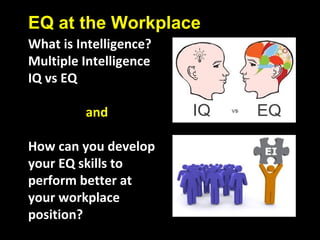
What is Intelligence?
Multiple Intelligence
IQ vs EQ
and
How can you develop
your EQ skills to
perform better at
your workplace
position?
EQ at the Workplace
Emotional Intelligence refers to a
set of emotional and social skills
and competencies that influence
the way we perceive and
express ourselves; develop and
maintain social relationships;
cope with challenges; and use
the information in emotions in
effective and meaningful ways.
This program explores how you can leverage EQ
competencies to enhance performance and productivity in
your organization.
Content
Self Awareness and Self-
Management Competencies
Strategic Leadership
- Applying EQ to Address your
Workplace Challenges
Moving Forward
- Setting Clear Action Plans for Ongoing EQ
Engagement
Emotional Intelligence (EQ) at the Workplace
- Understanding EQ in Yourself and the Workplace
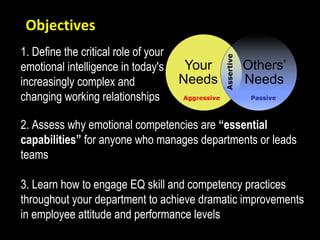
1. Define the critical role of your
emotional intelligence in today's
increasingly complex and
changing working relationships
Objectives
2. Assess why emotional competencies are “essential
capabilities” for anyone who manages departments or leads
teams
3. Learn how to engage EQ skill and competency practices
throughout your department to achieve dramatic improvements
in employee attitude and performance levels
EQ at the Workplace
What is Intelligence? Multiple Intelligence?
IQ vs EQ
Is There Multiple Intelligence?Is There Multiple Intelligence?
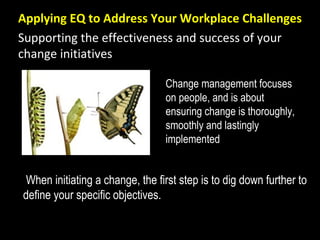
IQ vs EQIQ vs EQ
Definition of IntelligenceDefinition of Intelligence
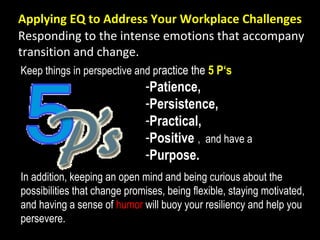
The ability to learn or understand or to deal
with new or trying situations: the skilled
use of reason
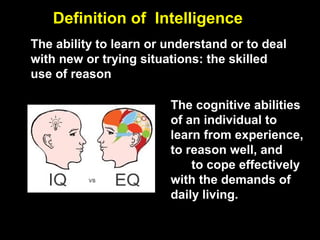
The cognitive abilities
of an individual to
learn from experience,
to reason well, and
to cope effectively
with the demands of
daily living.
"Intelligence, is the aggregate or global
capacity of the individual to act
purposefully, to think rationally, and to
deal effectively with his environment”
- David Wechsler
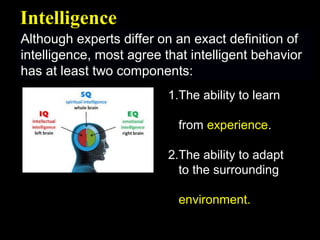
Although experts differ on an exact definition ofAlthough experts differ on an exact definition of
intelligence, most agree that intelligent behaviorintelligence, most agree that intelligent behavior
has at least two components:has at least two components:
IntelligenceIntelligence
1.The ability to learn
from experience.
2.The ability to adapt
to the surrounding
environment.
What do we know about IQ?What do we know about IQ?
Predicts school grades relatively well
Does not predict success in life
Predicts 6% of job success
Peaks in late teens
Culture-bound, Gender Bias, SES
Racial controversies
Gets you in the door
– Professional schools (medicine, dentistry, law)
– Can help you get hired (Harvard MBA)
Static
Factors of General Intelligence TestsFactors of General Intelligence Tests
1. Verbal Comprehension - vocabulary,
verbal analogies
2. Number - mathematical operations
3. Space - visual-spatial and mental
transformation
4. Associative Memory - rote memory
5. Perceptual Speed - quickness in
noticing similarities and differences
6. Reasoning - skill in inductive,
deductive, and math problems, and math problems
Is There MultipleIs There Multiple
Intelligence?Intelligence?
Gardner first theory on Multiple Intelligence
(1983)
Since 1999, Gardner has
identified eight intelligences:
1.logic-mathematical,
2.linguistic,
3.musical,
4.spatial,
5.bodily/kinesthetic,
6.interpersonal,
7.intrapersonal, and
8.naturalistic.
“humans have several different ways of processing information
and these ways are relatively independent of one another”.
Intelligence Core Components End-States
Logical-
mathematical
Linguistic
Musical
Spatial
Sensitivity to, and capacity to discern, logical
or numerical patterns; ability to handle long
chains of reasoning.
Sensitivity to the sounds, rhythms, and
meanings of words; sensitivity to the
different functions of language.
Abilities to produce and appreciate rhythm,
pitch, and timbre; appreciation of the forms
of musical expressiveness.
Capacities to perceive the visual-spatial
world accurately and to perform
transformations on ones initial perceptions.
Scientist
Mathematician
Poet
Journalist
Violinist
Composer
Sculptor
Navigator
Gardner’s Seven Intelligences
Intelligence Core Components End-States
Bodily-
Kinesthetic
Interpersonal
Intrapersonal
Abilities to control ones body
movements and to handle objects
skillfully.
Capacities to discern and respond
appropriately to the moods,
temperaments, motivations, and desires
of other people.
Access to ones own feelings and the
ability to discriminate among them and
draw upon them to guide behavior;
knowledge of one’s own strengths,
weaknesses, desires, and intelligences.
Dancer
Athlete
Therapist
Salesman
Person with
detailed
accurate self-
knowledge
Gardner’s Seven Intelligences
Multiple IntelligenceMultiple Intelligence
Naturalistic is the most recent addition to Gardner’s
theory and has been met with more resistance than
his original seven intelligences.
According to Gardner, individuals who
are high in this type of intelligence are
more in tune with nature and are often
interested in nurturing, exploring the
environment and learning about other
species.
These individuals are said to be highly aware of even subtle
changes to their environments.
What is Emotional Intelligence ? (EQ)
Wikipedia
Emotional intelligence
or (EQ) is the ability to
identify, assess, and
control the emotions of
oneself, of others, and
of groups.
Generally, it’s being able to correctly perceive
and respond appropriately to the underlying
emotions of the people you come in contact to.
Where did the concept of EmotionalWhere did the concept of Emotional
Intelligence come from?Intelligence come from?
In 1983, after Gardner theory, from extensive brain
research on Multiple Intelligence,
Reuven Bar-On (1988),
Peter Salovey & John Mayer (1990) and
Goleman (1995-2003)
all proposed, defined and popularized their
individual theory and concept of emotional
intelligence (EI)
Emotional intelligence is
“an array of non-cognitive
capabilities,
competencies, and skills
that influence one’s ability
to succeed in coping with
environmental demands
and pressures”
Reuven Bar-On (1988) has placed EI in the context of
personality theory, specifically a model of well-being
Emotional intelligence is
“an array of non-cognitive
capabilities, competencies,
and skills that influence
one’s ability to succeed in
coping with environmental
demands and pressures”
Peter Salovey and John Mayer first proposed their theory
of emotional intelligence (EI) in 1990 and defined it
John D. Mayer
“Emotional Intelligence
refers to the capacity for
recognizing our own feelings
and those of others, for
motivating ourselves, and for
managing emotions well in
ourselves and our
relationships.”
Goleman (1995-2003) has popularized the concept
of emotional intelligence and formulated EI in terms
of a theory of job and work performance
Emotionally Intelligent Behavior
“I look upon intelligence as
an effect rather than a cause,
that is, as a resultant of
interacting abilities – non
intellective included.
Intelligence Does Not = Behavior
The problem confronting psychologists today is how
these abilities interact to give the resultant effect we
call intelligence.“
- Wechsler
EQ at the Workplace
How can you develop your EQ skills to
perform better at your workplace position?
How can you develop your EQ skills to
perform better at your workplace position?
1.Take initiative
2. Act as a team player
3. Be flexible
4. Communicate
effectively
How can you develop your EQ skills to
perform better at your workplace position?
1. Take Initiative: Demonstrate responsibility and
enthusiasm for your job by striving to go the extra mile.
Do tasks without being
asked by someone else.
Look around, This starts by
finishing work without
constant reminders from
your supervisor.
And if you are already in a leadership role, this means setting
the example what needs to be done, and do it. Be the owner
Be the owner .This rarely goes unnoticed.
If a co-worker has a large project and you have
some time on your hands, volunteer to help.
How can you develop your EQ skills to
perform better at your workplace position?
Further, you could seek
more challenging work
and strive to develop
your technical skills
and do it.
How can you develop your EQ skills to
perform better at your workplace position?
Practice leading in small
group discussions by
asking your teammates
questions and bringing
quieter members into the
conversation.
2. Act as a team player: This means not only
being cooperative, but also displaying strong
leadership skills when necessary.
How can you develop your EQ skills to
perform better at your workplace position?
Be open and agreeable to
other people’s suggestions,
respect difference of
opinions, accept your
mistakes, and show empathy
to others.
3. Be flexible: Employees who can adapt to any situation
are dependable no matter what is thrown at them.
Understand constraints and reasons why someone is unable to
stick to a plan and then work to create a new plan if necessary.
You do not want to be called a “stuck up” as a manager. Adopt
agile methods. Be prepared for any breakdowns.
How can you develop your EQ skills to
perform better at your workplace position?
Get to a discussion, write down the key points and send
them all over Email, so that people can sign off to what
was being said, and everyone is on the same page.
4. Communicate effectively: Communicate clearly through
written, oral, and nonverbal communication. Be concise
instead of going in loops. Articulate well, be a good
listener, and use
appropriate body
language at all times.
People with High EQ Know:
• Who they are
• What they need to do to
take care of themselves
• Who others are within
their own context
How they need to manage their impact on
others.
EQ is not…
• Letting your feelings run rampant
• Being nice regardless of what
happens to you
• Specific to gender or genetically fixed
• IQ, knowledge or education based
• About anger management
EQ is being able to come into a relationship with
your full self. Do you swallow your truth? Be able
to speak your truth.
Emotional Intelligence is not just about managing
emotions:
Understanding EQ in Yourself and the Workplace
It involves engaging a distinct
combination of emotional,
personal and interpersonal
skills and competencies that
are essential to your leadership
and management success.
And the way we can
choose effective
leadership behaviors to
benefit individuals we
work with and the
organization as a whole.
Self Awareness and Self-Management
Competencies
How well we understand ourselves is the basis of
successful self management.
The Impact of Self-
Awareness
Research supports that
Self-Awareness
is a
necessary underpinning
of both
Self-Management and
Social Awareness
With Self-Awareness, a person has 50/50 chance of
demonstrating Self-Management
49%49%
4%4%
51%51%
Yes No
Yes
No
N = 427, p < .001 (Burckle and Boyatzis, 1999)
Self-Management
Self-
Awareness
Without Self-Awareness, a person has virtually no chance of
demonstrating Self-Management.
Self Awareness & Self Management
96%96%
83%83%
38%38%
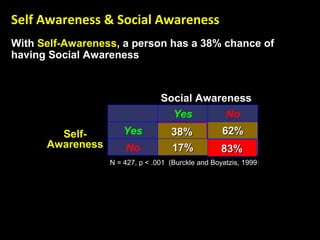
Self Awareness & Social Awareness
With Self-Awareness, a person has a 38% chance of
having Social Awareness
83%83%
38%38%
17%17%
62%62%
Yes No
Yes
No
Social Awareness
Self-
Awareness
N = 427, p < .001 (Burckle and Boyatzis, 1999)
• why some people with
moderate IQ do well in life
while others with high IQ
fail
• distinct from IQ (cognitive
intelligence)
• components resemble
personality factors, but can
change and can be altered
Dr. Reuven Bar-On in 1980 began to explore
factors that were related to success in life:
Self Awareness and Self-Management
Competencies
BarOn/EQ-iBarOn/EQ-i®®
FactorsFactors
Intra-Personal
– Emotional Self-Awareness
– Assertiveness
– Self-Regard
– Self-Actualization
– Independence
Stress Management
– Stress Tolerance
– Impulse Control
Inter-Personal
– Interpersonal
Relationship
– Empathy
– Social Responsibility
Adaptability
– Problem Solving
– Flexibility
– Reality Testing
General Mood
-- Optimism
-- Happiness
Why was the BarOn EQ-i Developed?Why was the BarOn EQ-i Developed?
To help answer a basic question:
Why do some peopleWhy do some people
with high IQ fail inwith high IQ fail in
life, while others withlife, while others with
moderate IQmoderate IQ
succeed?succeed?
How Does the EQ-i Work?How Does the EQ-i Work?
• 133 brief items answered on a 5-point scale from “Not
True of Me” to “True of Me”
• 30 minutes to complete
• Standard scores based on “100” as the average, Standard
Deviation of 15
• Includes the following scales:
–Total EQ
–5 EQ Composite Scales
–15 EQ Content Scales
–4 Validity Scales
Sample Test Items:
I have good relations with others
I’m fun to be with
I like helping people
Rating Scale:
1 = Very Seldom or Not True of me
5 = Very Often True of Me or True of Me
WorkshopWorkshop
Bar On /EQ-iBar On /EQ-i
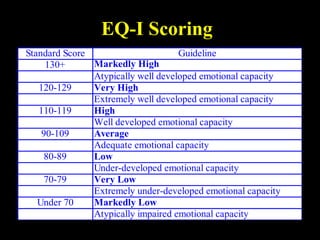
EQ-I ScoringEQ-I Scoring
Standard Score Guideline
130+ Markedly High
Atypically well developed emotional capacity
120-129 Very High
Extremely well developed emotional capacity
110-119 High
Well developed emotional capacity
90-109 Average
Adequate emotional capacity
80-89 Low
Under-developed emotional capacity
70-79 Very Low
Extremely under-developed emotional capacity
Under 70 Markedly Low
Atypically impaired emotional capacity
There’s No Crying in Baseball
How do you think the coach would score on his
EQ Assessment?
http://www.youtube.com/watch?v=gKCHvOvlHL0
•Critical thinking skills
•Influencing even when you do
not have authority
•Supporting the effectiveness
and success of your change
initiatives
•Responding to the intense
emotions that accompany
transition and change
Strategic Leadership – Applying EQ to Address
Your Workplace Challenges
An organization that collectively exhibits effective EQ
builds capacity for sustainable organizational change
and performance.
Critical thinking skills
The word “critical” often misleads us to think that critical thinking
is only based on soul-less data, information and evidences.
According to Rudd, Baker and
Hoover (2000), critical thinking is a
“reasoned, purposive and
introspective approach to solving
problems or addressing questions”.
Applying EQ to Address Your Workplace Challenges
Introspection when solving problems as a team includes acknowledging
the thoughts of others, one of the key elements of emotional intelligence.
Influencing even when you do not have authority
Applying EQ to Address Your Workplace Challenges
With authority, you can simply “order” to do what you want. That may
not be the most effective leadership strategy; you’ll get what you ask for.
But, how to influence someone over
whom we have no control, power or
authority?.
First, respect other people’s opinions
or thoughts.
Don't tell people they are wrong.
Be more inclusive, less divisive.
Be conversational, not argumentative.
 Listen more, talk less.
Influencing even when you do not have authority
Applying EQ to Address Your Workplace Challenges
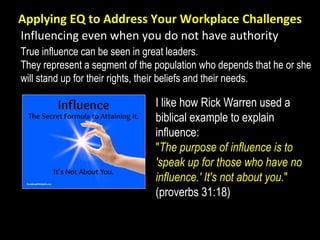
True influence can be seen in great leaders.
They represent a segment of the population who depends that he or she
will stand up for their rights, their beliefs and their needs.
I like how Rick Warren used a
biblical example to explain
influence:
"The purpose of influence is to
'speak up for those who have no
influence.' It's not about you."
(proverbs 31:18)
Supporting the effectiveness and success of your
change initiatives
Change management focuses
on people, and is about
ensuring change is thoroughly,
smoothly and lastingly
implemented
Applying EQ to Address Your Workplace Challenges
When initiating a change, the first step is to dig down further to
define your specific objectives.
Supporting the effectiveness and success of your
change initiatives
Typically, these will cover :
Sponsorship, - senior level directly or
indirectly
Buy-in, -from those involved and
affected
Involvement, -people from design
and implementation
Impact, how the changes will affect
people.
Applying EQ to Address Your Workplace Challenges
Communication, -Telling everyone who's affected about the changes
Readiness, - to adapt, ensuring they have the right information, training
and help
Applying EQ to Address Your Workplace Challenges
In addition, keeping an open mind and being curious about the
possibilities that change promises, being flexible, staying motivated,
and having a sense of humor will buoy your resiliency and help you
persevere.
Keep things in perspective and practice the 5 P‘s
-Patience,
-Persistence,
-Practical,
-Positive , and have a
-Purpose.
Responding to the intense emotions that accompany
transition and change.
Responding to the intense emotions that accompany
transition and change.
Applying EQ to Address Your Workplace Challenges
Going through transitions that
accompany change can be thriving and
also difficult. Mastering the art of change
over the course of a lifetime provides a
great advantage to alter your responses
to change in order to create a more
satisfying experience.
These are basic 5P’s of things to consider that can help you
negotiate and navigate your course to the intense emotion that
accompany transition & change.
Your EQ learning and development does not end here
and now. We must set clear intentions and action plans
in maintaining and moving forward.
Moving Forward – Setting Clear Action Plans for
Ongoing EQ Engagement
•Integrating your new ways of thinking
and acting to enhance your leadership
effectiveness back at the office
•Building on your strengths and
identifying strategic areas for
development
•Clarifying your vision of success and
developing a customized development
action plan
Setting Clear Action Plans for Ongoing EQ Engagement
•Empathy
•Self Control
•Self Confidence
------------------------------------
•Developing Others
•Holding People Accountable
•Team Leadership
-------------------------------------
•Results Orientation
•Initiative
•Problem Solving
-------------------------------------
•Influencing Others
•Fostering Teamwork
Manager Model
EQ in Action
What positive and/or negative examples do you see of emotional intelligence?
http://youtu.be/CiXTwfipyqk
He passed $2.5 million forged checks across
26 countries over five years, beginning 16
years old. He became one of the most famous
impostors ever, assumed no less than eight
separate identities as an airline pilot, a doctor,
a US Bureau of Prisons agent, and a lawyer.
Catch Me if You Can – scene demonstrates prime example of a person
with a very high EQ and social awareness and excellent ability to manage
his emotions. Movie is a true story based on the life of Frank Abignale
(played by Leonardo Di Caprio) who became notorious in the 1960s
He escaped from police custody twice (once from a taxiing airliner and
once from a US Federal Penitentiary before he was 21 years old.
He served fewer than five years in prison before starting to work for the
FBI with He is a consultant and lecturer at the academy and field offices
for the FBI – with Agent Carl Hanratty (Tom Hanks character)
EmotionsEmotionsEmotionsEmotions ThoughtsThoughtsThoughtsThoughts BehaviorBehaviorBehaviorBehavior Performance
Developing EQ Involves
• Revising responses to feelings
• Changing thinking patterns
• Altering behavior and trying new things
• Coaching can be instrumental in the process
Self-
Awareness
Social
Awareness
Self-
Management
Relationship
Management
• Emotional
Self-Awareness
• Accurate
Self-Assessment
• Self-Confidence
• Empathy
• Organizational
Awareness
• Service Orientation
• Emotional Self-Control
• Transparency
• Optimism
• Adaptability
• Achievement
Orientation
• Initiative
• Developing Others
• Inspirational
Leadership
• Influence
• Change Catalyst
• Conflict Management
• Teamwork &
Collaboration
The Twenty EQ Competencies
The Stake Prime
When you’re up to something big that requires enrolling a large group,
there will be a mix of all three types of people. You must address each
of their unique ways of listening.
When the STAKE is stated powerfully, of it’s impact on the Heart,
the Head and the Wallet, CHANGE and TRANSFORMATION become
possible. A weakly stated STAKE keeps groups entrenched in the status
quo.
Three basic ways that people
listen:
Analytical people listen with
their Heads.
Emotional people listen with
their Hearts.
Financially motivated people
listen with their Wallets.
The Stake Prime
We start by closely examining our
powerful STAKE conversation,
dissecting the patterns it reveals,
and from those revelations we
make the case for change.
Before any CHANGE or TRANSFORMATION can occur, people must
be convinced; therefore, the STAKE must operate on an
organizational, community, and personal level.
The STAKE illustration shows three basic ways that people listen:
Analytical people listen with their Heads.
Emotional people listen with their Hearts.
Financially motivated people listen with their Wallets.
Powerful STAKE conversat
ions must have negative
aspects (what to avoid or
PUSH away from) and
positive aspects (what
people desire and want to
PULL toward them).
The Path Between Feeling and Reason
The secret is to manage
the way we explain
situations to ourselves.
You have
to SHIFT YOUR
PERSPECTIVE
The mind needs
conditioning as much
as our muscles.
Changing our thinking patterns.
Some Applications of theSome Applications of the EQ-iEQ-i®®
• Recruiting high
performers
• Retaining high
performers
• Teambuilding
• Managing diversity
• Leadership
development
• Coaching
• Performance
management
• Risk management
• Self development
• Change management
• Merger integration &
re-shaping culture
• Restructuring &
realignment
• Stress management
• Career planning
Effects of IntelligenceEffects of Intelligence (EI)(EI) on Career Successon Career Success
High IQ & EI
CAREER
ADVANCEMENT
High IQ low EI
CAREER
DERAILMENT
Be Blessed!
Principal Consultant for Lean Management.
Certified Kaizen Specialist & TPM with 30 over
years working experience.
Provides Technical Consulting Services on
TPM, Kaizen, Cellular system & Moonshine set
up.
An Innovator with Mechanical background that
adopts Green Living. Innovates by Recycling
and Reusing Idle resources to eliminate waste
to add Value to promote Green.
Founder of Tim’s Waterfuel, an alternative
Hydroxy fuel supplement using Water that adds
power and reduce Co2 emission on
automobiles.
An NGO Community worker for Prison, Drug
Rehabilitation and CREST North (Crisis Relieve
& Training) Malaysia, an organization that
respond to Crisis & Flood.
Timothy Wooi
Add: 20C, Taman Bahagia, 06000,
Jitra, Kedah
Email: timothywooi2@gmail.com
H/p: 019 4514007 (Malaysia)

Eq at Workplace

  • 1.
    EQ at theWorkplace What is Intelligence? Multiple Intelligence IQ vs EQ and How can you develop your EQ skills to perform better at your workplace position?
  • 2.
    EQ at theWorkplace Emotional Intelligence refers to a set of emotional and social skills and competencies that influence the way we perceive and express ourselves; develop and maintain social relationships; cope with challenges; and use the information in emotions in effective and meaningful ways. This program explores how you can leverage EQ competencies to enhance performance and productivity in your organization.
  • 3.
    Content Self Awareness andSelf- Management Competencies Strategic Leadership - Applying EQ to Address your Workplace Challenges Moving Forward - Setting Clear Action Plans for Ongoing EQ Engagement Emotional Intelligence (EQ) at the Workplace - Understanding EQ in Yourself and the Workplace
  • 4.
    1. Define thecritical role of your emotional intelligence in today's increasingly complex and changing working relationships Objectives 2. Assess why emotional competencies are “essential capabilities” for anyone who manages departments or leads teams 3. Learn how to engage EQ skill and competency practices throughout your department to achieve dramatic improvements in employee attitude and performance levels
  • 5.
    EQ at theWorkplace What is Intelligence? Multiple Intelligence? IQ vs EQ
  • 6.
    Is There MultipleIntelligence?Is There Multiple Intelligence? IQ vs EQIQ vs EQ
  • 7.
    Definition of IntelligenceDefinitionof Intelligence The ability to learn or understand or to deal with new or trying situations: the skilled use of reason The cognitive abilities of an individual to learn from experience, to reason well, and to cope effectively with the demands of daily living.
  • 8.
    "Intelligence, is theaggregate or global capacity of the individual to act purposefully, to think rationally, and to deal effectively with his environment” - David Wechsler
  • 9.
    Although experts differon an exact definition ofAlthough experts differ on an exact definition of intelligence, most agree that intelligent behaviorintelligence, most agree that intelligent behavior has at least two components:has at least two components: IntelligenceIntelligence 1.The ability to learn from experience. 2.The ability to adapt to the surrounding environment.
  • 10.
    What do weknow about IQ?What do we know about IQ? Predicts school grades relatively well Does not predict success in life Predicts 6% of job success Peaks in late teens Culture-bound, Gender Bias, SES Racial controversies Gets you in the door – Professional schools (medicine, dentistry, law) – Can help you get hired (Harvard MBA) Static
  • 11.
    Factors of GeneralIntelligence TestsFactors of General Intelligence Tests 1. Verbal Comprehension - vocabulary, verbal analogies 2. Number - mathematical operations 3. Space - visual-spatial and mental transformation 4. Associative Memory - rote memory 5. Perceptual Speed - quickness in noticing similarities and differences 6. Reasoning - skill in inductive, deductive, and math problems, and math problems
  • 12.
    Is There MultipleIsThere Multiple Intelligence?Intelligence?
  • 13.
    Gardner first theoryon Multiple Intelligence (1983) Since 1999, Gardner has identified eight intelligences: 1.logic-mathematical, 2.linguistic, 3.musical, 4.spatial, 5.bodily/kinesthetic, 6.interpersonal, 7.intrapersonal, and 8.naturalistic. “humans have several different ways of processing information and these ways are relatively independent of one another”.
  • 14.
    Intelligence Core ComponentsEnd-States Logical- mathematical Linguistic Musical Spatial Sensitivity to, and capacity to discern, logical or numerical patterns; ability to handle long chains of reasoning. Sensitivity to the sounds, rhythms, and meanings of words; sensitivity to the different functions of language. Abilities to produce and appreciate rhythm, pitch, and timbre; appreciation of the forms of musical expressiveness. Capacities to perceive the visual-spatial world accurately and to perform transformations on ones initial perceptions. Scientist Mathematician Poet Journalist Violinist Composer Sculptor Navigator Gardner’s Seven Intelligences
  • 15.
    Intelligence Core ComponentsEnd-States Bodily- Kinesthetic Interpersonal Intrapersonal Abilities to control ones body movements and to handle objects skillfully. Capacities to discern and respond appropriately to the moods, temperaments, motivations, and desires of other people. Access to ones own feelings and the ability to discriminate among them and draw upon them to guide behavior; knowledge of one’s own strengths, weaknesses, desires, and intelligences. Dancer Athlete Therapist Salesman Person with detailed accurate self- knowledge Gardner’s Seven Intelligences
  • 16.
    Multiple IntelligenceMultiple Intelligence Naturalisticis the most recent addition to Gardner’s theory and has been met with more resistance than his original seven intelligences. According to Gardner, individuals who are high in this type of intelligence are more in tune with nature and are often interested in nurturing, exploring the environment and learning about other species. These individuals are said to be highly aware of even subtle changes to their environments.
  • 17.
    What is EmotionalIntelligence ? (EQ) Wikipedia Emotional intelligence or (EQ) is the ability to identify, assess, and control the emotions of oneself, of others, and of groups. Generally, it’s being able to correctly perceive and respond appropriately to the underlying emotions of the people you come in contact to.
  • 18.
    Where did theconcept of EmotionalWhere did the concept of Emotional Intelligence come from?Intelligence come from? In 1983, after Gardner theory, from extensive brain research on Multiple Intelligence, Reuven Bar-On (1988), Peter Salovey & John Mayer (1990) and Goleman (1995-2003) all proposed, defined and popularized their individual theory and concept of emotional intelligence (EI)
  • 19.
    Emotional intelligence is “anarray of non-cognitive capabilities, competencies, and skills that influence one’s ability to succeed in coping with environmental demands and pressures” Reuven Bar-On (1988) has placed EI in the context of personality theory, specifically a model of well-being
  • 20.
    Emotional intelligence is “anarray of non-cognitive capabilities, competencies, and skills that influence one’s ability to succeed in coping with environmental demands and pressures” Peter Salovey and John Mayer first proposed their theory of emotional intelligence (EI) in 1990 and defined it John D. Mayer
  • 21.
    “Emotional Intelligence refers tothe capacity for recognizing our own feelings and those of others, for motivating ourselves, and for managing emotions well in ourselves and our relationships.” Goleman (1995-2003) has popularized the concept of emotional intelligence and formulated EI in terms of a theory of job and work performance
  • 22.
    Emotionally Intelligent Behavior “Ilook upon intelligence as an effect rather than a cause, that is, as a resultant of interacting abilities – non intellective included. Intelligence Does Not = Behavior The problem confronting psychologists today is how these abilities interact to give the resultant effect we call intelligence.“ - Wechsler
  • 23.
    EQ at theWorkplace How can you develop your EQ skills to perform better at your workplace position?
  • 24.
    How can youdevelop your EQ skills to perform better at your workplace position? 1.Take initiative 2. Act as a team player 3. Be flexible 4. Communicate effectively
  • 25.
    How can youdevelop your EQ skills to perform better at your workplace position? 1. Take Initiative: Demonstrate responsibility and enthusiasm for your job by striving to go the extra mile. Do tasks without being asked by someone else. Look around, This starts by finishing work without constant reminders from your supervisor. And if you are already in a leadership role, this means setting the example what needs to be done, and do it. Be the owner
  • 26.
    Be the owner.This rarely goes unnoticed. If a co-worker has a large project and you have some time on your hands, volunteer to help. How can you develop your EQ skills to perform better at your workplace position? Further, you could seek more challenging work and strive to develop your technical skills and do it.
  • 27.
    How can youdevelop your EQ skills to perform better at your workplace position? Practice leading in small group discussions by asking your teammates questions and bringing quieter members into the conversation. 2. Act as a team player: This means not only being cooperative, but also displaying strong leadership skills when necessary.
  • 28.
    How can youdevelop your EQ skills to perform better at your workplace position? Be open and agreeable to other people’s suggestions, respect difference of opinions, accept your mistakes, and show empathy to others. 3. Be flexible: Employees who can adapt to any situation are dependable no matter what is thrown at them. Understand constraints and reasons why someone is unable to stick to a plan and then work to create a new plan if necessary. You do not want to be called a “stuck up” as a manager. Adopt agile methods. Be prepared for any breakdowns.
  • 29.
    How can youdevelop your EQ skills to perform better at your workplace position? Get to a discussion, write down the key points and send them all over Email, so that people can sign off to what was being said, and everyone is on the same page. 4. Communicate effectively: Communicate clearly through written, oral, and nonverbal communication. Be concise instead of going in loops. Articulate well, be a good listener, and use appropriate body language at all times.
  • 30.
    People with HighEQ Know: • Who they are • What they need to do to take care of themselves • Who others are within their own context How they need to manage their impact on others.
  • 31.
    EQ is not… •Letting your feelings run rampant • Being nice regardless of what happens to you • Specific to gender or genetically fixed • IQ, knowledge or education based • About anger management EQ is being able to come into a relationship with your full self. Do you swallow your truth? Be able to speak your truth.
  • 32.
    Emotional Intelligence isnot just about managing emotions: Understanding EQ in Yourself and the Workplace It involves engaging a distinct combination of emotional, personal and interpersonal skills and competencies that are essential to your leadership and management success.
  • 33.
    And the waywe can choose effective leadership behaviors to benefit individuals we work with and the organization as a whole. Self Awareness and Self-Management Competencies How well we understand ourselves is the basis of successful self management.
  • 34.
    The Impact ofSelf- Awareness Research supports that Self-Awareness is a necessary underpinning of both Self-Management and Social Awareness
  • 35.
    With Self-Awareness, aperson has 50/50 chance of demonstrating Self-Management 49%49% 4%4% 51%51% Yes No Yes No N = 427, p < .001 (Burckle and Boyatzis, 1999) Self-Management Self- Awareness Without Self-Awareness, a person has virtually no chance of demonstrating Self-Management. Self Awareness & Self Management 96%96%
  • 36.
    83%83% 38%38% Self Awareness &Social Awareness With Self-Awareness, a person has a 38% chance of having Social Awareness 83%83% 38%38% 17%17% 62%62% Yes No Yes No Social Awareness Self- Awareness N = 427, p < .001 (Burckle and Boyatzis, 1999)
  • 37.
    • why somepeople with moderate IQ do well in life while others with high IQ fail • distinct from IQ (cognitive intelligence) • components resemble personality factors, but can change and can be altered Dr. Reuven Bar-On in 1980 began to explore factors that were related to success in life: Self Awareness and Self-Management Competencies
  • 39.
    BarOn/EQ-iBarOn/EQ-i®® FactorsFactors Intra-Personal – Emotional Self-Awareness –Assertiveness – Self-Regard – Self-Actualization – Independence Stress Management – Stress Tolerance – Impulse Control Inter-Personal – Interpersonal Relationship – Empathy – Social Responsibility Adaptability – Problem Solving – Flexibility – Reality Testing General Mood -- Optimism -- Happiness
  • 40.
    Why was theBarOn EQ-i Developed?Why was the BarOn EQ-i Developed? To help answer a basic question: Why do some peopleWhy do some people with high IQ fail inwith high IQ fail in life, while others withlife, while others with moderate IQmoderate IQ succeed?succeed?
  • 41.
    How Does theEQ-i Work?How Does the EQ-i Work? • 133 brief items answered on a 5-point scale from “Not True of Me” to “True of Me” • 30 minutes to complete • Standard scores based on “100” as the average, Standard Deviation of 15 • Includes the following scales: –Total EQ –5 EQ Composite Scales –15 EQ Content Scales –4 Validity Scales
  • 42.
    Sample Test Items: Ihave good relations with others I’m fun to be with I like helping people Rating Scale: 1 = Very Seldom or Not True of me 5 = Very Often True of Me or True of Me WorkshopWorkshop Bar On /EQ-iBar On /EQ-i
  • 43.
    EQ-I ScoringEQ-I Scoring StandardScore Guideline 130+ Markedly High Atypically well developed emotional capacity 120-129 Very High Extremely well developed emotional capacity 110-119 High Well developed emotional capacity 90-109 Average Adequate emotional capacity 80-89 Low Under-developed emotional capacity 70-79 Very Low Extremely under-developed emotional capacity Under 70 Markedly Low Atypically impaired emotional capacity
  • 44.
    There’s No Cryingin Baseball How do you think the coach would score on his EQ Assessment? http://www.youtube.com/watch?v=gKCHvOvlHL0
  • 45.
    •Critical thinking skills •Influencingeven when you do not have authority •Supporting the effectiveness and success of your change initiatives •Responding to the intense emotions that accompany transition and change Strategic Leadership – Applying EQ to Address Your Workplace Challenges An organization that collectively exhibits effective EQ builds capacity for sustainable organizational change and performance.
  • 46.
    Critical thinking skills Theword “critical” often misleads us to think that critical thinking is only based on soul-less data, information and evidences. According to Rudd, Baker and Hoover (2000), critical thinking is a “reasoned, purposive and introspective approach to solving problems or addressing questions”. Applying EQ to Address Your Workplace Challenges Introspection when solving problems as a team includes acknowledging the thoughts of others, one of the key elements of emotional intelligence.
  • 47.
    Influencing even whenyou do not have authority Applying EQ to Address Your Workplace Challenges With authority, you can simply “order” to do what you want. That may not be the most effective leadership strategy; you’ll get what you ask for. But, how to influence someone over whom we have no control, power or authority?. First, respect other people’s opinions or thoughts. Don't tell people they are wrong. Be more inclusive, less divisive. Be conversational, not argumentative.  Listen more, talk less.
  • 48.
    Influencing even whenyou do not have authority Applying EQ to Address Your Workplace Challenges True influence can be seen in great leaders. They represent a segment of the population who depends that he or she will stand up for their rights, their beliefs and their needs. I like how Rick Warren used a biblical example to explain influence: "The purpose of influence is to 'speak up for those who have no influence.' It's not about you." (proverbs 31:18)
  • 49.
    Supporting the effectivenessand success of your change initiatives Change management focuses on people, and is about ensuring change is thoroughly, smoothly and lastingly implemented Applying EQ to Address Your Workplace Challenges When initiating a change, the first step is to dig down further to define your specific objectives.
  • 50.
    Supporting the effectivenessand success of your change initiatives Typically, these will cover : Sponsorship, - senior level directly or indirectly Buy-in, -from those involved and affected Involvement, -people from design and implementation Impact, how the changes will affect people. Applying EQ to Address Your Workplace Challenges Communication, -Telling everyone who's affected about the changes Readiness, - to adapt, ensuring they have the right information, training and help
  • 51.
    Applying EQ toAddress Your Workplace Challenges In addition, keeping an open mind and being curious about the possibilities that change promises, being flexible, staying motivated, and having a sense of humor will buoy your resiliency and help you persevere. Keep things in perspective and practice the 5 P‘s -Patience, -Persistence, -Practical, -Positive , and have a -Purpose. Responding to the intense emotions that accompany transition and change.
  • 52.
    Responding to theintense emotions that accompany transition and change. Applying EQ to Address Your Workplace Challenges Going through transitions that accompany change can be thriving and also difficult. Mastering the art of change over the course of a lifetime provides a great advantage to alter your responses to change in order to create a more satisfying experience. These are basic 5P’s of things to consider that can help you negotiate and navigate your course to the intense emotion that accompany transition & change.
  • 53.
    Your EQ learningand development does not end here and now. We must set clear intentions and action plans in maintaining and moving forward. Moving Forward – Setting Clear Action Plans for Ongoing EQ Engagement •Integrating your new ways of thinking and acting to enhance your leadership effectiveness back at the office •Building on your strengths and identifying strategic areas for development •Clarifying your vision of success and developing a customized development action plan
  • 54.
    Setting Clear ActionPlans for Ongoing EQ Engagement •Empathy •Self Control •Self Confidence ------------------------------------ •Developing Others •Holding People Accountable •Team Leadership ------------------------------------- •Results Orientation •Initiative •Problem Solving ------------------------------------- •Influencing Others •Fostering Teamwork Manager Model
  • 55.
    EQ in Action Whatpositive and/or negative examples do you see of emotional intelligence? http://youtu.be/CiXTwfipyqk
  • 56.
    He passed $2.5million forged checks across 26 countries over five years, beginning 16 years old. He became one of the most famous impostors ever, assumed no less than eight separate identities as an airline pilot, a doctor, a US Bureau of Prisons agent, and a lawyer. Catch Me if You Can – scene demonstrates prime example of a person with a very high EQ and social awareness and excellent ability to manage his emotions. Movie is a true story based on the life of Frank Abignale (played by Leonardo Di Caprio) who became notorious in the 1960s He escaped from police custody twice (once from a taxiing airliner and once from a US Federal Penitentiary before he was 21 years old. He served fewer than five years in prison before starting to work for the FBI with He is a consultant and lecturer at the academy and field offices for the FBI – with Agent Carl Hanratty (Tom Hanks character)
  • 57.
    EmotionsEmotionsEmotionsEmotions ThoughtsThoughtsThoughtsThoughts BehaviorBehaviorBehaviorBehaviorPerformance Developing EQ Involves • Revising responses to feelings • Changing thinking patterns • Altering behavior and trying new things • Coaching can be instrumental in the process
  • 58.
    Self- Awareness Social Awareness Self- Management Relationship Management • Emotional Self-Awareness • Accurate Self-Assessment •Self-Confidence • Empathy • Organizational Awareness • Service Orientation • Emotional Self-Control • Transparency • Optimism • Adaptability • Achievement Orientation • Initiative • Developing Others • Inspirational Leadership • Influence • Change Catalyst • Conflict Management • Teamwork & Collaboration The Twenty EQ Competencies
  • 59.
    The Stake Prime Whenyou’re up to something big that requires enrolling a large group, there will be a mix of all three types of people. You must address each of their unique ways of listening. When the STAKE is stated powerfully, of it’s impact on the Heart, the Head and the Wallet, CHANGE and TRANSFORMATION become possible. A weakly stated STAKE keeps groups entrenched in the status quo. Three basic ways that people listen: Analytical people listen with their Heads. Emotional people listen with their Hearts. Financially motivated people listen with their Wallets.
  • 60.
    The Stake Prime Westart by closely examining our powerful STAKE conversation, dissecting the patterns it reveals, and from those revelations we make the case for change. Before any CHANGE or TRANSFORMATION can occur, people must be convinced; therefore, the STAKE must operate on an organizational, community, and personal level. The STAKE illustration shows three basic ways that people listen: Analytical people listen with their Heads. Emotional people listen with their Hearts. Financially motivated people listen with their Wallets. Powerful STAKE conversat ions must have negative aspects (what to avoid or PUSH away from) and positive aspects (what people desire and want to PULL toward them).
  • 61.
    The Path BetweenFeeling and Reason The secret is to manage the way we explain situations to ourselves. You have to SHIFT YOUR PERSPECTIVE The mind needs conditioning as much as our muscles. Changing our thinking patterns.
  • 62.
    Some Applications oftheSome Applications of the EQ-iEQ-i®® • Recruiting high performers • Retaining high performers • Teambuilding • Managing diversity • Leadership development • Coaching • Performance management • Risk management • Self development • Change management • Merger integration & re-shaping culture • Restructuring & realignment • Stress management • Career planning
  • 63.
    Effects of IntelligenceEffectsof Intelligence (EI)(EI) on Career Successon Career Success High IQ & EI CAREER ADVANCEMENT High IQ low EI CAREER DERAILMENT
  • 64.
  • 65.
    Principal Consultant forLean Management. Certified Kaizen Specialist & TPM with 30 over years working experience. Provides Technical Consulting Services on TPM, Kaizen, Cellular system & Moonshine set up. An Innovator with Mechanical background that adopts Green Living. Innovates by Recycling and Reusing Idle resources to eliminate waste to add Value to promote Green. Founder of Tim’s Waterfuel, an alternative Hydroxy fuel supplement using Water that adds power and reduce Co2 emission on automobiles. An NGO Community worker for Prison, Drug Rehabilitation and CREST North (Crisis Relieve & Training) Malaysia, an organization that respond to Crisis & Flood. Timothy Wooi Add: 20C, Taman Bahagia, 06000, Jitra, Kedah Email: timothywooi2@gmail.com H/p: 019 4514007 (Malaysia)

Editor's Notes

  • #14 ccording to Gardner&amp;apos;s theory of multiple intelligences, humans have several different ways of processing information and these ways are relatively independent of one another. The theory is a critique of the standard intelligence theory, which emphasizes the correlation among abilities. Since 1999, Gardner has identified eight intelligences: linguistic, logic-mathematical, musical, spatial, bodily/kinesthetic, interpersonal, intrapersonal, and naturalistic. Gardner is informally considering two additional intelligences, existential and pedagogical.[10][11] Many teachers, school administrators, and special educators have been inspired by Gardner’s Theory of Multiple Intelligences as it has allowed for the idea that there is more than one way to define a person&amp;apos;s intellect.[12]
  • #17 Interpersonal Intelligence Relationship awareness / Management ability to perceive, express, understand, and regulate emotions Many teachers, school administrators, and special educators have been inspired by Gardner’s Theory of Multiple Intelligences as it has allowed for the idea that there is more than one way to define a person&amp;apos;s intellect.[12]
  • #32 EQ is being able to come into a relationship with your full self. Do you swallow your truth? Be able to speak your truth. EQ is about managing emotions in the moment, not controlling.
  • #39 This model was developed by Reuven Bar-On to measure emotional-social intelligence. It is considered to be one of the three major models of this construct according to the Encyclopedia of Applied Psychology (2004).
  • #42 The Emotional Quotient Inventory (EQ-i), EQ-360 and EQ-i: YV were developed to assess the Bar-On model of emotional-social intelligence. The EQ-i is a self-report measure designed to measure a number of constructs related to EI. The EQ-i consists of 133 items and takes approximately 30 minutes to complete. It gives an overall EQ score as well as scores for the following five composite scales and 15 subscales (Bar-On, 2006).
  • #46 Show film clip. Which skill set(s) does he need to work on? It is natural to assume that if something happens to you, the EVENT makes you FEEL a certain way. For example, a colleague speaks very rudely to you, and you conclude, he MADE you angry. You may also conclude that his BEHAVIOR Made YOU BEHAVE in a particular way – hang up on the person, etc.
  • #49 True influence can be seen in great leaders. They represent a segment of the population who depends that he or she will stand up for their rights, their beliefs and their needs. I like how Rick Warren used a biblical example to explain influence (proverbs 31:18): &amp;quot;The purpose of influence is to &amp;apos;speak up for those who have no influence.&amp;apos; It&amp;apos;s not about you.&amp;quot;
  • #50 True influence can be seen in great leaders. They represent a segment of the population who depends that he or she will stand up for their rights, their beliefs and their needs. I like how Rick Warren used a biblical example to explain influence (proverbs 31:18): &amp;quot;The purpose of influence is to &amp;apos;speak up for those who have no influence.&amp;apos; It&amp;apos;s not about you.&amp;quot;
  • #51 Typically, these will cover : Sponsorship: Ensuring there is active sponsorship for the change at a senior executive level within the organization, and engaging this sponsorship to achieve the desired results. Buy-in: Gaining buy-in for the changes from those involved and affected, directly or indirectly. Involvement: Involving the right people in the design and implementation of changes, to make sure the right changes are made. Impact: Assessing and addressing how the changes will affect people. Communication: Telling everyone who&amp;apos;s affected about the changes. Readiness: Getting people ready to adapt to the changes, by ensuring they have the right information, training and help.
  • #52 Typically, these will cover : Sponsorship: Ensuring there is active sponsorship for the change at a senior executive level within the organization, and engaging this sponsorship to achieve the desired results. Buy-in: Gaining buy-in for the changes from those involved and affected, directly or indirectly. Involvement: Involving the right people in the design and implementation of changes, to make sure the right changes are made. Impact: Assessing and addressing how the changes will affect people. Communication: Telling everyone who&amp;apos;s affected about the changes. Readiness: Getting people ready to adapt to the changes, by ensuring they have the right information, training and help.
  • #53 Practice the 5 &amp;quot;P&amp;apos;s&amp;quot;. Learn patience. Generally, things do not happen overnight. In fact, it may take some time before a desired and/or reasonable outcome is reached. Don&amp;apos;t be impulsive or try to rush the results. Patience will help you arrive at the best possible place you need to be. Be persistent. It&amp;apos;s easy to want to give up, especially when things are not going your way, or are even looking glum. Keep on chipping away at the issues; the outcome or solution you&amp;apos;re seeking may be just around the bend. Be practical. Some changes require an immediate response to remedy a situation, but in most instances, there&amp;apos;s simply no rush to the finish line. Go about your life in a way that focuses attention on maintaining balance. Stay present, firmly rooted, in the here and now. In other words, create a structure that provides stability and support while you&amp;apos;re in the process of transitioning. Be positive. Expect &amp;quot;up and down&amp;quot;. In fact, that&amp;apos;s more the norm while you&amp;apos;re going through change. A sense of optimism will help equalize the hills and valleys and will keep you focused and committed. Have a purpose. No matter how many major changes and transitions you go through during the course of your life, having an organizing guiding principle that is vital to you and gives meaning to your life is essential.
  • #54 Practice the 5 &amp;quot;P&amp;apos;s&amp;quot;. Learn patience. Generally, things do not happen overnight. In fact, it may take some time before a desired and/or reasonable outcome is reached. Don&amp;apos;t be impulsive or try to rush the results. Patience will help you arrive at the best possible place you need to be. Be persistent. It&amp;apos;s easy to want to give up, especially when things are not going your way, or are even looking glum. Keep on chipping away at the issues; the outcome or solution you&amp;apos;re seeking may be just around the bend. Be practical. Some changes require an immediate response to remedy a situation, but in most instances, there&amp;apos;s simply no rush to the finish line. Go about your life in a way that focuses attention on maintaining balance. Stay present, firmly rooted, in the here and now. In other words, create a structure that provides stability and support while you&amp;apos;re in the process of transitioning. Be positive. Expect &amp;quot;up and down&amp;quot;. In fact, that&amp;apos;s more the norm while you&amp;apos;re going through change. A sense of optimism will help equalize the hills and valleys and will keep you focused and committed. Have a purpose. No matter how many major changes and transitions you go through during the course of your life, having an organizing guiding principle that is vital to you and gives meaning to your life is essential.
  • #57 Show Catch me If You Can Hotel Scene – start at 1:20 (bad language at beginning of scene) Catch Me if You Can – prime example of a person with a very high EQ. Movie is a true story based on the life of Frank Abignale (played by Leonardo Di Caprio) who became notorious in the 1960s for passing $2.5 million worth of forged checks across 26 countries over the course of five years, beginning when he was 16 years old. He became one of the most famous impostors ever, claiming to have assumed no fewer than eight separate identities as an airline pilot, a doctor, a US Bureau of Prisons agent, and a lawyer. He escaped from police custody twice (once from a taxiing airliner and once from a US Federal Penitentiary before he was 21 years old. He served fewer than five years in prison before starting to work for the FBI with He is a consultant and lecturer at the academy and field offices for the FBI – with Agent Carl Hanratty (Tom Hanks character) This scene demonstrates Frank’s social awareness and excellent ability to manage his emotions.
  • #58 Show Catch me If You Can Hotel Scene – start at 1:20 (bad language at beginning of scene) Catch Me if You Can – prime example of a person with a very high EQ. Movie is a true story based on the life of Frank Abignale (played by Leonardo Di Caprio) who became notorious in the 1960s for passing $2.5 million worth of forged checks across 26 countries over the course of five years, beginning when he was 16 years old. He became one of the most famous impostors ever, claiming to have assumed no fewer than eight separate identities as an airline pilot, a doctor, a US Bureau of Prisons agent, and a lawyer. He escaped from police custody twice (once from a taxiing airliner and once from a US Federal Penitentiary before he was 21 years old. He served fewer than five years in prison before starting to work for the FBI with He is a consultant and lecturer at the academy and field offices for the FBI – with Agent Carl Hanratty (Tom Hanks character) This scene demonstrates Frank’s social awareness and excellent ability to manage his emotions.
  • #61 When the STAKE is stated powerfully, in terms of it’s impact on the Heart, the Head and the Wallet, CHANGE and TRANSFORMATION become possible. A weakly stated STAKE keeps groups entrenched in the status quo.             After you’ve enlisted others in bold effort to achieve the extraordinary, questions and doubts arise — all perfectly reasonable — among the same people who heeded your call and pledged their support. STAKE is a key element of the CORE PRIME and it reveals six components of a robust answer to the question, “What’s at STAKE?”   Before any CHANGE or TRANSFORMATION can occur, people must be convinced; therefore, the STAKE must operate on an organizational, community, and personal level. We start by closely examining our powerful STAKE conversation, dissecting the patterns it reveals, and from those revelations we make the case for change.   The STAKE illustration shows three basic ways that people listen: Analytical people listen with their Heads. Emotional people listen with their Hearts. Financially motivated people listen with their Wallets.   When you’re up to something big that requires enrolling a large group, there will be a mix of all three types of people. You must address each of their unique ways of listening.   Powerful STAKE conversations must have negative aspects (what to avoid or PUSH away from) and positive aspects (what people desire and want to PULL toward them). 
  • #62 When the STAKE is stated powerfully, in terms of it’s impact on the Heart, the Head and the Wallet, CHANGE and TRANSFORMATION become possible. A weakly stated STAKE keeps groups entrenched in the status quo.             After you’ve enlisted others in bold effort to achieve the extraordinary, questions and doubts arise — all perfectly reasonable — among the same people who heeded your call and pledged their support. STAKE is a key element of the CORE PRIME and it reveals six components of a robust answer to the question, “What’s at STAKE?”   Before any CHANGE or TRANSFORMATION can occur, people must be convinced; therefore, the STAKE must operate on an organizational, community, and personal level. We start by closely examining our powerful STAKE conversation, dissecting the patterns it reveals, and from those revelations we make the case for change.   The STAKE illustration shows three basic ways that people listen: Analytical people listen with their Heads. Emotional people listen with their Hearts. Financially motivated people listen with their Wallets.   When you’re up to something big that requires enrolling a large group, there will be a mix of all three types of people. You must address each of their unique ways of listening.   Powerful STAKE conversations must have negative aspects (what to avoid or PUSH away from) and positive aspects (what people desire and want to PULL toward them). 
  • #63 Our brains are hard-wired to make us emotional creatures – our feelings are strong motivators of our behavior. Everything we sense travels through our bodies up the spinal cord to the brain in the form of electric signals. The signals first pass through the brain’s limbic system, the place where emotions are produced. They then travel to our frontal lobe (behind our forehead) the place where rational, logical thinking takes place. The journey the signals follow ensures we experience things emotionally before reason and rationality kick in. The Limbic and Frontal areas do communicate and this is the source of EQ. When Emotions are high it is hard to think clearly. In face of danger or under stress, the brain puts out a rush of adrenaline that drives the blood from our brain and into our limbs where it can help us fight or take flight. We get dumbed down. In order to think clearly, we have to reengage the brain. SHIFT PERSPECTIVE Changing our thinking patterns. The secret is to manage the way we explain situations to ourselves. You have to SHIFT YOUR PERSPECTIVE The mind needs conditioning as much as our muscles.