1
EmotionalEmotional
IntelligenceIntelligence
at Workat Work
2
Have you ever thought of why people of
average intelligence outperform people with the
highest levels of intelligence majority of the
time?
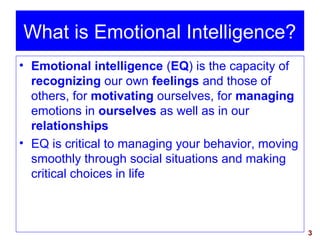
What is Emotional Intelligence?
3
• Emotional intelligence (EQ) is the capacity of
recognizing our own feelings and those of
others, for motivating ourselves, for managing
emotions in ourselves as well as in our
relationships
• EQ is critical to managing your behavior, moving
smoothly through social situations and making
critical choices in life
What is Emotional Intelligence?
4
Activity: Emotional Contagion
5
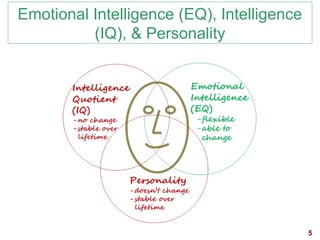
Emotional Intelligence (EQ), Intelligence
(IQ), & Personality
6
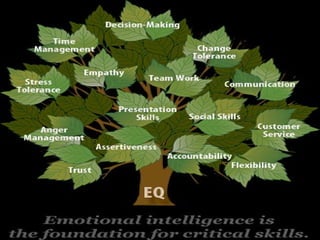
Why is EQ important?
EQ is the pattern of how
people's biases in their
thinking leads them to
think one thing or
choice is better than
another, as well as their
clarity in differentiating
within those biases to
exercise clear and
sound judgment.
7
8
9
EQ Composition
10
Emotional IntelligenceEmotional Intelligence
FrameworkFramework
• The Intrapersonal
Realm
• The Interpersonal
Realm
• The Adaptability
Realm
• The Stress
Management Realm
• The General Mood Realm
11
The IntrapersonalThe Intrapersonal
RealmRealm
12
The Intrapersonal RealmThe Intrapersonal Realm
concerns your ability to know
and manage yourself.
It embraces:
• Self Awareness
• Assertiveness
• Independence
• Self-Regard
• Self-Actualization
13
Self AwarenessSelf Awareness
The ability to recognize how you're
feeling and why you're feeling that
way and the impact your behavior
has on others
14
Self Awareness – ActivitySelf Awareness – Activity
(Group Discussion):(Group Discussion):
• Over the last week, what was the strongest emotion you
had experienced. Beside each emotion, write down your
accompanying body language/gestures and thoughts.
• Also, write down how you became aware of that feeling.
That is, did you recognize the emotion as it occurred,
become aware of it through bodily sensations, or
become aware of it through thoughts?
15
AssertivenessAssertiveness
The ability to clearly express your
thoughts and feelings, stand your
ground and defend a position
16
Assertiveness – ActivityAssertiveness – Activity
(Group Discussion):(Group Discussion):
• Over the last two weeks, write down instances where you
behaved assertively, passively and aggressively, and list
the self-talk that accompanied each instance
• For situations where you behaved passively, dispute and
debate the self-talk that interfered with your being
assertive
• For situations where you behaved aggressively, dispute
and debate the self-talk that led you to such behavior
17
IndependenceIndependence
The ability to be self-directed and
self-controlled in your thinking and
actions and to be free of emotional
dependency. Independent people
are self-reliant in planning and
making important decisions.
18
Self RegardSelf Regard
The ability to appreciate your
perceived positive aspects and
possibilities as well as to accept
your negative aspects and
limitations and still feel good about
yourself.
19
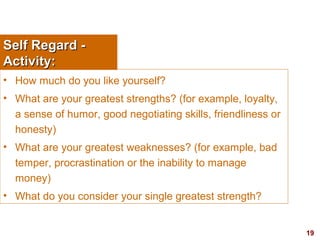
Self Regard -Self Regard -
Activity:Activity:
• How much do you like yourself?
• What are your greatest strengths? (for example, loyalty,
a sense of humor, good negotiating skills, friendliness or
honesty)
• What are your greatest weaknesses? (for example, bad
temper, procrastination or the inability to manage
money)
• What do you consider your single greatest strength?
20
Self - ActualizationSelf - Actualization
The ability to realize your potential.
This component of emotional
intelligence is manifested by
becoming involved in pursuits that
lead to a meaningful, rich and full
life.
21
Self ActualizationSelf Actualization
Activity:Activity:
• How many hours per week do you spend at work?
with family? with friends? alone?
• In which of these areas would you most like to
improve the quality of your time?
• What are your hobbies and interests?
• Which hobby would you like to pursue more actively?
22
The Inter-The Inter-
PersonalPersonal
RealmRealm
23
The Inter-personal RealmThe Inter-personal Realm
concerns your "people skills" —
your ability to interact and get
along with others. It is composed
of three scales.
• Empathy
• Social Responsibility
• Interpersonal Relationship
24
EmpathyEmpathy
The ability to understand what
others might be feeling and
thinking. It is the ability to view the
world through another person's
eyes.
25
Empathy - Activity: Get the Memo!Empathy - Activity: Get the Memo!
26
Social ResponsibilitySocial Responsibility
The ability to demonstrate that you
are a cooperative, contributing and
constructive member of your social
group.
27
Social ResponsibilitySocial Responsibility
Assignment:Assignment:
• In your notebook, write down at least three
things you could do that would be appreciated
by people in need
• Now think of one thing you could do this week
that would help others
28
Interpersonal RelationInterpersonal Relation
The ability to forge and maintain
relationships that are mutually
beneficial and marked by give-and-
take and a sense of emotional
closeness.
29
TheThe
AdaptabilityAdaptability
RealmRealm
30
The Adaptability RealmThe Adaptability Realm
involves your ability to be flexible
and realistic, and to solve a range
of problems as they arise. Its three
scales are :
• Reality Testing
• Flexibility
• Problem Solving
31
Reality TestingReality Testing
The ability to assess the
correspondence between what's
experienced and what objectively
exists. It is the capacity to see
things objectively, the way they are,
rather than the way we wish or fear
them to be.
32
FlexibilityFlexibility
The ability to adjust your emotions,
thoughts and behavior to changing
situations and conditions. This
component of emotional intelligence
applies to your overall ability to
adapt to unfamiliar, unpredictable
and dynamic circumstances
33
Problem SolvingProblem Solving
The ability to identify and define
problems as well as to generate and
implement potentially effective
solutions.
34
The StressThe Stress
ManagementManagement
RealmRealm
35
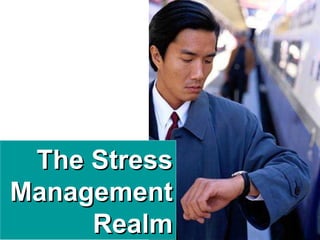
The Stress ManagementThe Stress Management
RealmRealm concerns your ability to
tolerate stress and control
impulses. Its two scales are :
• Stress Tolerance
• Impulse Control
36
Stress Management Activity:Stress Management Activity:
Hot Buttons!Hot Buttons!
37
Stress ToleranceStress Tolerance
The ability to withstand adverse
events and stressful situations
without falling apart by actively and
positively coping with stress.
38
Stress ToleranceStress Tolerance
Stress tolerance includes having a
repertoire of suitable responses to
stressful situations. It is associated
with the capacity to be relaxed and
composed and to calmly face
difficulties without getting carried
away by strong emotions.
39
Impulse ControlImpulse Control
The ability to resist or delay an
impulse, drive or temptation to act.
Impulse control entails a capacity for
accepting your aggressive impulses,
being composed, and controlling
aggression, hostility and irresponsible
behavior.
40
Impulse ControlImpulse Control
Assignment:Assignment:
• Over the next week, pay close attention to anger or
frustration as it begins to build, monitoring and
understanding your feelings and self-talk.
• Debate and dispute it at the time, if you can. In any
case, later in the day, summarize these incidents in
your notebook, and see whether your efforts
allowed you to get a better handle on your
emotions.
41
TheThe
GeneralGeneral
MoodMood
RealmRealm
42
The General Mood RealmThe General Mood Realm
concerns your outlook on life, your
ability to enjoy yourself and others
and your overall feelings of
contentment or dissatisfaction. It
has two dimensions.
• Happiness
• Optimism
43
HappinessHappiness
The ability to feel satisfied with
your life, to enjoy yourself and
others and to have fun. Happiness
combines self-satisfaction, general
contentment and the ability to
enjoy life.
44
HappinessHappiness
Happiness is associated with a
general feeling of cheerfulness
and enthusiasm. It is a by-product
and/or barometric indicator of your
overall degree of emotional
intelligence and emotional
functioning.
45
OptimismOptimism
The ability to look at the brighter
side of life and to maintain a
positive attitude even in the face of
adversity. Optimism assumes a
measure of hope in one's
approach to life
46
Can EQ be increased?
• Yes, EQ can be increased with practice
• Your brain is hard-wired to give emotions
the upper hand
• The limbic system (the emotional brain)
reacts to events first before we have the
opportunity to engage the rational brain
• EQ requires effective communication
between the rational and emotional
centers of the brain
47
Skills to Develop EQ Activity:
Treasure Hunt
48
5 Skills to Develop EQ
• EQ Skill 1: Rapidly reduce stress
• EQ Skill 2: Emotional Awareness
• EQ Skill 3: Nonverbal Communication
• EQ Skill 4: Use humor and play to deal
with challenges
• EQ Skill 5: Resolve Conflict positively
49

Emotional intelligence

  • 1.
  • 2.
    2 Have you everthought of why people of average intelligence outperform people with the highest levels of intelligence majority of the time? What is Emotional Intelligence?
  • 3.
    3 • Emotional intelligence(EQ) is the capacity of recognizing our own feelings and those of others, for motivating ourselves, for managing emotions in ourselves as well as in our relationships • EQ is critical to managing your behavior, moving smoothly through social situations and making critical choices in life What is Emotional Intelligence?
  • 4.
  • 5.
    5 Emotional Intelligence (EQ),Intelligence (IQ), & Personality
  • 6.
    6 Why is EQimportant? EQ is the pattern of how people's biases in their thinking leads them to think one thing or choice is better than another, as well as their clarity in differentiating within those biases to exercise clear and sound judgment.
  • 7.
  • 8.
  • 9.
  • 10.
    10 Emotional IntelligenceEmotional Intelligence FrameworkFramework •The Intrapersonal Realm • The Interpersonal Realm • The Adaptability Realm • The Stress Management Realm • The General Mood Realm
  • 11.
  • 12.
    12 The Intrapersonal RealmTheIntrapersonal Realm concerns your ability to know and manage yourself. It embraces: • Self Awareness • Assertiveness • Independence • Self-Regard • Self-Actualization
  • 13.
    13 Self AwarenessSelf Awareness Theability to recognize how you're feeling and why you're feeling that way and the impact your behavior has on others
  • 14.
    14 Self Awareness –ActivitySelf Awareness – Activity (Group Discussion):(Group Discussion): • Over the last week, what was the strongest emotion you had experienced. Beside each emotion, write down your accompanying body language/gestures and thoughts. • Also, write down how you became aware of that feeling. That is, did you recognize the emotion as it occurred, become aware of it through bodily sensations, or become aware of it through thoughts?
  • 15.
    15 AssertivenessAssertiveness The ability toclearly express your thoughts and feelings, stand your ground and defend a position
  • 16.
    16 Assertiveness – ActivityAssertiveness– Activity (Group Discussion):(Group Discussion): • Over the last two weeks, write down instances where you behaved assertively, passively and aggressively, and list the self-talk that accompanied each instance • For situations where you behaved passively, dispute and debate the self-talk that interfered with your being assertive • For situations where you behaved aggressively, dispute and debate the self-talk that led you to such behavior
  • 17.
    17 IndependenceIndependence The ability tobe self-directed and self-controlled in your thinking and actions and to be free of emotional dependency. Independent people are self-reliant in planning and making important decisions.
  • 18.
    18 Self RegardSelf Regard Theability to appreciate your perceived positive aspects and possibilities as well as to accept your negative aspects and limitations and still feel good about yourself.
  • 19.
    19 Self Regard -SelfRegard - Activity:Activity: • How much do you like yourself? • What are your greatest strengths? (for example, loyalty, a sense of humor, good negotiating skills, friendliness or honesty) • What are your greatest weaknesses? (for example, bad temper, procrastination or the inability to manage money) • What do you consider your single greatest strength?
  • 20.
    20 Self - ActualizationSelf- Actualization The ability to realize your potential. This component of emotional intelligence is manifested by becoming involved in pursuits that lead to a meaningful, rich and full life.
  • 21.
    21 Self ActualizationSelf Actualization Activity:Activity: •How many hours per week do you spend at work? with family? with friends? alone? • In which of these areas would you most like to improve the quality of your time? • What are your hobbies and interests? • Which hobby would you like to pursue more actively?
  • 22.
  • 23.
    23 The Inter-personal RealmTheInter-personal Realm concerns your "people skills" — your ability to interact and get along with others. It is composed of three scales. • Empathy • Social Responsibility • Interpersonal Relationship
  • 24.
    24 EmpathyEmpathy The ability tounderstand what others might be feeling and thinking. It is the ability to view the world through another person's eyes.
  • 25.
    25 Empathy - Activity:Get the Memo!Empathy - Activity: Get the Memo!
  • 26.
    26 Social ResponsibilitySocial Responsibility Theability to demonstrate that you are a cooperative, contributing and constructive member of your social group.
  • 27.
    27 Social ResponsibilitySocial Responsibility Assignment:Assignment: •In your notebook, write down at least three things you could do that would be appreciated by people in need • Now think of one thing you could do this week that would help others
  • 28.
    28 Interpersonal RelationInterpersonal Relation Theability to forge and maintain relationships that are mutually beneficial and marked by give-and- take and a sense of emotional closeness.
  • 29.
  • 30.
    30 The Adaptability RealmTheAdaptability Realm involves your ability to be flexible and realistic, and to solve a range of problems as they arise. Its three scales are : • Reality Testing • Flexibility • Problem Solving
  • 31.
    31 Reality TestingReality Testing Theability to assess the correspondence between what's experienced and what objectively exists. It is the capacity to see things objectively, the way they are, rather than the way we wish or fear them to be.
  • 32.
    32 FlexibilityFlexibility The ability toadjust your emotions, thoughts and behavior to changing situations and conditions. This component of emotional intelligence applies to your overall ability to adapt to unfamiliar, unpredictable and dynamic circumstances
  • 33.
    33 Problem SolvingProblem Solving Theability to identify and define problems as well as to generate and implement potentially effective solutions.
  • 34.
  • 35.
    35 The Stress ManagementTheStress Management RealmRealm concerns your ability to tolerate stress and control impulses. Its two scales are : • Stress Tolerance • Impulse Control
  • 36.
    36 Stress Management Activity:StressManagement Activity: Hot Buttons!Hot Buttons!
  • 37.
    37 Stress ToleranceStress Tolerance Theability to withstand adverse events and stressful situations without falling apart by actively and positively coping with stress.
  • 38.
    38 Stress ToleranceStress Tolerance Stresstolerance includes having a repertoire of suitable responses to stressful situations. It is associated with the capacity to be relaxed and composed and to calmly face difficulties without getting carried away by strong emotions.
  • 39.
    39 Impulse ControlImpulse Control Theability to resist or delay an impulse, drive or temptation to act. Impulse control entails a capacity for accepting your aggressive impulses, being composed, and controlling aggression, hostility and irresponsible behavior.
  • 40.
    40 Impulse ControlImpulse Control Assignment:Assignment: •Over the next week, pay close attention to anger or frustration as it begins to build, monitoring and understanding your feelings and self-talk. • Debate and dispute it at the time, if you can. In any case, later in the day, summarize these incidents in your notebook, and see whether your efforts allowed you to get a better handle on your emotions.
  • 41.
  • 42.
    42 The General MoodRealmThe General Mood Realm concerns your outlook on life, your ability to enjoy yourself and others and your overall feelings of contentment or dissatisfaction. It has two dimensions. • Happiness • Optimism
  • 43.
    43 HappinessHappiness The ability tofeel satisfied with your life, to enjoy yourself and others and to have fun. Happiness combines self-satisfaction, general contentment and the ability to enjoy life.
  • 44.
    44 HappinessHappiness Happiness is associatedwith a general feeling of cheerfulness and enthusiasm. It is a by-product and/or barometric indicator of your overall degree of emotional intelligence and emotional functioning.
  • 45.
    45 OptimismOptimism The ability tolook at the brighter side of life and to maintain a positive attitude even in the face of adversity. Optimism assumes a measure of hope in one's approach to life
  • 46.
    46 Can EQ beincreased? • Yes, EQ can be increased with practice • Your brain is hard-wired to give emotions the upper hand • The limbic system (the emotional brain) reacts to events first before we have the opportunity to engage the rational brain • EQ requires effective communication between the rational and emotional centers of the brain
  • 47.
    47 Skills to DevelopEQ Activity: Treasure Hunt
  • 48.
    48 5 Skills toDevelop EQ • EQ Skill 1: Rapidly reduce stress • EQ Skill 2: Emotional Awareness • EQ Skill 3: Nonverbal Communication • EQ Skill 4: Use humor and play to deal with challenges • EQ Skill 5: Resolve Conflict positively
  • 49.

Editor's Notes

  • #6 EQ, IQ & Personality are not connected. The three do not go together in any meaningful way. Emotional intelligence explains a fundamental element of your behavior that is unique from your intellect. You cannot determine someone's IQ based on their EQ and vice versa. Intelligence is how quickly you absorb new information and it does not change throughout your life. Emotional intelligence is unique because it is a flexible skill that you can improve with practice. Anyone can develop a high degree of emotional intelligence. Like IQ, your personality does not change. Personality is the style with which you approach the world: what motivates you and the people and situations that give you energy (versus those that drain it). One example of this is the tendency we all have to be introverted or extroverted.
  • #9 activity