Emotional Intelligence
Dr. Suresh Kumar Murugesan PhD
Yellow
Pond
About the Presenter
● Dr.Suresh Kumar Murugesan is a passionate Professor, Researcher and
Positive Mental Health Practitioner from Madurai, Tamil Nadu, India
● At present he is heading the PG Department of Psychology, The American
College, Madurai
● He is very keen in research studies and open to learn.
● His ultimate aim is to make impression in the field of Knowledge
● His area of specializations are Psychomentry, Positive Psychotherapy, etc
● He has published 30 journal articles, 50 Conference and seminar
proceedings
● Organised more than 500 webinars and acted as a resource person for 250
+ webinar session
● Received 4 Awards and delivered 25+ Radio Talks
● Qualified UGC NET in Psychology and Education, Central Teacher Eligibility
Test
● Published three books Yellow
Pond
Disclaimer
● This presentation is prepared for
learning purpose only and all the
images used in this presentation are
taken from google image search.
● Due recognition was given to all the
material collected from the various
sources.
● Any name or reference is missed
kindly bring it to the notice of the
presenter for inclusion.
● Email -
sureshkumar800@yahoo.com
Thank you
Yellow
Pond
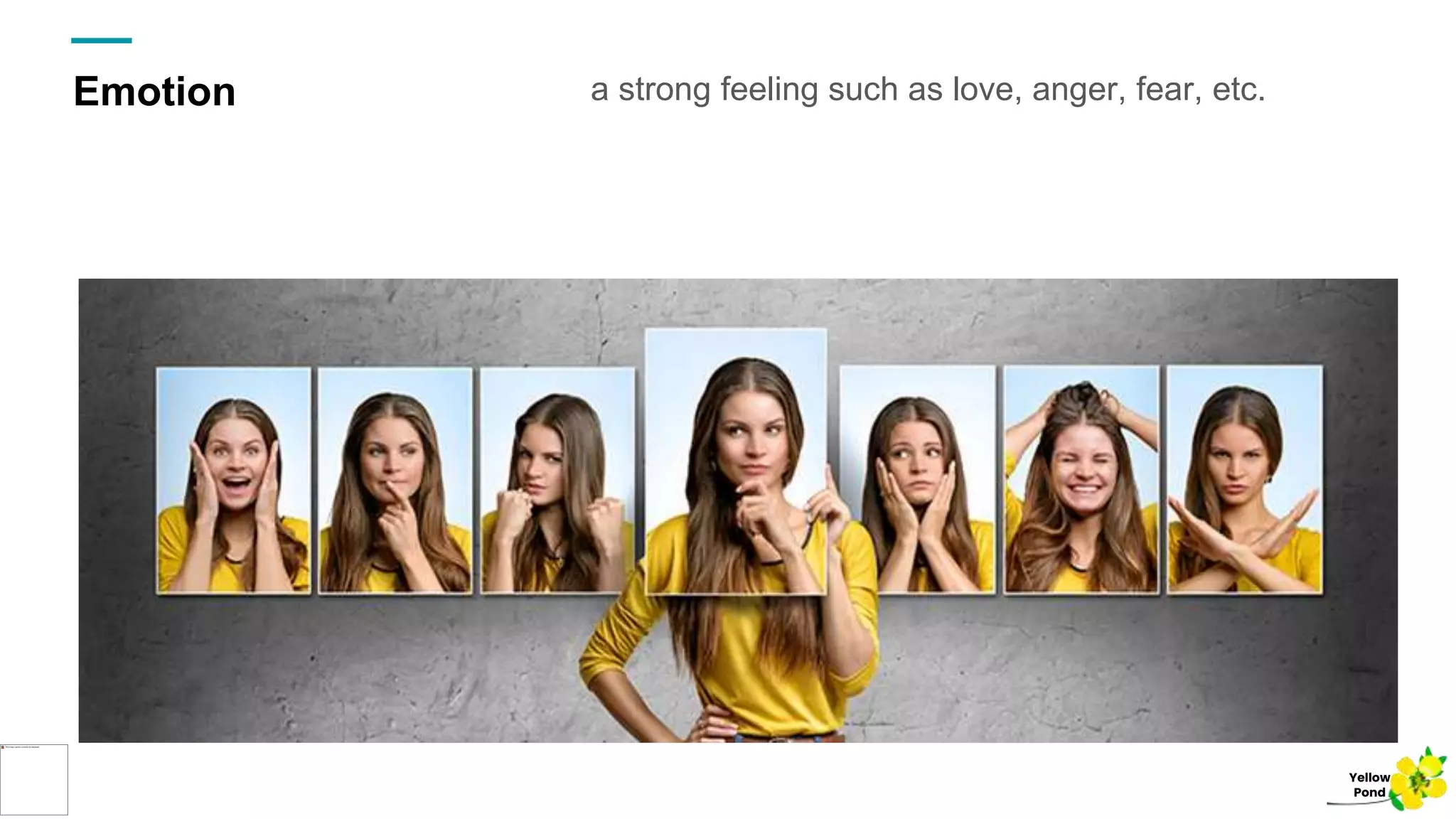
Emotion a strong feeling such as love, anger, fear, etc.
Yellow
Pond
Intelligence
the ability to understand, learn
and think.
Yellow
Pond
Emotional Intelligence
Emotional intelligence refers to the ability to identify and manage our own
emotions and others.
Yellow
Pond
Emotional
Intelligence
Emotional intelligence is the ability to
understand, use, and manage our own
emotions in positive ways
● to relieve stress,
● communicate effectively,
● empathize with others,
● overcome challenges and
● defuse conflict.
Yellow
Pond
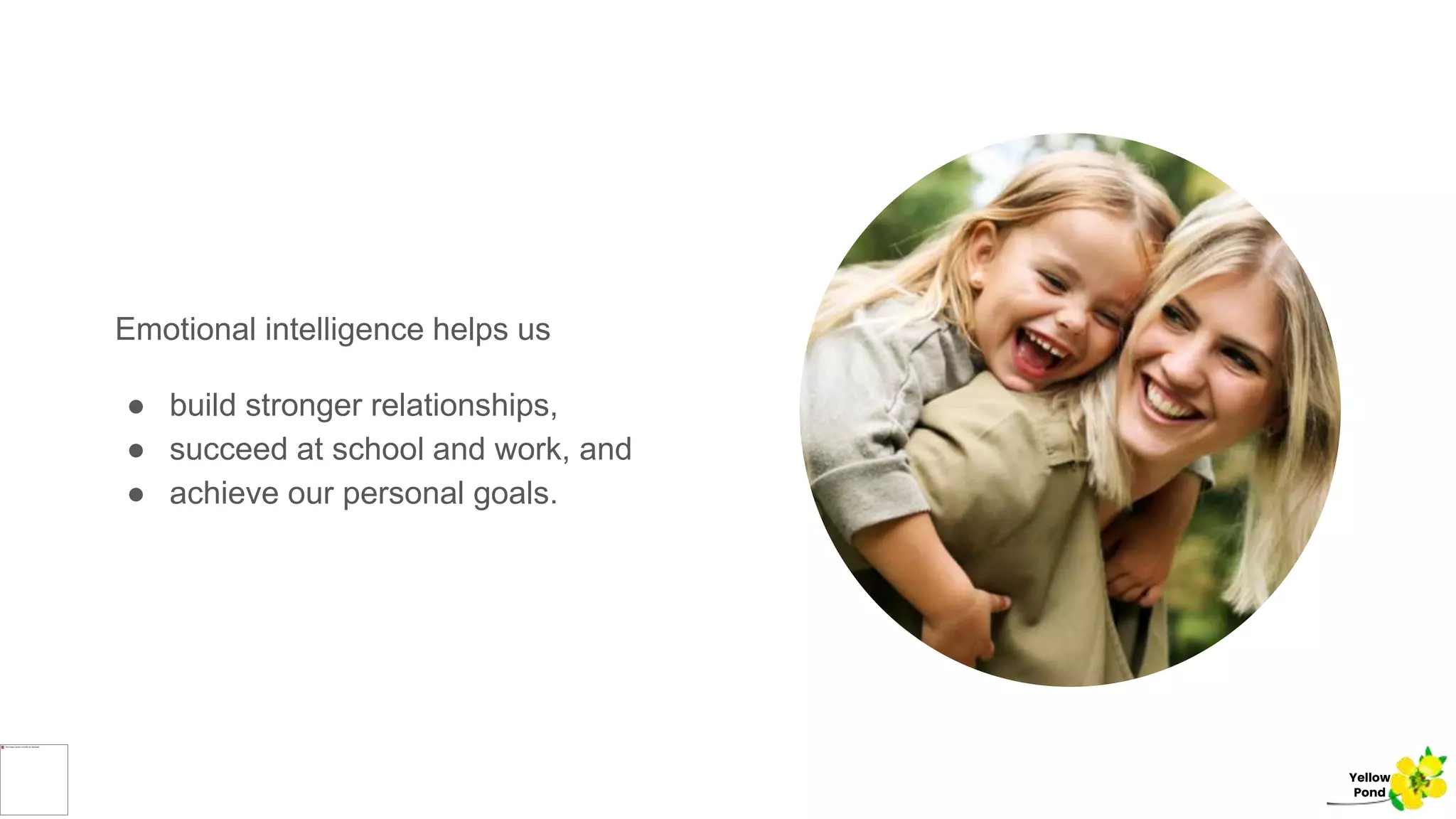
Emotional intelligence helps us
● build stronger relationships,
● succeed at school and work, and
● achieve our personal goals.
Yellow
Pond
John D Mayer and Peter Salovey
has introduced the theory of
Emotional Intelligence and
demonstrated that how it might be
measured in two journal articles
(1990)
Yellow
Pond
Emotional Intelligence
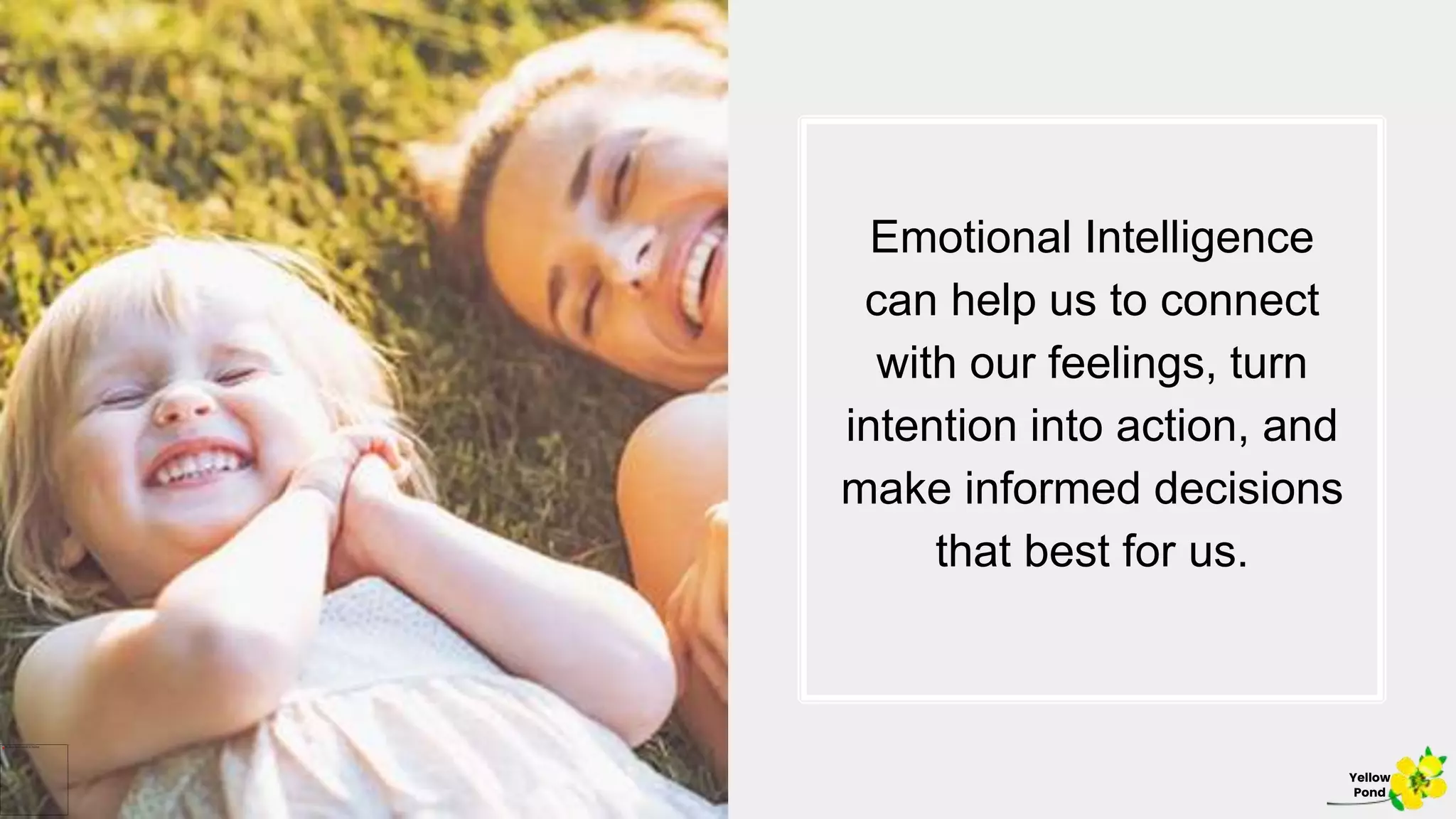
can help us to connect
with our feelings, turn
intention into action, and
make informed decisions
that best for us.
Yellow
Pond
Emotional Intelligence
Emotional intelligence is generally said to
include at least three skills:
1. emotional awareness, or the ability to
identify and name one’s own
emotions;
2. the ability to harness those emotions
and apply them to tasks like thinking
and problem solving; and
3. the ability to manage emotions, which
includes both regulating one’s own
emotions when necessary and helping
others to do the same.
Yellow
Pond
The concept of emotional
intelligence—sometimes referred
to as emotional quotient or EQ—
has gained wide acceptance in
recent days.
Yellow
Pond
People with high EI
could solve a variety
of emotion-related
problems accurately
and quickly.
Yellow
Pond
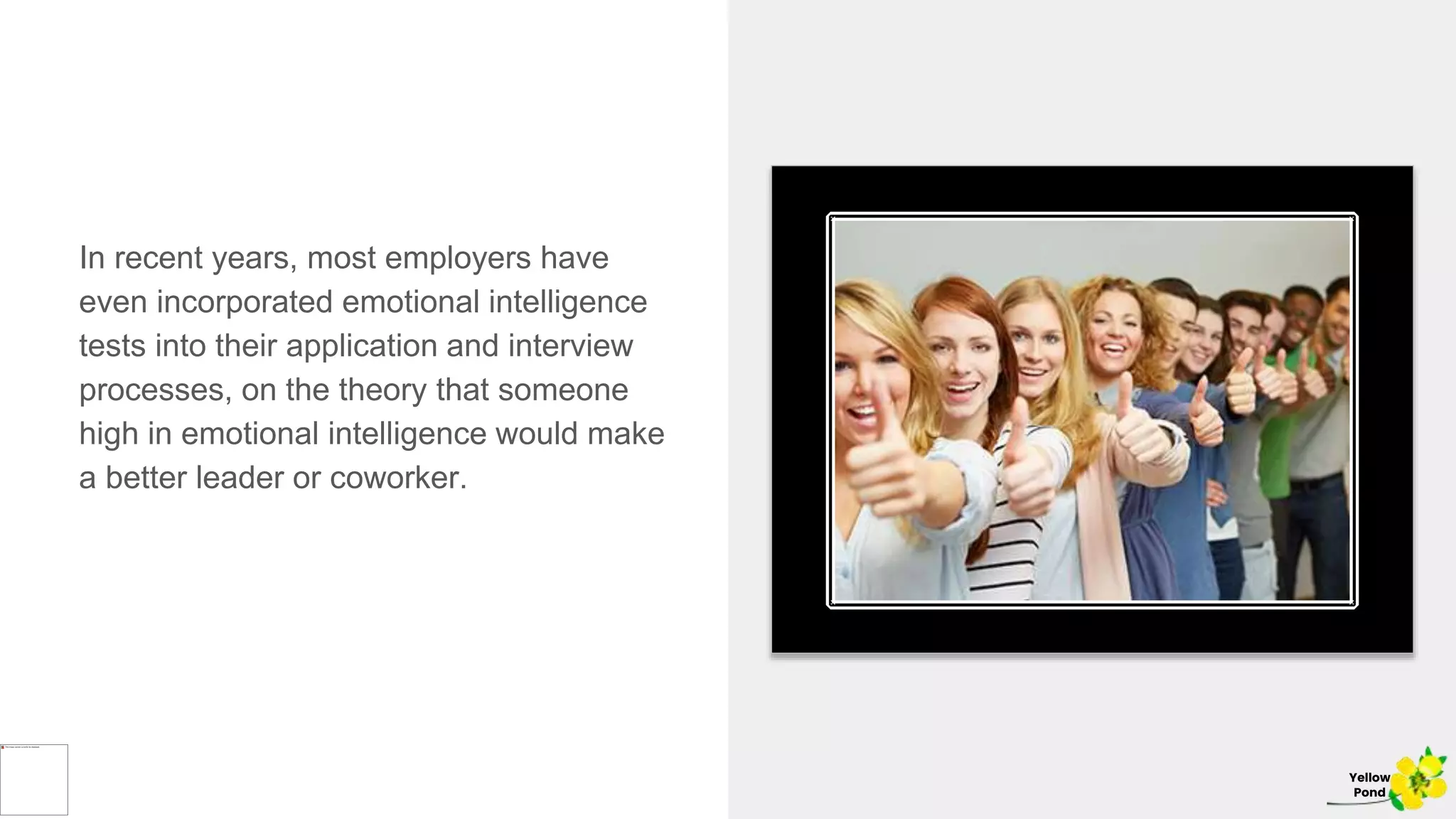
In recent years, most employers have
even incorporated emotional intelligence
tests into their application and interview
processes, on the theory that someone
high in emotional intelligence would make
a better leader or coworker.
Yellow
Pond
Some studies have
found a link between
emotional intelligence
and job performance
Yellow
Pond
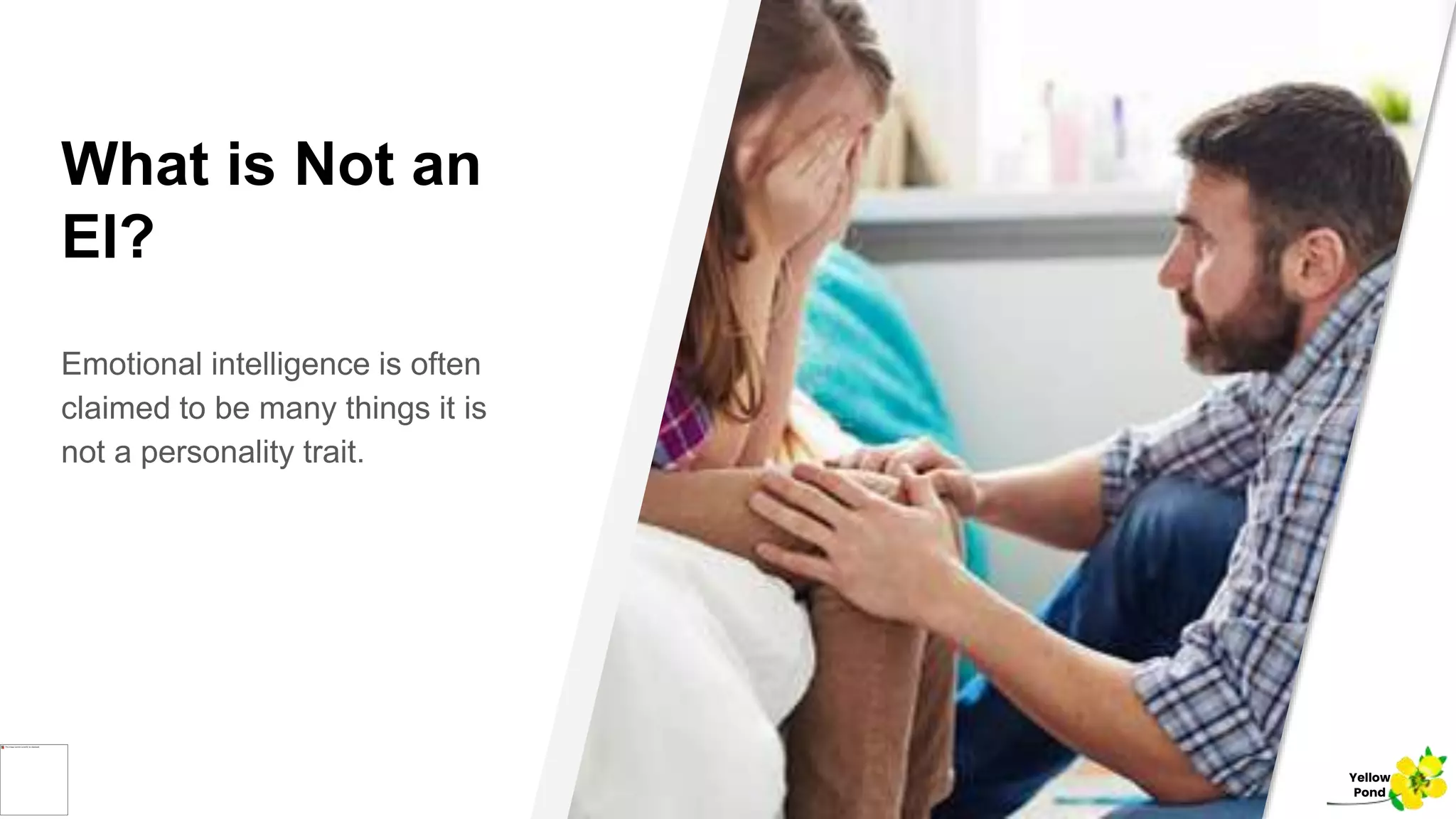
What is Not an
EI?
Emotional intelligence is often
claimed to be many things it is
not a personality trait.
Yellow
Pond
What is Not an Emotional
Intelligence?
Emotional intelligence, however, is not
1. agreeableness.
2. optimism.
3. happiness.
4. calmness.
5. motivation.
Yellow
Pond
The qualities such as
agreeableness, optimism,
happiness, calmness and
motivation are important,
have little to do with
intelligence, little to do with
emotions, and nearly
nothing to do with actual
emotional intelligence. by
John D. Mayer (2009)
Yellow
Pond
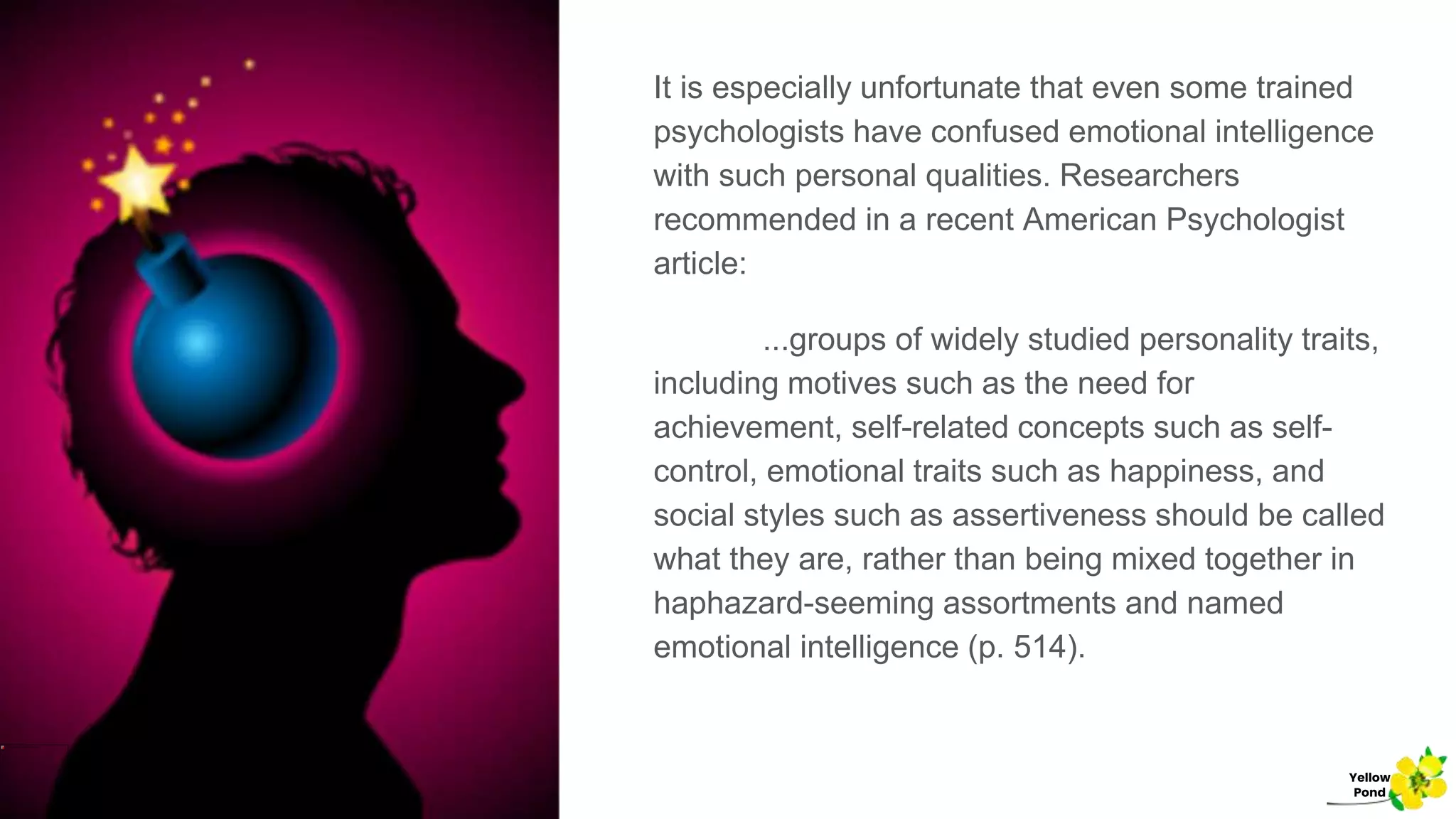
It is especially unfortunate that even some trained
psychologists have confused emotional intelligence
with such personal qualities. Researchers
recommended in a recent American Psychologist
article:
...groups of widely studied personality traits,
including motives such as the need for
achievement, self-related concepts such as self-
control, emotional traits such as happiness, and
social styles such as assertiveness should be called
what they are, rather than being mixed together in
haphazard-seeming assortments and named
emotional intelligence (p. 514).
Yellow
Pond
Characteristics of
Emotional
Intelligence
Yellow
Pond
Characteristics of
Emotional Intelligence
According to Success.com’s Rhett Power (2017),
identified seven qualities that best describe a
person with a high EQ:
Yellow
Pond
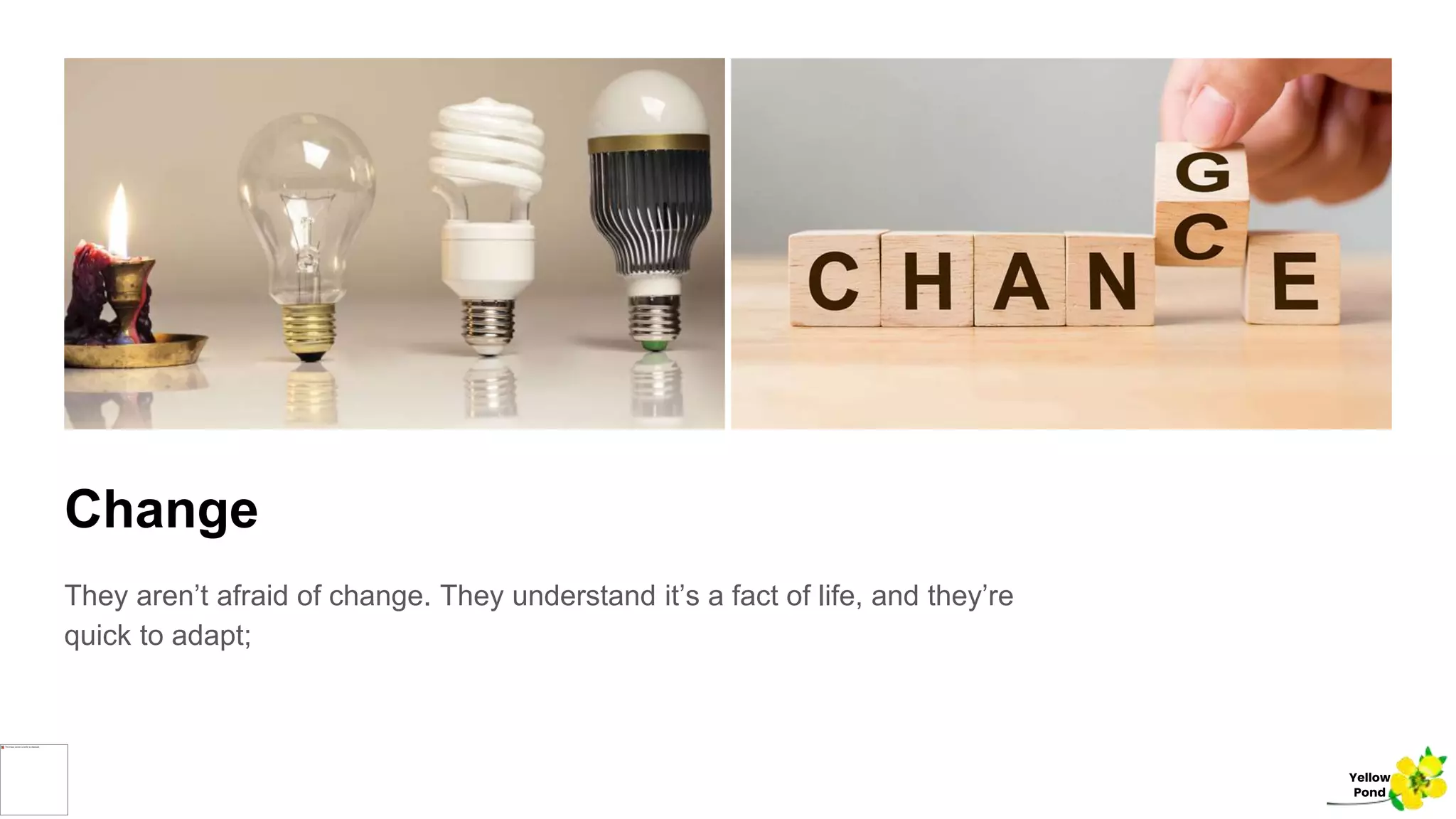
Change
They aren’t afraid of change. They understand it’s a fact of life, and they’re
quick to adapt;
Yellow
Pond
Self Aware They’re self-aware.
They know what they’re good at, what they can work on, and
what kinds of environments suit them best;
Yellow
Pond
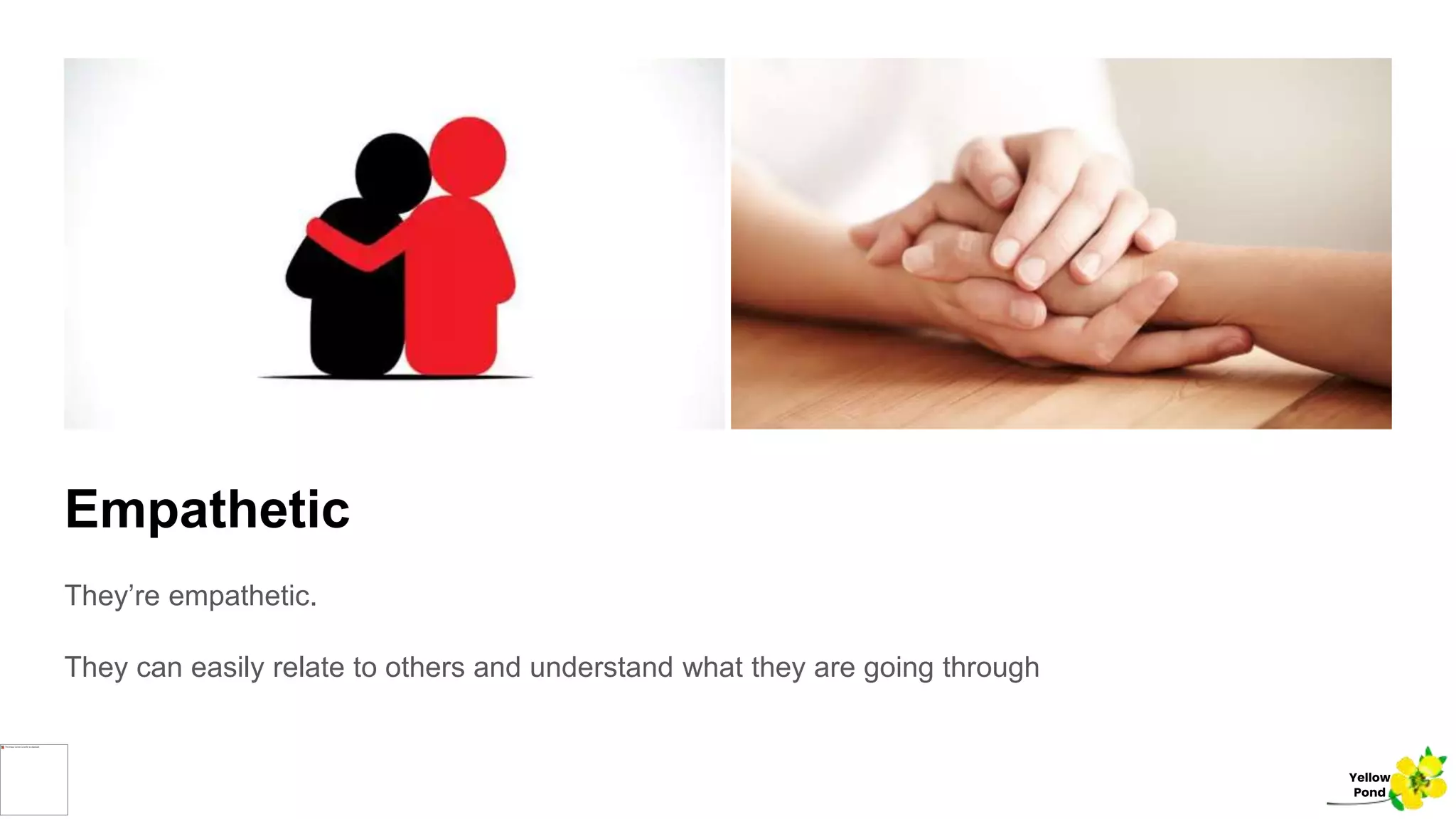
Empathetic
They’re empathetic.
They can easily relate to others and understand what they are going through
Yellow
Pond
Committed
They’re committed to quality but understand that perfection is an impossible
standard;
Yellow
Pond
Balanced
They’re balanced and able to have a healthy professional and personal life;
Yellow
Pond
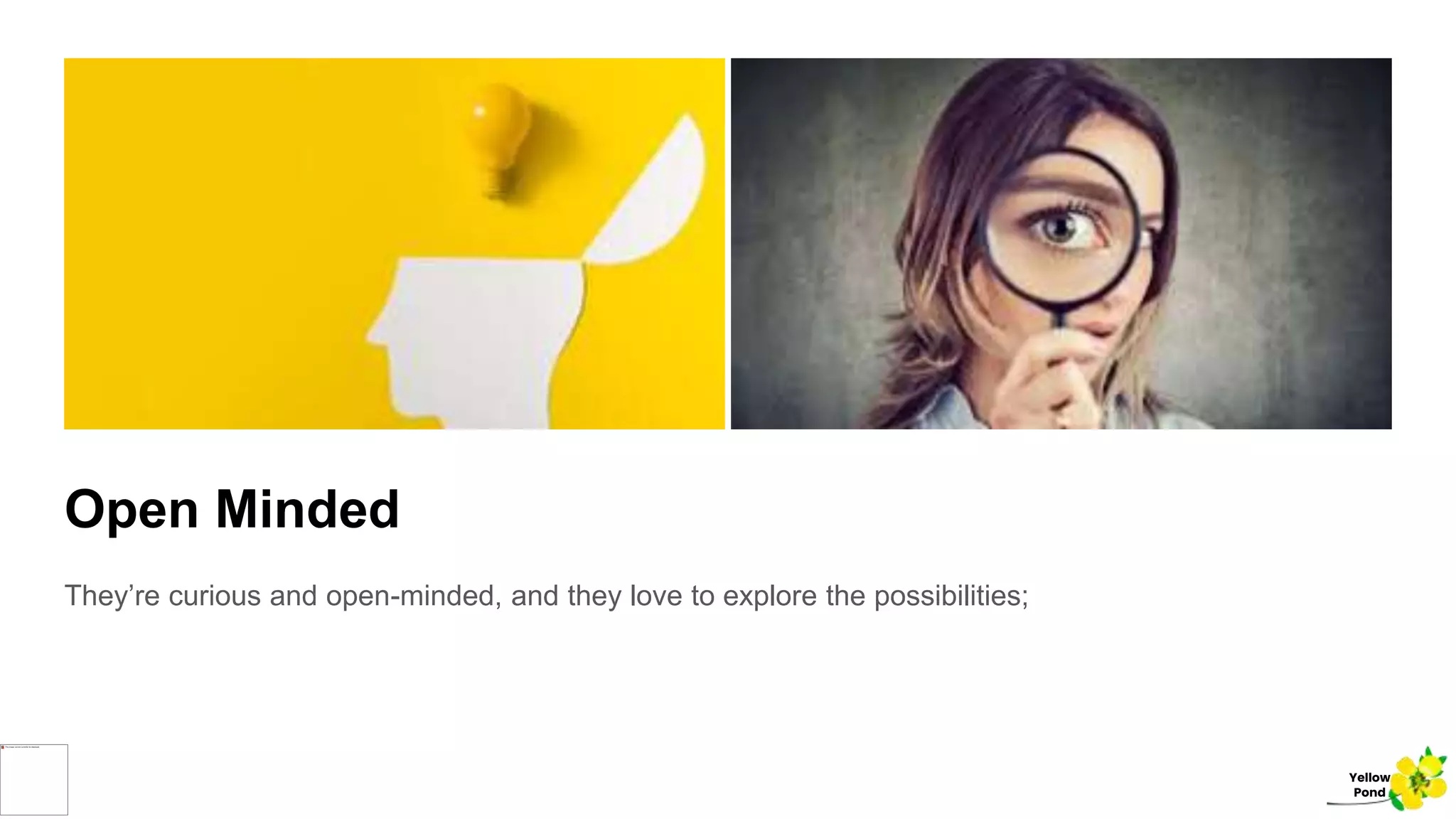
Open Minded
They’re curious and open-minded, and they love to explore the possibilities;
Yellow
Pond
Grateful
They’re gracious, grateful, and happy.
Yellow
Pond
Signs of HIgh EI
They have a healthy
work/life balance
because they know
when to work and
when to play
Yellow
Pond
They have laserlike focus and don’t get distracted
easily
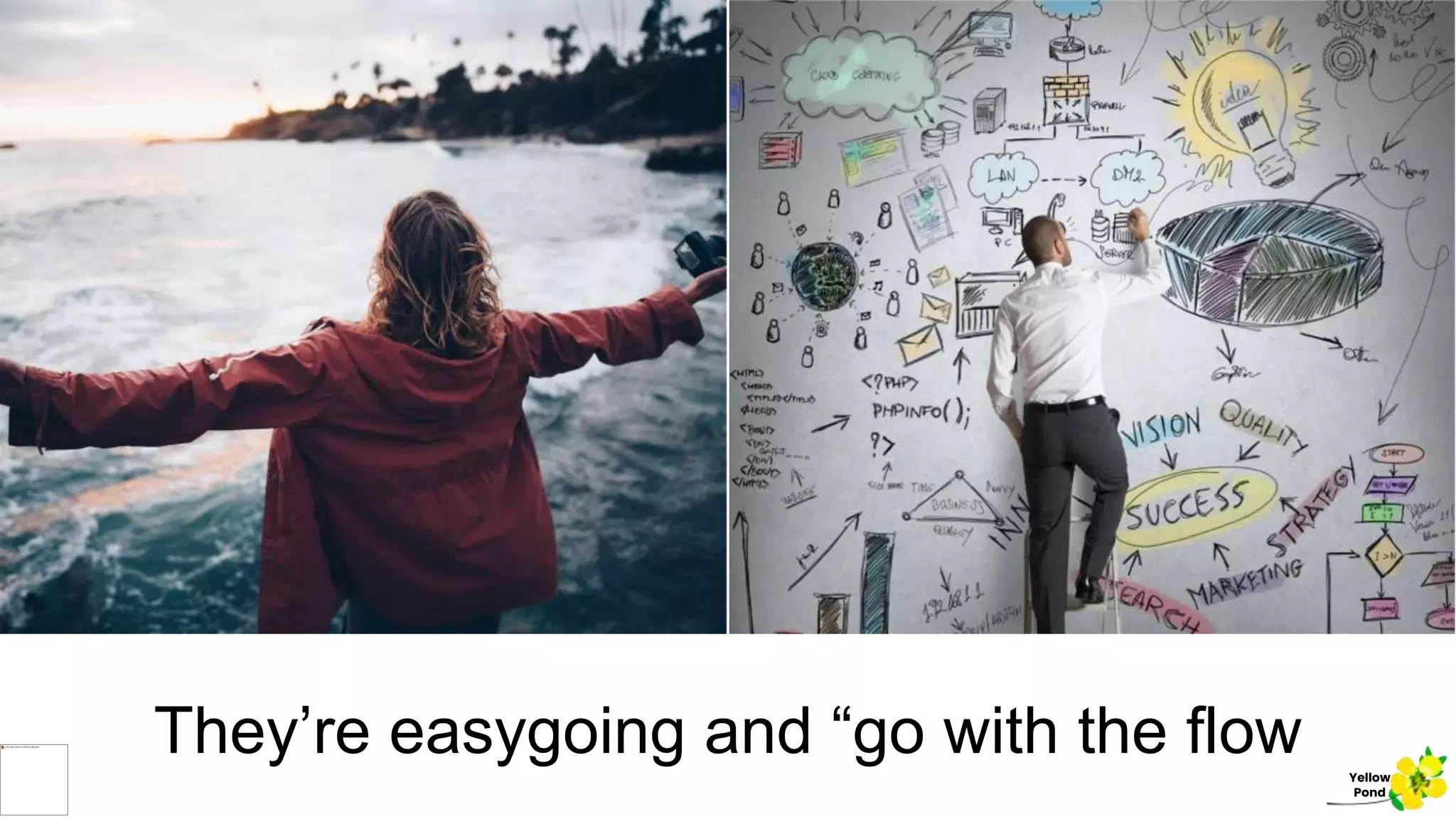
Yellow
Pond
They’re easygoing and “go with the flow Yellow
Pond
They’re open-minded and open to new
ideas Yellow
Pond
They’re a bit guarded
because they know
when to open up and
when to stick to their
boundaries
Yellow
Pond
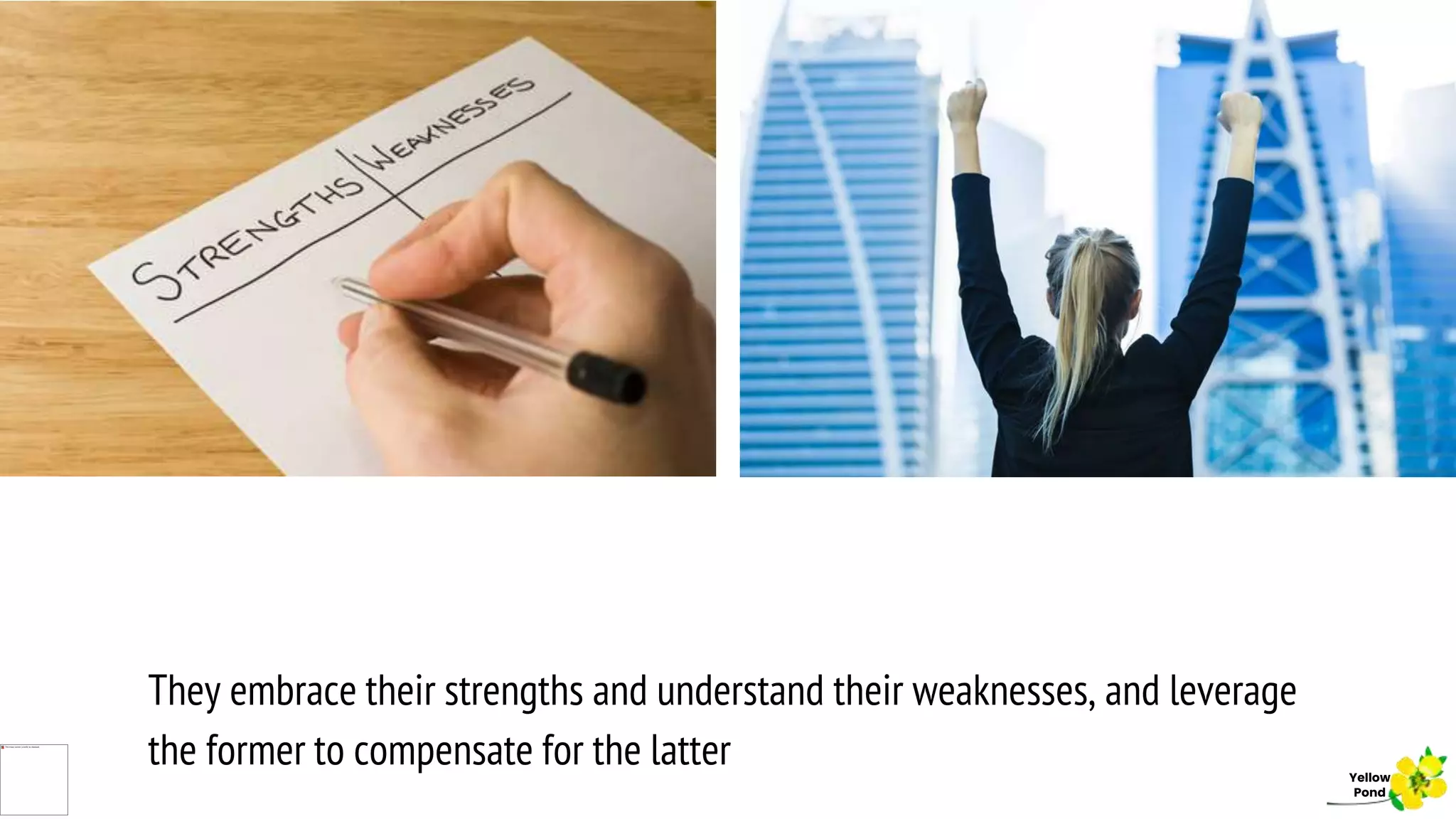
They embrace their strengths and understand their weaknesses, and leverage
the former to compensate for the latter Yellow
Pond
They have a true
sense of empathy
that allows them to
relate to others and
show compassion
Yellow
Pond
They’re inquisitive, curious, and interested in people
Yellow
Pond
They’re always
looking ahead and
focusing on how to
move forward
Yellow
Pond
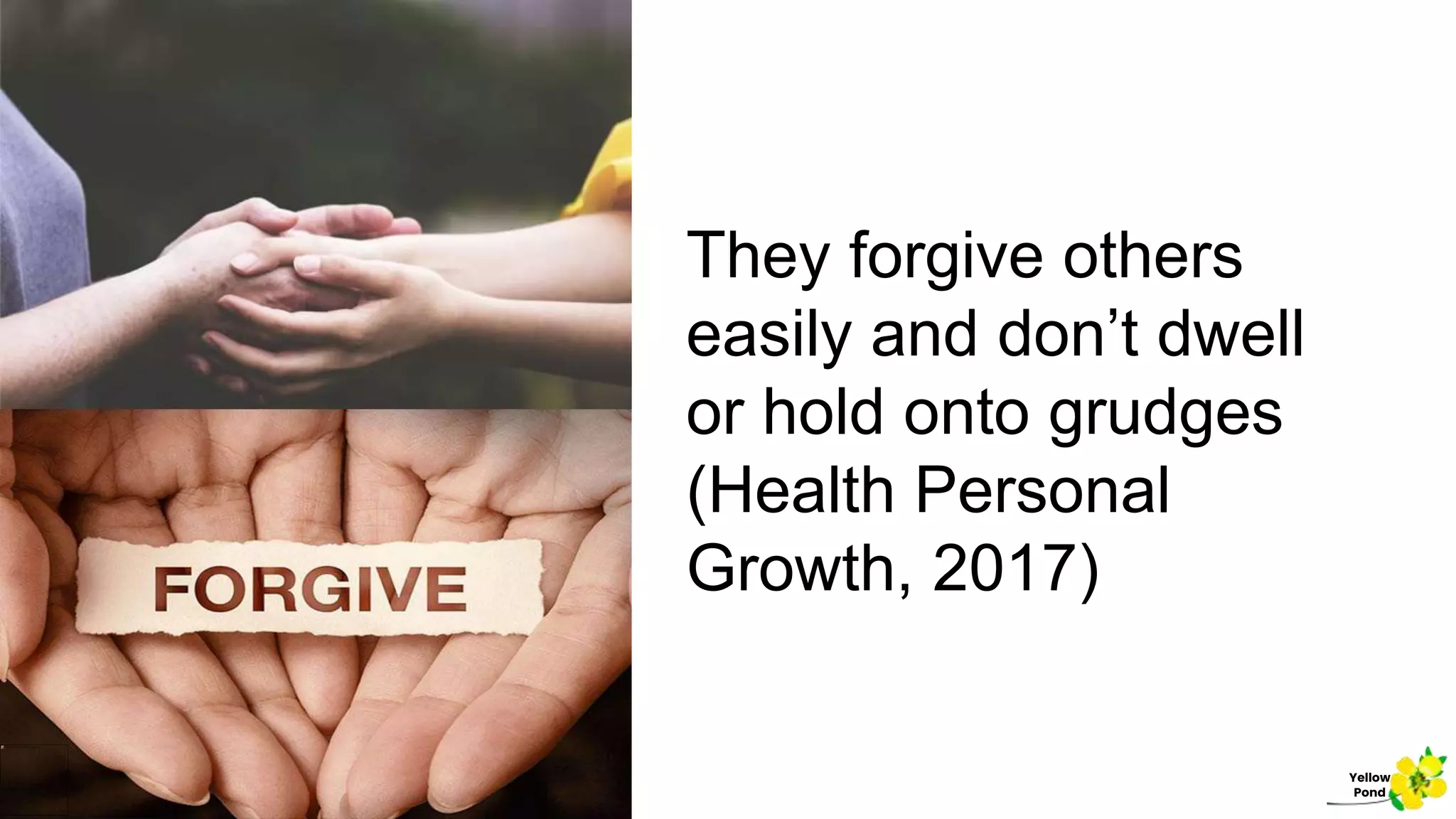
They forgive others
easily and don’t dwell
or hold onto grudges
(Health Personal
Growth, 2017)
Yellow
Pond
Qualities of emotional
intelligence Person
The studies of Daniel Goleman illustrated an emotionally
intelligent person to have:
● The ability to recognize own emotions
● The ability to relate to others’ emotions
● The ability to actively listen to others
● The ability to actively participate in interpersonal
communication and understand the nonverbal cues
of behavior
● The ability to control one’s thoughts and feelings
● The ability to effectively manage emotions and
express them in a socially acceptable way
● The ability to receive criticisms positively and benefit
from them
● The power to forgive, forget, and move on rationally
Signs of Low Emotional Intelligence
● They are unable to control their emotions;
● They are clueless about the feelings of others, even those close to them;
● They can’t maintain good relationships, whether work or personal;
● They always have a “poker face,” meaning others have a hard time reading them;
● They are often emotionally inappropriate for the situation;
● They have trouble coping with sadness;
● They are emotionally tone deaf, and have trouble reading emotions from tone of voice;
● They have trouble being sympathetic with others;
● They have no “volume control” over their emotions; they especially have trouble with emotional
reactions that are too “loud”;
● They are completely unmoved by emotional scenes in movies, TV, or books—no matter the genre;
● They trivialize the importance of emotions in general and elevate the importance of “cool, calm
logic”;
● They are not aware of dogs’ emotion states—including their own dogs’ emotional states—even
when the signs are clear (Riggio, 2015).
Yellow
Pond
Poor Emotional Intelligence
The vision-killing behaviors include:
1. Treating people badly—such as not showing people they care, forgetting to say thank you, not respecting people, not making people
feel valued;
2. Living by the adage “Do as I say, not as I do,” and not setting good examples;
3. Focusing on too many things at once;
4. Pushing too hard on the task and forgetting the people;
5. Not giving clear direction;
6. Giving inconsistent direction;
7. Not taking responsibility for failure;
8. Focusing on the detail and forgetting to tell the “whys” or the big picture;
9. Showing little or no personal commitment to the vision;
10. Allowing people who aren’t performing the job to remain.
Key Researchers of Emotional
Intelligence Yellow
Pond
Three Key Theories of EI
1. The Work of Peter Salovey
2. Daniel Goleman
3. Travis Bradberry and Emotional Intelligence 2.0
Yellow
Pond
1. The Work of
Peter Salovey
Peter Salovey, along with his colleague
John Mayer, put forth one of the first
formal theories of emotional
intelligence in 1990.
Yellow
Pond
Peter Salovey
and John Mayer
They coined the term and described it as “the ability to
recognize, understand, utilize, and regulate emotions
effectively in everyday life” (Yale Center for Emotional
Intelligence, 2013).
Yellow
Pond
Peter Salovey
and John Mayer
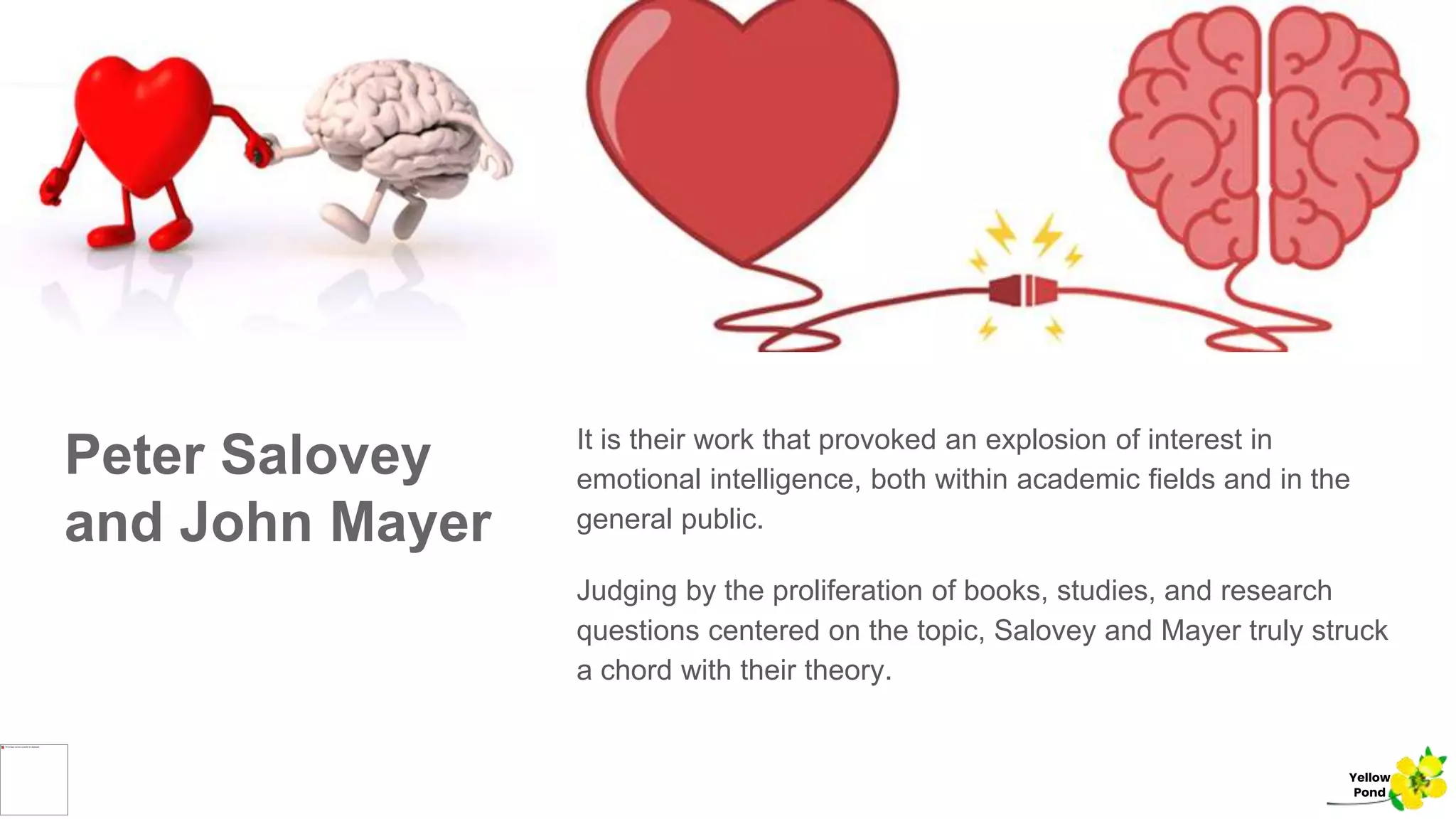
It is their work that provoked an explosion of interest in
emotional intelligence, both within academic fields and in the
general public.
Judging by the proliferation of books, studies, and research
questions centered on the topic, Salovey and Mayer truly struck
a chord with their theory.
Yellow
Pond
2. Daniel Goleman
Not long after Salovey and Mayer
introduced emotional intelligence to the
world, other researchers and psychologists
began to run with it.
Daniel Goleman was one such
psychologist; he published the bestselling
book Emotional Intelligence in 1995.
It helped introduce it into the mainstream.
Yellow
Pond
Daniel Goleman
● Goleman saw emotional intelligence as a vital factor
in success, especially for children.
● He proposed that promoting social and emotional
learning in children to boost their EI would not only
improve their learning abilities,
● it would also help them succeed in school by
reducing or eliminating some of the most distracting
and harmful behavioral problems (Goleman, n.d.).
Yellow
Pond
Daniel Goleman
His proposal has been welcomed by both the research community and the
general public, and it is now almost taken for granted that emotional
intelligence might be just as important—if not more important—to individual
success as IQ.
Yellow
Pond
Daniel Goleman
Schools, educators, and education researchers have also heartily welcomed
the idea that emotional intelligence is not simply a genetic, “you have it or
you don’t” sort of trait, but a set of skills that can be learned and improved
upon.
Yellow
Pond
Travis Bradberry and
Emotional Intelligence
2.0
Yellow
Pond
Travis Bradberry
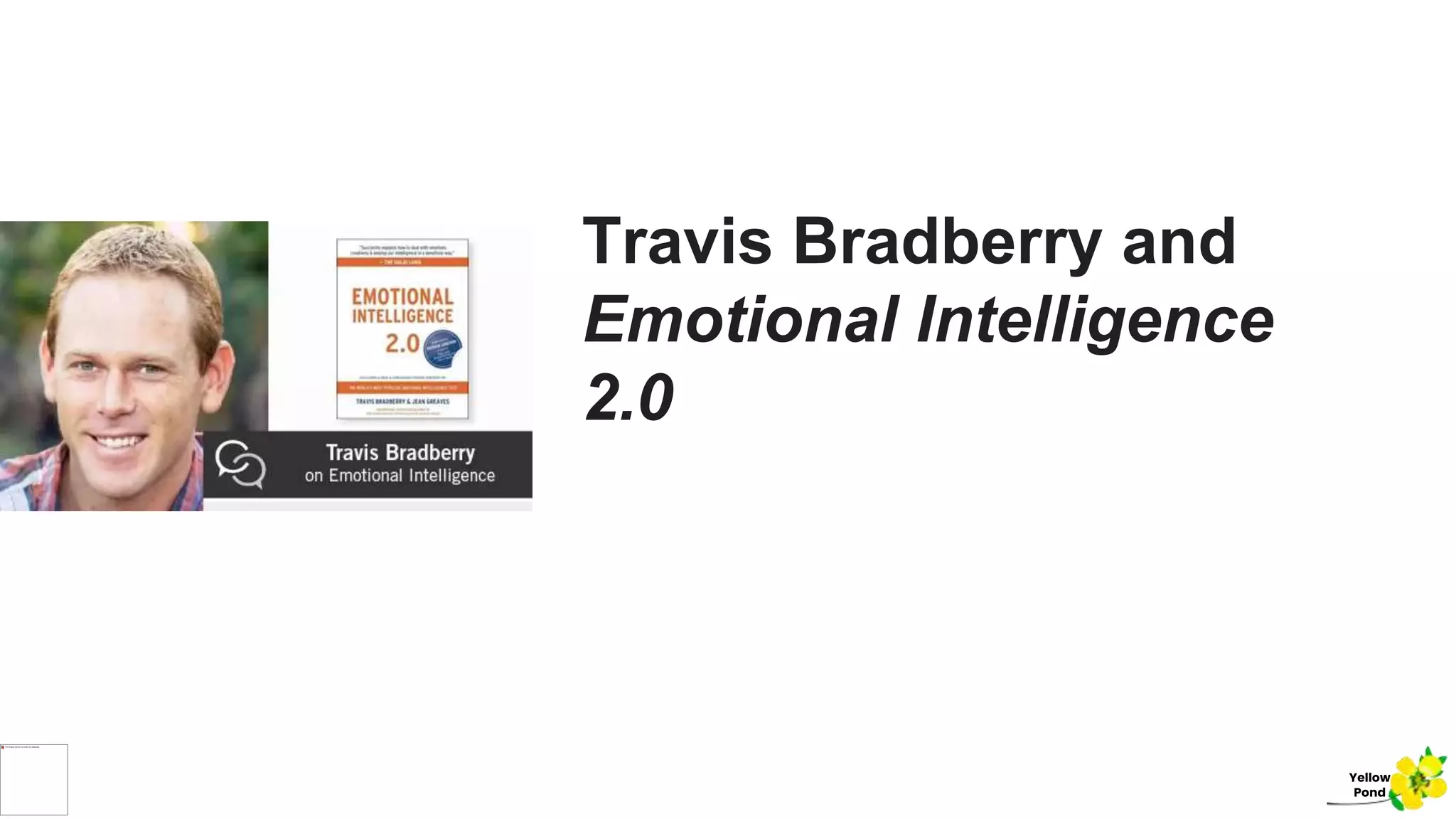
Following the groundbreaking book by Goleman,
author Travis Bradberry and his colleague Jean
Greaves capitalized on the growing interest and
published their own book, Emotional Intelligence
2.0, which outlines a step-by-step program for
enhancing it.
Yellow
Pond
Travis Bradberry
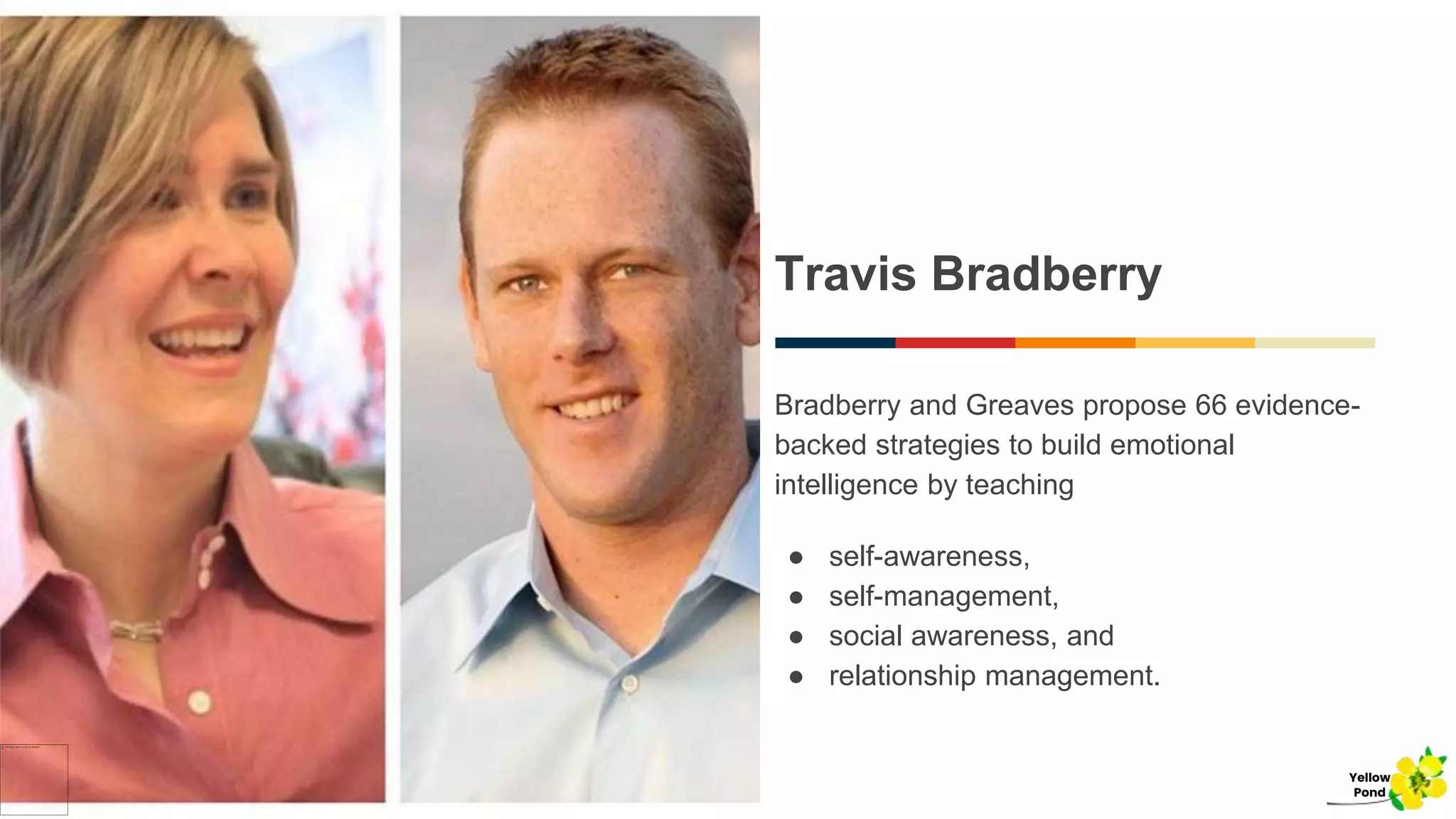
Bradberry and Greaves propose 66 evidence-
backed strategies to build emotional
intelligence by teaching
● self-awareness,
● self-management,
● social awareness, and
● relationship management.
Yellow
Pond
Bradberry &
Greaves
The authors claim that the book,
praised by the Dalai Lama
himself, can help the person
better understand the emotions
of our self and others, and
offers a pre- and post-test to
prove it.
Yellow
Pond
Elements of EI
Yellow
Pond
Elements of
Emotional
Intelligence
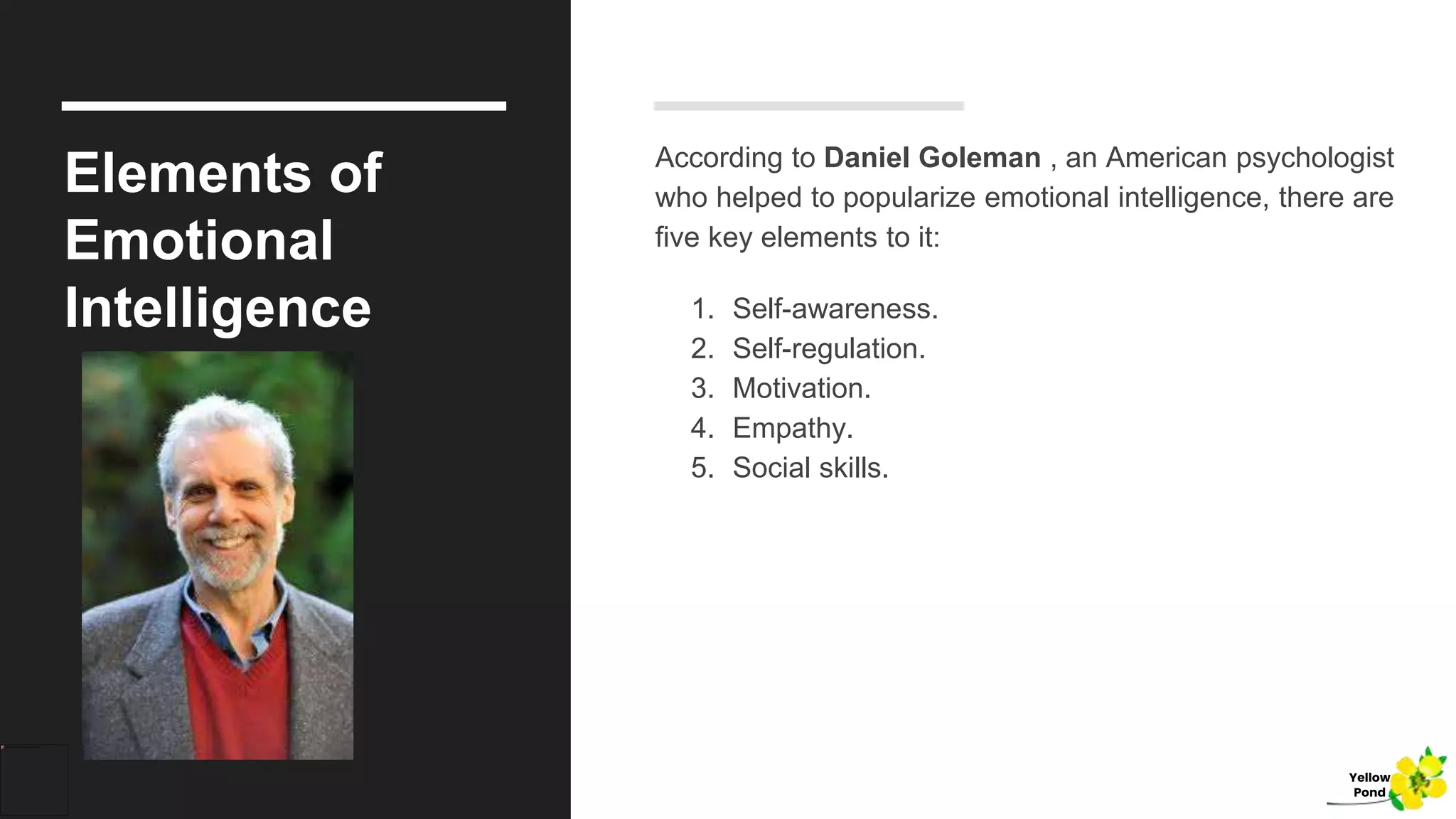
According to Daniel Goleman , an American psychologist
who helped to popularize emotional intelligence, there are
five key elements to it:
1. Self-awareness.
2. Self-regulation.
3. Motivation.
4. Empathy.
5. Social skills.
Yellow
Pond
Self-Awareness
● Emotional awareness: recognizing one’s
emotions and their effects;
● Accurate self-assessment: knowing one’s
strengths and limits;
● Self-confidence: sureness about one’s
self-worth and capabilities.
Yellow
Pond
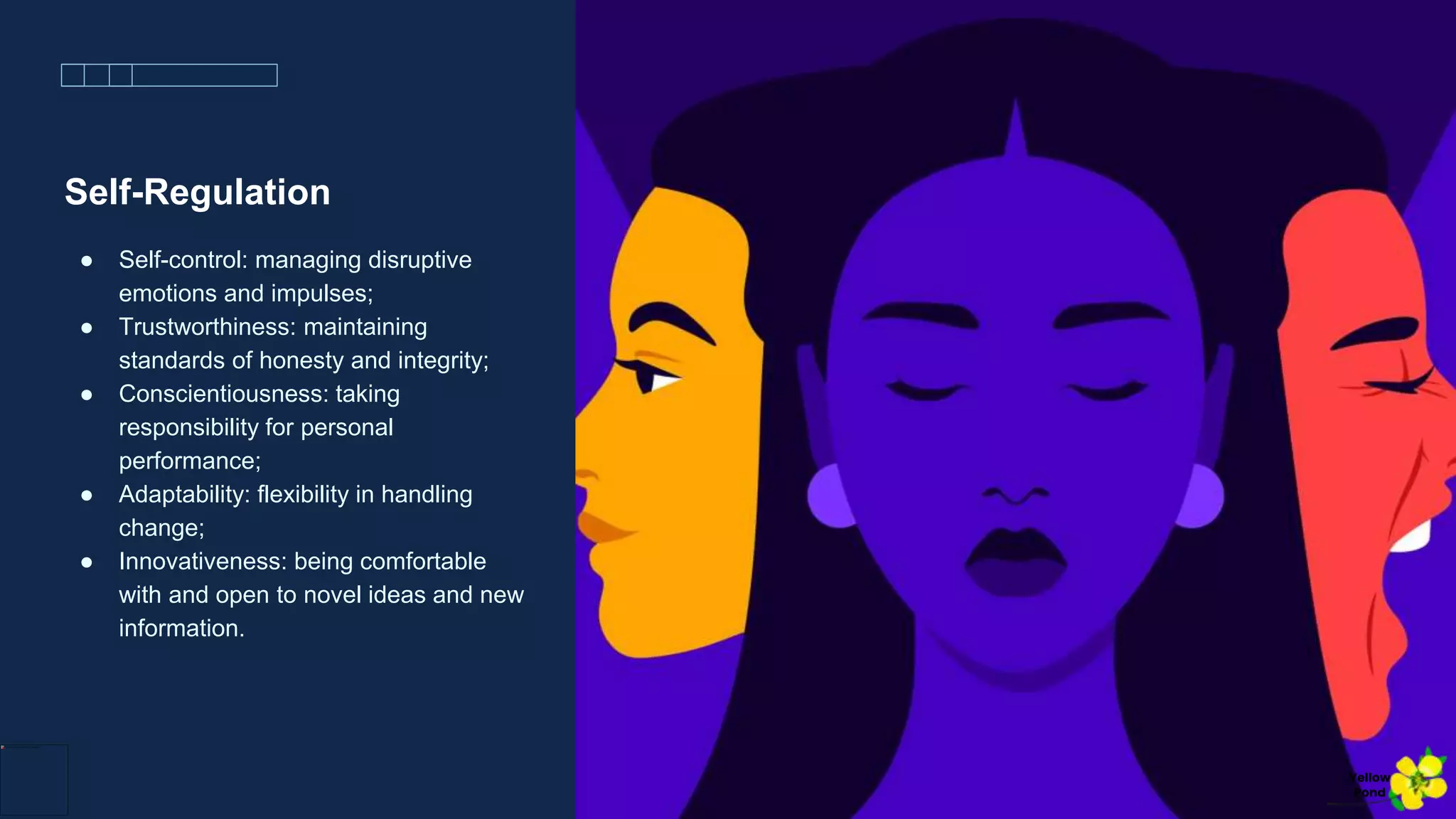
Self-Regulation
● Self-control: managing disruptive
emotions and impulses;
● Trustworthiness: maintaining
standards of honesty and integrity;
● Conscientiousness: taking
responsibility for personal
performance;
● Adaptability: flexibility in handling
change;
● Innovativeness: being comfortable
with and open to novel ideas and new
information.
Yellow
Pond
Self-Motivation
● Achievement drive: striving to improve
or meet a standard of excellence;
● Commitment: aligning with the goals of
the group or organization;
● Initiative: readiness to act on
opportunities;
● Optimism: persistence in pursuing
goals despite obstacles and setbacks.
Yellow
Pond
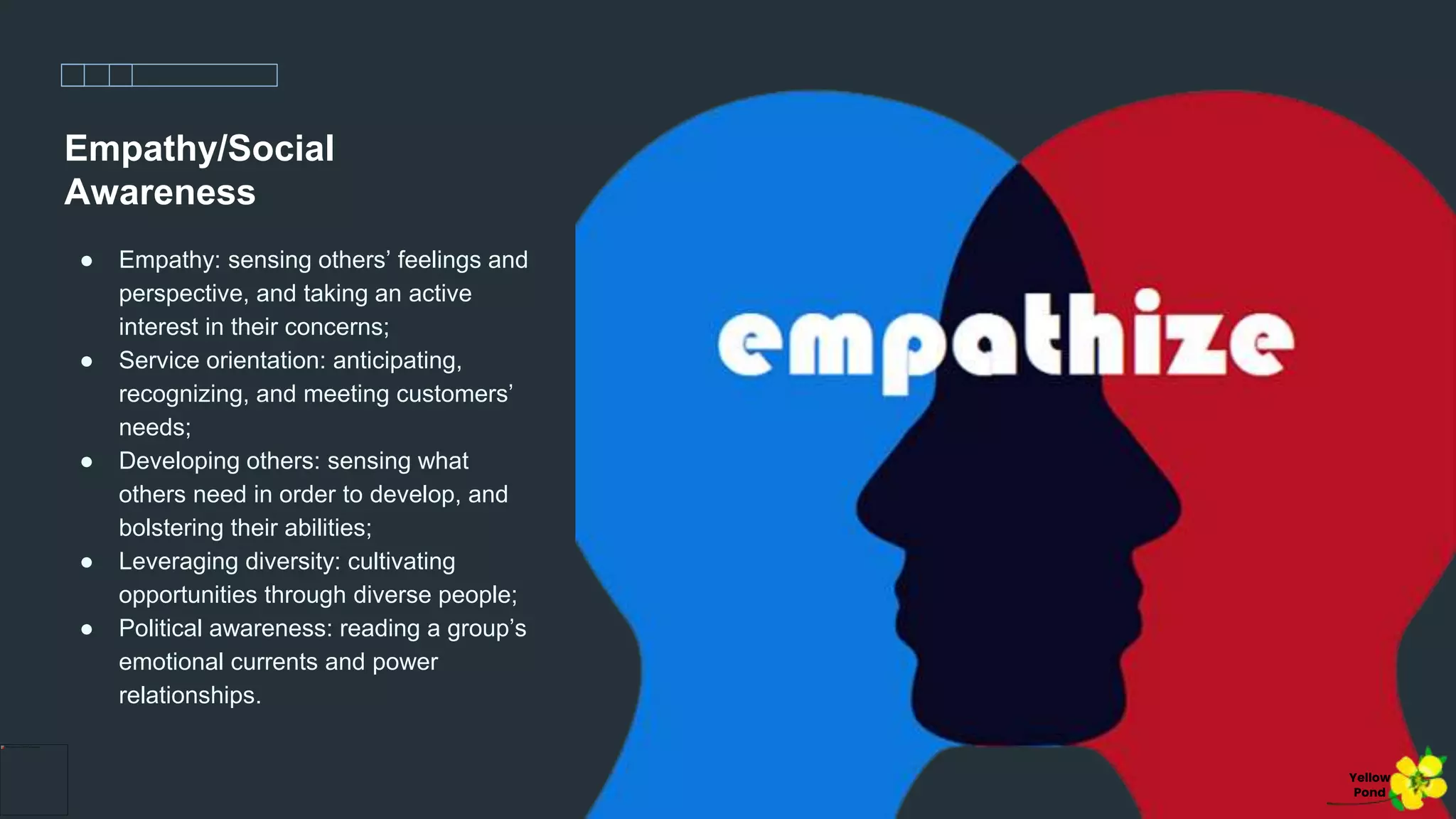
Empathy/Social
Awareness
● Empathy: sensing others’ feelings and
perspective, and taking an active
interest in their concerns;
● Service orientation: anticipating,
recognizing, and meeting customers’
needs;
● Developing others: sensing what
others need in order to develop, and
bolstering their abilities;
● Leveraging diversity: cultivating
opportunities through diverse people;
● Political awareness: reading a group’s
emotional currents and power
relationships.
Yellow
Pond
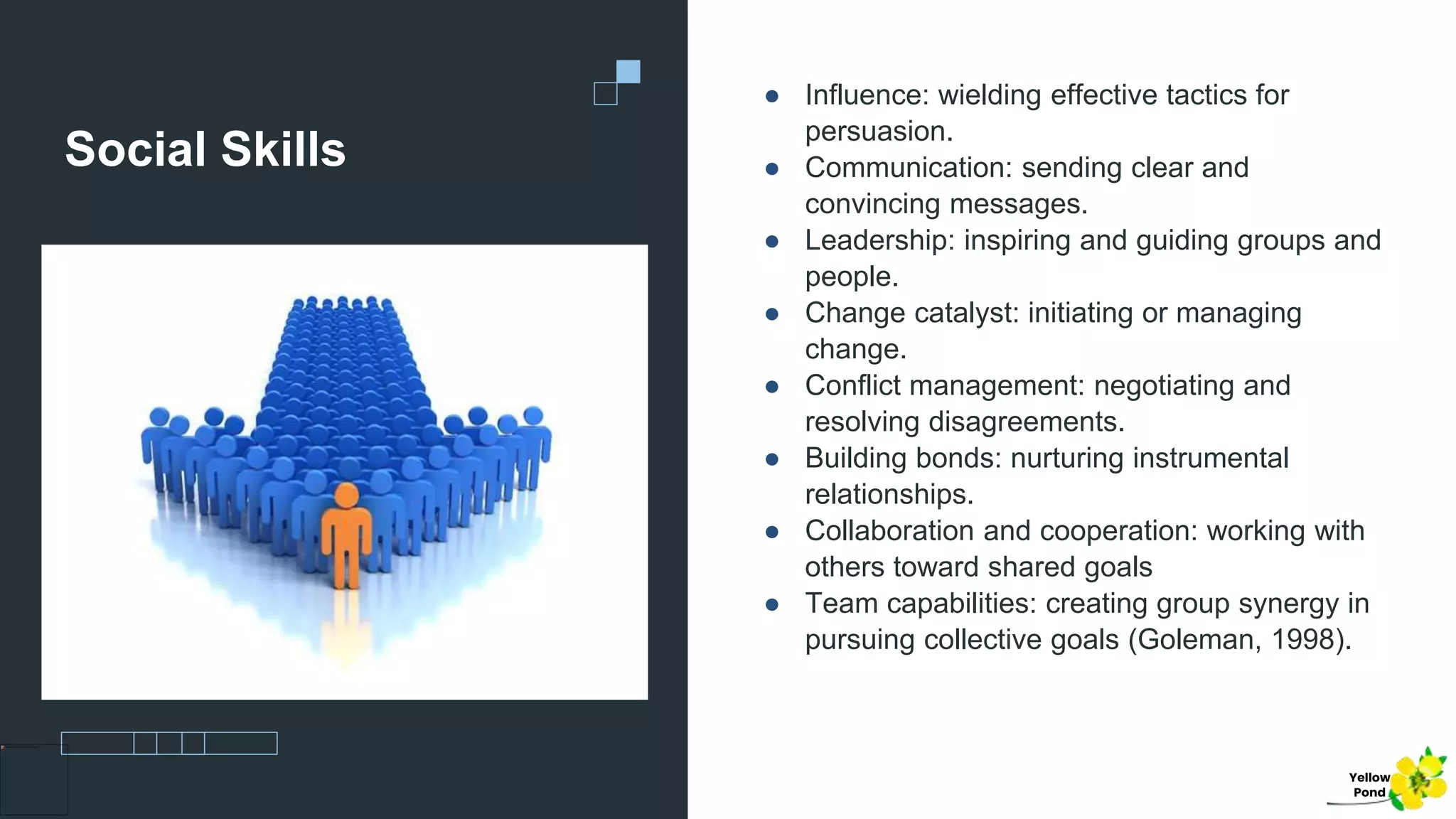
Social Skills
● Influence: wielding effective tactics for
persuasion.
● Communication: sending clear and
convincing messages.
● Leadership: inspiring and guiding groups and
people.
● Change catalyst: initiating or managing
change.
● Conflict management: negotiating and
resolving disagreements.
● Building bonds: nurturing instrumental
relationships.
● Collaboration and cooperation: working with
others toward shared goals
● Team capabilities: creating group synergy in
pursuing collective goals (Goleman, 1998).
Yellow
Pond
Salovey and Mayer
According to EQ “founding fathers” Salovey and Mayer,
there are four distinct dimensions or branches of
emotional intelligence that form a hierarchy of emotional
skills and abilities:
1. Perceiving emotion;
2. Using emotions to facilitate thought;
3. Understanding emotions;
4. Managing emotions.
Yellow
Pond
Yellow
Pond
EQ Vs IQ
Emotional Quotient Intelligence Quotient
Characteristics Empathy, good interpersonal
relationships, survival skills, ability to
control impulses, thoughtful, sensitive
Logical, analytical mind, reasoning
abilities, abstract thinking, problem-
solving abilities
Suitable professions High E.Q. are suitable for teams and
managerial responsibilities, individual
business, social works, working with non-
profit organizations for humanitarian
causes, counseling, human resource jobs
People with high I.Q are great at
Mathematical jobs, software and
web development, linguistics,
programming jobs
Assessments 1. Mayer-Salovey-Caruso Test
2. Daniel Goleman Model Test
3. Emotional Quotient Inventory
1. Stanford-Binet Intelligence Scale
2. Wechsler Intelligence Scale For
Adults and Children
Yellow
Pond
Research Studies on
Emotional
Intelligence
Yellow
Pond
Research and
Studies into the
Theory of EQ
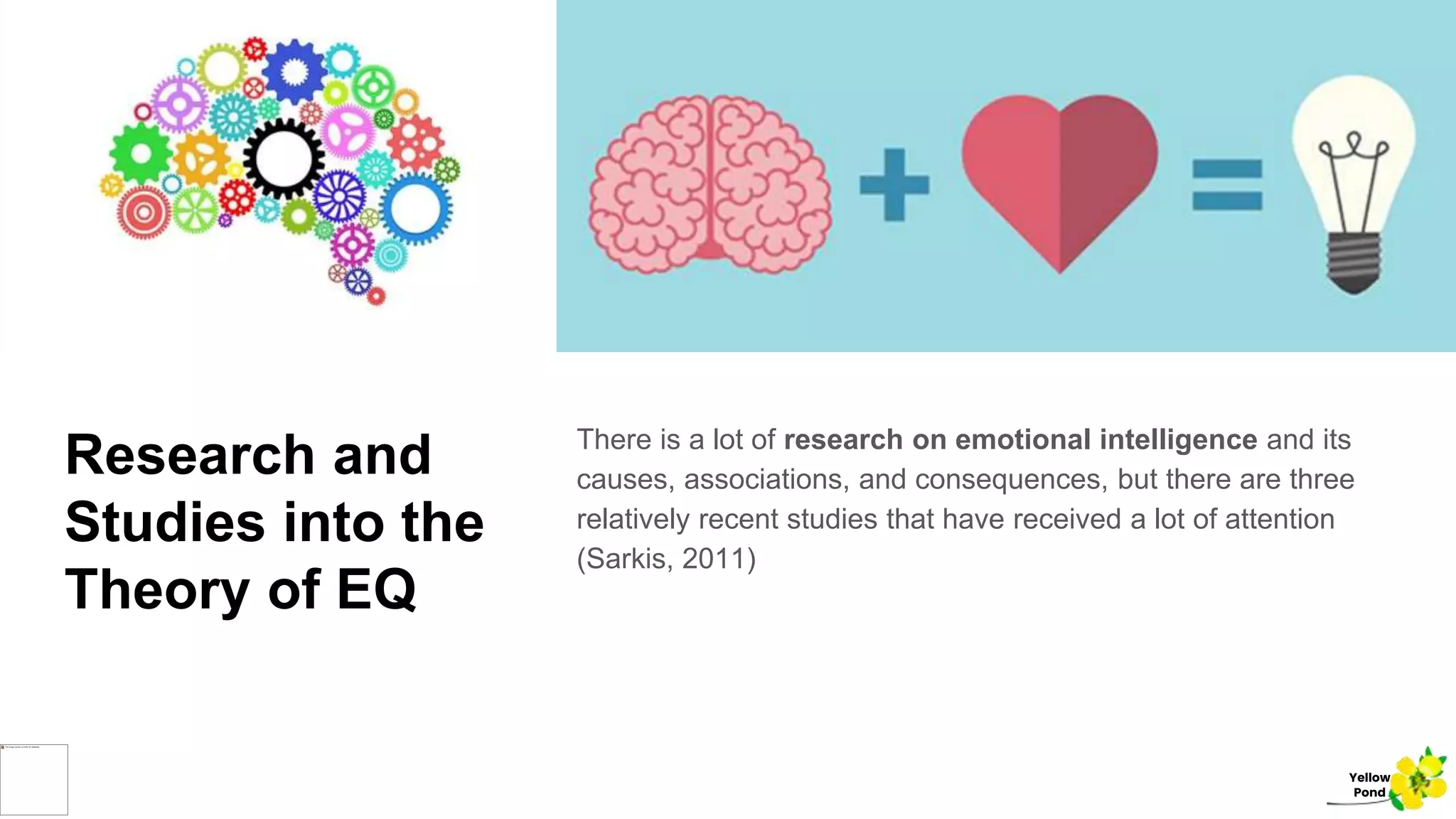
There is a lot of research on emotional intelligence and its
causes, associations, and consequences, but there are three
relatively recent studies that have received a lot of attention
(Sarkis, 2011)
Yellow
Pond
Study 1
1. Researcher Lynda Jiwen Song and colleagues
(2010) explored how emotional intelligence and
cognitive intelligence positively affect college
students’ academic performance and social
interactions.
2. They found that, while IQ is a strong predictor of
academic success, EQ is also a contributor.
3. Further, EQ is a significant factor in the quality of
social interactions with peers, while IQ does not
seem to have much of a role in a college student’s
social life.
Yellow
Pond
Study 2
● Kimmy S. Kee, Peter Salovey, and colleagues
(2009) asked a fascinating question about EQ and
mental illness: Do people with schizophrenia have
significantly lower EQs than those without mental
illness?
● They found that those with schizophrenia indeed had
significantly lower EQ and performed significantly
worse on three out of four EQ tests involving
identifying, understanding, and managing emotions.
Yellow
Pond
Study 3
● Delphine Nelis and colleagues (2009) posed one of
the most important questions that: “Increasing
emotional intelligence: (How) is it possible?”
● They designed an experiment in which two groups
were tested on EQ, once at the beginning of the
study and once at the end.
● The treatment group received a “brief empirically-
derived EI training (four group training sessions of
two hours and a half)” while the control group
received no such training.
● At the end of the experiment, the treatment group
showed significant gains in EQ, while the control
group showed no change.
Yellow
Pond
Trait Emotional
Intelligence Explained
1. A state is a temporary thought
pattern/feeling/behavior that is circumstantial and
highly dependent on the environment as well as the
individual’s personality.
2. A trait is a permanent or semi-permanent thought
pattern/feeling/behavior that is consistent, long-
lasting, and relatively stable with characteristics that
are much more dependent on personality than
environment.
Yellow
Pond
Trait Emotional
Intelligence
Explained
Emotional intelligence generally falls on the trait side of the
state-trait continuum, although our emotional intelligence and
our EQ-related skills and abilities can certainly vary based on
our circumstances.
For example, one could be more emotionally intelligent in
personal relationships than in work situations, or vice versa.
Yellow
Pond
EI for the
Positive
Psychology
Practitioner
● Practitioner of positive psychology as a coach, a therapist or counselor,
or an educators know the benefits of high emotional intelligence.
● Being able to understand, recognize, and effectively manage both
positive and negative emotions will help positive psychology
practitioners in their interactions with clients, boosting their own
performance and their clients’ success rate.
Yellow
Pond
Criticism of EI
Yellow
Pond
Criticism of EI
● EI intelligence is not a new one it is a old wine in a new bottle by Peterson
● EI measurements are not reliable
● EI theories are not rigorous one
● EI can be faked by people
Yellow
Pond
References
1. https://www.helpguide.org/articles/mental-health/emotional-intelligence-eq.htm
2. https://www.psychologytoday.com/intl/basics/emotional-intelligence
3. https://hbr.org/2017/02/emotional-intelligence-has-12-elements-which-do-you-need-to-work-on
4. https://www.mindtools.com/pages/article/newLDR_45.htm
5. https://positivepsychology.com/emotional-intelligence-eq/
6. https://www.theatlantic.com/health/archive/2014/01/the-dark-side-of-emotional-intelligence/282720/
7. http://www.danielgoleman.info/topics/emotional-intelligence/
8. https://www.psychologytoday.com/intl/blog/the-personality-analyst/200909/what-emotional-intelligence-is-and-
is-not
9. https://www.psychologytoday.com/intl/blog/supersurvivors/201911/building-emotional-intelligence-isnt-hard-
you-think
10. https://www.psychologytoday.com/intl/blog/fulfillment-any-age/201906/is-emotional-intelligence-something-you-
can-learn
11. https://www.psychologytoday.com/intl/blog/the-squeaky-wheel/201908/why-distinguishing-your-emotions-can-
buffer-depression
12. https://positivepsychology.com/emotional-intelligence-exercises/
Yellow
Pond

Emotional intelligence

  • 1.
    Emotional Intelligence Dr. SureshKumar Murugesan PhD Yellow Pond
  • 2.
    About the Presenter ●Dr.Suresh Kumar Murugesan is a passionate Professor, Researcher and Positive Mental Health Practitioner from Madurai, Tamil Nadu, India ● At present he is heading the PG Department of Psychology, The American College, Madurai ● He is very keen in research studies and open to learn. ● His ultimate aim is to make impression in the field of Knowledge ● His area of specializations are Psychomentry, Positive Psychotherapy, etc ● He has published 30 journal articles, 50 Conference and seminar proceedings ● Organised more than 500 webinars and acted as a resource person for 250 + webinar session ● Received 4 Awards and delivered 25+ Radio Talks ● Qualified UGC NET in Psychology and Education, Central Teacher Eligibility Test ● Published three books Yellow Pond
  • 3.
    Disclaimer ● This presentationis prepared for learning purpose only and all the images used in this presentation are taken from google image search. ● Due recognition was given to all the material collected from the various sources. ● Any name or reference is missed kindly bring it to the notice of the presenter for inclusion. ● Email - sureshkumar800@yahoo.com Thank you Yellow Pond
  • 4.
    Emotion a strongfeeling such as love, anger, fear, etc. Yellow Pond
  • 5.
    Intelligence the ability tounderstand, learn and think. Yellow Pond
  • 6.
    Emotional Intelligence Emotional intelligencerefers to the ability to identify and manage our own emotions and others. Yellow Pond
  • 7.
    Emotional Intelligence Emotional intelligence isthe ability to understand, use, and manage our own emotions in positive ways ● to relieve stress, ● communicate effectively, ● empathize with others, ● overcome challenges and ● defuse conflict. Yellow Pond
  • 8.
    Emotional intelligence helpsus ● build stronger relationships, ● succeed at school and work, and ● achieve our personal goals. Yellow Pond
  • 9.
    John D Mayerand Peter Salovey has introduced the theory of Emotional Intelligence and demonstrated that how it might be measured in two journal articles (1990) Yellow Pond
  • 10.
    Emotional Intelligence can helpus to connect with our feelings, turn intention into action, and make informed decisions that best for us. Yellow Pond
  • 11.
    Emotional Intelligence Emotional intelligenceis generally said to include at least three skills: 1. emotional awareness, or the ability to identify and name one’s own emotions; 2. the ability to harness those emotions and apply them to tasks like thinking and problem solving; and 3. the ability to manage emotions, which includes both regulating one’s own emotions when necessary and helping others to do the same. Yellow Pond
  • 12.
    The concept ofemotional intelligence—sometimes referred to as emotional quotient or EQ— has gained wide acceptance in recent days. Yellow Pond
  • 13.
    People with highEI could solve a variety of emotion-related problems accurately and quickly. Yellow Pond
  • 14.
    In recent years,most employers have even incorporated emotional intelligence tests into their application and interview processes, on the theory that someone high in emotional intelligence would make a better leader or coworker. Yellow Pond
  • 15.
    Some studies have founda link between emotional intelligence and job performance Yellow Pond
  • 16.
    What is Notan EI? Emotional intelligence is often claimed to be many things it is not a personality trait. Yellow Pond
  • 17.
    What is Notan Emotional Intelligence? Emotional intelligence, however, is not 1. agreeableness. 2. optimism. 3. happiness. 4. calmness. 5. motivation. Yellow Pond
  • 18.
    The qualities suchas agreeableness, optimism, happiness, calmness and motivation are important, have little to do with intelligence, little to do with emotions, and nearly nothing to do with actual emotional intelligence. by John D. Mayer (2009) Yellow Pond
  • 19.
    It is especiallyunfortunate that even some trained psychologists have confused emotional intelligence with such personal qualities. Researchers recommended in a recent American Psychologist article: ...groups of widely studied personality traits, including motives such as the need for achievement, self-related concepts such as self- control, emotional traits such as happiness, and social styles such as assertiveness should be called what they are, rather than being mixed together in haphazard-seeming assortments and named emotional intelligence (p. 514). Yellow Pond
  • 20.
  • 21.
    Characteristics of Emotional Intelligence Accordingto Success.com’s Rhett Power (2017), identified seven qualities that best describe a person with a high EQ: Yellow Pond
  • 22.
    Change They aren’t afraidof change. They understand it’s a fact of life, and they’re quick to adapt; Yellow Pond
  • 23.
    Self Aware They’reself-aware. They know what they’re good at, what they can work on, and what kinds of environments suit them best; Yellow Pond
  • 24.
    Empathetic They’re empathetic. They caneasily relate to others and understand what they are going through Yellow Pond
  • 25.
    Committed They’re committed toquality but understand that perfection is an impossible standard; Yellow Pond
  • 26.
    Balanced They’re balanced andable to have a healthy professional and personal life; Yellow Pond
  • 27.
    Open Minded They’re curiousand open-minded, and they love to explore the possibilities; Yellow Pond
  • 28.
  • 29.
  • 30.
    They have ahealthy work/life balance because they know when to work and when to play Yellow Pond
  • 31.
    They have laserlikefocus and don’t get distracted easily Yellow Pond
  • 32.
    They’re easygoing and“go with the flow Yellow Pond
  • 33.
    They’re open-minded andopen to new ideas Yellow Pond
  • 34.
    They’re a bitguarded because they know when to open up and when to stick to their boundaries Yellow Pond
  • 35.
    They embrace theirstrengths and understand their weaknesses, and leverage the former to compensate for the latter Yellow Pond
  • 36.
    They have atrue sense of empathy that allows them to relate to others and show compassion Yellow Pond
  • 37.
    They’re inquisitive, curious,and interested in people Yellow Pond
  • 38.
    They’re always looking aheadand focusing on how to move forward Yellow Pond
  • 39.
    They forgive others easilyand don’t dwell or hold onto grudges (Health Personal Growth, 2017) Yellow Pond
  • 40.
    Qualities of emotional intelligencePerson The studies of Daniel Goleman illustrated an emotionally intelligent person to have: ● The ability to recognize own emotions ● The ability to relate to others’ emotions ● The ability to actively listen to others ● The ability to actively participate in interpersonal communication and understand the nonverbal cues of behavior ● The ability to control one’s thoughts and feelings ● The ability to effectively manage emotions and express them in a socially acceptable way ● The ability to receive criticisms positively and benefit from them ● The power to forgive, forget, and move on rationally
  • 41.
    Signs of LowEmotional Intelligence ● They are unable to control their emotions; ● They are clueless about the feelings of others, even those close to them; ● They can’t maintain good relationships, whether work or personal; ● They always have a “poker face,” meaning others have a hard time reading them; ● They are often emotionally inappropriate for the situation; ● They have trouble coping with sadness; ● They are emotionally tone deaf, and have trouble reading emotions from tone of voice; ● They have trouble being sympathetic with others; ● They have no “volume control” over their emotions; they especially have trouble with emotional reactions that are too “loud”; ● They are completely unmoved by emotional scenes in movies, TV, or books—no matter the genre; ● They trivialize the importance of emotions in general and elevate the importance of “cool, calm logic”; ● They are not aware of dogs’ emotion states—including their own dogs’ emotional states—even when the signs are clear (Riggio, 2015). Yellow Pond
  • 42.
    Poor Emotional Intelligence Thevision-killing behaviors include: 1. Treating people badly—such as not showing people they care, forgetting to say thank you, not respecting people, not making people feel valued; 2. Living by the adage “Do as I say, not as I do,” and not setting good examples; 3. Focusing on too many things at once; 4. Pushing too hard on the task and forgetting the people; 5. Not giving clear direction; 6. Giving inconsistent direction; 7. Not taking responsibility for failure; 8. Focusing on the detail and forgetting to tell the “whys” or the big picture; 9. Showing little or no personal commitment to the vision; 10. Allowing people who aren’t performing the job to remain.
  • 43.
    Key Researchers ofEmotional Intelligence Yellow Pond
  • 44.
    Three Key Theoriesof EI 1. The Work of Peter Salovey 2. Daniel Goleman 3. Travis Bradberry and Emotional Intelligence 2.0 Yellow Pond
  • 45.
    1. The Workof Peter Salovey Peter Salovey, along with his colleague John Mayer, put forth one of the first formal theories of emotional intelligence in 1990. Yellow Pond
  • 46.
    Peter Salovey and JohnMayer They coined the term and described it as “the ability to recognize, understand, utilize, and regulate emotions effectively in everyday life” (Yale Center for Emotional Intelligence, 2013). Yellow Pond
  • 47.
    Peter Salovey and JohnMayer It is their work that provoked an explosion of interest in emotional intelligence, both within academic fields and in the general public. Judging by the proliferation of books, studies, and research questions centered on the topic, Salovey and Mayer truly struck a chord with their theory. Yellow Pond
  • 48.
    2. Daniel Goleman Notlong after Salovey and Mayer introduced emotional intelligence to the world, other researchers and psychologists began to run with it. Daniel Goleman was one such psychologist; he published the bestselling book Emotional Intelligence in 1995. It helped introduce it into the mainstream. Yellow Pond
  • 49.
    Daniel Goleman ● Golemansaw emotional intelligence as a vital factor in success, especially for children. ● He proposed that promoting social and emotional learning in children to boost their EI would not only improve their learning abilities, ● it would also help them succeed in school by reducing or eliminating some of the most distracting and harmful behavioral problems (Goleman, n.d.). Yellow Pond
  • 50.
    Daniel Goleman His proposalhas been welcomed by both the research community and the general public, and it is now almost taken for granted that emotional intelligence might be just as important—if not more important—to individual success as IQ. Yellow Pond
  • 51.
    Daniel Goleman Schools, educators,and education researchers have also heartily welcomed the idea that emotional intelligence is not simply a genetic, “you have it or you don’t” sort of trait, but a set of skills that can be learned and improved upon. Yellow Pond
  • 52.
    Travis Bradberry and EmotionalIntelligence 2.0 Yellow Pond
  • 53.
    Travis Bradberry Following thegroundbreaking book by Goleman, author Travis Bradberry and his colleague Jean Greaves capitalized on the growing interest and published their own book, Emotional Intelligence 2.0, which outlines a step-by-step program for enhancing it. Yellow Pond
  • 54.
    Travis Bradberry Bradberry andGreaves propose 66 evidence- backed strategies to build emotional intelligence by teaching ● self-awareness, ● self-management, ● social awareness, and ● relationship management. Yellow Pond
  • 55.
    Bradberry & Greaves The authorsclaim that the book, praised by the Dalai Lama himself, can help the person better understand the emotions of our self and others, and offers a pre- and post-test to prove it. Yellow Pond
  • 56.
  • 57.
    Elements of Emotional Intelligence According toDaniel Goleman , an American psychologist who helped to popularize emotional intelligence, there are five key elements to it: 1. Self-awareness. 2. Self-regulation. 3. Motivation. 4. Empathy. 5. Social skills. Yellow Pond
  • 58.
    Self-Awareness ● Emotional awareness:recognizing one’s emotions and their effects; ● Accurate self-assessment: knowing one’s strengths and limits; ● Self-confidence: sureness about one’s self-worth and capabilities. Yellow Pond
  • 59.
    Self-Regulation ● Self-control: managingdisruptive emotions and impulses; ● Trustworthiness: maintaining standards of honesty and integrity; ● Conscientiousness: taking responsibility for personal performance; ● Adaptability: flexibility in handling change; ● Innovativeness: being comfortable with and open to novel ideas and new information. Yellow Pond
  • 60.
    Self-Motivation ● Achievement drive:striving to improve or meet a standard of excellence; ● Commitment: aligning with the goals of the group or organization; ● Initiative: readiness to act on opportunities; ● Optimism: persistence in pursuing goals despite obstacles and setbacks. Yellow Pond
  • 61.
    Empathy/Social Awareness ● Empathy: sensingothers’ feelings and perspective, and taking an active interest in their concerns; ● Service orientation: anticipating, recognizing, and meeting customers’ needs; ● Developing others: sensing what others need in order to develop, and bolstering their abilities; ● Leveraging diversity: cultivating opportunities through diverse people; ● Political awareness: reading a group’s emotional currents and power relationships. Yellow Pond
  • 62.
    Social Skills ● Influence:wielding effective tactics for persuasion. ● Communication: sending clear and convincing messages. ● Leadership: inspiring and guiding groups and people. ● Change catalyst: initiating or managing change. ● Conflict management: negotiating and resolving disagreements. ● Building bonds: nurturing instrumental relationships. ● Collaboration and cooperation: working with others toward shared goals ● Team capabilities: creating group synergy in pursuing collective goals (Goleman, 1998). Yellow Pond
  • 63.
    Salovey and Mayer Accordingto EQ “founding fathers” Salovey and Mayer, there are four distinct dimensions or branches of emotional intelligence that form a hierarchy of emotional skills and abilities: 1. Perceiving emotion; 2. Using emotions to facilitate thought; 3. Understanding emotions; 4. Managing emotions. Yellow Pond
  • 64.
  • 65.
  • 66.
    Emotional Quotient IntelligenceQuotient Characteristics Empathy, good interpersonal relationships, survival skills, ability to control impulses, thoughtful, sensitive Logical, analytical mind, reasoning abilities, abstract thinking, problem- solving abilities Suitable professions High E.Q. are suitable for teams and managerial responsibilities, individual business, social works, working with non- profit organizations for humanitarian causes, counseling, human resource jobs People with high I.Q are great at Mathematical jobs, software and web development, linguistics, programming jobs Assessments 1. Mayer-Salovey-Caruso Test 2. Daniel Goleman Model Test 3. Emotional Quotient Inventory 1. Stanford-Binet Intelligence Scale 2. Wechsler Intelligence Scale For Adults and Children Yellow Pond
  • 67.
  • 68.
    Research and Studies intothe Theory of EQ There is a lot of research on emotional intelligence and its causes, associations, and consequences, but there are three relatively recent studies that have received a lot of attention (Sarkis, 2011) Yellow Pond
  • 69.
    Study 1 1. ResearcherLynda Jiwen Song and colleagues (2010) explored how emotional intelligence and cognitive intelligence positively affect college students’ academic performance and social interactions. 2. They found that, while IQ is a strong predictor of academic success, EQ is also a contributor. 3. Further, EQ is a significant factor in the quality of social interactions with peers, while IQ does not seem to have much of a role in a college student’s social life. Yellow Pond
  • 70.
    Study 2 ● KimmyS. Kee, Peter Salovey, and colleagues (2009) asked a fascinating question about EQ and mental illness: Do people with schizophrenia have significantly lower EQs than those without mental illness? ● They found that those with schizophrenia indeed had significantly lower EQ and performed significantly worse on three out of four EQ tests involving identifying, understanding, and managing emotions. Yellow Pond
  • 71.
    Study 3 ● DelphineNelis and colleagues (2009) posed one of the most important questions that: “Increasing emotional intelligence: (How) is it possible?” ● They designed an experiment in which two groups were tested on EQ, once at the beginning of the study and once at the end. ● The treatment group received a “brief empirically- derived EI training (four group training sessions of two hours and a half)” while the control group received no such training. ● At the end of the experiment, the treatment group showed significant gains in EQ, while the control group showed no change. Yellow Pond
  • 72.
    Trait Emotional Intelligence Explained 1.A state is a temporary thought pattern/feeling/behavior that is circumstantial and highly dependent on the environment as well as the individual’s personality. 2. A trait is a permanent or semi-permanent thought pattern/feeling/behavior that is consistent, long- lasting, and relatively stable with characteristics that are much more dependent on personality than environment. Yellow Pond
  • 73.
    Trait Emotional Intelligence Explained Emotional intelligencegenerally falls on the trait side of the state-trait continuum, although our emotional intelligence and our EQ-related skills and abilities can certainly vary based on our circumstances. For example, one could be more emotionally intelligent in personal relationships than in work situations, or vice versa. Yellow Pond
  • 74.
    EI for the Positive Psychology Practitioner ●Practitioner of positive psychology as a coach, a therapist or counselor, or an educators know the benefits of high emotional intelligence. ● Being able to understand, recognize, and effectively manage both positive and negative emotions will help positive psychology practitioners in their interactions with clients, boosting their own performance and their clients’ success rate. Yellow Pond
  • 75.
  • 76.
    Criticism of EI ●EI intelligence is not a new one it is a old wine in a new bottle by Peterson ● EI measurements are not reliable ● EI theories are not rigorous one ● EI can be faked by people Yellow Pond
  • 77.
    References 1. https://www.helpguide.org/articles/mental-health/emotional-intelligence-eq.htm 2. https://www.psychologytoday.com/intl/basics/emotional-intelligence 3.https://hbr.org/2017/02/emotional-intelligence-has-12-elements-which-do-you-need-to-work-on 4. https://www.mindtools.com/pages/article/newLDR_45.htm 5. https://positivepsychology.com/emotional-intelligence-eq/ 6. https://www.theatlantic.com/health/archive/2014/01/the-dark-side-of-emotional-intelligence/282720/ 7. http://www.danielgoleman.info/topics/emotional-intelligence/ 8. https://www.psychologytoday.com/intl/blog/the-personality-analyst/200909/what-emotional-intelligence-is-and- is-not 9. https://www.psychologytoday.com/intl/blog/supersurvivors/201911/building-emotional-intelligence-isnt-hard- you-think 10. https://www.psychologytoday.com/intl/blog/fulfillment-any-age/201906/is-emotional-intelligence-something-you- can-learn 11. https://www.psychologytoday.com/intl/blog/the-squeaky-wheel/201908/why-distinguishing-your-emotions-can- buffer-depression 12. https://positivepsychology.com/emotional-intelligence-exercises/ Yellow Pond