Bipolar Disorder

By Anny Dow, Period 3
It is a serious brain disorder
An illness characterized by extreme changes in
mood, behavior and energy levels
Also called Manic-Depressive Psychosis (MDP)
This serious mental illness involves mood
swings that range anywhere from depression to
mania
Affects nearly 5.7 million Americans!!!
How Bipolar Disorder Affects the Body
How Bipolar Disorder Affects

the Body

-it damages to the brain; certain parts of the brain

A

may be unbalanced in volume which can affect the brain’s

F

ability to learn, remember things, and function

F

-People with BPD tend to suffer from anxiety and
panic, and usually also have another mental illness
-People with BPD generally die about 7 yrs earlier
than that of the average population, aside from suicide
-Depression forms of BPD have been linked to be
the causes of over-smoking, drinking, heart disease, heart
attacks, high blood sugar, diabetes, bone loss, stroke, IBS,
even cancer

E
C
T
S
!
!
!
When and How do Most Get
When and How do Most Get Bipolar?
Bipolar?

Most people become bipolar anytime from their
late teens to their early twenties. There are some cases,
which are becoming far more frequent lately, that kids
get BPD.
Studies show that bipolar children out of control than
bipolar adults, often raging for hrs at a time.
There is not a proven cause for BPD yet, but researchers
do know that genes can cause a predisposition to the
mental illness. Other possibilities include too much
stress, overload of excitatory NT glutamate in the
synapse.
Some evidence also hints that a lack of vit and/or
minerals cause BPD.
These are all possibilities for BPD can range from person
to person, so there is no solid cause.
How is a Person’s Life Life
How is a Person’s DailyDailyAffected?
affected? disease
Having BPD is just like having any other

(diabetes or heart disease). People with BPD suffer from manic
and depressive episodes in their daily lives and have to
constantly keep watch on their condition.
Victims of the illness are usually extremely tired or overly hyper
and are not in control of their brain functions. Their range of
moods is abnormal. Without treatment, it worsens quickly. Life
is an “emotional roller coaster” for the people with BPD.
Fortunately, BPD comes with many treatment forms. With the
proper medication, education, and support, people with BPD
can manage and live normal lives.
Symptoms
Symptoms of Bipolar Disorder
Depression Form:

Manic Form:

- constantly feeling sad or
worthless

- increase in energy level

- sleeping too much or too little

- easily distracted

P

- feeling tired and having little
energy

- nonstop talking

O

-appetite and weight changes

L

-problems focusing

A

- thoughts of suicide

B
I

R

- less need for sleep

- increased self confidence
- focused on getting things done, but
does not accomplish much
- is involved in risky activities even
though bad things may happen
What is the Cost of Treatment?
BPD is not cheap to manage. More
than a decade ago, the total cost of
BPD was estimated to be up to $45
billion a yr. Most of the cost comes
from reduced functional capacity and
lost work. Compared with the general
population, bipolar pts have higher
rates of utilization of healthcare
resources. The lost productivity of
bipolar pts who have committed
suicide was $8 billion of the $45 billion
in costs recorded in 1991. Only about
$7 billion was spent on direct pts care.
Misdiagnosis also has to do with
increased costs.
Famous People with Bipolar Disorder
Hans Christian Anderson, writer.

Sylvia Plath, poet.

Ludwig Van Beethoven, composer.

Edgar Allen Poe, writer.

Lord Byron, poet.

Axl Rose, musician.

Charles Dickens, author.

Robert Schumann, composer.

Ralph Waldo Emerson, philosopher & poet.

Mark Twain, author.

Ernest Hemingway, writer.

Vincent Van Gogh, Artist.

Vivien Leigh, actress.

Virginia Woolf, poet & novelist.

Abraham Lincoln, 16th U.S. president.

Frank Bruno, boxer.

Marilyn Monroe, actress.

Adolf Hitler, dictator.

Isaac Newton, scientist & mathematician.

Winston Churchill, politician.

Florence Nightingale, nurse.

Francis Scott Key Fitzgerald, writer.

Ozzy Osbourne, singer.

Courtney Love, musician & actress.
Cures/Treatments for Bipolar Disorder
Cures/Treatments for Bipolar

Disorder

There is no actual “cure” for BPD yet, but with the help of various
treatments and medications, people with BPD can live normally.
These are just a few of the treatments for BPD:
Medications:
Mood Stabilizers- delay and relieve episodes of depression and mania
Antidepressants- work with mood stabilizers to help slow depression
Antipsychotics- helps treat mania and also severe cases of mania/depression
Electroconvulsive therapy (ECT)- used to treat mania/depression

Talk Therapy: Also known as psychotherapy, talk therapy can help people
with BPD make sense of their thoughts and feelings. Through talk therapy,
people can get valuable advice and support, regain their confidence, and reduce
any strain or stress they may have.

Self Care: Learning about BPD is the first critical step in self-care. Tracking
and recording moods is also helpful. Avoiding things that may trigger
depression/manic episodes and joining a mental illness support group are just
a few other things that can help you lessen the stress of having BPD.
Altman Self-Rating Mania Scale (ASRM)

is a 5-item self-reported diagnostic scale
which can be used to assess the presence
and severity manic and hypomanic
symptoms, most commonly in patients
diagnosed with BPD
• It assess differences in "normal" or baseline levels
in 5 subjective and behavioral areas:
1 positive mood
2 self-confidence
3 sleep patterns
4 speech patterns and amount
5 motor activity
Young Mania Rating Scale
• is an eleven-item, multiple-choice diagnostic questionnaire
which psychiatrists use to measure the severity of manic
episodes in pts.
• The scale was originally developed for use in the evaluation
of adult pts - BPD, but has since been modified for use
in pediatric pts.
• A similar scale was then developed to allow clinicians to
interview parents about their children's symptoms, in order
to ascertain a better diagnosis of mania in children. Clinical
studies have demonstrated the effectiveness of the parent
version of the scale.
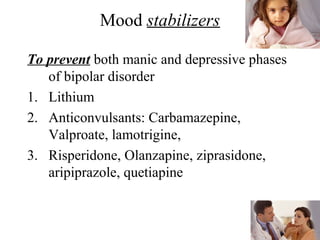
Mood stabilizers
To prevent both manic and depressive phases
of bipolar disorder
1. Lithium
2. Anticonvulsants: Carbamazepine,
Valproate, lamotrigine,
3. Risperidone, Olanzapine, ziprasidone,
aripiprazole, quetiapine
Lithium
• BPD–also along with antidepressants in depression :900-1800
mg/day
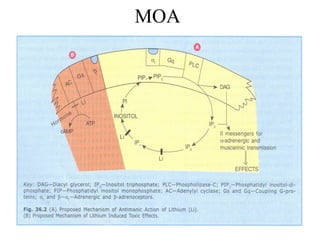
• ? Second messenger modification-Phosphatidyl-InositolBiphosphate [PIP2] / Membrane stabilization/5HT/regulates
circadian rhythms
• Toxic = Monitor blood levels= (0.8-1.2mEq/L) OW/OM
• Renal dysfunction polydipsia, polyuria, Cardiac conduction
abnormalities, GI, tremor, cognitive impairment,
Thyroid dysfunction – hypothyroidism, precipitation of acne
• BUN, creatinine: 3 months
• WBC, THYROID, urine output: 3-6 months
C/I:- PREGNANCY
• COMMON A/E: H, dryness, GI, PPP, hand tremor,
dizziness, fatigue, sedation
• Ataxia, slurring, coarse tremors, confusion, convulsion
MOA
Lithium - uses
• Prevention of both manic and depressive
episodes
• Aggressive behavior
• Borderline personality disorder
• Bulimia nervosa
• Cluster headaches
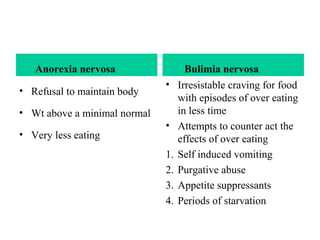
Anorexia nervosa
• Refusal to maintain body
• Wt above a minimal normal
• Very less eating

Bulimia nervosa
• Irresistable craving for food
with episodes of over eating
in less time
• Attempts to counter act the
effects of over eating
1. Self induced vomiting
2. Purgative abuse
3. Appetite suppressants
4. Periods of starvation
Anticonvulsants as mood stabilizers – facilitate GABA- rapid
cycling, mixed episode, alcohol and BZD withdrawal

• Intolerance/resistance to Lithium
• Carbamazepine -Drug of choice for Trigeminal neuralgia.
A/E:- Aplastic, agranulocytosis, sedation, dizziness,
ataxia, Steven-Johnson syndrome,
C/I:- Pregnancy- neural tube defects
• Oxcarbamazepine: Less blood dyscrasias
• Valproic acid: (psychotic, cognitive, substance abuse)
C/I:- Pregnancy- neural tube defects
• VALPROATE, CARBAMAZEPINE
1 Along with lithium to help the action
2 not responding or resistant to lithium
3 not tolerating lithium
Remember –
Acute phase of mania – antipsychotic
Long term treatment – mood stabilizer

ACUTE PHASE OF MANIA: Immediate
treatment: ANTIPSYCHOTICS – eg.
Haloperidol to acutely control psychotic
symptoms and/or diazepam/lorazepam
Then LONG TERM treatment with –
MOOD STABILIZERS
CARBAMAZEPINE
• 400 – 1000 mg/day
• Most effective for mixed states, rapid
cycling
• S/E– sedation, ataxia, aplastic anemia,
agranulocytosis
• Check CBC
VALPROATE
• 500 – 2000 mg/day; Highest blood level for
effect. Highest dose is 60 mg/kg/day
S/E – GI upset, weight gain, alopecia,
teratogenicity, liver problems
• Best for mixed states, rapid cycling,
secondary mania. Ineffective for depression
• Selenium for hair loss
ATYPICAL
ANTIPSYCHOTICS
• Olanzepine – 2.5-20 mg/day; very effective;
significant wt gain and lipid problems in
some
• Risperidone - 5-4 mg/day; more EPS and
increased prolactin in some
• Clozapine - For truly refractory patient, but
can be remarkably effective. Slow response,
serious SE profile and significant wt gain
GABAPENTIN
•
•
•
•

Anticonvulsant, least effective new drug
Most helpful with anxiety, insomnia, pain
May cause persistent sedation
Excreted by kidneys only, no drug
interaction
• 1200 to 4000 mg/day.
LAMOTRIGINE
• Anticonvulsant, best for Bipolar depression
• Improved cognition, excellent tolerance,
serious autoimmune rash
• Valproate interaction
• 75 - 300mg/day.
TOPYRAMATE
• Significant cognitive ill effect and
paresthesiae
• WEIGHT LOSS
• 50 mg qhs, increase by 50 mg/wk. in
divided doses to maximum of 200 mg bid
NEVER GIVE UP
It will help patient to be inspired by
us, rather than the other way around
THE END!!!
Thank you for your time.
Hope you enjoyed the
presentation!

Bipolar Disorder (VK)

  • 1.
  • 2.
    It is aserious brain disorder An illness characterized by extreme changes in mood, behavior and energy levels Also called Manic-Depressive Psychosis (MDP) This serious mental illness involves mood swings that range anywhere from depression to mania Affects nearly 5.7 million Americans!!!
  • 3.
    How Bipolar DisorderAffects the Body How Bipolar Disorder Affects the Body -it damages to the brain; certain parts of the brain A may be unbalanced in volume which can affect the brain’s F ability to learn, remember things, and function F -People with BPD tend to suffer from anxiety and panic, and usually also have another mental illness -People with BPD generally die about 7 yrs earlier than that of the average population, aside from suicide -Depression forms of BPD have been linked to be the causes of over-smoking, drinking, heart disease, heart attacks, high blood sugar, diabetes, bone loss, stroke, IBS, even cancer E C T S ! ! !
  • 4.
    When and Howdo Most Get When and How do Most Get Bipolar? Bipolar? Most people become bipolar anytime from their late teens to their early twenties. There are some cases, which are becoming far more frequent lately, that kids get BPD. Studies show that bipolar children out of control than bipolar adults, often raging for hrs at a time. There is not a proven cause for BPD yet, but researchers do know that genes can cause a predisposition to the mental illness. Other possibilities include too much stress, overload of excitatory NT glutamate in the synapse. Some evidence also hints that a lack of vit and/or minerals cause BPD. These are all possibilities for BPD can range from person to person, so there is no solid cause.
  • 5.
    How is aPerson’s Life Life How is a Person’s DailyDailyAffected? affected? disease Having BPD is just like having any other (diabetes or heart disease). People with BPD suffer from manic and depressive episodes in their daily lives and have to constantly keep watch on their condition. Victims of the illness are usually extremely tired or overly hyper and are not in control of their brain functions. Their range of moods is abnormal. Without treatment, it worsens quickly. Life is an “emotional roller coaster” for the people with BPD. Fortunately, BPD comes with many treatment forms. With the proper medication, education, and support, people with BPD can manage and live normal lives.
  • 6.
    Symptoms Symptoms of BipolarDisorder Depression Form: Manic Form: - constantly feeling sad or worthless - increase in energy level - sleeping too much or too little - easily distracted P - feeling tired and having little energy - nonstop talking O -appetite and weight changes L -problems focusing A - thoughts of suicide B I R - less need for sleep - increased self confidence - focused on getting things done, but does not accomplish much - is involved in risky activities even though bad things may happen
  • 7.
    What is theCost of Treatment? What is the Cost of Treatment? BPD is not cheap to manage. More than a decade ago, the total cost of BPD was estimated to be up to $45 billion a yr. Most of the cost comes from reduced functional capacity and lost work. Compared with the general population, bipolar pts have higher rates of utilization of healthcare resources. The lost productivity of bipolar pts who have committed suicide was $8 billion of the $45 billion in costs recorded in 1991. Only about $7 billion was spent on direct pts care. Misdiagnosis also has to do with increased costs.
  • 8.
    Famous People withBipolar Disorder Hans Christian Anderson, writer. Sylvia Plath, poet. Ludwig Van Beethoven, composer. Edgar Allen Poe, writer. Lord Byron, poet. Axl Rose, musician. Charles Dickens, author. Robert Schumann, composer. Ralph Waldo Emerson, philosopher & poet. Mark Twain, author. Ernest Hemingway, writer. Vincent Van Gogh, Artist. Vivien Leigh, actress. Virginia Woolf, poet & novelist. Abraham Lincoln, 16th U.S. president. Frank Bruno, boxer. Marilyn Monroe, actress. Adolf Hitler, dictator. Isaac Newton, scientist & mathematician. Winston Churchill, politician. Florence Nightingale, nurse. Francis Scott Key Fitzgerald, writer. Ozzy Osbourne, singer. Courtney Love, musician & actress.
  • 9.
    Cures/Treatments for BipolarDisorder Cures/Treatments for Bipolar Disorder There is no actual “cure” for BPD yet, but with the help of various treatments and medications, people with BPD can live normally. These are just a few of the treatments for BPD: Medications: Mood Stabilizers- delay and relieve episodes of depression and mania Antidepressants- work with mood stabilizers to help slow depression Antipsychotics- helps treat mania and also severe cases of mania/depression Electroconvulsive therapy (ECT)- used to treat mania/depression Talk Therapy: Also known as psychotherapy, talk therapy can help people with BPD make sense of their thoughts and feelings. Through talk therapy, people can get valuable advice and support, regain their confidence, and reduce any strain or stress they may have. Self Care: Learning about BPD is the first critical step in self-care. Tracking and recording moods is also helpful. Avoiding things that may trigger depression/manic episodes and joining a mental illness support group are just a few other things that can help you lessen the stress of having BPD.
  • 10.
    Altman Self-Rating ManiaScale (ASRM) is a 5-item self-reported diagnostic scale which can be used to assess the presence and severity manic and hypomanic symptoms, most commonly in patients diagnosed with BPD
  • 11.
    • It assessdifferences in "normal" or baseline levels in 5 subjective and behavioral areas: 1 positive mood 2 self-confidence 3 sleep patterns 4 speech patterns and amount 5 motor activity
  • 12.
    Young Mania RatingScale • is an eleven-item, multiple-choice diagnostic questionnaire which psychiatrists use to measure the severity of manic episodes in pts. • The scale was originally developed for use in the evaluation of adult pts - BPD, but has since been modified for use in pediatric pts. • A similar scale was then developed to allow clinicians to interview parents about their children's symptoms, in order to ascertain a better diagnosis of mania in children. Clinical studies have demonstrated the effectiveness of the parent version of the scale.
  • 13.
    Mood stabilizers To preventboth manic and depressive phases of bipolar disorder 1. Lithium 2. Anticonvulsants: Carbamazepine, Valproate, lamotrigine, 3. Risperidone, Olanzapine, ziprasidone, aripiprazole, quetiapine
  • 14.
    Lithium • BPD–also alongwith antidepressants in depression :900-1800 mg/day • ? Second messenger modification-Phosphatidyl-InositolBiphosphate [PIP2] / Membrane stabilization/5HT/regulates circadian rhythms • Toxic = Monitor blood levels= (0.8-1.2mEq/L) OW/OM • Renal dysfunction polydipsia, polyuria, Cardiac conduction abnormalities, GI, tremor, cognitive impairment, Thyroid dysfunction – hypothyroidism, precipitation of acne • BUN, creatinine: 3 months • WBC, THYROID, urine output: 3-6 months C/I:- PREGNANCY • COMMON A/E: H, dryness, GI, PPP, hand tremor, dizziness, fatigue, sedation • Ataxia, slurring, coarse tremors, confusion, convulsion
  • 15.
  • 16.
    Lithium - uses •Prevention of both manic and depressive episodes • Aggressive behavior • Borderline personality disorder • Bulimia nervosa • Cluster headaches
  • 17.
    Anorexia nervosa • Refusalto maintain body • Wt above a minimal normal • Very less eating Bulimia nervosa • Irresistable craving for food with episodes of over eating in less time • Attempts to counter act the effects of over eating 1. Self induced vomiting 2. Purgative abuse 3. Appetite suppressants 4. Periods of starvation
  • 18.
    Anticonvulsants as moodstabilizers – facilitate GABA- rapid cycling, mixed episode, alcohol and BZD withdrawal • Intolerance/resistance to Lithium • Carbamazepine -Drug of choice for Trigeminal neuralgia. A/E:- Aplastic, agranulocytosis, sedation, dizziness, ataxia, Steven-Johnson syndrome, C/I:- Pregnancy- neural tube defects • Oxcarbamazepine: Less blood dyscrasias • Valproic acid: (psychotic, cognitive, substance abuse) C/I:- Pregnancy- neural tube defects
  • 19.
    • VALPROATE, CARBAMAZEPINE 1Along with lithium to help the action 2 not responding or resistant to lithium 3 not tolerating lithium
  • 20.
    Remember – Acute phaseof mania – antipsychotic Long term treatment – mood stabilizer ACUTE PHASE OF MANIA: Immediate treatment: ANTIPSYCHOTICS – eg. Haloperidol to acutely control psychotic symptoms and/or diazepam/lorazepam Then LONG TERM treatment with – MOOD STABILIZERS
  • 21.
    CARBAMAZEPINE • 400 –1000 mg/day • Most effective for mixed states, rapid cycling • S/E– sedation, ataxia, aplastic anemia, agranulocytosis • Check CBC
  • 22.
    VALPROATE • 500 –2000 mg/day; Highest blood level for effect. Highest dose is 60 mg/kg/day S/E – GI upset, weight gain, alopecia, teratogenicity, liver problems • Best for mixed states, rapid cycling, secondary mania. Ineffective for depression • Selenium for hair loss
  • 23.
    ATYPICAL ANTIPSYCHOTICS • Olanzepine –2.5-20 mg/day; very effective; significant wt gain and lipid problems in some • Risperidone - 5-4 mg/day; more EPS and increased prolactin in some • Clozapine - For truly refractory patient, but can be remarkably effective. Slow response, serious SE profile and significant wt gain
  • 24.
    GABAPENTIN • • • • Anticonvulsant, least effectivenew drug Most helpful with anxiety, insomnia, pain May cause persistent sedation Excreted by kidneys only, no drug interaction • 1200 to 4000 mg/day.
  • 25.
    LAMOTRIGINE • Anticonvulsant, bestfor Bipolar depression • Improved cognition, excellent tolerance, serious autoimmune rash • Valproate interaction • 75 - 300mg/day.
  • 26.
    TOPYRAMATE • Significant cognitiveill effect and paresthesiae • WEIGHT LOSS • 50 mg qhs, increase by 50 mg/wk. in divided doses to maximum of 200 mg bid
  • 27.
    NEVER GIVE UP Itwill help patient to be inspired by us, rather than the other way around
  • 28.
    THE END!!! Thank youfor your time. Hope you enjoyed the presentation!

Editor's Notes

  • #10 Hospitalization for mania, severe depression Mood stabilizers, antipsychotics and antidepressants, ECT – most effective treatment, Supportive psychotherapy and CBT, Lifestyle change , Substance abuse treatment
  • #15 Bld urea nitrogen
  • #19 blood dyscrasias :a morbid gneral state resulting 4m the presence of abnormal material in the bld ,usually appliedto disease affecting bld cells or platelets
  • #22 Complete bld count
  • #23 POLYCYSTIC OVARIAN DISEASE: condition comminly characterized by hirsutism ,obesity ,menustrual abnormalities,infertility,insuline resistance and enlarged ovaries commonly associated with insuline resistance tought 2 reflect excessive androgen secn of ovarion origin women with pcod are frequently at increased risk for cvd and breast cancer