EMETICS & ANTI-EMETICS
Lokesh Patil
B. Pharmacy, 3rd year, 6th semester
Nausea and vomiting are unwanted side
effects of many clinically used drugs,
notably those used for cancer
chemotherapy but also opioids, general
anaesthetics and digoxin. They also
occur in motion sickness, during early
pregnancy and in numerous disease
states (e.g. migraine) as well as bacterial
and viral infections.
VOMITING
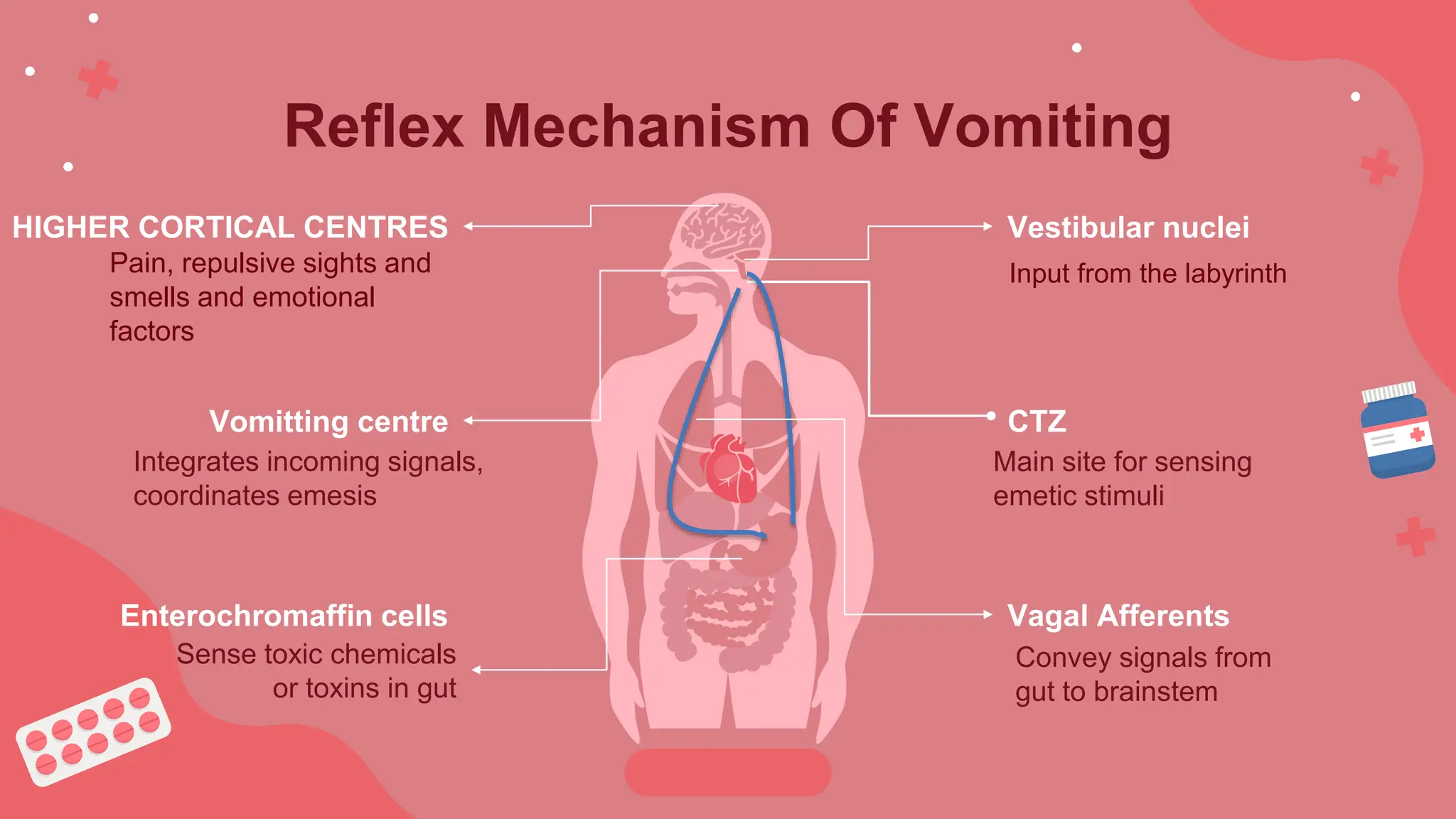
Reflex Mechanism Of Vomiting
Enterochromaffin cells
Sense toxic chemicals
or toxins in gut
Vagal Afferents
Convey signals from
gut to brainstem
Vomitting centre
Integrates incoming signals,
coordinates emesis
CTZ
Main site for sensing
emetic stimuli
HIGHER CORTICAL CENTRES
Pain, repulsive sights and
smells and emotional
factors
Vestibular nuclei
Input from the labyrinth
EMETICS
Emetics are the drugs that produce vomiting.
When noxious substance is ingested, vomiting
has to be induced. Emetics may act directly by
stimulating the CTZ or reflexly by irritating the
stomach mucosa. Mustard powder (1 teaspoon)
with water or hypertonic salt solution can evoke
vomiting reflexly.
1. Centrally acting Emetics
APOMORPHINE
Apomorphine is a derivative of morphine
given SC/IM. It induces vomiting in 5-10
minutes.
It acts by stimulating the dopaminergic receptors
in the CTZ.
NOTE
Apomorphine can depress respiration and
should therefore, avoided in presence of
respiratory depression
IPECACUANHA
Ipecacuanha is obtained from the dried
root of Cephalis ipecacuanha, contains
alkaloid of emetine.
Given as syrup (15-20 ml), produces vomiting in
15 minutes
NOTE
Acts both directly on CTZ and reflexly by
irritating gastric mucosa & is safe even is
childrens.
2. Locally acting Emetics
They cause vomiting by their irritant action
on Gastric Mucosa
1. Copper sulphate
2. Zinc Sulphate
3. NaCl – (2 tablespoon)
4. Black mustard
CONTRAINDICATIONS
• During heart disease
• Advanced pregnancy
• Hernia
• Peptic ulcer
Pathophysiology of drug induced emetics
Pathways stimulating Emesis
ANTI-EMETICS
Antiemetics are the drugs used in the prevention
and treatment of vomiting. Vomiting is a protective
mechanism aimed at eliminating the unwanted
harmful material from the stomach.
5-HT3 Antagonists
Anticancer drugs, radiation therapy and
infection of gastrointestinal mucosa induce
the release of 5HT in the gut which initiates
emetics reflex through 5HT3 receptors
present in gut, NTS,& CTZ
Ondansetron blocks 5HT3 receptors gut,
NTS, CTZ and prevents vomiting.
MO
A
Pharmacokinetics
Ondansetron is powerful antiemetic and can be administered orally or
intravenously (4-8 mg). It has an oral bioavailability of 60-70%, t½ of 3-
5 hours and a duration of action of 4-12 hours.
They are well absorbed from the gut, metabolized by the liver and are
excreted from the kidneys and partly through the gut.
Requires dose reduction in Renal
dysfunction
USES
• To control vomiting induced by anticancer drugs or
radiotherapy.
• Should be given IV 30 min before or orally 1 hr before
starting chemotherapy.
• Also useful in prevention of postoperative vomiting and
other drug induced vomiting. (Dose- 4-8 mg)
Adverse effects
• Headache
• Constipation
• Abdominal discomfort
• Rashes
• Dolasetron may prolong QT interval and should be avoided in
patients with prolonged QT interval.
Dopamine Antagonists
Drugs such as chlorpromazine,
prochlorperazine are effective emetics
commonly used for treating more severe nausea
and vomiting associated with cancer, radiation
therapy and other drugs.
They can be administered orally, IV, or by
suppository.
MOA
Chlorpromazine,
prochlorperazine
Antagonizes dopamine D2
receptors in the CTZ. They
also block the histamine
and muscarinic receptors.
Adverse reactions
• Sedation
• Hypotension
• Dystonias
• Tardive dyskinesia
Anticholinergics
• Hyoscine is a labyrinthine sedative very effective in motion sickness or travelling sickness is
due to over stimulation of the vestibular apparatus along with psychological and environmental
factors.
• Hyoscine also relaxes the GIT smooth muscle.
• It should be taken 30 mins before journey, it acts for 6 hrs.
• A transdermal patch delivers hyoscine constantly over 3 days and is applied behind the year
Adverse Effects
• Sedation
• Dry mouth
Neurokinin Receptor
Antagonists
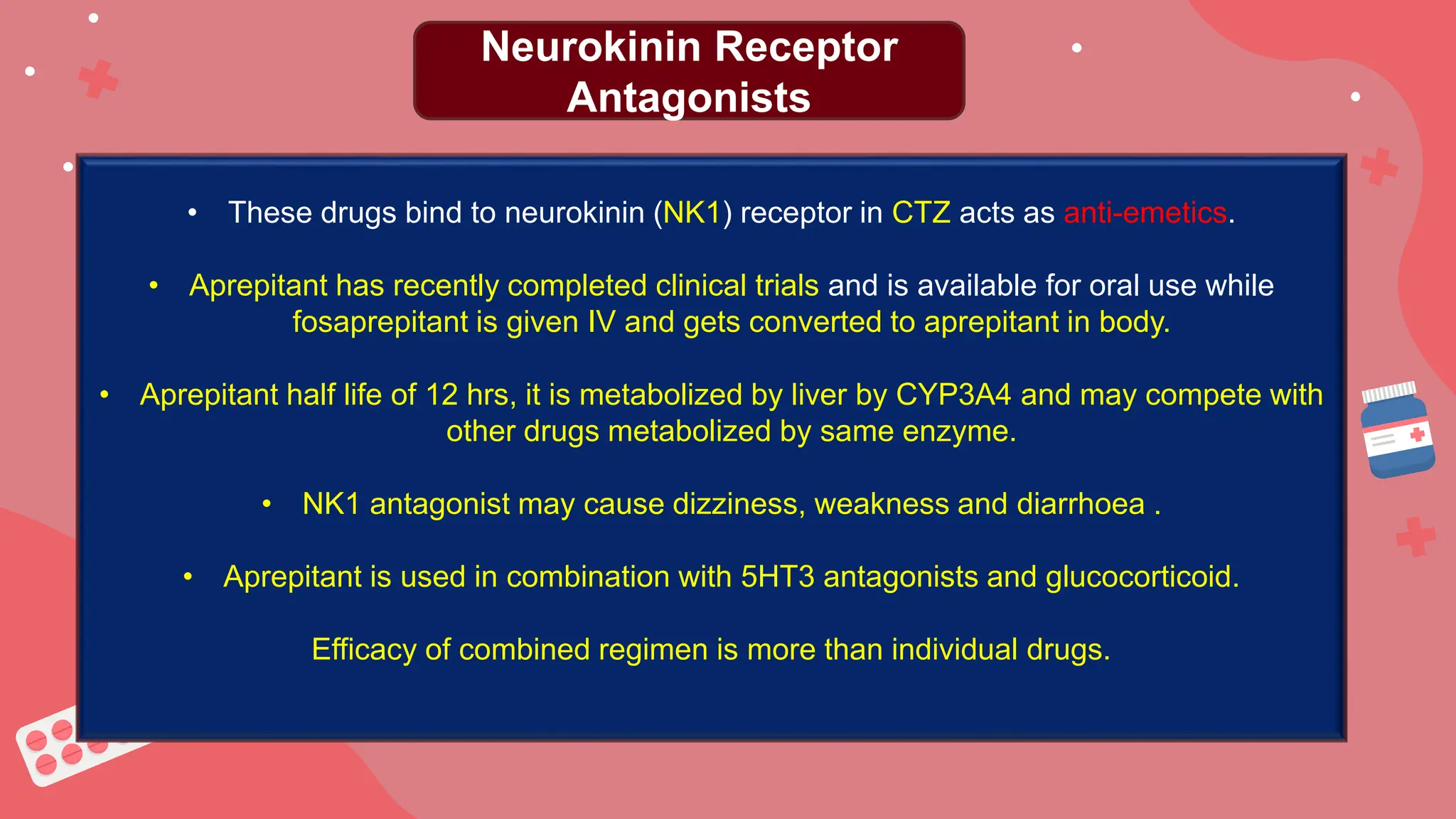
• These drugs bind to neurokinin (NK1) receptor in CTZ acts as anti-emetics.
• Aprepitant has recently completed clinical trials and is available for oral use while
fosaprepitant is given IV and gets converted to aprepitant in body.
• Aprepitant half life of 12 hrs, it is metabolized by liver by CYP3A4 and may compete with
other drugs metabolized by same enzyme.
• NK1 antagonist may cause dizziness, weakness and diarrhoea .
• Aprepitant is used in combination with 5HT3 antagonists and glucocorticoid.
Efficacy of combined regimen is more than individual drugs.
Prokinetic Agents
Drugs that enhance gastroduodenal motility and
hasten gastric emptying are called gastric emptying
are called prokinetic agents.
• Metoclopramide
• Domperidone
• Cisapride
• Mosapride
• Itopride
Metoclopramide
Metoclopramide was introduced in
1970’s. It is structurally related to
Procainamide but it is not local
anaesthetic.
Pharmacological
actions
GIT:- Metaclopramide promotes forward movement of contents
of the upper GI tract, increases oesophagal and gastric peristalsis.
It raises lower oesophagal sphincter pressure, speeds up the
gastric emptying and prevents reflux of stomach contents into
oesophagus. Prokinetics have no significant effects on motility of
small intestine and colon.
CNS:- Metoclopramide acts as an antiemetic
by blocking D2 dopamine receptors on the CTZ.
It also contributes to gastric emptying.
Mechanism of action
1. D2 blockade:-
• Stimulation of dopamine receptors is gut particularly upper
GIT.
• Inhibits cholinergic stimulation of GIT smooth muscle-
relaxes the stomach, lower oesophagal sphincter (LES) and
delays gastric emptying.
• Blocking if D2 receptors in CTZ is responsible for anti-emetic
actions.
Mechanism of action
2. Seratonergic receptors:-
• 5HT4 agonist- metoclopramide stimulates 5HT4 receptors
on the excitatory interneurons of the gut which enhances
the release of acetylcholine myentric motor neurons.
• 5HT3 antagonist- in high doses metoclopramide blocks
5HT3 receptors on inhibitory myentric interneurons which
can enhance Ach release in the GUT. Blockade of NTS and
CTZ adds to anti-emetic action.
Pharmacokinetics
• Metoclopramide is rapidly absorbed on oral
administration. It crosses the BLOOD BRAIN BARRIER,
placenta and is also secreted in milk.
• It has a half life of 3-6 hours. Onset of action is almost
immediate (1-2 mins) after IV injection while it takes
30-60 mins following the oral intake.
Adverse effects
• Sedation
• Restlessness
• Anxiety
• Diarrhoea
• D2 receptor blockade results in
GYNAECOMASTIA and extrapyramidal
symptoms with dystonia and tardive
dyskinesia.
• On long term use symptoms of parkinsonism
can occur.
Drug interactions
1. Metoclopramide blocks the D2 receptors hence blocks
the effects of levodopa.
2. Hastens gastric emptying and thereby hastens
absorption of drugs like diazepam.
Uses
1. Gastro-oesophageal reflux disease.
2. As anti-emetics
3. As preanaesthetic medication
4. In endoscopy
5. Delayed gastric emptying
In case of hill journey, antimotion sickness
drugs are
best administered at:
A. Twelve hours before commencing journey
B. One hour before commencing journey
C. Immediately after commencing journey
D. At the first feeling of motion sickness
The most effective antimotion sickness drug
suitable
for short brisk journies is:
A. Promethazine theoclate
B. Cinnarizine
C. Prochlorperazine
D. Hyoscine
Choose the phenothiazine compound which has
selective
labyrinthine suppressant action, is used for
vomiting and vertigo, but not in schizophrenia:
A. Triflupromazine
B. Prochlorperazine
C. Trifluoperazine
D. Thioridazine
The most dependable emetic used to expel
ingested
poisons is:
A. Intramuscular emetine
B. Oral syrup ipecacuanha
C. Intramuscular apomorphine
D. Oral bromocriptine
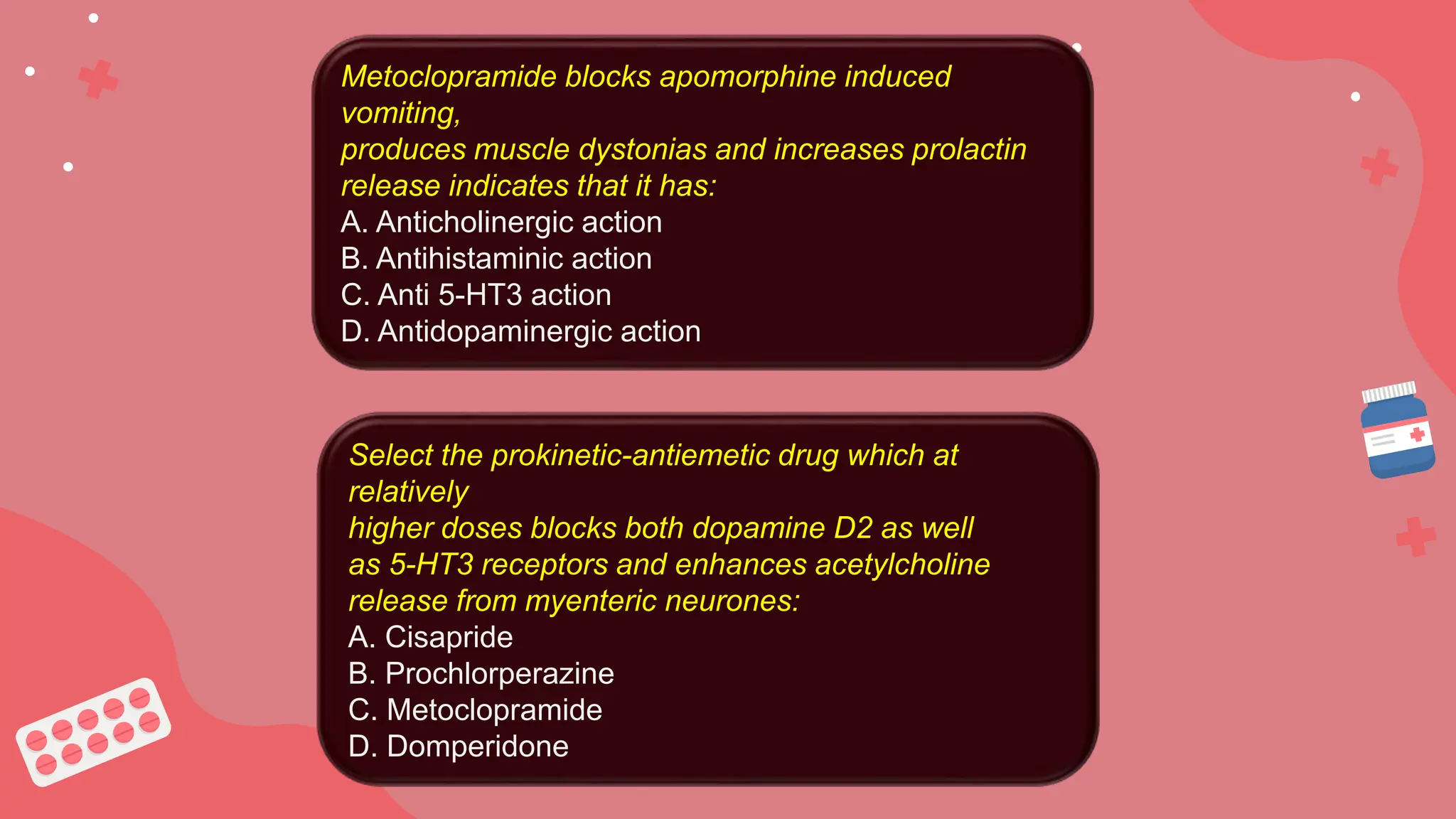
Select the prokinetic-antiemetic drug which at
relatively
higher doses blocks both dopamine D2 as well
as 5-HT3 receptors and enhances acetylcholine
release from myenteric neurones:
A. Cisapride
B. Prochlorperazine
C. Metoclopramide
D. Domperidone
Metoclopramide blocks apomorphine induced
vomiting,
produces muscle dystonias and increases prolactin
release indicates that it has:
A. Anticholinergic action
B. Antihistaminic action
C. Anti 5-HT3 action
D. Antidopaminergic action
Cancer chemotherapy induced vomiting that is not
controlled by metoclopramide alone can be
suppressed
by combining it with:
A. Amphetamine
B. Dexamethasone
C. Hyoscine
D. Cyclizine
Select the drug(s) which afford(s) relief in
gastroesophageal
reflux by increasing lower esophageal
sphincter tone and promoting gastric emptying, but
without affecting acidity of gastric contents:
A. Sodium alginate
B. Metoclopramide
C. Cisapride
D. Both ‘B’ and ‘C’
Ondansetron blocks emetogenic impulses at
the
following site(s):
A. Vagal afferents in intestines
B. Nucleus tractus solitarius
C. Chemoreceptor trigger zone
D. All of the above
Granisetron is a:
A. Second generation antihistaminic
B. Drug for peptic ulcer
C. Antiemetic for cancer chemotherapy
D. New antiarrhythmic drug
Emetics & Anti-emetics presentation for pharmacy students

Emetics & Anti-emetics presentation for pharmacy students

  • 1.
    EMETICS & ANTI-EMETICS LokeshPatil B. Pharmacy, 3rd year, 6th semester
  • 2.
    Nausea and vomitingare unwanted side effects of many clinically used drugs, notably those used for cancer chemotherapy but also opioids, general anaesthetics and digoxin. They also occur in motion sickness, during early pregnancy and in numerous disease states (e.g. migraine) as well as bacterial and viral infections. VOMITING
  • 3.
    Reflex Mechanism OfVomiting Enterochromaffin cells Sense toxic chemicals or toxins in gut Vagal Afferents Convey signals from gut to brainstem Vomitting centre Integrates incoming signals, coordinates emesis CTZ Main site for sensing emetic stimuli HIGHER CORTICAL CENTRES Pain, repulsive sights and smells and emotional factors Vestibular nuclei Input from the labyrinth
  • 4.
    EMETICS Emetics are thedrugs that produce vomiting. When noxious substance is ingested, vomiting has to be induced. Emetics may act directly by stimulating the CTZ or reflexly by irritating the stomach mucosa. Mustard powder (1 teaspoon) with water or hypertonic salt solution can evoke vomiting reflexly.
  • 5.
    1. Centrally actingEmetics APOMORPHINE Apomorphine is a derivative of morphine given SC/IM. It induces vomiting in 5-10 minutes. It acts by stimulating the dopaminergic receptors in the CTZ. NOTE Apomorphine can depress respiration and should therefore, avoided in presence of respiratory depression
  • 6.
    IPECACUANHA Ipecacuanha is obtainedfrom the dried root of Cephalis ipecacuanha, contains alkaloid of emetine. Given as syrup (15-20 ml), produces vomiting in 15 minutes NOTE Acts both directly on CTZ and reflexly by irritating gastric mucosa & is safe even is childrens.
  • 7.
    2. Locally actingEmetics They cause vomiting by their irritant action on Gastric Mucosa 1. Copper sulphate 2. Zinc Sulphate 3. NaCl – (2 tablespoon) 4. Black mustard CONTRAINDICATIONS • During heart disease • Advanced pregnancy • Hernia • Peptic ulcer
  • 8.
    Pathophysiology of druginduced emetics
  • 9.
  • 10.
    ANTI-EMETICS Antiemetics are thedrugs used in the prevention and treatment of vomiting. Vomiting is a protective mechanism aimed at eliminating the unwanted harmful material from the stomach.
  • 12.
    5-HT3 Antagonists Anticancer drugs,radiation therapy and infection of gastrointestinal mucosa induce the release of 5HT in the gut which initiates emetics reflex through 5HT3 receptors present in gut, NTS,& CTZ Ondansetron blocks 5HT3 receptors gut, NTS, CTZ and prevents vomiting. MO A
  • 14.
    Pharmacokinetics Ondansetron is powerfulantiemetic and can be administered orally or intravenously (4-8 mg). It has an oral bioavailability of 60-70%, t½ of 3- 5 hours and a duration of action of 4-12 hours. They are well absorbed from the gut, metabolized by the liver and are excreted from the kidneys and partly through the gut. Requires dose reduction in Renal dysfunction
  • 15.
    USES • To controlvomiting induced by anticancer drugs or radiotherapy. • Should be given IV 30 min before or orally 1 hr before starting chemotherapy. • Also useful in prevention of postoperative vomiting and other drug induced vomiting. (Dose- 4-8 mg)
  • 16.
    Adverse effects • Headache •Constipation • Abdominal discomfort • Rashes • Dolasetron may prolong QT interval and should be avoided in patients with prolonged QT interval.
  • 18.
    Dopamine Antagonists Drugs suchas chlorpromazine, prochlorperazine are effective emetics commonly used for treating more severe nausea and vomiting associated with cancer, radiation therapy and other drugs. They can be administered orally, IV, or by suppository.
  • 19.
    MOA Chlorpromazine, prochlorperazine Antagonizes dopamine D2 receptorsin the CTZ. They also block the histamine and muscarinic receptors.
  • 20.
    Adverse reactions • Sedation •Hypotension • Dystonias • Tardive dyskinesia
  • 22.
    Anticholinergics • Hyoscine isa labyrinthine sedative very effective in motion sickness or travelling sickness is due to over stimulation of the vestibular apparatus along with psychological and environmental factors. • Hyoscine also relaxes the GIT smooth muscle. • It should be taken 30 mins before journey, it acts for 6 hrs. • A transdermal patch delivers hyoscine constantly over 3 days and is applied behind the year Adverse Effects • Sedation • Dry mouth
  • 23.
    Neurokinin Receptor Antagonists • Thesedrugs bind to neurokinin (NK1) receptor in CTZ acts as anti-emetics. • Aprepitant has recently completed clinical trials and is available for oral use while fosaprepitant is given IV and gets converted to aprepitant in body. • Aprepitant half life of 12 hrs, it is metabolized by liver by CYP3A4 and may compete with other drugs metabolized by same enzyme. • NK1 antagonist may cause dizziness, weakness and diarrhoea . • Aprepitant is used in combination with 5HT3 antagonists and glucocorticoid. Efficacy of combined regimen is more than individual drugs.
  • 24.
    Prokinetic Agents Drugs thatenhance gastroduodenal motility and hasten gastric emptying are called gastric emptying are called prokinetic agents. • Metoclopramide • Domperidone • Cisapride • Mosapride • Itopride
  • 25.
    Metoclopramide Metoclopramide was introducedin 1970’s. It is structurally related to Procainamide but it is not local anaesthetic.
  • 26.
    Pharmacological actions GIT:- Metaclopramide promotesforward movement of contents of the upper GI tract, increases oesophagal and gastric peristalsis. It raises lower oesophagal sphincter pressure, speeds up the gastric emptying and prevents reflux of stomach contents into oesophagus. Prokinetics have no significant effects on motility of small intestine and colon. CNS:- Metoclopramide acts as an antiemetic by blocking D2 dopamine receptors on the CTZ. It also contributes to gastric emptying.
  • 27.
    Mechanism of action 1.D2 blockade:- • Stimulation of dopamine receptors is gut particularly upper GIT. • Inhibits cholinergic stimulation of GIT smooth muscle- relaxes the stomach, lower oesophagal sphincter (LES) and delays gastric emptying. • Blocking if D2 receptors in CTZ is responsible for anti-emetic actions.
  • 28.
    Mechanism of action 2.Seratonergic receptors:- • 5HT4 agonist- metoclopramide stimulates 5HT4 receptors on the excitatory interneurons of the gut which enhances the release of acetylcholine myentric motor neurons. • 5HT3 antagonist- in high doses metoclopramide blocks 5HT3 receptors on inhibitory myentric interneurons which can enhance Ach release in the GUT. Blockade of NTS and CTZ adds to anti-emetic action.
  • 29.
    Pharmacokinetics • Metoclopramide israpidly absorbed on oral administration. It crosses the BLOOD BRAIN BARRIER, placenta and is also secreted in milk. • It has a half life of 3-6 hours. Onset of action is almost immediate (1-2 mins) after IV injection while it takes 30-60 mins following the oral intake.
  • 30.
    Adverse effects • Sedation •Restlessness • Anxiety • Diarrhoea • D2 receptor blockade results in GYNAECOMASTIA and extrapyramidal symptoms with dystonia and tardive dyskinesia. • On long term use symptoms of parkinsonism can occur.
  • 32.
    Drug interactions 1. Metoclopramideblocks the D2 receptors hence blocks the effects of levodopa. 2. Hastens gastric emptying and thereby hastens absorption of drugs like diazepam.
  • 33.
    Uses 1. Gastro-oesophageal refluxdisease. 2. As anti-emetics 3. As preanaesthetic medication 4. In endoscopy 5. Delayed gastric emptying
  • 35.
    In case ofhill journey, antimotion sickness drugs are best administered at: A. Twelve hours before commencing journey B. One hour before commencing journey C. Immediately after commencing journey D. At the first feeling of motion sickness The most effective antimotion sickness drug suitable for short brisk journies is: A. Promethazine theoclate B. Cinnarizine C. Prochlorperazine D. Hyoscine
  • 36.
    Choose the phenothiazinecompound which has selective labyrinthine suppressant action, is used for vomiting and vertigo, but not in schizophrenia: A. Triflupromazine B. Prochlorperazine C. Trifluoperazine D. Thioridazine The most dependable emetic used to expel ingested poisons is: A. Intramuscular emetine B. Oral syrup ipecacuanha C. Intramuscular apomorphine D. Oral bromocriptine
  • 37.
    Select the prokinetic-antiemeticdrug which at relatively higher doses blocks both dopamine D2 as well as 5-HT3 receptors and enhances acetylcholine release from myenteric neurones: A. Cisapride B. Prochlorperazine C. Metoclopramide D. Domperidone Metoclopramide blocks apomorphine induced vomiting, produces muscle dystonias and increases prolactin release indicates that it has: A. Anticholinergic action B. Antihistaminic action C. Anti 5-HT3 action D. Antidopaminergic action
  • 38.
    Cancer chemotherapy inducedvomiting that is not controlled by metoclopramide alone can be suppressed by combining it with: A. Amphetamine B. Dexamethasone C. Hyoscine D. Cyclizine Select the drug(s) which afford(s) relief in gastroesophageal reflux by increasing lower esophageal sphincter tone and promoting gastric emptying, but without affecting acidity of gastric contents: A. Sodium alginate B. Metoclopramide C. Cisapride D. Both ‘B’ and ‘C’
  • 39.
    Ondansetron blocks emetogenicimpulses at the following site(s): A. Vagal afferents in intestines B. Nucleus tractus solitarius C. Chemoreceptor trigger zone D. All of the above Granisetron is a: A. Second generation antihistaminic B. Drug for peptic ulcer C. Antiemetic for cancer chemotherapy D. New antiarrhythmic drug