ANTIEMETICS
- BY SURAJ DHARA
(MMCH)
Learning objectives
 Classify the main different classes of antiemetic
drugs according to their mechanism of action.
 Know the characteristic pharmacokinetics &
dynamics of different classes of antiemetic drugs.
 Identify the selective drugs that can be used
according to the cause of vomiting.
 Learn the adjuvant antiemetics.
 Describe the major side effects for the different
classes of antiemetics.
Vomiting
 Is a complex series of integrated events culminating
in the forceful expulsion of gastric contents through
the mouth.
 Such events are coordinated by the emetic (vomiting)
center (VC), lying in reticular formation in medulla.
 Vomiting can be a valuable, life-saving
physiological response ‼‼ to rid stomach & intestine
of toxins & prevent their further ingestion
Consequences of vomiting
 Severe vomiting may result in :
 Dehydration
 Acid-base imbalance
 Electrolyte depletion
 Aspiration, pneumonia
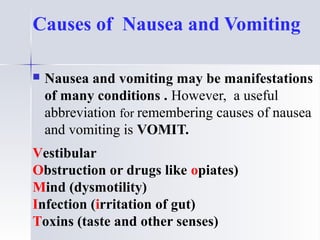
Causes of Nausea and Vomiting
 Nausea and vomiting may be manifestations
of many conditions . However, a useful
abbreviation for remembering causes of nausea
and vomiting is VOMIT.
Vestibular
Obstruction or drugs like opiates)
Mind (dysmotility)
Infection (irritation of gut)
Toxins (taste and other senses)
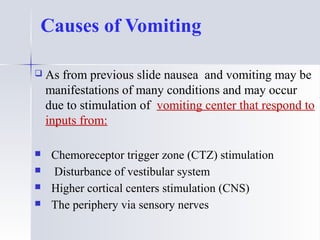
Causes of Vomiting
 As from previous slide nausea and vomiting may be
manifestations of many conditions and may occur
due to stimulation of vomiting center that respond to
inputs from:
 Chemoreceptor trigger zone (CTZ) stimulation
 Disturbance of vestibular system
 Higher cortical centers stimulation (CNS)
 The periphery via sensory nerves
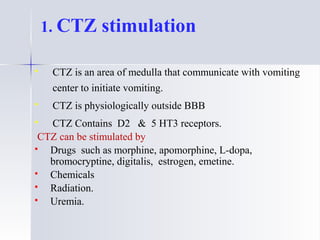
1. CTZ stimulation
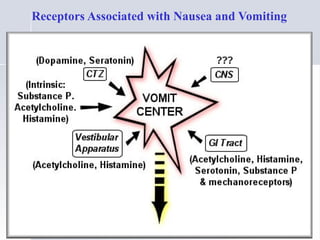
 CTZ is an area of medulla that communicate with vomiting
center to initiate vomiting.
 CTZ is physiologically outside BBB
 CTZ Contains D2 & 5 HT3 receptors.
CTZ can be stimulated by
 Drugs such as morphine, apomorphine, L-dopa,
bromocryptine, digitalis, estrogen, emetine.
 Chemicals
 Radiation.
 Uremia.
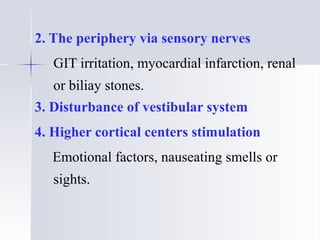
2. The periphery via sensory nerves
GIT irritation, myocardial infarction, renal
or biliay stones.
3. Disturbance of vestibular system
4. Higher cortical centers stimulation
Emotional factors, nauseating smells or
sights.
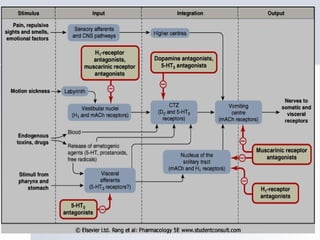
Receptors Associated with Nausea and Vomiting
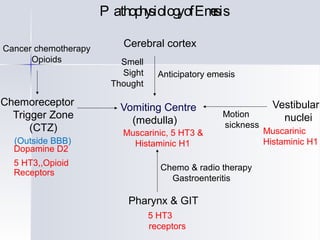
Vomiting Centre
(medulla)
Cerebral cortex
Anticipatory emesis
Smell
Sight
Thought
Vestibular
nucleiMotion
sickness
Pharynx & GIT
Chemo & radio therapy
Gastroenteritis
Chemoreceptor
Trigger Zone
(CTZ)
(Outside BBB)
Cancer chemotherapy
Opioids
Muscarinic, 5 HT3 &
Histaminic H1
5 HT3
receptors
Dopamine D2
5 HT3,,Opioid
Receptors
Muscarinic
Histaminic H1
P athophysiologyofEmesis
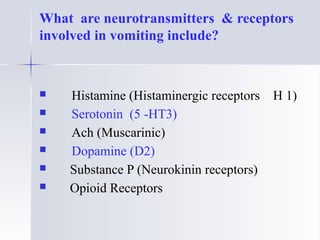
What are neurotransmitters & receptors
involved in vomiting include?
 Histamine (Histaminergic receptors H 1)
 Serotonin (5 -HT3)
 Ach (Muscarinic)
 Dopamine (D2)
 Substance P (Neurokinin receptors)
 Opioid Receptors
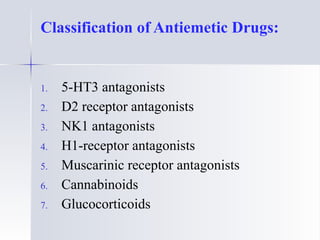
Classification of Antiemetic Drugs:
1. 5-HT3 antagonists
2. D2 receptor antagonists
3. NK1 antagonists
4. H1-receptor antagonists
5. Muscarinic receptor antagonists
6. Cannabinoids
7. Glucocorticoids
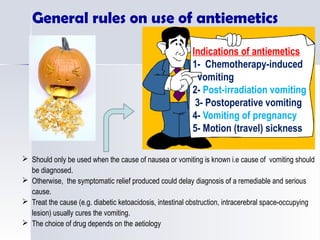
Indications of antiemetics
1- Chemotherapy-induced
vomiting
2- Post-irradiation vomiting
3- Postoperative vomiting
4- Vomiting of pregnancy
5- Motion (travel) sickness
 Should only be used when the cause of nausea or vomiting is known i.e cause of vomiting should
be diagnosed.
 Otherwise, the symptomatic relief produced could delay diagnosis of a remediable and serious
cause.
 Treat the cause (e.g. diabetic ketoacidosis, intestinal obstruction, intracerebral space-occupying
lesion) usually cures the vomiting.
 The choice of drug depends on the aetiology
General rules on use of antiemetics
5-HT3 antagonists
Ondansetron, Granisetron, palonosetron
 The most Potent antiemetic, mediated through central
(vomiting center, chemoreceptor trigger zone) and
peripheral (intestinal and spinal) act by 5-HT3
receptor blockade .
 Orally or i.v., long duration of action.
 Has high first pass metabolism.
 Very effective in nausea & vomiting due to :
– Cytotoxic drugs (cisplatin)
– Post-radiation and Post-operative (second line).
Side effects of 5-HT3 antagonists
Well tolerated
Headache, dizziness and constipation
minor ECG abnormalities (QT prolongation)
D2 receptor antagonists
o Antagonize D2 receptors in CTZ
o Drugs such as Metoclopramide (PlasilR), Domperidone
(MotiliumR )
o Both drugs are also prokinetic agents due to their 5 HT4
agonist activity .
o Domperidone- oral; Metoclopramide-oral, i.v.
o Metoclopramide crosses BBB but domperidone cannot.
o Effective against vomiting due to drugs, gastroenteritis,
surgery, toxins, uremia, radiation
o Can be used in reflux esophagitis .
●
Note: Metoclopramide also it has 5-
HT3 antagonistic activity (First
discovered 5-HT3 antagonist)
Which is a better antiemetic, Metoclopramide
or
Domperidone ?
 As CTZ is outside BBB both have antiemetic effects.
 But as Metoclopramide crosses BBB it has adverse
effects like extrapyramidal side effects.
 Side effects dyskinesia , galactorrhea, menstruation
disorders, sedation (only for metoclopramide).
 Domperidone is preferred antiemetic in children and
levo-dopa induced vomiting.
 Cardiac arrest as a result of QT prolongation occurred with
very few patients taking domperidone. Therefore:
Dose of domperidone should not exceed 30 mg/day
Only used for Nausea and vomiting and should not be
used as prokinetic
Should not be given for patients with cardiac
conductivity problems
Lastly, should also not to be used for long time.
Recent caution regarding the cardiac side
effects of domperidone
Other uses of Metoclopramide
 Facilitate duodenal intubation & endoscopy
 Dec. regurgitation & reflux oesophagitis
 Diagnostic radiology of gut : dec. time required for
barium to reach caecum – dec. No. of films required
 Clears gastric contents in emergency anaesthesia
 Gastroenteritis (the most common use)
Other D2 receptor antagonists
Neuroleptics:
 Antipsychotics with potent antiemetic property due to
D2 antagonism
 Chlorpromazine, Droperidol
 Orally, parenterally, suppository
 Used for vomiting due to chemotherapy- induced emesis
 Side effects: extrapyramidal symptoms hypotension,
sedation, restlessness
Neurokinin1 (NK1) receptor antagonists
Aprepitant
 Is a substance P antagonists that acts by blocking
neurokinin 1 receptors.
 Used in prevention of acute and delayed
chemotherapy-induced nausea and vomiting (CINV) and
for prevention of postoperative nausea and vomiting
(Third line).
H1-receptor antagonists
 Effective for motion sickness, morning sickness in
pregnancy, Vestibular Disturbances and to combat
opioid nausea.
 Drugs as
 Diphenhydramine
 Cyclizine
 Meclizine
 Promethazine: severe morning sickness of pregnancy
(if only essential).
 Not in chemotherapy-induced vomiting.
Muscarinic receptor antagonists
 Hyoscine (Scopolamine)
 Used as trans-dermal patches in motion sickness (applied
behind the external ear).
 Not in chemotherapy-induced vomiting
Cannabinoids
 Nabilone, Dronabinol (psychoactive drugs)
 Used as adjuvant in chemotherapy induced vomiting.
 Side effects: Sedation, hallucination and dysphoria.
Glucocorticoids
 Dexamethasone and Methylprednisolone
 Highly effective in acute emesis alone or combined
with ondansetron.
 Used for vomiting by cytotoxic drugs.
 Side effects:
– Hyperglycemia
– Hypertension
– Cataract
– Osteoporosis
– Increased intraocular pressure
– Increased susceptibility to infection
– Increased appetite & obesity
Summary for Therapeutic Choice of
Antiemetics
Motion sickness
Hyoscine: For short Journey.
Diphenhydramine: For Long Journey.
Vomiting with pregnancy (morning sickness)
Avoid all drugs in the first trimester
Pyridoxine (B6)
Promethazine (late pregnancy).
Drug- induced vomiting (CTZ)
Domperidone & Metoclopramide
Vomiting due to cytotoxic drugs.
Ondansetron
D2- antagonists.
Dexamethazone
Nabilone .
Post operative vomiting
Dopamine antagonists (Metoclopromide or
Domperidone)
Now a day, selective 5-HT3 antagonists are
commonly used
Follow my fb page
@mbbs.disandrev.suraj
THANK YOU

ANTIEMETICS (GIT - 1)

  • 1.
  • 2.
    Learning objectives  Classifythe main different classes of antiemetic drugs according to their mechanism of action.  Know the characteristic pharmacokinetics & dynamics of different classes of antiemetic drugs.  Identify the selective drugs that can be used according to the cause of vomiting.  Learn the adjuvant antiemetics.  Describe the major side effects for the different classes of antiemetics.
  • 3.
    Vomiting  Is acomplex series of integrated events culminating in the forceful expulsion of gastric contents through the mouth.  Such events are coordinated by the emetic (vomiting) center (VC), lying in reticular formation in medulla.  Vomiting can be a valuable, life-saving physiological response ‼‼ to rid stomach & intestine of toxins & prevent their further ingestion
  • 4.
    Consequences of vomiting Severe vomiting may result in :  Dehydration  Acid-base imbalance  Electrolyte depletion  Aspiration, pneumonia
  • 5.
    Causes of Nauseaand Vomiting  Nausea and vomiting may be manifestations of many conditions . However, a useful abbreviation for remembering causes of nausea and vomiting is VOMIT. Vestibular Obstruction or drugs like opiates) Mind (dysmotility) Infection (irritation of gut) Toxins (taste and other senses)
  • 6.
    Causes of Vomiting As from previous slide nausea and vomiting may be manifestations of many conditions and may occur due to stimulation of vomiting center that respond to inputs from:  Chemoreceptor trigger zone (CTZ) stimulation  Disturbance of vestibular system  Higher cortical centers stimulation (CNS)  The periphery via sensory nerves
  • 7.
    1. CTZ stimulation CTZ is an area of medulla that communicate with vomiting center to initiate vomiting.  CTZ is physiologically outside BBB  CTZ Contains D2 & 5 HT3 receptors. CTZ can be stimulated by  Drugs such as morphine, apomorphine, L-dopa, bromocryptine, digitalis, estrogen, emetine.  Chemicals  Radiation.  Uremia.
  • 8.
    2. The peripheryvia sensory nerves GIT irritation, myocardial infarction, renal or biliay stones. 3. Disturbance of vestibular system 4. Higher cortical centers stimulation Emotional factors, nauseating smells or sights.
  • 9.
    Receptors Associated withNausea and Vomiting
  • 10.
    Vomiting Centre (medulla) Cerebral cortex Anticipatoryemesis Smell Sight Thought Vestibular nucleiMotion sickness Pharynx & GIT Chemo & radio therapy Gastroenteritis Chemoreceptor Trigger Zone (CTZ) (Outside BBB) Cancer chemotherapy Opioids Muscarinic, 5 HT3 & Histaminic H1 5 HT3 receptors Dopamine D2 5 HT3,,Opioid Receptors Muscarinic Histaminic H1 P athophysiologyofEmesis
  • 11.
    What are neurotransmitters& receptors involved in vomiting include?  Histamine (Histaminergic receptors H 1)  Serotonin (5 -HT3)  Ach (Muscarinic)  Dopamine (D2)  Substance P (Neurokinin receptors)  Opioid Receptors
  • 12.
    Classification of AntiemeticDrugs: 1. 5-HT3 antagonists 2. D2 receptor antagonists 3. NK1 antagonists 4. H1-receptor antagonists 5. Muscarinic receptor antagonists 6. Cannabinoids 7. Glucocorticoids
  • 14.
    Indications of antiemetics 1-Chemotherapy-induced vomiting 2- Post-irradiation vomiting 3- Postoperative vomiting 4- Vomiting of pregnancy 5- Motion (travel) sickness  Should only be used when the cause of nausea or vomiting is known i.e cause of vomiting should be diagnosed.  Otherwise, the symptomatic relief produced could delay diagnosis of a remediable and serious cause.  Treat the cause (e.g. diabetic ketoacidosis, intestinal obstruction, intracerebral space-occupying lesion) usually cures the vomiting.  The choice of drug depends on the aetiology General rules on use of antiemetics
  • 15.
    5-HT3 antagonists Ondansetron, Granisetron,palonosetron  The most Potent antiemetic, mediated through central (vomiting center, chemoreceptor trigger zone) and peripheral (intestinal and spinal) act by 5-HT3 receptor blockade .  Orally or i.v., long duration of action.  Has high first pass metabolism.  Very effective in nausea & vomiting due to : – Cytotoxic drugs (cisplatin) – Post-radiation and Post-operative (second line).
  • 16.
    Side effects of5-HT3 antagonists Well tolerated Headache, dizziness and constipation minor ECG abnormalities (QT prolongation)
  • 17.
    D2 receptor antagonists oAntagonize D2 receptors in CTZ o Drugs such as Metoclopramide (PlasilR), Domperidone (MotiliumR ) o Both drugs are also prokinetic agents due to their 5 HT4 agonist activity . o Domperidone- oral; Metoclopramide-oral, i.v. o Metoclopramide crosses BBB but domperidone cannot. o Effective against vomiting due to drugs, gastroenteritis, surgery, toxins, uremia, radiation o Can be used in reflux esophagitis .
  • 18.
    ● Note: Metoclopramide alsoit has 5- HT3 antagonistic activity (First discovered 5-HT3 antagonist)
  • 19.
    Which is abetter antiemetic, Metoclopramide or Domperidone ?  As CTZ is outside BBB both have antiemetic effects.  But as Metoclopramide crosses BBB it has adverse effects like extrapyramidal side effects.  Side effects dyskinesia , galactorrhea, menstruation disorders, sedation (only for metoclopramide).  Domperidone is preferred antiemetic in children and levo-dopa induced vomiting.
  • 20.
     Cardiac arrestas a result of QT prolongation occurred with very few patients taking domperidone. Therefore: Dose of domperidone should not exceed 30 mg/day Only used for Nausea and vomiting and should not be used as prokinetic Should not be given for patients with cardiac conductivity problems Lastly, should also not to be used for long time. Recent caution regarding the cardiac side effects of domperidone
  • 21.
    Other uses ofMetoclopramide  Facilitate duodenal intubation & endoscopy  Dec. regurgitation & reflux oesophagitis  Diagnostic radiology of gut : dec. time required for barium to reach caecum – dec. No. of films required  Clears gastric contents in emergency anaesthesia  Gastroenteritis (the most common use)
  • 22.
    Other D2 receptorantagonists Neuroleptics:  Antipsychotics with potent antiemetic property due to D2 antagonism  Chlorpromazine, Droperidol  Orally, parenterally, suppository  Used for vomiting due to chemotherapy- induced emesis  Side effects: extrapyramidal symptoms hypotension, sedation, restlessness
  • 23.
    Neurokinin1 (NK1) receptorantagonists Aprepitant  Is a substance P antagonists that acts by blocking neurokinin 1 receptors.  Used in prevention of acute and delayed chemotherapy-induced nausea and vomiting (CINV) and for prevention of postoperative nausea and vomiting (Third line).
  • 24.
    H1-receptor antagonists  Effectivefor motion sickness, morning sickness in pregnancy, Vestibular Disturbances and to combat opioid nausea.  Drugs as  Diphenhydramine  Cyclizine  Meclizine  Promethazine: severe morning sickness of pregnancy (if only essential).  Not in chemotherapy-induced vomiting.
  • 25.
    Muscarinic receptor antagonists Hyoscine (Scopolamine)  Used as trans-dermal patches in motion sickness (applied behind the external ear).  Not in chemotherapy-induced vomiting Cannabinoids  Nabilone, Dronabinol (psychoactive drugs)  Used as adjuvant in chemotherapy induced vomiting.  Side effects: Sedation, hallucination and dysphoria.
  • 26.
    Glucocorticoids  Dexamethasone andMethylprednisolone  Highly effective in acute emesis alone or combined with ondansetron.  Used for vomiting by cytotoxic drugs.  Side effects: – Hyperglycemia – Hypertension – Cataract – Osteoporosis – Increased intraocular pressure – Increased susceptibility to infection – Increased appetite & obesity
  • 27.
    Summary for TherapeuticChoice of Antiemetics Motion sickness Hyoscine: For short Journey. Diphenhydramine: For Long Journey. Vomiting with pregnancy (morning sickness) Avoid all drugs in the first trimester Pyridoxine (B6) Promethazine (late pregnancy).
  • 28.
    Drug- induced vomiting(CTZ) Domperidone & Metoclopramide Vomiting due to cytotoxic drugs. Ondansetron D2- antagonists. Dexamethazone Nabilone . Post operative vomiting Dopamine antagonists (Metoclopromide or Domperidone) Now a day, selective 5-HT3 antagonists are commonly used
  • 29.
    Follow my fbpage @mbbs.disandrev.suraj
  • 30.

Editor's Notes

  • #2 <number>
  • #7 <number>
  • #8 <number>
  • #12 <number>
  • #16 <number>
  • #30 <number>