Laxative-purgative
Ravish Yadav
Definitions
• These are drugs that promote evacuation of
• bowels.
• A distinction is sometimes made according to the intensity of
action.
• (a) Laxative or aperient: milder action, elimination of soft but
formed stools.
• (b) Purgative or cathartic: stronger action resulting in more
fluid evacuation.
• Many drugs in low doses act as laxative and in larger doses as
purgative.
Mechanism of Action: General
• All purgatives increase the water content of the faeces
by:
• (a) A hydrophilic or osmotic action, retaining water and
electrolytes in the intestinal lumen—increase volume
of colonic content and make it easily propelled.
• (b) Acting on intestinal mucosa, decrease net
absorption of water and electrolyte; intestinal transit is
enhanced indirectly by the fluid bulk.
• (c) Increasing propulsive activity as primary action—
allowing less time for absorption of salt and water as a
secondary effect.
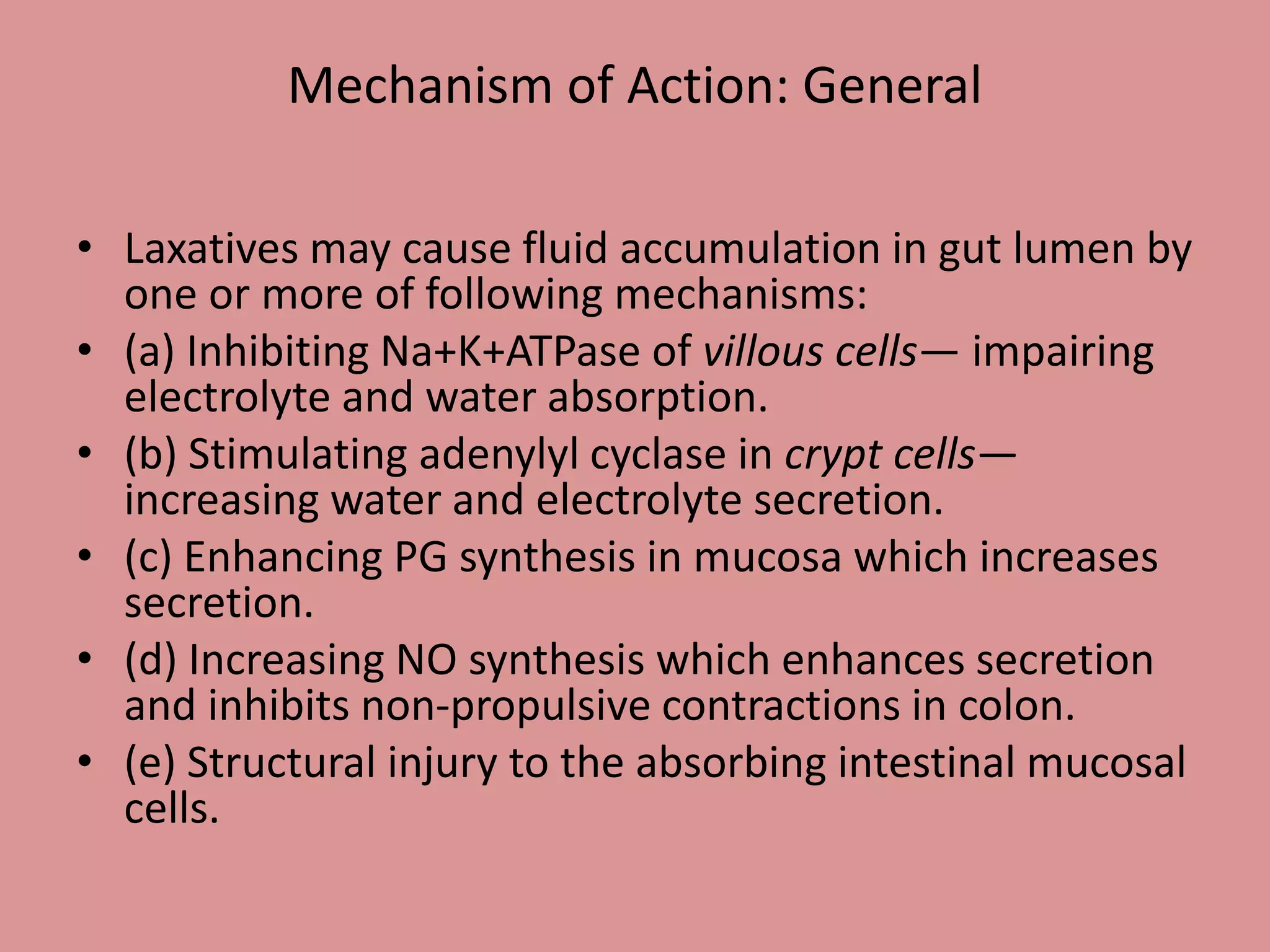
• Laxatives may cause fluid accumulation in gut lumen by
one or more of following mechanisms:
• (a) Inhibiting Na+K+ATPase of villous cells— impairing
electrolyte and water absorption.
• (b) Stimulating adenylyl cyclase in crypt cells—
increasing water and electrolyte secretion.
• (c) Enhancing PG synthesis in mucosa which increases
secretion.
• (d) Increasing NO synthesis which enhances secretion
and inhibits non-propulsive contractions in colon.
• (e) Structural injury to the absorbing intestinal mucosal
cells.
Mechanism of Action: General
Bulk Purgatives
Agents Features
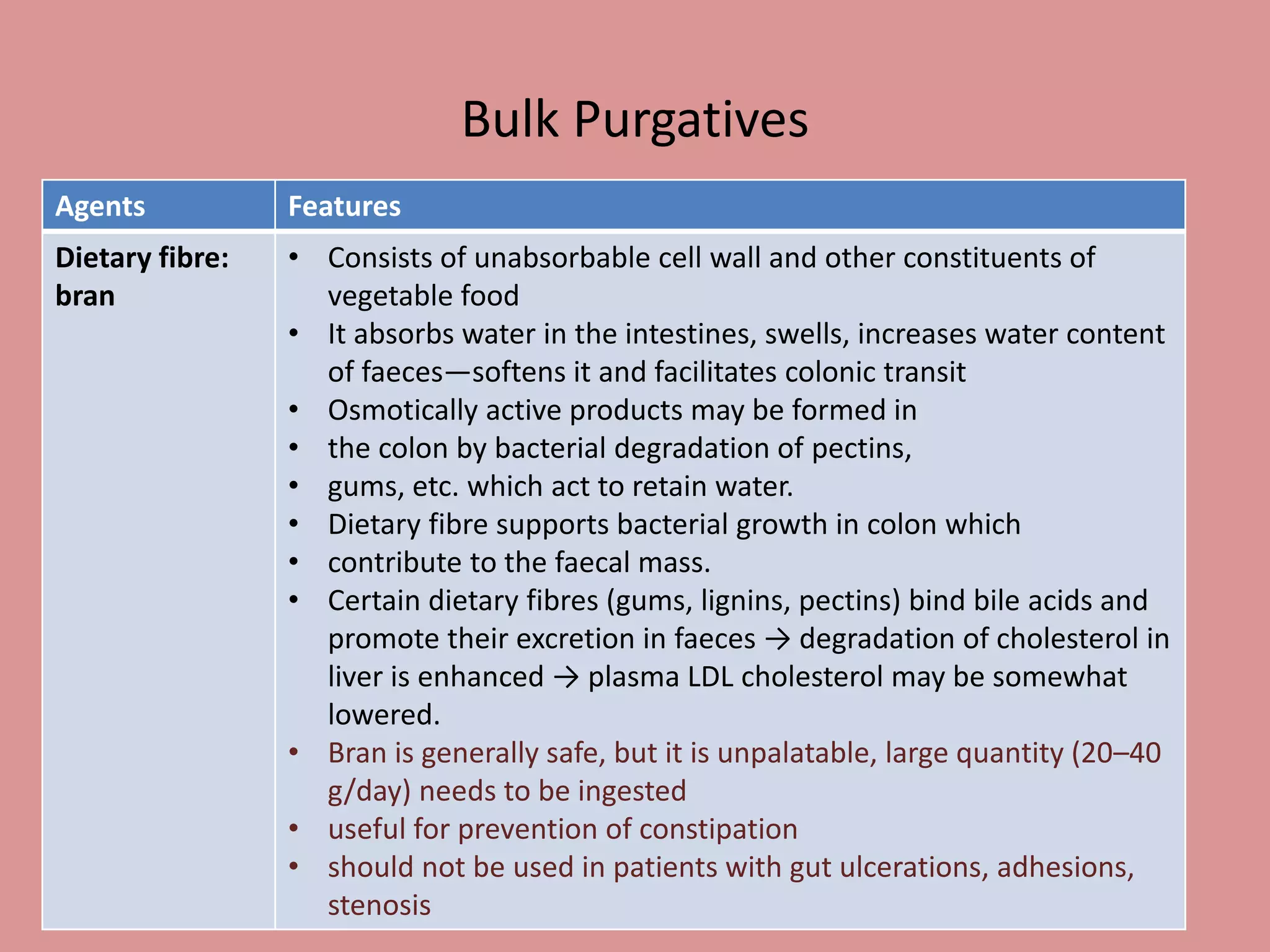
Dietary fibre:
bran
• Consists of unabsorbable cell wall and other constituents of
vegetable food
• It absorbs water in the intestines, swells, increases water content
of faeces—softens it and facilitates colonic transit
• Osmotically active products may be formed in
• the colon by bacterial degradation of pectins,
• gums, etc. which act to retain water.
• Dietary fibre supports bacterial growth in colon which
• contribute to the faecal mass.
• Certain dietary fibres (gums, lignins, pectins) bind bile acids and
promote their excretion in faeces → degradation of cholesterol in
liver is enhanced → plasma LDL cholesterol may be somewhat
lowered.
• Bran is generally safe, but it is unpalatable, large quantity (20–40
g/day) needs to be ingested
• useful for prevention of constipation
• should not be used in patients with gut ulcerations, adhesions,
stenosis
Bulk Purgatives
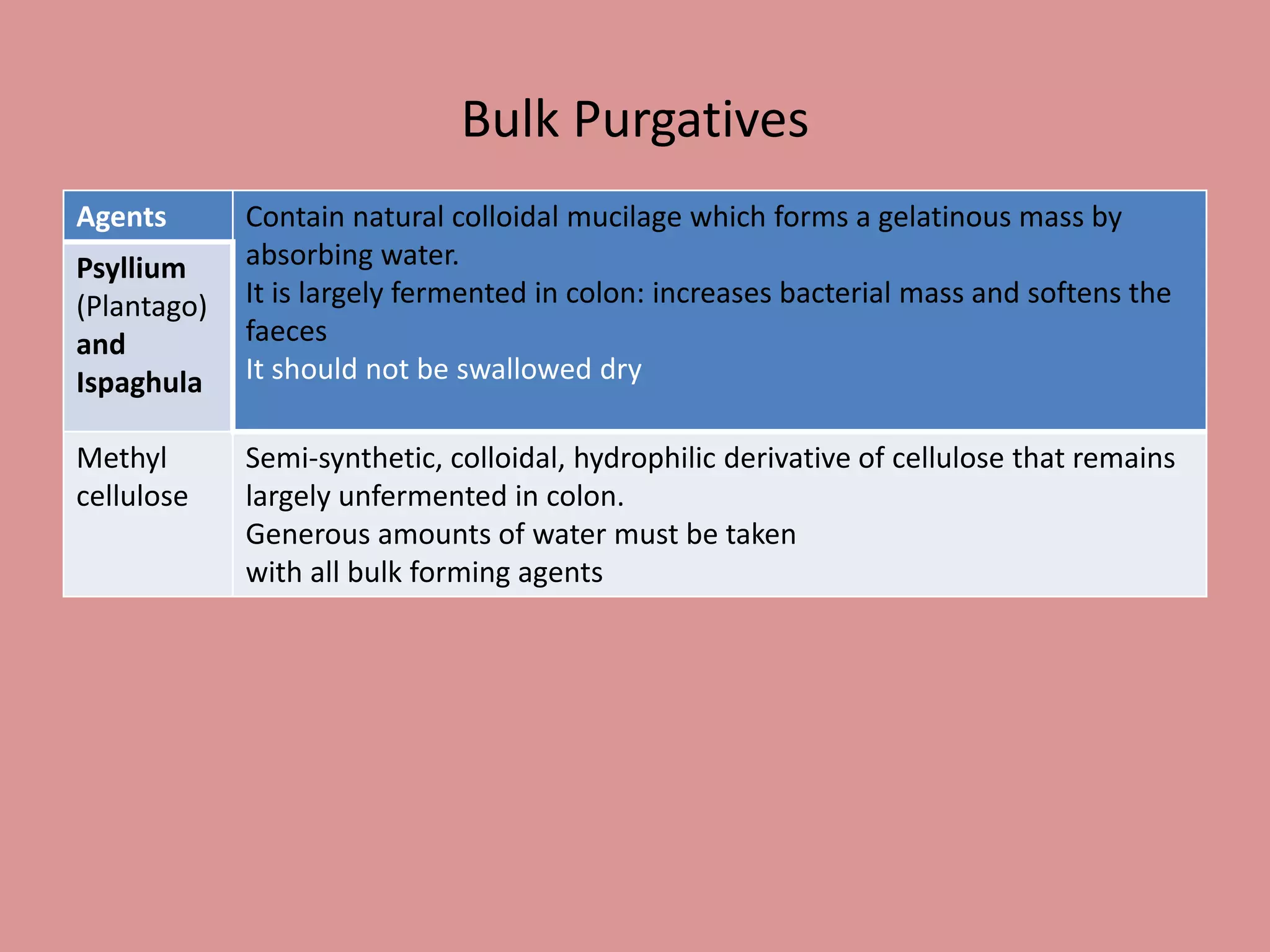
Agents Contain natural colloidal mucilage which forms a gelatinous mass by
absorbing water.
It is largely fermented in colon: increases bacterial mass and softens the
faeces
It should not be swallowed dry
Psyllium
(Plantago)
and
Ispaghula
Methyl
cellulose
Semi-synthetic, colloidal, hydrophilic derivative of cellulose that remains
largely unfermented in colon.
Generous amounts of water must be taken
with all bulk forming agents
Stool Softeners
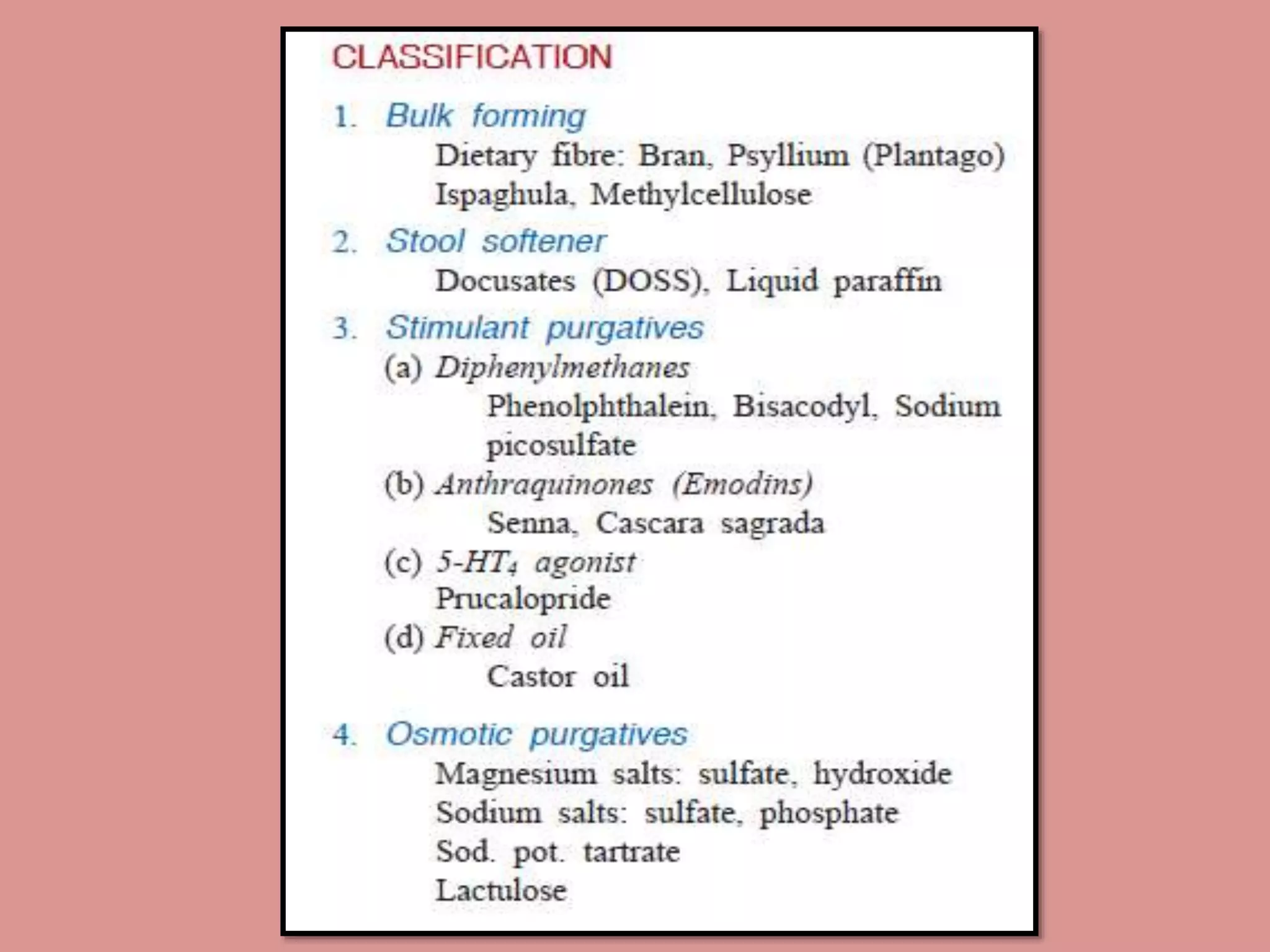
• Docussates: (DOSS)
– It is an anionic detergent, softens the stools by net water
accumulation in the lumen by an action on the intestinal mucosa.
– It emulsifies the colonic contents and increases penetration of water
into the faeces.
– By a detergent action, it can disrupt the mucosal barrier and enhance
absorption of many nonabsorbable drugs, e.g. liquid paraffin—should
not be combined with it.
– It is a mild laxative; especially indicated when
– straining at stools must be avoided.
Stool Softeners
• Liquid paraffin
– It is a viscous liquid; a mixture of petroleum hydrocarbons, It is
pharmacologically inert. It softens stools
– It is bland but very unpleasant to swallow because of oily consistency.
– Small amount passes into the intestinal mucosa—is carried into the
lymph → may produce foreign body granulomas in the intestinal
submucosa, mesenteric lymph nodes, liver and spleen.
– While swallowing it may trickle into lungs—cause lipid
– pneumonia.
– Carries away fat soluble vitamins with it into the stools: deficiency may
occur on chronic use.
– Leakage of the oil past anal sphincter may embarrass.
– May interfere with healing in the anorectal region.
Stimulant Purgatives
• They are powerful purgatives: often produce griping.
• They irritate intestinal mucosa – thus increase motility
• Though some of them do directly increase motility by acting on myenteric plexuses
• the more important mechanism of action is accumulation of water and
electrolytes in the lumen by altering absorptive and secretory activity of the
mucosal cell. They inhibit Na+K+ATPase at the basolateral membrane of villous
cells—transport of Na+ and accompanying water into the interstitium is reduced.
Secretion is enhanced by activation of cAMP in crypt cells as well as by increased
PG synthesis.
• The laxative action of bisacodyl and cascara is shown to be partly dependent upon
increased NO synthesis/action in the colon.
• Larger doses of stimulant purgatives can cause excess purgation resulting in fluid
and electrolyte imbalance.
• Hypokalaemia can occur on regular intake.
• Routine and long-term use must be discouraged, because it can produce colonic
atony. They can reflexly stimulate gravid uterus, therefore are contraindicated
during pregnancy.
• Subacute or chronic intestinal obstruction is another contraindication.
Stimulant Purgatives:
Diphenylmethanes
• Phenolphthalein is in use as purgative from the beginning of
the 20th century. It turns urine pink if alkaline.
• Bisacodyl is more popular.
– They are partly absorbed and reexcreted in bile. Bisacodyl is activated
in the intestine by deacetylation. The primary site of action of diphenyl
methanes is in the colon where they irritate the mucosa, produce mild
inflammation and increase secretion.
– One or two semiformed motions occur after 6–8 hours.
• Sodium picosulfate: Related to bisacodyl. It is hydrolysed by
colonic bacteria to the active form, which then acts locally to
irritate the mucosa and activate myenteric neurones. Bowel
movement generally occurs after 6–12 hours of oral dose.
Stimulant Purgatives:
Anthraquinones
• A number of other plant purgatives contain anthraquinone
glycosides, also called emodins.
• Senna is most popularly used. The glycosides are not active as
such. Unabsorbed in the small intestine, they are passed to
the colon where bacteria liberate the active anthrol form,
which either acts locally or is absorbed into circulation—
excreted in bile to act on small intestine. They also promote
secretion and inhibit salt and water absorption in the colon
• The active principle of these drugs acts on the myenteric
plexus to increase peristalsis and decrease segmentation
• Senna anthraquinone has been found to stimulate PGE2
production in rat intestine.
Stimulant Purgatives:
Anthraquinones
• Thus, they take 6–8 hours to produce action. Excreted in milk
• Taken at bed time—a single, soft but formed evacuation
generally occurs in the morning.
• Cramps and excessive purging may occur
• Senna anthraquinone has been found to stimulate PGE2
production in rat intestine.
• Skin rashes, fixed drug eruption are the occasional adverse
effects.
• Regular use for 4–12 months causes colonic atony and
mucosal pigmentation
Stimulant Purgatives
• Prucalopride
– It is a selective 5-HT4 receptor agonist
– It activates prejunctional 5-HT4receptors on intrinsic enteric neurones
to enhance release of the excitatory transmitter ACh, thereby
promoting propulsive contractions in ileum and more prominently in
colon.
– Colonic transit and stool frequency is improved in constipation-
predominant irritable bowel syndrome (IBS).
• Lubiprostone
– This PG analogue (EP4 receptor agonist), developed recently,
represents a new strategy in the treatment of constipation-
predominant IBS and chronic constipation by stimulating mucosal Cl¯
channels and increasing intestinal secretion.
Stimulant Purgatives: Castor Oil
• It is one of the oldest purgatives
• It mainly contains triglyceride of ricinoleic acid which is a polar longchain
fatty acid.
• Castor oil is hydrolysed in the ileum by lipase to ricinoleic acid and
glycerol. Ricinoleic acid, being polar, is poorly absorbed. It was believed to
irritate the mucosa and stimulate intestinal contractions.
• The primary action is now shown to be decreased intestinal absorption of
water and electrolytes, and enhanced secretion by a detergent like action
on the mucosa.
• Structural damage to the villous tips has also been observed.
• Due to its unpalatability, frequent cramping, a rather violent action,
possibility of dehydration and after-constipation (due to complete
evacuation of colon), it is no longer a favoured purgative. Regular use is
particularly to be avoided— may damage intestinal mucosa.
Osmotic purgatives
• Solutes that are not absorbed in the intestine retain water
osmotically and distend the bowel— increasing peristalsis
indirectly.
• Magnesium ions release cholecystokinin which augments
motility and secretion, contributing to purgative action of
Mag. salts.
• Saline purgatives are not used now for the treatment of
constipation because they are inconvenient/ unpleasant,
produce watery stools and after constipation
• Lactulose
– It is a semisynthetic disaccharide of fructose and lactose which is
neither digested nor absorbed in the small intestine—retains water.
– Further, it is broken down in the colon by bacteria to osmotically more
active products.
– In a dose of 10 g BD taken with plenty of water, it produces soft
formed stools in 1–3 days. Flatulence is common, cramps occur in few.
– Some patients feel nauseated by its peculiar sweet taste.
– In patients with hepatic encephalopathy, lactulose causes reduction of
blood NH3 concentration by 25–50%. The breakdown products of
lactulose are acidic—lower the pH of stools. Ammonia produced by
bacteria in colon is converted to ionized NH4 + salts that are not
absorbed. For this purpose 20 g TDS or more may be needed. Loose
motions are produced at this dose.
Osmotic purgatives
Uses of Laxatives and Purgatives
1. Functional constipation
• Constipation may be spastic or atonic.
• (i) Spastic constipation (irritable bowel): The stools are hard,
rounded, stone like and difficult to pass. The first choice laxative is
dietary fibre or any of the bulk forming agents taken over
weeks/months. Stimulant purgatives are contraindicated.
• (ii) Atonic constipation (sluggish bowel): mostly due to advanced
age, debility or laxative abuse. Non-drug measures like plenty of
fluids, exercise, regular habits and reassurance should be tried.
• In resistant cases a bulk forming agent should be prescribed. In case
of poor compliance or if the patient is not satisfied—bisacodyl or
senna may be given once or twice a week for as short a period as
possible.
Uses of Laxatives and Purgatives
2. Bedridden patients: bowel movement sluggish.
To prevent constipation: Bulk forming agents on a regular schedule;
docusates, lactulose and liquid paraffin are alternatives.
To treat constipation: Enema (soap-water/ glycerine) is preferred;
bisacodyl or senna may be used.
3. To avoid straining at stools: essential to keep the faeces soft-bulk
forming agent, lactulose or docusates.
4. Preparation of bowel for surgery, colonoscopy, abdominal X-ray: The
bowel needs to be emptied of the contents including gas. Saline
purgative, bisacodyl or senna may be used.
5. After certain anthelmintics (especially for tapeworm) Saline
purgative or senna may be used.
6. Food/drug poisoning: To remove out the unabsorbed
irritant/poisonous material from the intestines. Only saline purgatives
are satisfactory.

Laxatives purgatives

  • 1.
  • 2.
    Definitions • These aredrugs that promote evacuation of • bowels. • A distinction is sometimes made according to the intensity of action. • (a) Laxative or aperient: milder action, elimination of soft but formed stools. • (b) Purgative or cathartic: stronger action resulting in more fluid evacuation. • Many drugs in low doses act as laxative and in larger doses as purgative.
  • 4.
    Mechanism of Action:General • All purgatives increase the water content of the faeces by: • (a) A hydrophilic or osmotic action, retaining water and electrolytes in the intestinal lumen—increase volume of colonic content and make it easily propelled. • (b) Acting on intestinal mucosa, decrease net absorption of water and electrolyte; intestinal transit is enhanced indirectly by the fluid bulk. • (c) Increasing propulsive activity as primary action— allowing less time for absorption of salt and water as a secondary effect.
  • 5.
    • Laxatives maycause fluid accumulation in gut lumen by one or more of following mechanisms: • (a) Inhibiting Na+K+ATPase of villous cells— impairing electrolyte and water absorption. • (b) Stimulating adenylyl cyclase in crypt cells— increasing water and electrolyte secretion. • (c) Enhancing PG synthesis in mucosa which increases secretion. • (d) Increasing NO synthesis which enhances secretion and inhibits non-propulsive contractions in colon. • (e) Structural injury to the absorbing intestinal mucosal cells. Mechanism of Action: General
  • 6.
    Bulk Purgatives Agents Features Dietaryfibre: bran • Consists of unabsorbable cell wall and other constituents of vegetable food • It absorbs water in the intestines, swells, increases water content of faeces—softens it and facilitates colonic transit • Osmotically active products may be formed in • the colon by bacterial degradation of pectins, • gums, etc. which act to retain water. • Dietary fibre supports bacterial growth in colon which • contribute to the faecal mass. • Certain dietary fibres (gums, lignins, pectins) bind bile acids and promote their excretion in faeces → degradation of cholesterol in liver is enhanced → plasma LDL cholesterol may be somewhat lowered. • Bran is generally safe, but it is unpalatable, large quantity (20–40 g/day) needs to be ingested • useful for prevention of constipation • should not be used in patients with gut ulcerations, adhesions, stenosis
  • 7.
    Bulk Purgatives Agents Containnatural colloidal mucilage which forms a gelatinous mass by absorbing water. It is largely fermented in colon: increases bacterial mass and softens the faeces It should not be swallowed dry Psyllium (Plantago) and Ispaghula Methyl cellulose Semi-synthetic, colloidal, hydrophilic derivative of cellulose that remains largely unfermented in colon. Generous amounts of water must be taken with all bulk forming agents
  • 8.
    Stool Softeners • Docussates:(DOSS) – It is an anionic detergent, softens the stools by net water accumulation in the lumen by an action on the intestinal mucosa. – It emulsifies the colonic contents and increases penetration of water into the faeces. – By a detergent action, it can disrupt the mucosal barrier and enhance absorption of many nonabsorbable drugs, e.g. liquid paraffin—should not be combined with it. – It is a mild laxative; especially indicated when – straining at stools must be avoided.
  • 9.
    Stool Softeners • Liquidparaffin – It is a viscous liquid; a mixture of petroleum hydrocarbons, It is pharmacologically inert. It softens stools – It is bland but very unpleasant to swallow because of oily consistency. – Small amount passes into the intestinal mucosa—is carried into the lymph → may produce foreign body granulomas in the intestinal submucosa, mesenteric lymph nodes, liver and spleen. – While swallowing it may trickle into lungs—cause lipid – pneumonia. – Carries away fat soluble vitamins with it into the stools: deficiency may occur on chronic use. – Leakage of the oil past anal sphincter may embarrass. – May interfere with healing in the anorectal region.
  • 10.
    Stimulant Purgatives • Theyare powerful purgatives: often produce griping. • They irritate intestinal mucosa – thus increase motility • Though some of them do directly increase motility by acting on myenteric plexuses • the more important mechanism of action is accumulation of water and electrolytes in the lumen by altering absorptive and secretory activity of the mucosal cell. They inhibit Na+K+ATPase at the basolateral membrane of villous cells—transport of Na+ and accompanying water into the interstitium is reduced. Secretion is enhanced by activation of cAMP in crypt cells as well as by increased PG synthesis. • The laxative action of bisacodyl and cascara is shown to be partly dependent upon increased NO synthesis/action in the colon. • Larger doses of stimulant purgatives can cause excess purgation resulting in fluid and electrolyte imbalance. • Hypokalaemia can occur on regular intake. • Routine and long-term use must be discouraged, because it can produce colonic atony. They can reflexly stimulate gravid uterus, therefore are contraindicated during pregnancy. • Subacute or chronic intestinal obstruction is another contraindication.
  • 11.
    Stimulant Purgatives: Diphenylmethanes • Phenolphthaleinis in use as purgative from the beginning of the 20th century. It turns urine pink if alkaline. • Bisacodyl is more popular. – They are partly absorbed and reexcreted in bile. Bisacodyl is activated in the intestine by deacetylation. The primary site of action of diphenyl methanes is in the colon where they irritate the mucosa, produce mild inflammation and increase secretion. – One or two semiformed motions occur after 6–8 hours. • Sodium picosulfate: Related to bisacodyl. It is hydrolysed by colonic bacteria to the active form, which then acts locally to irritate the mucosa and activate myenteric neurones. Bowel movement generally occurs after 6–12 hours of oral dose.
  • 12.
    Stimulant Purgatives: Anthraquinones • Anumber of other plant purgatives contain anthraquinone glycosides, also called emodins. • Senna is most popularly used. The glycosides are not active as such. Unabsorbed in the small intestine, they are passed to the colon where bacteria liberate the active anthrol form, which either acts locally or is absorbed into circulation— excreted in bile to act on small intestine. They also promote secretion and inhibit salt and water absorption in the colon • The active principle of these drugs acts on the myenteric plexus to increase peristalsis and decrease segmentation • Senna anthraquinone has been found to stimulate PGE2 production in rat intestine.
  • 13.
    Stimulant Purgatives: Anthraquinones • Thus,they take 6–8 hours to produce action. Excreted in milk • Taken at bed time—a single, soft but formed evacuation generally occurs in the morning. • Cramps and excessive purging may occur • Senna anthraquinone has been found to stimulate PGE2 production in rat intestine. • Skin rashes, fixed drug eruption are the occasional adverse effects. • Regular use for 4–12 months causes colonic atony and mucosal pigmentation
  • 14.
    Stimulant Purgatives • Prucalopride –It is a selective 5-HT4 receptor agonist – It activates prejunctional 5-HT4receptors on intrinsic enteric neurones to enhance release of the excitatory transmitter ACh, thereby promoting propulsive contractions in ileum and more prominently in colon. – Colonic transit and stool frequency is improved in constipation- predominant irritable bowel syndrome (IBS). • Lubiprostone – This PG analogue (EP4 receptor agonist), developed recently, represents a new strategy in the treatment of constipation- predominant IBS and chronic constipation by stimulating mucosal Cl¯ channels and increasing intestinal secretion.
  • 15.
    Stimulant Purgatives: CastorOil • It is one of the oldest purgatives • It mainly contains triglyceride of ricinoleic acid which is a polar longchain fatty acid. • Castor oil is hydrolysed in the ileum by lipase to ricinoleic acid and glycerol. Ricinoleic acid, being polar, is poorly absorbed. It was believed to irritate the mucosa and stimulate intestinal contractions. • The primary action is now shown to be decreased intestinal absorption of water and electrolytes, and enhanced secretion by a detergent like action on the mucosa. • Structural damage to the villous tips has also been observed. • Due to its unpalatability, frequent cramping, a rather violent action, possibility of dehydration and after-constipation (due to complete evacuation of colon), it is no longer a favoured purgative. Regular use is particularly to be avoided— may damage intestinal mucosa.
  • 16.
    Osmotic purgatives • Solutesthat are not absorbed in the intestine retain water osmotically and distend the bowel— increasing peristalsis indirectly. • Magnesium ions release cholecystokinin which augments motility and secretion, contributing to purgative action of Mag. salts. • Saline purgatives are not used now for the treatment of constipation because they are inconvenient/ unpleasant, produce watery stools and after constipation
  • 17.
    • Lactulose – Itis a semisynthetic disaccharide of fructose and lactose which is neither digested nor absorbed in the small intestine—retains water. – Further, it is broken down in the colon by bacteria to osmotically more active products. – In a dose of 10 g BD taken with plenty of water, it produces soft formed stools in 1–3 days. Flatulence is common, cramps occur in few. – Some patients feel nauseated by its peculiar sweet taste. – In patients with hepatic encephalopathy, lactulose causes reduction of blood NH3 concentration by 25–50%. The breakdown products of lactulose are acidic—lower the pH of stools. Ammonia produced by bacteria in colon is converted to ionized NH4 + salts that are not absorbed. For this purpose 20 g TDS or more may be needed. Loose motions are produced at this dose. Osmotic purgatives
  • 18.
    Uses of Laxativesand Purgatives 1. Functional constipation • Constipation may be spastic or atonic. • (i) Spastic constipation (irritable bowel): The stools are hard, rounded, stone like and difficult to pass. The first choice laxative is dietary fibre or any of the bulk forming agents taken over weeks/months. Stimulant purgatives are contraindicated. • (ii) Atonic constipation (sluggish bowel): mostly due to advanced age, debility or laxative abuse. Non-drug measures like plenty of fluids, exercise, regular habits and reassurance should be tried. • In resistant cases a bulk forming agent should be prescribed. In case of poor compliance or if the patient is not satisfied—bisacodyl or senna may be given once or twice a week for as short a period as possible.
  • 19.
    Uses of Laxativesand Purgatives 2. Bedridden patients: bowel movement sluggish. To prevent constipation: Bulk forming agents on a regular schedule; docusates, lactulose and liquid paraffin are alternatives. To treat constipation: Enema (soap-water/ glycerine) is preferred; bisacodyl or senna may be used. 3. To avoid straining at stools: essential to keep the faeces soft-bulk forming agent, lactulose or docusates. 4. Preparation of bowel for surgery, colonoscopy, abdominal X-ray: The bowel needs to be emptied of the contents including gas. Saline purgative, bisacodyl or senna may be used. 5. After certain anthelmintics (especially for tapeworm) Saline purgative or senna may be used. 6. Food/drug poisoning: To remove out the unabsorbed irritant/poisonous material from the intestines. Only saline purgatives are satisfactory.