SYMPATHETIC
NERVOUS SYSTEM
(ADRENERGICS)
SYMPATHOMIMETIC


Sympathomimetic drugs mimic the effects of
sympathetic nerve stimulation



Also adrenergic agonists



Adrenergic receptors
Adrenergic Agonists


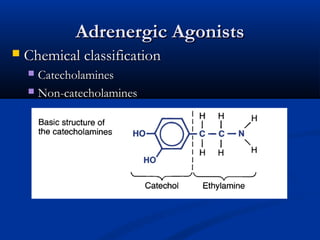
Chemical classification
Catecholamines
 Non-catecholamines

Adrenergic Agonists
Differences
Catecholamine
 Cannot use orally
 Cannot cross BBB
Short-half
live
Examples:
Norepinephrine
Epinephrine
Isoproteronol
Dopamine
Dobutamine

Noncatecholamines
 Can use orally
 Can cross BBB
Longer half life
Examples:
Ephedrine
Phenylephrine
Terbutaline
ENDOGENOUS
CATECHOLAMINES
Naturally occurring in body:
 Norepinephrine -Sites: postganglionic sympathetic
sites (except sweat glands , erector pillorie, hair
follicles, )
 Epinephrine- Secreted by adrenal medulla
 Dopamine- Major transmitter in basal ganglia, CTZ,
limbic system, anterior pitutory.
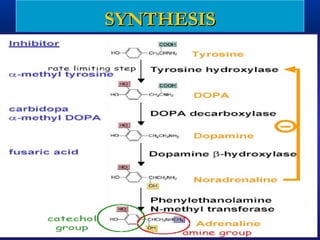
SYNTHESIS
Catecholamine s

In dopaminergic
neurons, synthesis
stops here

Final step only in
adrenal medulla
and CNS neurons

Tyrosine
↓
Dopa
↓
Dopamine
↓
Norepinephrine
↓
Epinephrine

In noradrenergic
neurons,
synthesis stops
here
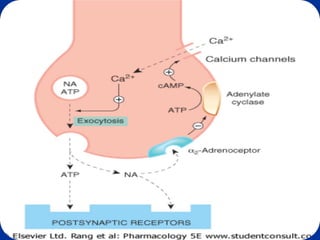
STORAGE, RELEASE, UPTAKE
L-Phenylalanine
Hepatic
hydroxylase
Adrenergic Receptors
These are mainly 2 types
(α) Alfa
(β) Beta
These are again subdivided into various types

ADRENERGIC RECEPTORS
ADRENERGIC DRUGS
Symphathomimetics



DIRECT SYMPHATHOMIMETICS










INDIRECT SYMPHATHOMIMETICS





Adrenaline
Noradrenaline
Isoprenaline
Phenylephrine
Methoxamine
Salbutamol
Xylometazoline
Tyramine
Amphetamine

MIXED SYMPHATHOMIMETICS




Ephedrine
Dopamine
Mephenteramine
THERAPEUTIC CLASSIFICATION OF
ADRENERGIC DRUGS
Pressor agents
Noradrenaline
Ephedrine
Dopamine

Phenylephrine
Methoxamine
Mephentermine

Cardiac stimulants
Adrenaline
Isoprenaline

Dobutamine

Bronchodilators
Adrenaline
Isoprenaline
Salbutamol
(Albuterol)

Terbutaline
Salmeterol
Formoterol
Bambuterol
Nasal decongestants
Phenylephrine
Xylometazoline
Oxymetazoline

Naphazoline
Pseudoephedrine
Phenyl propanolamine

CNS stimulants
Amphetamine Dexamphetamine Methamphetamine

Anorectics
Fenfluramine Dexfenfluramine Sibutramine

Uterine relaxant and vasodilators
Ritodrine
Isoxsuprine

Salbutamol
Terbutaline
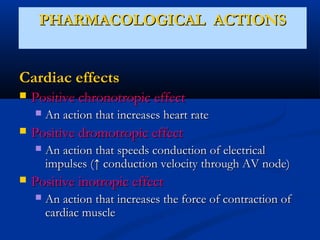
PHARMACOLOGICAL ACTIONS
Cardiac effects


Positive chronotropic effect




Positive dromotropic effect




An action that increases heart rate
An action that speeds conduction of electrical
impulses (↑ conduction velocity through AV node)

Positive inotropic effect


An action that increases the force of contraction of
cardiac muscle
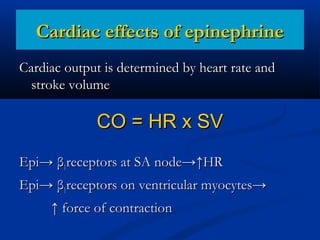
Cardiac effects of epinephrine
Cardiac output is determined by heart rate and
stroke volume

CO = HR x SV
Epi→ β1receptors at SA node→↑HR
Epi→ β1receptors on ventricular myocytes→
↑ force of contraction
vascular smooth muscle

α1





In blood vessels
supplying skin, mucous
membranes, viscera and
kidneys, vascular
smooth muscle has
almost exclusively
alpha1-adrenergic
receptors
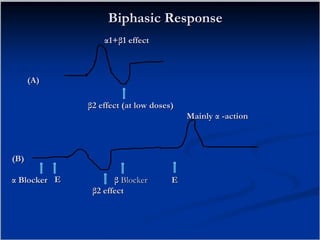
Also biphasic response
Biphasic Response
α1+β1 effect

(A)
β2 effect (at low doses)
Mainly α -action

(B)
α Blocker E

β Blocker
β2 effect

E
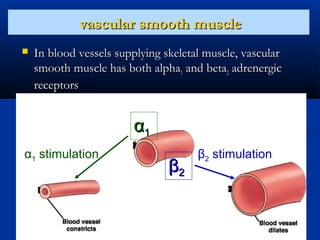
vascular smooth muscle


In blood vessels supplying skeletal muscle, vascular
smooth muscle has both alpha1 and beta2 adrenergic
receptors

α1
α1 stimulation

β2

β2 stimulation
Effects of epinephrine on blood vessel caliber

α1





Blood vessels to
skin, mucous
membranes, viscera
and kidneys
Stimulation of α1adrenergic
receptors causes
constriction of
vascular smooth
muscle
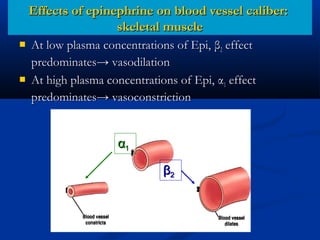
Effects of epinephrine on blood vessel caliber:
skeletal muscle




At low plasma concentrations of Epi, β2 effect
predominates→ vasodilation
At high plasma concentrations of Epi, α1 effect
predominates→ vasoconstriction

α1
β2
Effects of Epi on arterial blood pressure
Arterial BP = CO x PVR
Epinephrine:
 ↑ CO
 Low doses ↓ PVR (arteriolar dilation in
skeletal muscle)
 High doses ↑PVR
Effects of epinephrine on airways


Epi→β2-adrenergic
receptors on airway
smooth muscle→
rapid, powerful
relaxation→
bronchodilation
Effects of epinephrine in the eye


α1
β2

Epi at α1adrenergic
receptors on
radial smooth
muscle →
contraction→
mydriasis



Epi at B2adrenergic
receptors→
relaxation of
ciliary muscle
OTHER SYSTEMS









GIT: Peristalsis is reduced, sphincters are contracted.
Bladder : Detrusors relaxed, trigone contracted
Splenic capsule : Contracts (alpha action), RBCs are
poured
Skeletal muscle : Neuromuscular transmission is
facilitated. (Tremors due to beta 2 actions)
CNS: Restlessness , tremors , fall in BP and bradycardia
Metabolic : Hyperglycemia, lipolysis
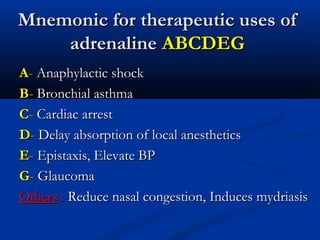
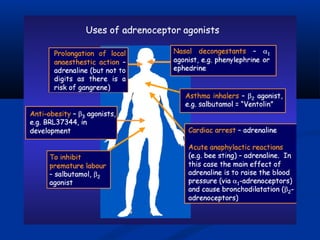
Mnemonic for therapeutic uses of
adrenaline ABCDEG
A- Anaphylactic shock
B- Bronchial asthma
C- Cardiac arrest
D- Delay absorption of local anesthetics
E- Epistaxis, Elevate BP
G- Glaucoma
Others : Reduce nasal congestion, Induces mydriasis
Epinephrine (contd..)
 Adverse effects of epinephrine
Hypertensive crisis
Dysrhythmias
Angina pectoris
Necrosis following extravasation
Hyperglycemia
Dopamine (DA)


Dopaminergic neurons in brain, enteric nervous
system and kidney



Dopaminergic receptors in brain, mesenteric and
renal vascular beds
Dopamine


Moderate doses DA:
 Stimulate DA receptors in mesenteric and

renal vascular beds → vasodilation
 Stimulate β receptors in heart → ↑HR and
1
↑force of contraction


High doses DA:
 Stimulate α

1

receptors → vasoconstriction
Therapeutic uses


Shock (moderate doses)
 ↑ blood flow to kidney and mesentery
 ↑ cardiac output



Refractory congestive heart failure
 Moderate doses ↑ cardiac output without

↑PVR
Synthetic Catecholamines: Isoproterenol


Very powerfully
stimulates β1- and β2adrenergic receptors


β1 SA nodal cells→↑HR
β1 AV nodal cells→↑
conduction velocity

No significant effect
at α1-adrenergic
receptors
β1 Ventricular muscle
cells→ ↑ force of
contraction
Synthetic Catecholamines: Isoproterenol


Very powerful β-adrenergic receptor agonist; no effect
at α-adrenergic receptors

α1
α1 stimulation

β2

β2 stimulation
Isoproterenol
↓arterial BP = ↑CO x ↓↓PVR
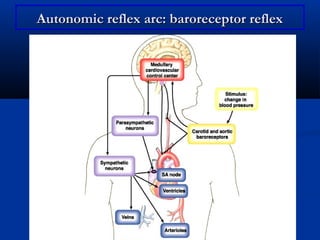
Decreased arterial blood pressure triggers
autonomic reflex arc
Autonomic reflex arc: baroreceptor reflex
Cardiovascular
control center in
medulla
Carotid and
↓BP
aortic
Carotid and
baroreceptors
aortic
↓BP
baroreceptors

Isoproterenol

↑ Sympathetic
outflow→↑NEpi

β1 ↑↑HR

↓ Parasympathetic
outflow→↓ACh

Reflex tachycardia

↑↑SV
+ dromotropic effect
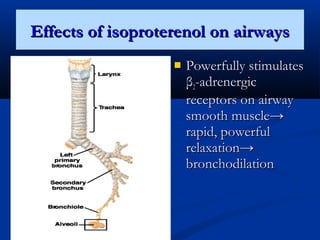
Effects of isoproterenol on airways


Powerfully stimulates
β2-adrenergic
receptors on airway
smooth muscle→
rapid, powerful
relaxation→
bronchodilation
Therapeutic uses: isoproterenol



Bronchodilator
Complete AV block (3rd degree heart block)
Synthetic Catecholamines:
Dobutamine






It’s a derivative of DA but not a D1 or D2
receptor agonist
Stimulates β1- and β2-adrenergic receptors, but at
therapeutic doses, β1-effects predominate
Increases force of contraction more than
increases heart rate

↑CO = ↑HR x ↑ ↑ SV
Dobutamine: Therapeutic uses





Shock
MI
Cardiac surgery
Refractory congestive heart failure
Major toxic effects of catecholamines


All are potentially arrhythmogenic







Epi and isoproterenol more arrhythmogenic than
dopamine and dobutamine

Some can cause hypertension
Epinephrine, in particular, can cause CNS
effects – fear, anxiety, restlessness
Dobutamine can cause vomiting and seizures in
cats – must be used at very low doses
Adverse effects


CNS:
 Restlessness
 Palpitation
 Anxiety, tremors



CVS:
 Increase BP….cerebral haemmorrhage
 Ventricular tachycardia, fibrillation
 May precipitate angina or AMI
Non-catecholamine direct-acting
adrenergic agonists
Ephedrine
Stimulates α1-, β1 and β2-adrenergic receptors
and ↑ NE release from noradrenergic fibers
 Repeated injections produce tachyphylaxis
 It is resistant MAO, orally
 Longer acting (4-6), cross BBB

 Marketed as dietary supplement promoted to

aid weight loss, ↑ sports performance and ↑
energy. Ingredient in OTC nasal
decongestants and bronchodilators
Uses : Mild chronic Bronchial asthma,
hypotension during spinal anaesthesia
,occasionally for postural hypotension
 Sale prohibited by FDA in 2004 due to
risks of life-threatening cardiac
arrhythmias, stroke and death
Non-catecholamine direct-acting adrenergic
agonists: Phenylpropanolamine (PPA)





Actions much like ephedrine in the PNS
In veterinary medicine, used to treat urinary
incontinence in dogs
Available in OTC products for treatment of
nasal decongestion and as appetite suppressant
FDA has requested all companies
discontinue marketing products containing
PPA due to risk of hemorrhagic stroke
α1 –adrenergic
receptor
agonistcontraction
urethral smooth
muscle
β2 –adrenergic
receptor agonist
–relaxation
detrusor muscle
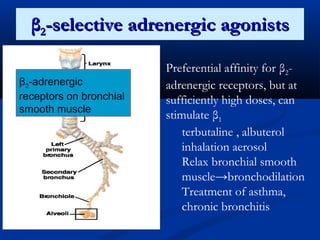
β2-selective adrenergic agonists
β2-adrenergic
receptors on bronchial
smooth muscle

Preferential affinity for β2adrenergic receptors, but at
sufficiently high doses, can
stimulate β1
terbutaline , albuterol
inhalation aerosol
Relax bronchial smooth
muscle→bronchodilation
Treatment of asthma,
chronic bronchitis
β2-selective adrenergic agonists


Due to selectivity for β2 receptors at
recommended doses, little-to-no direct
stimulation of β1 receptors in heart



Inhalant administration maximizes local effect
and minimizes systemic effects
Mephenteramine


It is mixed sympathomimetic



COP, BP, heart rate are increased



Active orally with longer DOA (2-6 hrs),can crosses BBB

Uses:




To treat hypotension due to spinal anesthesia and surgical
procedures
Shock in MI and other hypotensive states
USES
Vascular
Hypotensive states
 Shock: hemorrhagic/ hypovolemic, spinal,
neurogenic, cardiogenic, anaphylactic shock.
 Postural hypotension- in parkinsonism, diabetes
mallitus
 Along with local anaesthetics
 To control local bleeding
 Nasal decongestants
 Peripheral vascular diseases
Cardiac
 Cardiac arrest
 Partial AV block
 Congestive heart failure

Bronchial asthma
 Acute severe bronchial asthma
Allergic disorders
 Urticaria, angiodema, anaphylaxis
Mydriatics
 Fundus examination
 Wide angle glaucoma
CNS uses
 ADHD
 Narcolepsy
 Epilepsy
 Parkinsonism
 Obesity
Uterine relaxant
Adrenergic Agonists


Indirect:
Cause NE release only
 Example:


 Amphetamine

CNS stimulant
 Increases BP by alpha
effect on vasculature,
beta effect on heart


Adrenergic drugs (VK)

  • 1.
  • 2.
    SYMPATHOMIMETIC  Sympathomimetic drugs mimicthe effects of sympathetic nerve stimulation  Also adrenergic agonists  Adrenergic receptors
  • 3.
  • 4.
    Adrenergic Agonists Differences Catecholamine  Cannotuse orally  Cannot cross BBB Short-half live Examples: Norepinephrine Epinephrine Isoproteronol Dopamine Dobutamine Noncatecholamines  Can use orally  Can cross BBB Longer half life Examples: Ephedrine Phenylephrine Terbutaline
  • 5.
    ENDOGENOUS CATECHOLAMINES Naturally occurring inbody:  Norepinephrine -Sites: postganglionic sympathetic sites (except sweat glands , erector pillorie, hair follicles, )  Epinephrine- Secreted by adrenal medulla  Dopamine- Major transmitter in basal ganglia, CTZ, limbic system, anterior pitutory.
  • 6.
  • 7.
    Catecholamine s In dopaminergic neurons,synthesis stops here Final step only in adrenal medulla and CNS neurons Tyrosine ↓ Dopa ↓ Dopamine ↓ Norepinephrine ↓ Epinephrine In noradrenergic neurons, synthesis stops here
  • 8.
  • 11.
    Adrenergic Receptors These aremainly 2 types (α) Alfa (β) Beta These are again subdivided into various types 
  • 12.
  • 13.
    ADRENERGIC DRUGS Symphathomimetics  DIRECT SYMPHATHOMIMETICS         INDIRECTSYMPHATHOMIMETICS    Adrenaline Noradrenaline Isoprenaline Phenylephrine Methoxamine Salbutamol Xylometazoline Tyramine Amphetamine MIXED SYMPHATHOMIMETICS    Ephedrine Dopamine Mephenteramine
  • 14.
    THERAPEUTIC CLASSIFICATION OF ADRENERGICDRUGS Pressor agents Noradrenaline Ephedrine Dopamine Phenylephrine Methoxamine Mephentermine Cardiac stimulants Adrenaline Isoprenaline Dobutamine Bronchodilators Adrenaline Isoprenaline Salbutamol (Albuterol) Terbutaline Salmeterol Formoterol Bambuterol
  • 15.
    Nasal decongestants Phenylephrine Xylometazoline Oxymetazoline Naphazoline Pseudoephedrine Phenyl propanolamine CNSstimulants Amphetamine Dexamphetamine Methamphetamine Anorectics Fenfluramine Dexfenfluramine Sibutramine Uterine relaxant and vasodilators Ritodrine Isoxsuprine Salbutamol Terbutaline
  • 16.
    PHARMACOLOGICAL ACTIONS Cardiac effects  Positivechronotropic effect   Positive dromotropic effect   An action that increases heart rate An action that speeds conduction of electrical impulses (↑ conduction velocity through AV node) Positive inotropic effect  An action that increases the force of contraction of cardiac muscle
  • 17.
    Cardiac effects ofepinephrine Cardiac output is determined by heart rate and stroke volume CO = HR x SV Epi→ β1receptors at SA node→↑HR Epi→ β1receptors on ventricular myocytes→ ↑ force of contraction
  • 18.
    vascular smooth muscle α1   Inblood vessels supplying skin, mucous membranes, viscera and kidneys, vascular smooth muscle has almost exclusively alpha1-adrenergic receptors Also biphasic response
  • 19.
    Biphasic Response α1+β1 effect (A) β2effect (at low doses) Mainly α -action (B) α Blocker E β Blocker β2 effect E
  • 20.
    vascular smooth muscle  Inblood vessels supplying skeletal muscle, vascular smooth muscle has both alpha1 and beta2 adrenergic receptors α1 α1 stimulation β2 β2 stimulation
  • 21.
    Effects of epinephrineon blood vessel caliber α1   Blood vessels to skin, mucous membranes, viscera and kidneys Stimulation of α1adrenergic receptors causes constriction of vascular smooth muscle
  • 22.
    Effects of epinephrineon blood vessel caliber: skeletal muscle   At low plasma concentrations of Epi, β2 effect predominates→ vasodilation At high plasma concentrations of Epi, α1 effect predominates→ vasoconstriction α1 β2
  • 23.
    Effects of Epion arterial blood pressure Arterial BP = CO x PVR Epinephrine:  ↑ CO  Low doses ↓ PVR (arteriolar dilation in skeletal muscle)  High doses ↑PVR
  • 24.
    Effects of epinephrineon airways  Epi→β2-adrenergic receptors on airway smooth muscle→ rapid, powerful relaxation→ bronchodilation
  • 25.
    Effects of epinephrinein the eye  α1 β2 Epi at α1adrenergic receptors on radial smooth muscle → contraction→ mydriasis  Epi at B2adrenergic receptors→ relaxation of ciliary muscle
  • 26.
    OTHER SYSTEMS       GIT: Peristalsisis reduced, sphincters are contracted. Bladder : Detrusors relaxed, trigone contracted Splenic capsule : Contracts (alpha action), RBCs are poured Skeletal muscle : Neuromuscular transmission is facilitated. (Tremors due to beta 2 actions) CNS: Restlessness , tremors , fall in BP and bradycardia Metabolic : Hyperglycemia, lipolysis
  • 27.
    Mnemonic for therapeuticuses of adrenaline ABCDEG A- Anaphylactic shock B- Bronchial asthma C- Cardiac arrest D- Delay absorption of local anesthetics E- Epistaxis, Elevate BP G- Glaucoma Others : Reduce nasal congestion, Induces mydriasis
  • 28.
    Epinephrine (contd..)  Adverseeffects of epinephrine Hypertensive crisis Dysrhythmias Angina pectoris Necrosis following extravasation Hyperglycemia
  • 29.
    Dopamine (DA)  Dopaminergic neuronsin brain, enteric nervous system and kidney  Dopaminergic receptors in brain, mesenteric and renal vascular beds
  • 30.
    Dopamine  Moderate doses DA: Stimulate DA receptors in mesenteric and renal vascular beds → vasodilation  Stimulate β receptors in heart → ↑HR and 1 ↑force of contraction  High doses DA:  Stimulate α 1 receptors → vasoconstriction
  • 31.
    Therapeutic uses  Shock (moderatedoses)  ↑ blood flow to kidney and mesentery  ↑ cardiac output  Refractory congestive heart failure  Moderate doses ↑ cardiac output without ↑PVR
  • 32.
    Synthetic Catecholamines: Isoproterenol  Verypowerfully stimulates β1- and β2adrenergic receptors  β1 SA nodal cells→↑HR β1 AV nodal cells→↑ conduction velocity No significant effect at α1-adrenergic receptors β1 Ventricular muscle cells→ ↑ force of contraction
  • 33.
    Synthetic Catecholamines: Isoproterenol  Verypowerful β-adrenergic receptor agonist; no effect at α-adrenergic receptors α1 α1 stimulation β2 β2 stimulation
  • 34.
    Isoproterenol ↓arterial BP =↑CO x ↓↓PVR Decreased arterial blood pressure triggers autonomic reflex arc
  • 35.
    Autonomic reflex arc:baroreceptor reflex
  • 36.
    Cardiovascular control center in medulla Carotidand ↓BP aortic Carotid and baroreceptors aortic ↓BP baroreceptors Isoproterenol ↑ Sympathetic outflow→↑NEpi β1 ↑↑HR ↓ Parasympathetic outflow→↓ACh Reflex tachycardia ↑↑SV + dromotropic effect
  • 37.
    Effects of isoproterenolon airways  Powerfully stimulates β2-adrenergic receptors on airway smooth muscle→ rapid, powerful relaxation→ bronchodilation
  • 38.
  • 39.
    Synthetic Catecholamines: Dobutamine    It’s aderivative of DA but not a D1 or D2 receptor agonist Stimulates β1- and β2-adrenergic receptors, but at therapeutic doses, β1-effects predominate Increases force of contraction more than increases heart rate ↑CO = ↑HR x ↑ ↑ SV
  • 40.
    Dobutamine: Therapeutic uses     Shock MI Cardiacsurgery Refractory congestive heart failure
  • 41.
    Major toxic effectsof catecholamines  All are potentially arrhythmogenic     Epi and isoproterenol more arrhythmogenic than dopamine and dobutamine Some can cause hypertension Epinephrine, in particular, can cause CNS effects – fear, anxiety, restlessness Dobutamine can cause vomiting and seizures in cats – must be used at very low doses
  • 42.
    Adverse effects  CNS:  Restlessness Palpitation  Anxiety, tremors  CVS:  Increase BP….cerebral haemmorrhage  Ventricular tachycardia, fibrillation  May precipitate angina or AMI
  • 43.
    Non-catecholamine direct-acting adrenergic agonists Ephedrine Stimulatesα1-, β1 and β2-adrenergic receptors and ↑ NE release from noradrenergic fibers  Repeated injections produce tachyphylaxis  It is resistant MAO, orally  Longer acting (4-6), cross BBB 
  • 44.
     Marketed asdietary supplement promoted to aid weight loss, ↑ sports performance and ↑ energy. Ingredient in OTC nasal decongestants and bronchodilators Uses : Mild chronic Bronchial asthma, hypotension during spinal anaesthesia ,occasionally for postural hypotension  Sale prohibited by FDA in 2004 due to risks of life-threatening cardiac arrhythmias, stroke and death
  • 45.
    Non-catecholamine direct-acting adrenergic agonists:Phenylpropanolamine (PPA)     Actions much like ephedrine in the PNS In veterinary medicine, used to treat urinary incontinence in dogs Available in OTC products for treatment of nasal decongestion and as appetite suppressant FDA has requested all companies discontinue marketing products containing PPA due to risk of hemorrhagic stroke
  • 46.
    α1 –adrenergic receptor agonistcontraction urethral smooth muscle β2–adrenergic receptor agonist –relaxation detrusor muscle
  • 47.
    β2-selective adrenergic agonists β2-adrenergic receptorson bronchial smooth muscle Preferential affinity for β2adrenergic receptors, but at sufficiently high doses, can stimulate β1 terbutaline , albuterol inhalation aerosol Relax bronchial smooth muscle→bronchodilation Treatment of asthma, chronic bronchitis
  • 48.
    β2-selective adrenergic agonists  Dueto selectivity for β2 receptors at recommended doses, little-to-no direct stimulation of β1 receptors in heart  Inhalant administration maximizes local effect and minimizes systemic effects
  • 49.
    Mephenteramine  It is mixedsympathomimetic  COP, BP, heart rate are increased  Active orally with longer DOA (2-6 hrs),can crosses BBB Uses:   To treat hypotension due to spinal anesthesia and surgical procedures Shock in MI and other hypotensive states
  • 51.
    USES Vascular Hypotensive states  Shock:hemorrhagic/ hypovolemic, spinal, neurogenic, cardiogenic, anaphylactic shock.  Postural hypotension- in parkinsonism, diabetes mallitus  Along with local anaesthetics  To control local bleeding  Nasal decongestants  Peripheral vascular diseases Cardiac  Cardiac arrest  Partial AV block  Congestive heart failure 
  • 52.
    Bronchial asthma  Acutesevere bronchial asthma Allergic disorders  Urticaria, angiodema, anaphylaxis Mydriatics  Fundus examination  Wide angle glaucoma CNS uses  ADHD  Narcolepsy  Epilepsy  Parkinsonism  Obesity Uterine relaxant
  • 53.
    Adrenergic Agonists  Indirect: Cause NErelease only  Example:   Amphetamine CNS stimulant  Increases BP by alpha effect on vasculature, beta effect on heart 