Drugs Acting on the
Gastrointestinal Tract
1. Emetics and Antiemetics
Vomiting reflex
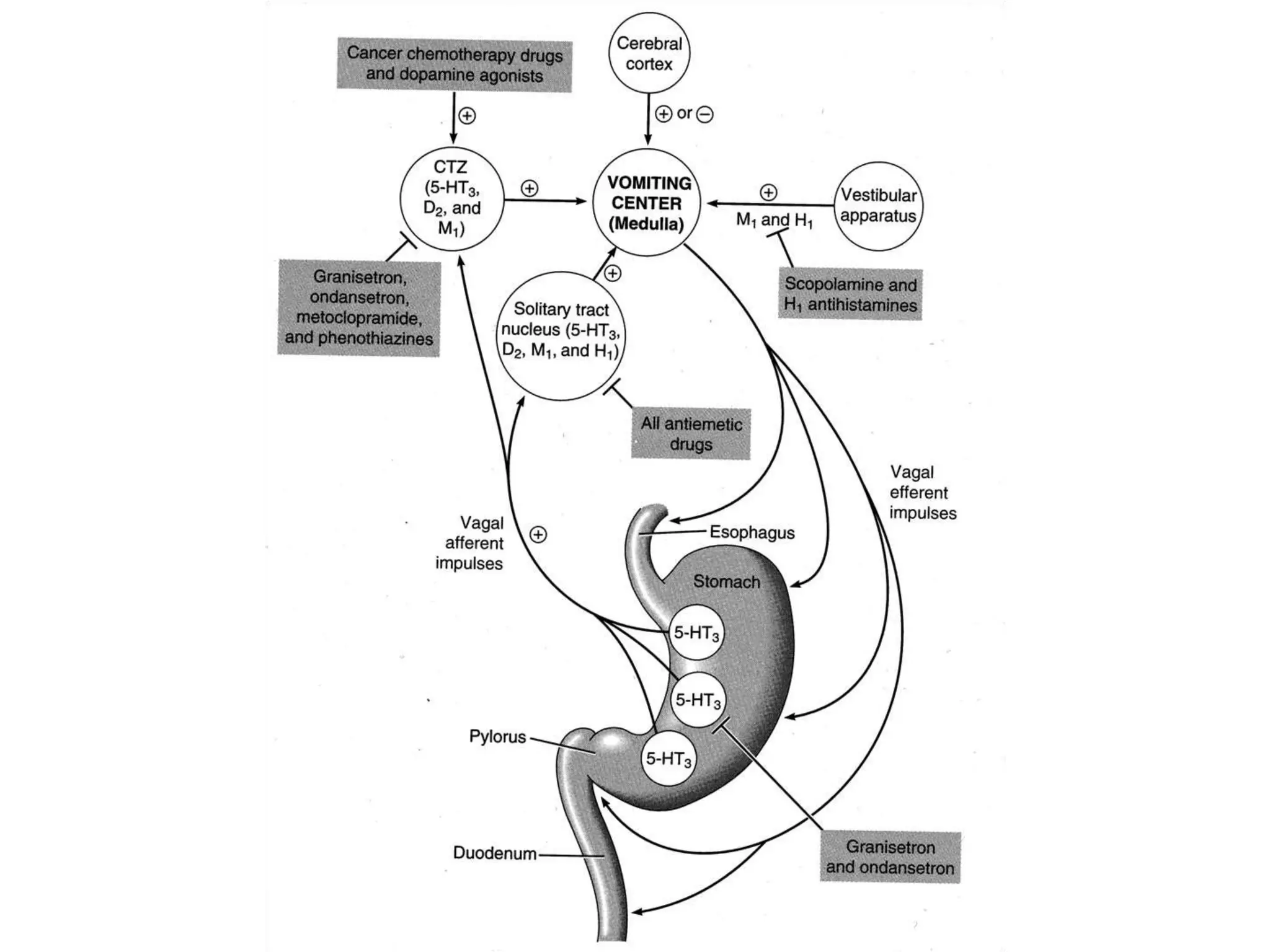
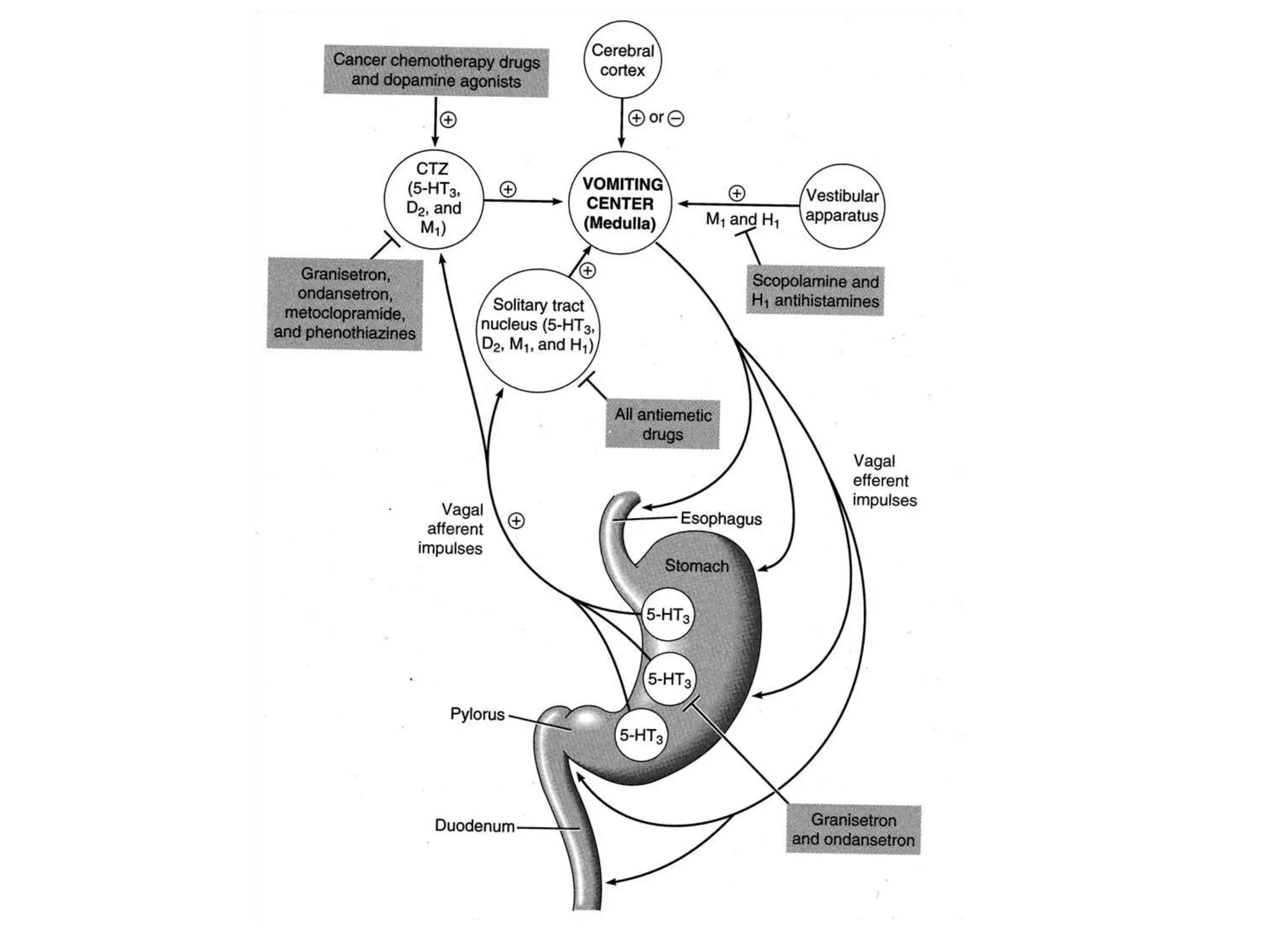
– The vomiting reflex is a coordinated reflex controlled
by a bilateral vomiting center in the dorsal portion of
the lateral reticular formation in the medulla.
– Pharmacologic intervention relies on inhibition of
inputs or depression of the vomiting center.
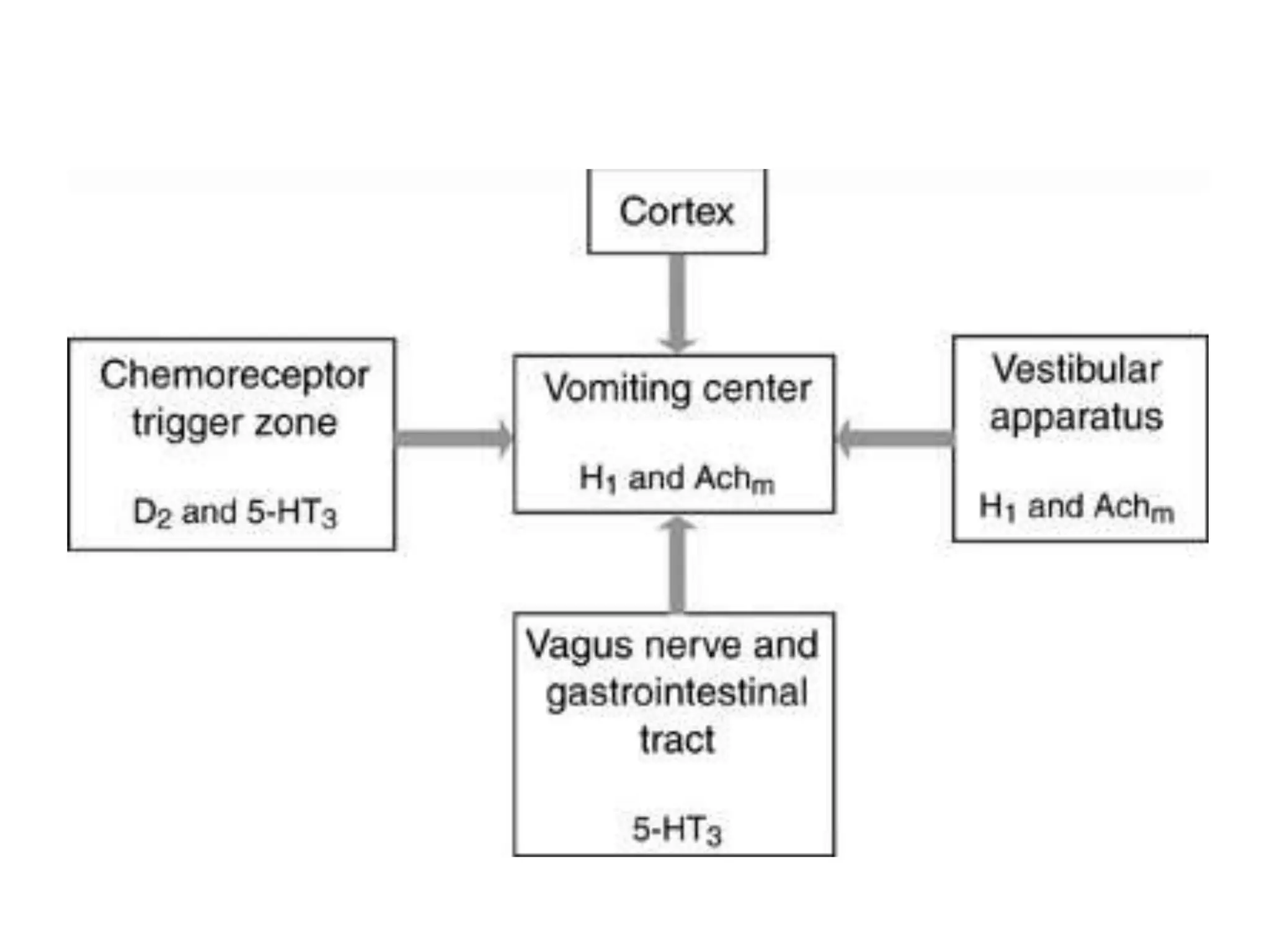
– The vomiting center receives inputs from several
sources:
1. Chemoreceptor trigger zone (CTZ)
2. Vestibular nucleus
3. Peripheral afferents from the pharynx,
gastrointestinal tract, and genitals
4. Psychologic input from the central nervous
system (CNS)
– Serotonin (5-HT3)-receptors, which are the
predominant mediators of the reflex, are present in:
– vomiting center
– CTZ
– periphery
Antiemetics
• Def.: Agents to treat nausea and vomiting
• Useful in the treatment of vomiting associated
with:
• motion sickness
• chemotherapy
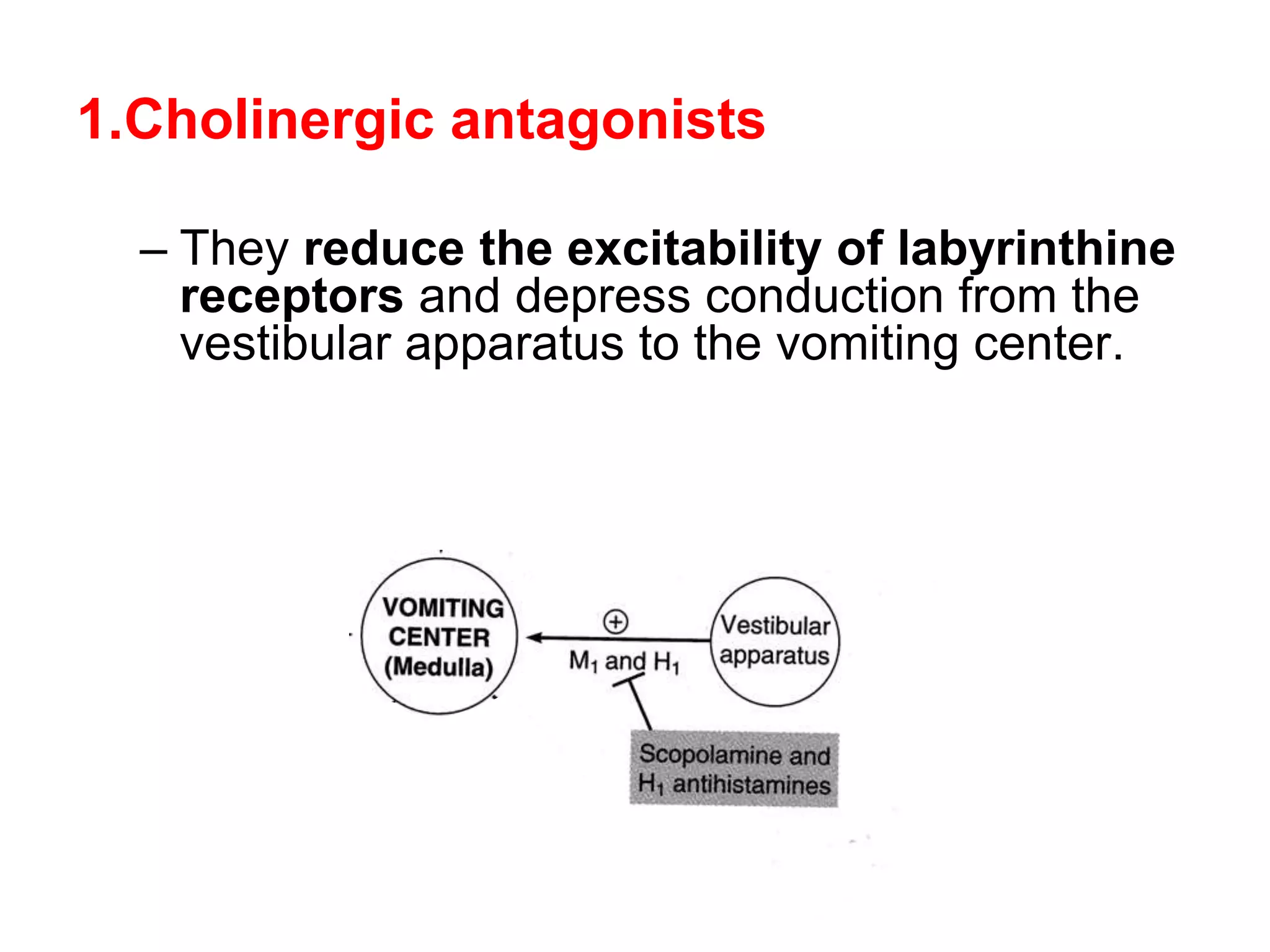
1.Cholinergic antagonists
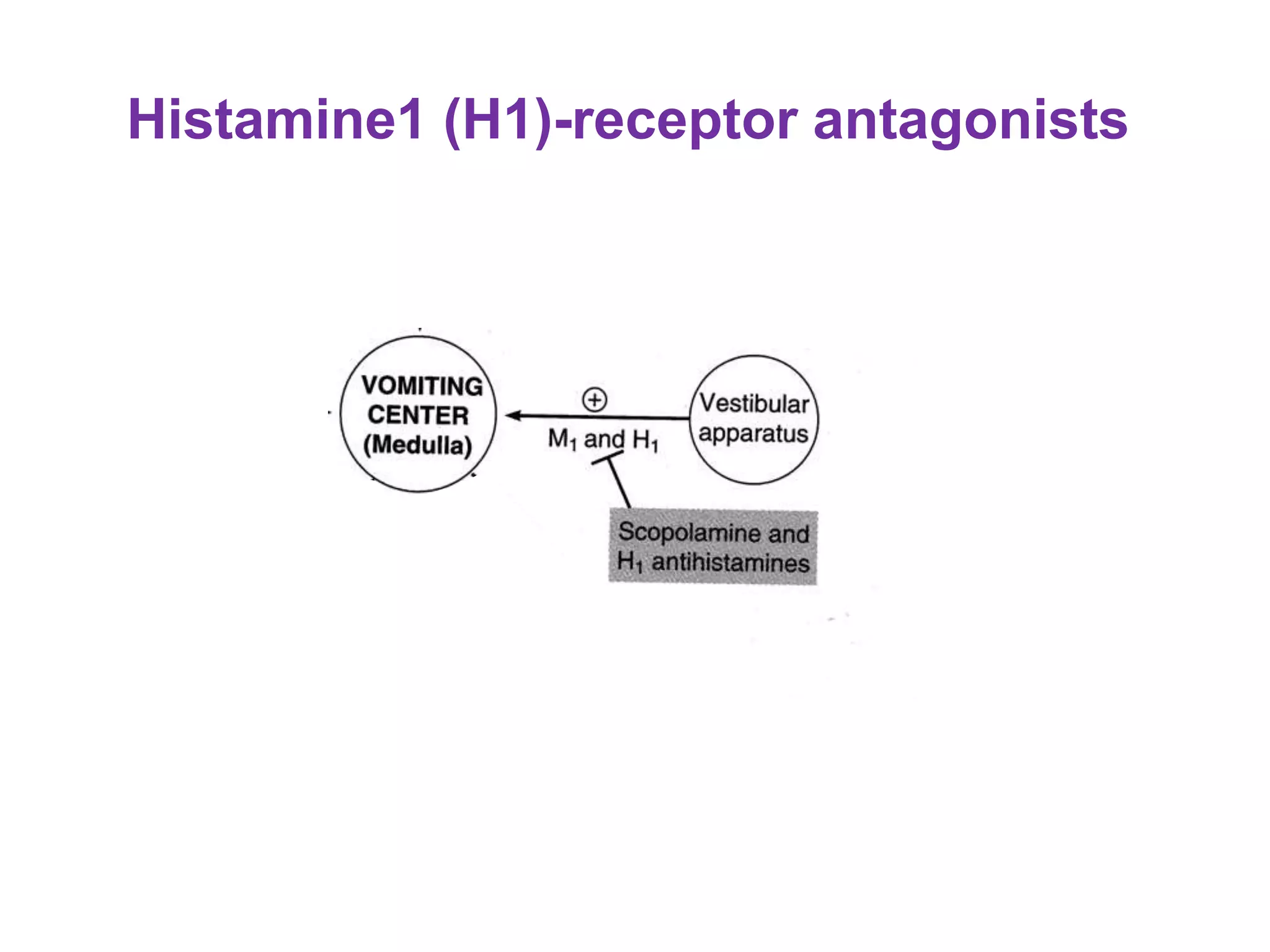
– They reduce the excitability of labyrinthine
receptors and depress conduction from the
vestibular apparatus to the vomiting center.
• Cholinergic antagonists are used to:
– treat motion sickness
– in preoperative situations.
• They are not useful in treating nausea caused
by chemotherapy.
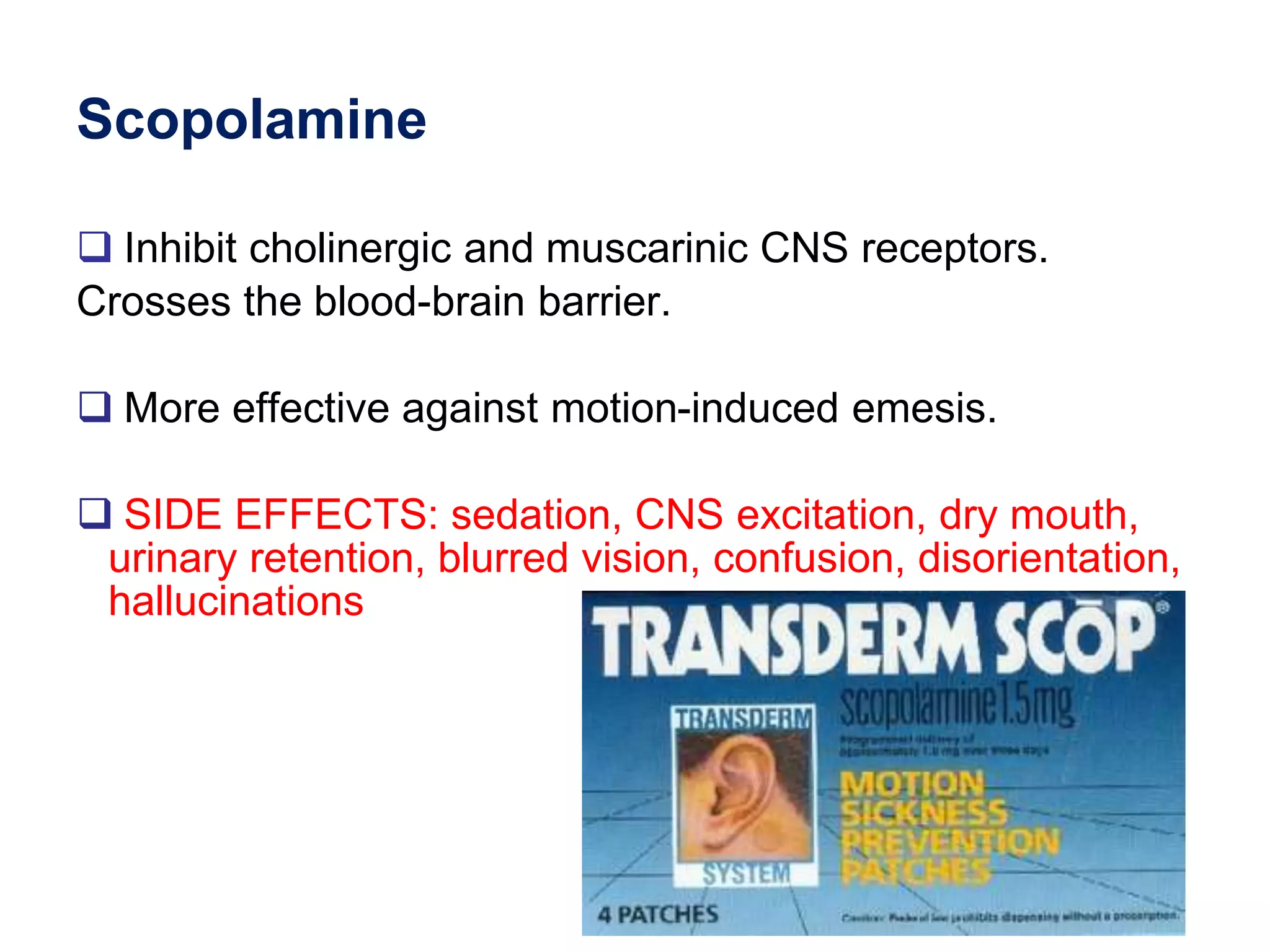
Scopolamine
 Inhibit cholinergic and muscarinic CNS receptors.
Crosses the blood-brain barrier.
 More effective against motion-induced emesis.
 SIDE EFFECTS: sedation, CNS excitation, dry mouth,
urinary retention, blurred vision, confusion, disorientation,
hallucinations
Histamine1 (H1)-receptor antagonists
• diphenhydramine [Benadryl]
• meclizine [Antivert, Bonine]
• dimenhydrinate [Dramamine]
• promethazine [Phenergan]
• These agents most likely act by inhibiting
cholinergic pathways of the vestibular apparatus
by receptor “crossover.”
• H1-receptor antagonists are used to treat motion
sickness and vertigo.
• These agents produce sedation and dry mouth.
• Meclizine and promethazine have minimal
anticholinergic side effects and are used most
often.
Dopamine antagonists
1. Metoclopramide [Reglan]
– blocks receptors within the CTZ.
– increases the sensitivity of the gastrointestinal tract to
the action of acetylcholine (ACh)
– this enhances gastrointestinal motility and gastric
emptying and increases lower esophageal sphincter
tone.
– High doses of metoclopramide antagonize serotonin
(5-HT3)-receptors in the vomiting center and
gastrointestinal tract.
• Metoclopramide is used to treat:
• nausea due to chemotherapy (caused by agents
such as cisplatin and doxorubicin)
• narcotic-induced vomiting.
• Metoclopramide produces sedation, diarrhea,
extrapyramidal effects, and elevated prolactin
secretion.
2. Phenothiazines and butyrophenones
• Phenothiazine: prochlorperazine [Compazine]
• Butyrophenone: droperidol [Inapsine].
• Phenothiazines and butyrophenones:
– block dopaminergic receptors in the CTZ
– inhibit peripheral transmission to the vomiting center.
• These agents are used to:
– treat nausea due to chemotherapy and radiation therapy
– control postoperative nausea.
• Adverse effects (less pronounced with butyrophenones)
include:
• Anticholinergic effects (drowsiness, dry mouth, and blurred
vision),
• Extrapyramidal effects
• Orthostatic hypotension.
5-HT3 antagonists
• Ondansetron [Zofran]
– not effective for motion-sickness-induced nausea.
– more effective against nausea induced by
chemotherapy.
– used in postoperative nausea.
– can be administered intravenously or orally.
– Side effects may include mild constipation.
Granisetron [Kytril]
• has a greater affinity for 5-HT3 receptors.
• Granisetron is longer acting and more potent
than ondansetron or metoclopramide.
• administered by intravenous infusion or orally.
• The most common adverse effect of granisetron is
headache.
Cannabinoids
– The most commonly used in the USA is dronabinol
(Δ-9-tetrahydrocannabinol) [Marinol].
– Acts by inhibiting the vomiting center, but the
mechanism is unclear.
– used to control nausea induced by chemotherapy.
– administered as oral preparations.
– adverse effect : produce sedation, psychoactive
effects (“high”), dry mouth, orthostatic hypotension,
and increased appetite.
Glucocorticoids
• Dexamethasone [Decadron]
• Methylprednisolone [Solu-Medrol].
• These agents can be effective as a treatment of
vomiting caused by highly emetic agents.
• High doses are given as an intravenous (IV) bolus or
orally for delayed nausea, often combined with
metoclopramide, haloperidol, diphenhydramine, or
ondansetron.
Benzodiazepines
• Lorazepam [Ativan]
• Diazepam [Valium]
• act as anxiolytic agents to reduce anticipatory
emesis.
• Diazepam is useful as a treatment of vertigo.
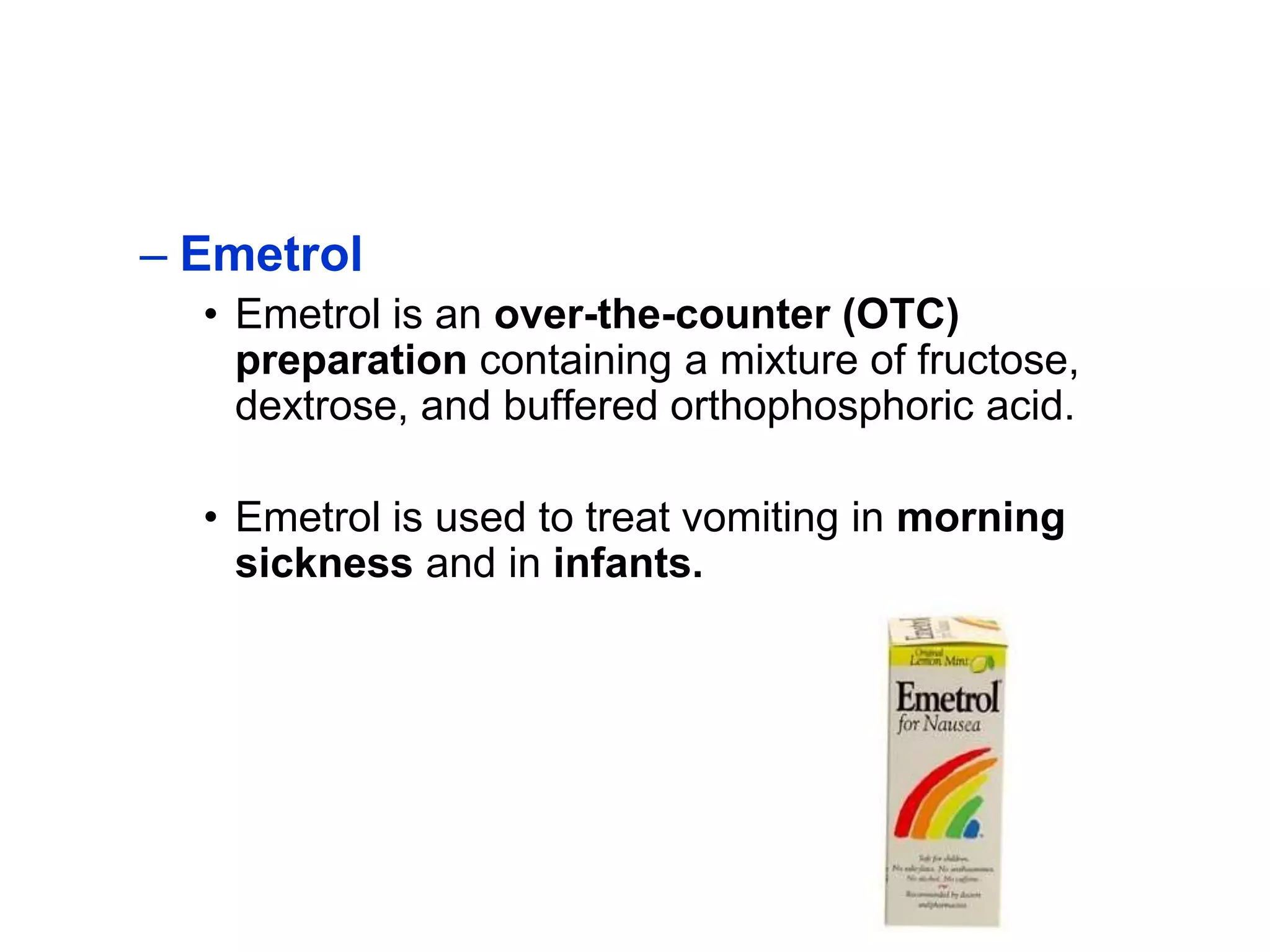
– Emetrol
• Emetrol is an over-the-counter (OTC)
preparation containing a mixture of fructose,
dextrose, and buffered orthophosphoric acid.
• Emetrol is used to treat vomiting in morning
sickness and in infants.
Neurokinin 1 (NK1) antagonist
• Aprepitant [Emend]
• (substance P receptor antagonist) used in
delayed nausea caused by chemotherapy.
• It can be used in a combination with
benzodiazepines and 5-HT3 antagonists, or alone.
Emetics: agents that induce reflex vomiting.
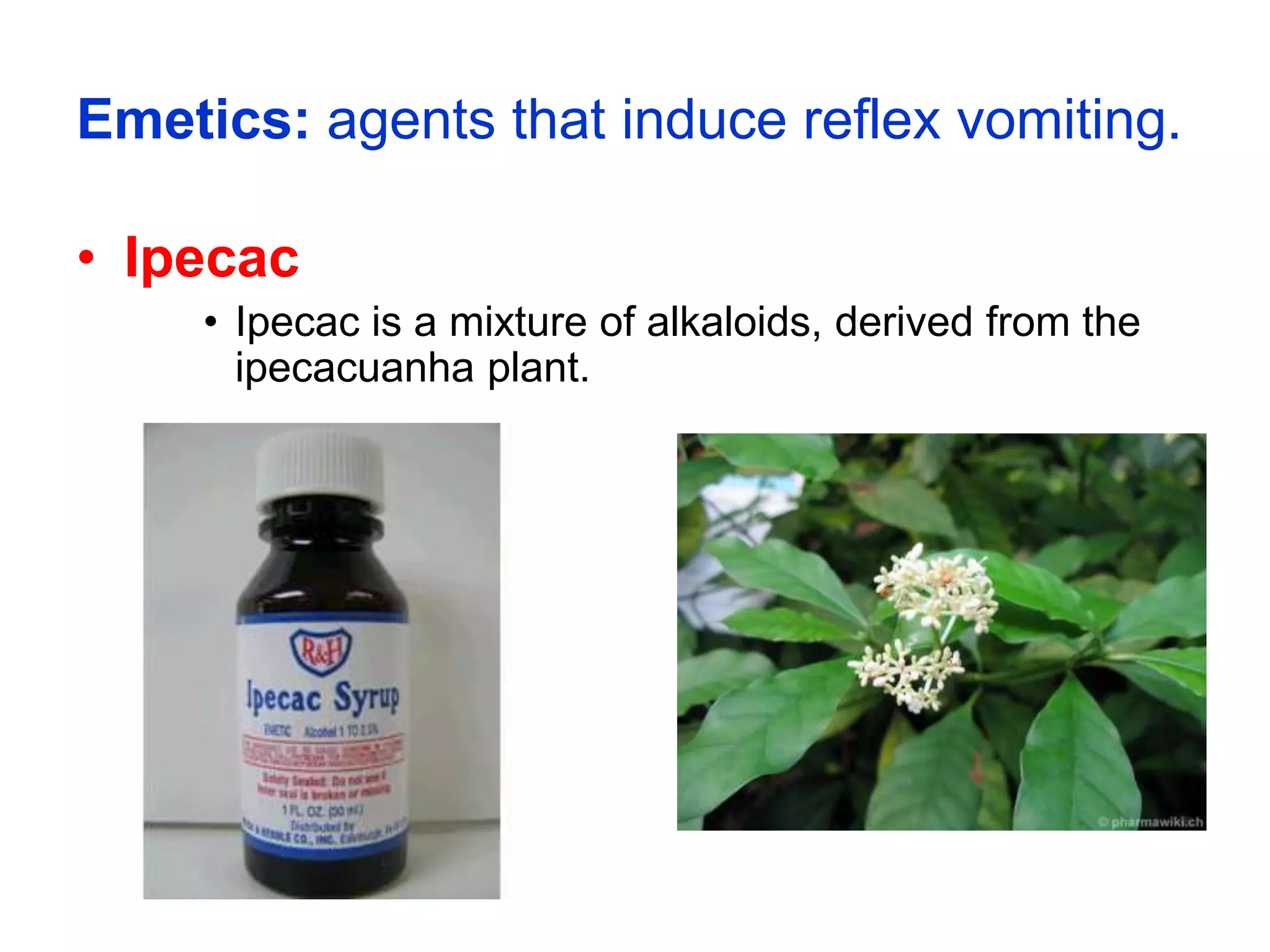
• Ipecac
• Ipecac is a mixture of alkaloids, derived from the
ipecacuanha plant.
• Ipecac induces vomiting by stimulating the CTZ
and by causing gastrointestinal irritation.
• Ipecac is administered orally and is fast acting,
causing vomiting in 85% of patients within 20
minutes.
• Ipecac is rarely used anymore because of its low
effectiveness and high side effect profile.
• Cardiac toxicity caused by the emetine in ipecac
is noted in abusers such as bulimics.

GIT DRUGS-1-1.ppt

  • 1.
    Drugs Acting onthe Gastrointestinal Tract
  • 2.
    1. Emetics andAntiemetics
  • 3.
    Vomiting reflex – Thevomiting reflex is a coordinated reflex controlled by a bilateral vomiting center in the dorsal portion of the lateral reticular formation in the medulla. – Pharmacologic intervention relies on inhibition of inputs or depression of the vomiting center.
  • 4.
    – The vomitingcenter receives inputs from several sources: 1. Chemoreceptor trigger zone (CTZ) 2. Vestibular nucleus 3. Peripheral afferents from the pharynx, gastrointestinal tract, and genitals 4. Psychologic input from the central nervous system (CNS) – Serotonin (5-HT3)-receptors, which are the predominant mediators of the reflex, are present in: – vomiting center – CTZ – periphery
  • 7.
    Antiemetics • Def.: Agentsto treat nausea and vomiting • Useful in the treatment of vomiting associated with: • motion sickness • chemotherapy
  • 8.
    1.Cholinergic antagonists – Theyreduce the excitability of labyrinthine receptors and depress conduction from the vestibular apparatus to the vomiting center.
  • 9.
    • Cholinergic antagonistsare used to: – treat motion sickness – in preoperative situations. • They are not useful in treating nausea caused by chemotherapy.
  • 10.
    Scopolamine  Inhibit cholinergicand muscarinic CNS receptors. Crosses the blood-brain barrier.  More effective against motion-induced emesis.  SIDE EFFECTS: sedation, CNS excitation, dry mouth, urinary retention, blurred vision, confusion, disorientation, hallucinations
  • 11.
  • 12.
    Histamine1 (H1)-receptor antagonists •diphenhydramine [Benadryl] • meclizine [Antivert, Bonine] • dimenhydrinate [Dramamine] • promethazine [Phenergan]
  • 13.
    • These agentsmost likely act by inhibiting cholinergic pathways of the vestibular apparatus by receptor “crossover.” • H1-receptor antagonists are used to treat motion sickness and vertigo. • These agents produce sedation and dry mouth. • Meclizine and promethazine have minimal anticholinergic side effects and are used most often.
  • 14.
    Dopamine antagonists 1. Metoclopramide[Reglan] – blocks receptors within the CTZ. – increases the sensitivity of the gastrointestinal tract to the action of acetylcholine (ACh) – this enhances gastrointestinal motility and gastric emptying and increases lower esophageal sphincter tone. – High doses of metoclopramide antagonize serotonin (5-HT3)-receptors in the vomiting center and gastrointestinal tract.
  • 16.
    • Metoclopramide isused to treat: • nausea due to chemotherapy (caused by agents such as cisplatin and doxorubicin) • narcotic-induced vomiting. • Metoclopramide produces sedation, diarrhea, extrapyramidal effects, and elevated prolactin secretion.
  • 17.
    2. Phenothiazines andbutyrophenones • Phenothiazine: prochlorperazine [Compazine] • Butyrophenone: droperidol [Inapsine].
  • 18.
    • Phenothiazines andbutyrophenones: – block dopaminergic receptors in the CTZ – inhibit peripheral transmission to the vomiting center. • These agents are used to: – treat nausea due to chemotherapy and radiation therapy – control postoperative nausea. • Adverse effects (less pronounced with butyrophenones) include: • Anticholinergic effects (drowsiness, dry mouth, and blurred vision), • Extrapyramidal effects • Orthostatic hypotension.
  • 19.
    5-HT3 antagonists • Ondansetron[Zofran] – not effective for motion-sickness-induced nausea. – more effective against nausea induced by chemotherapy. – used in postoperative nausea. – can be administered intravenously or orally. – Side effects may include mild constipation.
  • 20.
    Granisetron [Kytril] • hasa greater affinity for 5-HT3 receptors. • Granisetron is longer acting and more potent than ondansetron or metoclopramide. • administered by intravenous infusion or orally. • The most common adverse effect of granisetron is headache.
  • 21.
    Cannabinoids – The mostcommonly used in the USA is dronabinol (Δ-9-tetrahydrocannabinol) [Marinol]. – Acts by inhibiting the vomiting center, but the mechanism is unclear. – used to control nausea induced by chemotherapy. – administered as oral preparations. – adverse effect : produce sedation, psychoactive effects (“high”), dry mouth, orthostatic hypotension, and increased appetite.
  • 22.
    Glucocorticoids • Dexamethasone [Decadron] •Methylprednisolone [Solu-Medrol]. • These agents can be effective as a treatment of vomiting caused by highly emetic agents. • High doses are given as an intravenous (IV) bolus or orally for delayed nausea, often combined with metoclopramide, haloperidol, diphenhydramine, or ondansetron.
  • 23.
    Benzodiazepines • Lorazepam [Ativan] •Diazepam [Valium] • act as anxiolytic agents to reduce anticipatory emesis. • Diazepam is useful as a treatment of vertigo.
  • 24.
    – Emetrol • Emetrolis an over-the-counter (OTC) preparation containing a mixture of fructose, dextrose, and buffered orthophosphoric acid. • Emetrol is used to treat vomiting in morning sickness and in infants.
  • 25.
    Neurokinin 1 (NK1)antagonist • Aprepitant [Emend] • (substance P receptor antagonist) used in delayed nausea caused by chemotherapy. • It can be used in a combination with benzodiazepines and 5-HT3 antagonists, or alone.
  • 26.
    Emetics: agents thatinduce reflex vomiting. • Ipecac • Ipecac is a mixture of alkaloids, derived from the ipecacuanha plant.
  • 27.
    • Ipecac inducesvomiting by stimulating the CTZ and by causing gastrointestinal irritation. • Ipecac is administered orally and is fast acting, causing vomiting in 85% of patients within 20 minutes. • Ipecac is rarely used anymore because of its low effectiveness and high side effect profile. • Cardiac toxicity caused by the emetine in ipecac is noted in abusers such as bulimics.