Emerging and Re- Emerging Infections
PRESENTED BY:
Dr. Rakesh Prajapat
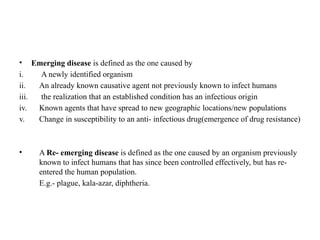
• Emerging disease is defined as the one caused by
i. A newly identified organism
ii. An already known causative agent not previously known to infect humans
iii. the realization that an established condition has an infectious origin
iv. Known agents that have spread to new geographic locations/new populations
v. Change in susceptibility to an anti- infectious drug(emergence of drug resistance)
• A Re- emerging disease is defined as the one caused by an organism previously
known to infect humans that has since been controlled effectively, but has re-
entered the human population.
E.g.- plague, kala-azar, diphtheria.
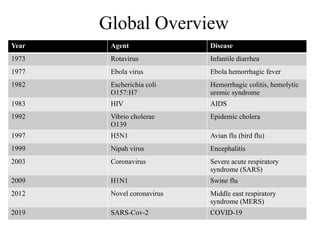
Global Overview
Year Agent Disease
1973 Rotavirus Infantile diarrhea
1977 Ebola virus Ebola hemorrhagic fever
1982 Escherichia coli
O157:H7
Hemorrhagic colitis, hemolytic
uremic syndrome
1983 HIV AIDS
1992 Vibrio cholerae
O139
Epidemic cholera
1997 H5N1 Avian flu (bird flu)
1999 Nipah virus Encephalitis
2003 Coronavirus Severe acute respiratory
syndrome (SARS)
2009 H1N1 Swine flu
2012 Novel coronavirus Middle east respiratory
syndrome (MERS)
2019 SARS-Cov-2 COVID-19
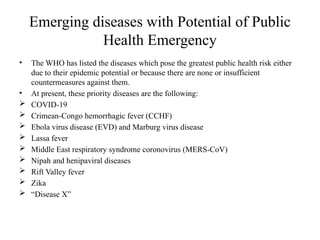
Emerging diseases with Potential of Public
Health Emergency
• The WHO has listed the diseases which pose the greatest public health risk either
due to their epidemic potential or because there are none or insufficient
countermeasures against them.
• At present, these priority diseases are the following:
 COVID-19
 Crimean-Congo hemorrhagic fever (CCHF)
 Ebola virus disease (EVD) and Marburg virus disease
 Lassa fever
 Middle East respiratory syndrome coronovirus (MERS-CoV)
 Nipah and henipaviral diseases
 Rift Valley fever
 Zika
 “Disease X”
• Disease X
A serious international epidemic can be caused by a pathogen which may
be currently unknown to cause human disease. We should therefore ensure
early cross-cutting research and development (R&D) preparedness that is
also relevant for an unknown "Disease X".
The WHO had forwarded the concept of "Disease X" much before the
occurrence of COVID-19 pandemic and this is where the importance of
realizing the potential of Disease X lies. We have to realize that an as-till-
unknown disease can cause epidemics or pandemic at any time in the
future and hence we should be prepared to deal with it.
Ebola Virus Disease
• EVD is a viral hemorrhagic fever with an acute onset and high fatality. It was
initially detected in 1976 around the Ebola River in Democratic Republic of Congo
(DRC) and is restricted to Africa. The largest outbreak occurred in 2014-2016 in
West African countries of Sierra Leone, Liberia, and Guinea, with a case fatality
rate (CFR) of 50%.
• Transmission
Fruit bats are the natural hosts. Bats transmit the virus to apes, - monkeys, duikers,
forest antelopes, and porcupines. Humans get infected on close contact with body
fluids of infected animals. Human-to-human transmission is due to direct contact
with body fluids including blood of infected people.
• Symptoms
Incubation period is 2-21 days. Humans are not infectious till they develop
symptoms. Symptoms include fever, fatigue, myalgia, headache, and sore throat.
This is followed by vomiting, diarrhea, rash, impaired kidney and liver function,
and internal and external bleeding, i.e., oozing from gums or blood in stools.
• Diagnosis and Management
Diagnosis is by nucleic acid tests (NAT) and rapid antigen tests preferably on
blood or else on oral fluid. Antibody capture enzyme-linked immunoassay
(ELISA), reverse transcription- polymerase chain reaction (RT-PCR), and virus
isolation can also be done. All biosafety precautions should be taken like wearing
gloves, gown, and eye shield. Specimens are transported in triple-layered
containers under a proper cold chain.
• Treatment
Supportive care like rehydration and treatment of specific symptoms improves
survival. Two monoclonal antibodies (Inmazeb and Ebanga) are available for
treatment.
• Vaccines
The Ervebo vaccine is effective against Zaire ebolavirus and its global stockpile is
available since 2020. A two-component vaccine called Zabdeno and Mvabea is
also available (given in two doses, 8 weeks apart).
• Prevention and Control
Good outbreak control relies on a package of interventions:
 Reduce the risk of wildlife-to-human transmission from contact with
infected fruit bats, monkeys, apes, and the consumption of raw meat.
 Reduce the risk of human-to-human transmission from direct or close
contact with people with Ebola, particularly with their body fluids. Gloves,
masks, and personal protective equipment (PPE) should be used. Regular
hand washing is required. Male survivors should practice safe sex for 12
months from the onset of symptoms or until their semen tests negative
twice for Ebola.
 Outbreak containment measures include safe burial of dead, monitoring
health of contacts for 21 days, separating healthy from the sick to prevent
further spread, and the importance of good hygiene.
Middle East Respiratory Syndrome
• MERS is a viral respiratory disease caused by MERS-CoV, first identified in Saudi
Arabia in 2012. It is the same family of viruses that can cause SARS and COVID-
19.
• Transmission
MERS-CoV is a zoonotic virus, linked to human infections transmitted through
dromedary camels in the Middle East, Africa, and South Asia. Human-to-human
transmission is possible predominantly among close contacts and in healthcare
settings.
• Symptoms
Symptoms range from no/mild respiratory symptoms to severe acute respiratory
disease and death. Typical symptoms include fever, cough, and shortness of breath.
Pneumonia and diarrhea have also been reported. Elderly, those with an weakened
immunity, and those with chronic disease (renal disease, cancer, chronic lung
disease, hypertension, CVD, and diabetes) appear to be at a greater risk of severe
disease. About 35% of MERS cases reported to the WHO had died.
• Prevention
 Those visiting farms, markets, and barns with dromedary camels should
avoid contact with sick animals, drinking raw camel milk or urine, or
eating uncooked meat.
 Good general hygiene and regular hand washing should be practiced.
 No vaccine or specific treatment is currently available; however, several
MERS-CoV-specific vaccines are in clinical development.
 Treatment is supportive.
Nipah Virus (NIV) Infection
• The NiV disease came to limelight with a localized outbreak in two districts of
Kerala, namely, Kozhikode and Malappuram, in 2018. Out of 19 reported cases,
17 died. NiV was first recognized in 1999 during an outbreak in village "Sungai
Nipah," in Malaysia. In India, it was first reported from West Bengal in 2001.
• Epidemiology
 Agent
NiV belongs to the genus Paramyxovirus (Henipavirus).
 Incubation Period-The incubation period is 4-14 days.
 Reservoir and Source
Pteropus bats (fruit-eating bats, also called "flying foxes") are the main reservoir.
The immediate source of infection is the excretions and secretions (feces, saliva,
urine) of infected bats, pigs, horses, and infected human beings.
• Transmission
NIV can be transmitted to human beings from bats coming in contact with
virus-contaminated material such as "date palm sap" or fruits
bitten/partially eaten by infected fruit-eating bats. Intermediate hosts (pigs
and horses) can also transmit Infection. Human-to-human transmission is
possible through close contact with the secretions of a patient.
• Clinical Features
The spectrum ranges from asymptomatic infection to acute respiratory
symptoms (mild or severe) to fatal encephalitis. Infected people initially
develop influenza-like symptoms of fever, headache, myalgia, vomiting,
and sore throat. This is followed by neurological signs indicative of acute
encephalitis, which progresses to coma. CFR, in the recent outbreak in
Kerala, was as high as 90%.
• Diagnosis
Laboratory diagnosis is made by RT-PCR from body fluids and antibody detection via
ELISA. The samples include acute-phase serum, CSF, throat swabs, saliva, and urine.
• Treatment
Supportive treatment is offered. There are currently no specific drugs for NiV infection.
• Prevention and Control
No vaccine is available for humans. So, health education is important:
 Decrease access of bats to date palm sap and boil the fresh collected juice.
 Partially eaten fruits should be discarded. Intact fruits should be thoroughly washed and
peeled.
 Avoid contact with infected pigs, and use gloves, etc., while handling them.
 Avoid close unprotected contact with patients with NiV. In a household having a patient,
regular hand washing, mask, and gloves should be used.
 Universal precautions and PPE should be used by hospital staff.
Zika Virus
• ZIKV is a mosquito-borne flavivirus that was first identified in Uganda in
1947 in monkeys. In October 2015, Brazil reported an association between
ZIKV and any microcephaly, India has reported numerous cases mainly from
Kerala, Uttar Pradesh, Madhya Pradesh. Maharashtra,Telangana, Jharkhand,
Rajasthan, Punjab, and Delhi.
• Epidemiology
 ZIKV is primarily transmitted to people through the bite of an infected
mosquito from the Aedes genus, But mainly A. aegypti in tropical regions. It
is also transmitted from mother to fetus during pregnancy and through sexual
contact, transfusion of blood, and organ transplantation. The incubation
period is 3-14 days.
 Clinical Features - Symptoms are similar to those of other arbovirus
infections, such as dengue. These include fever, skin rashes, conjunctivitis,
muscle and joint pain, malaise, and headache. These symptoms are usually
mild and last for 2-7 days. ZIKV may be suspected based on symptoms and
recent history of travel (e.g., residence in or travel to an area Ene with active
ZIKV).
 Complications - ZIKV during pregnancy can cause congenital brain
abnormalities, including microcephaly.
 Treatment - ZIKV infection is usually mild and requires no The specific
treatment. Patients should get plenty of rest and drink enough fluids. Pain
and fever can be treated with paracetamol.If symptoms worsen, they
should seek medical care. ZIKV is also associated with Guillain-
Barré syndrome.
 Prevention - There is currently no vaccine available. Prevention includes
protection against mosquito bites through wearing body-covering clothes
(preferably light colored), using physical barriers (window screens, closing
doors/windows, mosquito nets), and using insect repellents. Cover, empty,
or clean potential mosquito breeding sites in and around houses such as
buckets, drums, pots, gutters, and used tires.
Hand, Foot, and Mouth Disease (HFMD)/Tomato Flu
Tomato flu was first identified in Kollam district of Kerala in 2022 in
children younger than 5 years. Later, cases were reported from Tamil
Nadu, Karnataka, Odisha, and Haryana. Coxsackie A 17, an enterovirus, is
the most likely cause.
• Symptoms
It begins with mild fever, poor appetite, malaise, and sore throat. One or 2
days later, small red spots appear on the tongue, gums, buccal area, palms,
and soles which change to "tomato"-like blisters, and subsequently to
ulcers. Rash, pain in joints, fatigue, nausea, vomiting, and diarrhea may
occur. Owing to the typical blisters, it was also termed "tomato flu.“
• Diagnosis
It is largely clinical and is considered owing to typical blisters and on
exclusion of other viral exanthemata.
• Management
It is a self-limiting infectious disease so treatment is supportive, i.e.,
paracetamol, rest, plenty of fluids, and hot water sponge for relief of
irritation and rashes. Isolation for 5-7 days is recommended.
• Prevention
Maintenance of hygiene, sanitization, and respiratory etiquettes is a must.
Avoid scratching blisters. Avoid immediate contact with the patient.
Utensils, clothes, toys, and bedding should be separated and sanitized
regularly.
Re-Emerging Infectious Diseases in India
• In the recent past, India has witnessed many large outbreaks of re-
emerging infections too.
• Cholera
 In 1992, a large outbreak started in southern India which spread to Bengal.
A new serogroup of Vibrio cholerae O139 was associated with this
epidemic.
 Since then, several Outbreaks of cholera due to this or coexisting O1 and
O139 nave been reported from many parts.
 Between 1997 and 2006, here were 68 outbreaks in 18 states, and 222,038
cases were detected in Odisha, West Bengal, Andaman and Nicobar slands,
Assam, and Chhattisgarh.
• Plague
 In 1994, there was a pneumonic plague epidemic in Surat, India, causing
several deaths and mass exodus.
 India reported another pneumonic plague outbreak in 2002 in Himachal
Pradesh, followed by a localized outbreak of bubonic plague in Dangud
village of Uttarkashi, Uttarakhand, in October 2004.
 Plague infection continues to exist in sylvatic foci in many parts of India
which is transmitted to humans occasionally resulting in outbreaks.
 These recurrences have been attributed to a spillover from epizootic cycle of
plague in wild rodents to commensal rodents.
• Diphtheria
 In the last 10 years, there have been a number of reports of re-emergence
of diphtheria from several Indian states. This seems mainly due to low
coverage of immunization.
 An epidemiological age shift is also noted toward older children (5-19
years) and even adults.
 High coverage of primary and booster doses, administering the second
booster at school entry, and replacing tetanus toxoid (TT) vaccine with
adult type of tetanus and diphtheria (dT) might be useful.
• Chikungunya
After a quiescence of three decades, a resurgence of chikungunya from southern and
central parts India was reported in 2006 with 1.4 million suspected cases in 12 states.
• Dengue
Although dengue has been endemic in India from the 19th century, a major epidemic
was reported in 1996 with four serotypes in co-circulation. In 2012, another outbreak
caused 242 deaths. India now contributes to one-third of the total global burden.
Forces that sustain this expansion include rapid globalization, unplanned
urbanization, and poor mosquito control.
• Chandipura Virus
A new virus was isolated in 1965 in the Chandipura (Nagpur) region of India in two
adult patients with febrile illness. It was named Chandipura virus. Subsequently,
outbreaks al of Chandipura virus were reported in Andhra Pradesh 59 (2003), Gujarat
(2004), and Maharashtra (2007). The virus is transmitted to humans by sandflies.
• Acute Encephalitis Syndrome (AES)
 AES is characterized by acute-onset high fever and seizures.
 It takes a heavy toll in Uttar Pradesh, Bihar, Assam, and West Bengal,
especially in children younger than 10 years.
 In 2019, AES claimed lives of 150 children in Muzaffarpur, Bihar, within 3
weeks.
 Viruses are the most important cause but bacteria, parasites, spirochetes,
chemicals, and toxins could also be responsible for AES.
 Out of these, Japanese encephalitio (JE) is the main cause (5-35% of
cases). Other important Viruses are herpes simplex, mumps, measles,
dengue, Nipah, Zika, Chandipura, etc.
 The NVBDCP has set up surveillance to diagnose AES through national
reference laboratories.
 Diagnosis is through IgM capture ELISAs, IgG fourfold rise in paired sera,
PCR, and virus isolation.
 Treatment is essentially symptomatic.
 AES is notorious for high fatality (25%) and neurological sequelae (30-
40%).
 At the national level, AES control is part of JE control program under the
NVBDCP.
• Avian Influenza (H5N1)
 Bird flu was first reported from India in Nawapur tehsil, of Nandurbar
district, Maharashtra, in 2006.
 Since then, several outbreaks have been reported, the latest being in 2020-
2021, affecting more than 12 states.
 People coming in close contact with infected birds, usually poultry
handlers, have the highest risk.
 Its high CFR is a matter of concern.
Factors Influencing Emergence and Re-Emergence
• Several factors influence the emergence or re-emergence of a disease
ranging from natural processes, e.g., evolution of pathogens, to the human
behavior and practices.
 Weakened Public Health Infrastructure
Low public health spending accentuated by poverty, poor sanitation, and
lack of basic amenities lead to poor public health practices (e.g., weakened
childhood immunization programs for measles and diphtheria in Russia).
This facilitates the emergence of a disease.
 Population Shifts
Population movement facilitates disease transmission. Plague moved from
Asia to Europe via the Silk Route and the Mediterranean by traders on
merchant ships. Emergence of smallpox in the Americas from Europe was
due to European colonization and African slave trade. COVID-19
pandemic is a recent example of the role of people in fast transmission of a
disease.
 Anthropogenic Activities and Urbanization
Several (new) diseases emerge when people come in contact with the wild
animals that are natural reservoirs of new infections. The NiV outbreaks in
Malaysia and Singapore, Ebola in Africa, plague, scrub typhus, and KFD
in India are good examples.
 Consequences of Civil Disturbance, Human Displacement, and
Natural Disasters
Human population movements on a large scale as a result of war, conflict,
or natural calamities result in crowded and unhygienic conditions causing
emergence/re-emergence of a disease. Examples include cholera outbreaks
in refugee camps the aftermath of civil disturbance in Rwanda (1994) and
Yemen (2016-2020), leptospirosis outbreak following floods Philippines
(2009), and cholera outbreak following Haiti earthquake (2010).
 Human Behavior
Human behavior such as sex or IV drug abuse has contributed the
emergence of HIV.
 Antimicrobial Resistance (AMR)
Drugs effective in the past are no longer useful in controlling diseases.
Resistance to antitubercular, antimalarial, and antiretroviral drugs has led
to the emergence of newer strains. Same is the case with diarrheal diseases,
respiratory infections, hospital-acquired infections, and sexually
transmitted infections (STIs).
 Microbial Adaptation and Change
Many viruses show a high mutation rate and rapidly evolve to yield new
variants. A classic example is influenza which causes regular annual
epidemics due to "antigenic drift" in a previously circulating influenza
strain.
 Intent to Harm/Bioterrorism
Biological agents are relatively easy to produce, capable of causing mass
casualties, difficult to detect, and likely to generate widespread panic and
civil disruption. Six pathogens having the highest potential for bioterrorism
(Category A agents) are B. anthracis (anthrax), Clostridium botulinum
toxin (botulism), Yersinia pestis (plague), variola virus (smallpox),
Francisella tularensis (tularemia), and viral hemorrhagic fever viruses.
International Health Regulations (IHR) and
Global Initiatives for Control
• In 1969, the WHO agreed to IHR aimed at better global public health
security. It began with mandatory reporting of four infections: (i) cholera,
(ii) plague, (iii) yellow fever, and (iv) smallpox.
• The IHR (2005) escalated it to an up-to-date legal framework requiring
reporting of any public health emergency of international concern (PHEIC)
(defined as an extraordinary event that could spread internationally or
might require a coordinated international response).
• WHO Global Strategy for Containment of Antimicrobial Resistance in
2001 calls on countries to ensure rational use of anti-infective drugs to
limit drug resistance.
• The Global Outbreak Alert and Response Network (GOARN) is a global
technical partnership established by the WHO for rapid identification,
confirmation, and response to public health emergencies.
• The Coalition for Epidemic Preparedness Innovation (CEPI) is a global
partnership between public, private, philanthropic, and civil society
organizations launched in Davos in 2017 to develop vaccines to stop future
epidemics.
• The CEPI's vision is that the world should be able to respond to the next
"Disease X" with a new vaccine within 100 days of its occurrence, so as to
reduce the threat of any pathogen with pandemic potential.
• The current priority diseases are MERS, Lassa fever, Nipah, Disease X,
Rift Valley fever, chikungunya, and Ebola.
Way forward
• The most important defense against emerging and re-emerging infections is
robust surveillance and preparedness, response protocols, and mitigation
systems.
• This includes highly responsive national surveillance systems, public
health laboratories that can rapidly detect such outbreaks, and swift
activation mechanisms for timely outbreak containment and mitigation.
• References
 Textbook of Community Medicine by Rajvir Bhalwar 5th
Edition
THANK YOU !

Emerging and Re- Emerging Infections.pptx

  • 1.
    Emerging and Re-Emerging Infections PRESENTED BY: Dr. Rakesh Prajapat
  • 2.
    • Emerging diseaseis defined as the one caused by i. A newly identified organism ii. An already known causative agent not previously known to infect humans iii. the realization that an established condition has an infectious origin iv. Known agents that have spread to new geographic locations/new populations v. Change in susceptibility to an anti- infectious drug(emergence of drug resistance) • A Re- emerging disease is defined as the one caused by an organism previously known to infect humans that has since been controlled effectively, but has re- entered the human population. E.g.- plague, kala-azar, diphtheria.
  • 3.
    Global Overview Year AgentDisease 1973 Rotavirus Infantile diarrhea 1977 Ebola virus Ebola hemorrhagic fever 1982 Escherichia coli O157:H7 Hemorrhagic colitis, hemolytic uremic syndrome 1983 HIV AIDS 1992 Vibrio cholerae O139 Epidemic cholera 1997 H5N1 Avian flu (bird flu) 1999 Nipah virus Encephalitis 2003 Coronavirus Severe acute respiratory syndrome (SARS) 2009 H1N1 Swine flu 2012 Novel coronavirus Middle east respiratory syndrome (MERS) 2019 SARS-Cov-2 COVID-19
  • 4.
    Emerging diseases withPotential of Public Health Emergency • The WHO has listed the diseases which pose the greatest public health risk either due to their epidemic potential or because there are none or insufficient countermeasures against them. • At present, these priority diseases are the following:  COVID-19  Crimean-Congo hemorrhagic fever (CCHF)  Ebola virus disease (EVD) and Marburg virus disease  Lassa fever  Middle East respiratory syndrome coronovirus (MERS-CoV)  Nipah and henipaviral diseases  Rift Valley fever  Zika  “Disease X”
  • 5.
    • Disease X Aserious international epidemic can be caused by a pathogen which may be currently unknown to cause human disease. We should therefore ensure early cross-cutting research and development (R&D) preparedness that is also relevant for an unknown "Disease X". The WHO had forwarded the concept of "Disease X" much before the occurrence of COVID-19 pandemic and this is where the importance of realizing the potential of Disease X lies. We have to realize that an as-till- unknown disease can cause epidemics or pandemic at any time in the future and hence we should be prepared to deal with it.
  • 6.
    Ebola Virus Disease •EVD is a viral hemorrhagic fever with an acute onset and high fatality. It was initially detected in 1976 around the Ebola River in Democratic Republic of Congo (DRC) and is restricted to Africa. The largest outbreak occurred in 2014-2016 in West African countries of Sierra Leone, Liberia, and Guinea, with a case fatality rate (CFR) of 50%. • Transmission Fruit bats are the natural hosts. Bats transmit the virus to apes, - monkeys, duikers, forest antelopes, and porcupines. Humans get infected on close contact with body fluids of infected animals. Human-to-human transmission is due to direct contact with body fluids including blood of infected people. • Symptoms Incubation period is 2-21 days. Humans are not infectious till they develop symptoms. Symptoms include fever, fatigue, myalgia, headache, and sore throat. This is followed by vomiting, diarrhea, rash, impaired kidney and liver function, and internal and external bleeding, i.e., oozing from gums or blood in stools.
  • 7.
    • Diagnosis andManagement Diagnosis is by nucleic acid tests (NAT) and rapid antigen tests preferably on blood or else on oral fluid. Antibody capture enzyme-linked immunoassay (ELISA), reverse transcription- polymerase chain reaction (RT-PCR), and virus isolation can also be done. All biosafety precautions should be taken like wearing gloves, gown, and eye shield. Specimens are transported in triple-layered containers under a proper cold chain. • Treatment Supportive care like rehydration and treatment of specific symptoms improves survival. Two monoclonal antibodies (Inmazeb and Ebanga) are available for treatment. • Vaccines The Ervebo vaccine is effective against Zaire ebolavirus and its global stockpile is available since 2020. A two-component vaccine called Zabdeno and Mvabea is also available (given in two doses, 8 weeks apart).
  • 8.
    • Prevention andControl Good outbreak control relies on a package of interventions:  Reduce the risk of wildlife-to-human transmission from contact with infected fruit bats, monkeys, apes, and the consumption of raw meat.  Reduce the risk of human-to-human transmission from direct or close contact with people with Ebola, particularly with their body fluids. Gloves, masks, and personal protective equipment (PPE) should be used. Regular hand washing is required. Male survivors should practice safe sex for 12 months from the onset of symptoms or until their semen tests negative twice for Ebola.  Outbreak containment measures include safe burial of dead, monitoring health of contacts for 21 days, separating healthy from the sick to prevent further spread, and the importance of good hygiene.
  • 9.
    Middle East RespiratorySyndrome • MERS is a viral respiratory disease caused by MERS-CoV, first identified in Saudi Arabia in 2012. It is the same family of viruses that can cause SARS and COVID- 19. • Transmission MERS-CoV is a zoonotic virus, linked to human infections transmitted through dromedary camels in the Middle East, Africa, and South Asia. Human-to-human transmission is possible predominantly among close contacts and in healthcare settings. • Symptoms Symptoms range from no/mild respiratory symptoms to severe acute respiratory disease and death. Typical symptoms include fever, cough, and shortness of breath. Pneumonia and diarrhea have also been reported. Elderly, those with an weakened immunity, and those with chronic disease (renal disease, cancer, chronic lung disease, hypertension, CVD, and diabetes) appear to be at a greater risk of severe disease. About 35% of MERS cases reported to the WHO had died.
  • 10.
    • Prevention  Thosevisiting farms, markets, and barns with dromedary camels should avoid contact with sick animals, drinking raw camel milk or urine, or eating uncooked meat.  Good general hygiene and regular hand washing should be practiced.  No vaccine or specific treatment is currently available; however, several MERS-CoV-specific vaccines are in clinical development.  Treatment is supportive.
  • 11.
    Nipah Virus (NIV)Infection • The NiV disease came to limelight with a localized outbreak in two districts of Kerala, namely, Kozhikode and Malappuram, in 2018. Out of 19 reported cases, 17 died. NiV was first recognized in 1999 during an outbreak in village "Sungai Nipah," in Malaysia. In India, it was first reported from West Bengal in 2001. • Epidemiology  Agent NiV belongs to the genus Paramyxovirus (Henipavirus).  Incubation Period-The incubation period is 4-14 days.  Reservoir and Source Pteropus bats (fruit-eating bats, also called "flying foxes") are the main reservoir. The immediate source of infection is the excretions and secretions (feces, saliva, urine) of infected bats, pigs, horses, and infected human beings.
  • 12.
    • Transmission NIV canbe transmitted to human beings from bats coming in contact with virus-contaminated material such as "date palm sap" or fruits bitten/partially eaten by infected fruit-eating bats. Intermediate hosts (pigs and horses) can also transmit Infection. Human-to-human transmission is possible through close contact with the secretions of a patient. • Clinical Features The spectrum ranges from asymptomatic infection to acute respiratory symptoms (mild or severe) to fatal encephalitis. Infected people initially develop influenza-like symptoms of fever, headache, myalgia, vomiting, and sore throat. This is followed by neurological signs indicative of acute encephalitis, which progresses to coma. CFR, in the recent outbreak in Kerala, was as high as 90%.
  • 13.
    • Diagnosis Laboratory diagnosisis made by RT-PCR from body fluids and antibody detection via ELISA. The samples include acute-phase serum, CSF, throat swabs, saliva, and urine. • Treatment Supportive treatment is offered. There are currently no specific drugs for NiV infection. • Prevention and Control No vaccine is available for humans. So, health education is important:  Decrease access of bats to date palm sap and boil the fresh collected juice.  Partially eaten fruits should be discarded. Intact fruits should be thoroughly washed and peeled.  Avoid contact with infected pigs, and use gloves, etc., while handling them.  Avoid close unprotected contact with patients with NiV. In a household having a patient, regular hand washing, mask, and gloves should be used.  Universal precautions and PPE should be used by hospital staff.
  • 14.
    Zika Virus • ZIKVis a mosquito-borne flavivirus that was first identified in Uganda in 1947 in monkeys. In October 2015, Brazil reported an association between ZIKV and any microcephaly, India has reported numerous cases mainly from Kerala, Uttar Pradesh, Madhya Pradesh. Maharashtra,Telangana, Jharkhand, Rajasthan, Punjab, and Delhi. • Epidemiology  ZIKV is primarily transmitted to people through the bite of an infected mosquito from the Aedes genus, But mainly A. aegypti in tropical regions. It is also transmitted from mother to fetus during pregnancy and through sexual contact, transfusion of blood, and organ transplantation. The incubation period is 3-14 days.  Clinical Features - Symptoms are similar to those of other arbovirus infections, such as dengue. These include fever, skin rashes, conjunctivitis, muscle and joint pain, malaise, and headache. These symptoms are usually mild and last for 2-7 days. ZIKV may be suspected based on symptoms and recent history of travel (e.g., residence in or travel to an area Ene with active ZIKV).
  • 15.
     Complications -ZIKV during pregnancy can cause congenital brain abnormalities, including microcephaly.  Treatment - ZIKV infection is usually mild and requires no The specific treatment. Patients should get plenty of rest and drink enough fluids. Pain and fever can be treated with paracetamol.If symptoms worsen, they should seek medical care. ZIKV is also associated with Guillain- Barré syndrome.  Prevention - There is currently no vaccine available. Prevention includes protection against mosquito bites through wearing body-covering clothes (preferably light colored), using physical barriers (window screens, closing doors/windows, mosquito nets), and using insect repellents. Cover, empty, or clean potential mosquito breeding sites in and around houses such as buckets, drums, pots, gutters, and used tires.
  • 16.
    Hand, Foot, andMouth Disease (HFMD)/Tomato Flu Tomato flu was first identified in Kollam district of Kerala in 2022 in children younger than 5 years. Later, cases were reported from Tamil Nadu, Karnataka, Odisha, and Haryana. Coxsackie A 17, an enterovirus, is the most likely cause. • Symptoms It begins with mild fever, poor appetite, malaise, and sore throat. One or 2 days later, small red spots appear on the tongue, gums, buccal area, palms, and soles which change to "tomato"-like blisters, and subsequently to ulcers. Rash, pain in joints, fatigue, nausea, vomiting, and diarrhea may occur. Owing to the typical blisters, it was also termed "tomato flu.“ • Diagnosis It is largely clinical and is considered owing to typical blisters and on exclusion of other viral exanthemata.
  • 17.
    • Management It isa self-limiting infectious disease so treatment is supportive, i.e., paracetamol, rest, plenty of fluids, and hot water sponge for relief of irritation and rashes. Isolation for 5-7 days is recommended. • Prevention Maintenance of hygiene, sanitization, and respiratory etiquettes is a must. Avoid scratching blisters. Avoid immediate contact with the patient. Utensils, clothes, toys, and bedding should be separated and sanitized regularly.
  • 18.
    Re-Emerging Infectious Diseasesin India • In the recent past, India has witnessed many large outbreaks of re- emerging infections too. • Cholera  In 1992, a large outbreak started in southern India which spread to Bengal. A new serogroup of Vibrio cholerae O139 was associated with this epidemic.  Since then, several Outbreaks of cholera due to this or coexisting O1 and O139 nave been reported from many parts.  Between 1997 and 2006, here were 68 outbreaks in 18 states, and 222,038 cases were detected in Odisha, West Bengal, Andaman and Nicobar slands, Assam, and Chhattisgarh.
  • 19.
    • Plague  In1994, there was a pneumonic plague epidemic in Surat, India, causing several deaths and mass exodus.  India reported another pneumonic plague outbreak in 2002 in Himachal Pradesh, followed by a localized outbreak of bubonic plague in Dangud village of Uttarkashi, Uttarakhand, in October 2004.  Plague infection continues to exist in sylvatic foci in many parts of India which is transmitted to humans occasionally resulting in outbreaks.  These recurrences have been attributed to a spillover from epizootic cycle of plague in wild rodents to commensal rodents.
  • 20.
    • Diphtheria  Inthe last 10 years, there have been a number of reports of re-emergence of diphtheria from several Indian states. This seems mainly due to low coverage of immunization.  An epidemiological age shift is also noted toward older children (5-19 years) and even adults.  High coverage of primary and booster doses, administering the second booster at school entry, and replacing tetanus toxoid (TT) vaccine with adult type of tetanus and diphtheria (dT) might be useful.
  • 21.
    • Chikungunya After aquiescence of three decades, a resurgence of chikungunya from southern and central parts India was reported in 2006 with 1.4 million suspected cases in 12 states. • Dengue Although dengue has been endemic in India from the 19th century, a major epidemic was reported in 1996 with four serotypes in co-circulation. In 2012, another outbreak caused 242 deaths. India now contributes to one-third of the total global burden. Forces that sustain this expansion include rapid globalization, unplanned urbanization, and poor mosquito control. • Chandipura Virus A new virus was isolated in 1965 in the Chandipura (Nagpur) region of India in two adult patients with febrile illness. It was named Chandipura virus. Subsequently, outbreaks al of Chandipura virus were reported in Andhra Pradesh 59 (2003), Gujarat (2004), and Maharashtra (2007). The virus is transmitted to humans by sandflies.
  • 22.
    • Acute EncephalitisSyndrome (AES)  AES is characterized by acute-onset high fever and seizures.  It takes a heavy toll in Uttar Pradesh, Bihar, Assam, and West Bengal, especially in children younger than 10 years.  In 2019, AES claimed lives of 150 children in Muzaffarpur, Bihar, within 3 weeks.  Viruses are the most important cause but bacteria, parasites, spirochetes, chemicals, and toxins could also be responsible for AES.
  • 23.
     Out ofthese, Japanese encephalitio (JE) is the main cause (5-35% of cases). Other important Viruses are herpes simplex, mumps, measles, dengue, Nipah, Zika, Chandipura, etc.  The NVBDCP has set up surveillance to diagnose AES through national reference laboratories.  Diagnosis is through IgM capture ELISAs, IgG fourfold rise in paired sera, PCR, and virus isolation.  Treatment is essentially symptomatic.  AES is notorious for high fatality (25%) and neurological sequelae (30- 40%).  At the national level, AES control is part of JE control program under the NVBDCP.
  • 24.
    • Avian Influenza(H5N1)  Bird flu was first reported from India in Nawapur tehsil, of Nandurbar district, Maharashtra, in 2006.  Since then, several outbreaks have been reported, the latest being in 2020- 2021, affecting more than 12 states.  People coming in close contact with infected birds, usually poultry handlers, have the highest risk.  Its high CFR is a matter of concern.
  • 25.
    Factors Influencing Emergenceand Re-Emergence • Several factors influence the emergence or re-emergence of a disease ranging from natural processes, e.g., evolution of pathogens, to the human behavior and practices.  Weakened Public Health Infrastructure Low public health spending accentuated by poverty, poor sanitation, and lack of basic amenities lead to poor public health practices (e.g., weakened childhood immunization programs for measles and diphtheria in Russia). This facilitates the emergence of a disease.  Population Shifts Population movement facilitates disease transmission. Plague moved from Asia to Europe via the Silk Route and the Mediterranean by traders on merchant ships. Emergence of smallpox in the Americas from Europe was due to European colonization and African slave trade. COVID-19 pandemic is a recent example of the role of people in fast transmission of a disease.
  • 26.
     Anthropogenic Activitiesand Urbanization Several (new) diseases emerge when people come in contact with the wild animals that are natural reservoirs of new infections. The NiV outbreaks in Malaysia and Singapore, Ebola in Africa, plague, scrub typhus, and KFD in India are good examples.  Consequences of Civil Disturbance, Human Displacement, and Natural Disasters Human population movements on a large scale as a result of war, conflict, or natural calamities result in crowded and unhygienic conditions causing emergence/re-emergence of a disease. Examples include cholera outbreaks in refugee camps the aftermath of civil disturbance in Rwanda (1994) and Yemen (2016-2020), leptospirosis outbreak following floods Philippines (2009), and cholera outbreak following Haiti earthquake (2010).
  • 27.
     Human Behavior Humanbehavior such as sex or IV drug abuse has contributed the emergence of HIV.  Antimicrobial Resistance (AMR) Drugs effective in the past are no longer useful in controlling diseases. Resistance to antitubercular, antimalarial, and antiretroviral drugs has led to the emergence of newer strains. Same is the case with diarrheal diseases, respiratory infections, hospital-acquired infections, and sexually transmitted infections (STIs).  Microbial Adaptation and Change Many viruses show a high mutation rate and rapidly evolve to yield new variants. A classic example is influenza which causes regular annual epidemics due to "antigenic drift" in a previously circulating influenza strain.
  • 28.
     Intent toHarm/Bioterrorism Biological agents are relatively easy to produce, capable of causing mass casualties, difficult to detect, and likely to generate widespread panic and civil disruption. Six pathogens having the highest potential for bioterrorism (Category A agents) are B. anthracis (anthrax), Clostridium botulinum toxin (botulism), Yersinia pestis (plague), variola virus (smallpox), Francisella tularensis (tularemia), and viral hemorrhagic fever viruses.
  • 29.
    International Health Regulations(IHR) and Global Initiatives for Control • In 1969, the WHO agreed to IHR aimed at better global public health security. It began with mandatory reporting of four infections: (i) cholera, (ii) plague, (iii) yellow fever, and (iv) smallpox. • The IHR (2005) escalated it to an up-to-date legal framework requiring reporting of any public health emergency of international concern (PHEIC) (defined as an extraordinary event that could spread internationally or might require a coordinated international response). • WHO Global Strategy for Containment of Antimicrobial Resistance in 2001 calls on countries to ensure rational use of anti-infective drugs to limit drug resistance. • The Global Outbreak Alert and Response Network (GOARN) is a global technical partnership established by the WHO for rapid identification, confirmation, and response to public health emergencies.
  • 30.
    • The Coalitionfor Epidemic Preparedness Innovation (CEPI) is a global partnership between public, private, philanthropic, and civil society organizations launched in Davos in 2017 to develop vaccines to stop future epidemics. • The CEPI's vision is that the world should be able to respond to the next "Disease X" with a new vaccine within 100 days of its occurrence, so as to reduce the threat of any pathogen with pandemic potential. • The current priority diseases are MERS, Lassa fever, Nipah, Disease X, Rift Valley fever, chikungunya, and Ebola.
  • 31.
    Way forward • Themost important defense against emerging and re-emerging infections is robust surveillance and preparedness, response protocols, and mitigation systems. • This includes highly responsive national surveillance systems, public health laboratories that can rapidly detect such outbreaks, and swift activation mechanisms for timely outbreak containment and mitigation.
  • 32.
    • References  Textbookof Community Medicine by Rajvir Bhalwar 5th Edition THANK YOU !