Emerging & Re-emerging
Infections
Dr Swati Shikha
Assistant Professor
Dept. of Community Medicine
Learning objectives
• What is emerging and re emerging infections
• Factors responsible for emergence and re-emergence of infections
• Emerging infectious diseases: Ebola virus, Zika virus, Nipah virus, Lassa fever
• Examples of re-emerging infectious diseases
• Public health actions to be taken
09-10-2020 2
Emerging infectious diseases
(New diseases; New Threats)
Defined as:
• Those which were not experienced previously
• Those with already known causative agents but –
• Not previously known to infect humans OR
• Occuring in new regions where previously they were not existent OR
• Occuring in new age group with new clinical features AND
• Developing resistance to existing treatment
• Examples :
• AIDS after 1981
• Vibrio cholera O139 emerged in 1992
• ACT resistant malaria
• MDR and XDR tuberculosis
09-10-2020 3
Re-emerging Infectious Diseases
(Old diseases; New Threats)
• Re emerging infectious diseases are those which was previously controlled and efficaciously
treated but have recurred in a new epidemiological setting with increased frequency and mortality
or in a more virulent form to be a significant public health problem.
• Due to development of resistance by the organism for the drugs OR by the vector for the
pesticides/insecticides
• Example: Malaria, dengue
09-10-2020 4
Factors
• Improper planning of township
• Population explosion, poor living condition with overcrowding
• Industrialization/urbanization
• Lack of proper health care services
• Intense international travel
• Indiscriminate use of antibiotics
• Increase contact with animals
• Environmental degradation with changing weather pattern
09-10-2020 5
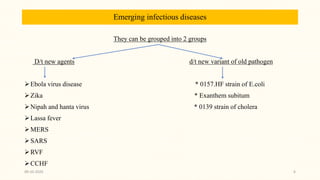
Emerging infectious diseases
They can be grouped into 2 groups
D/t new agents d/t new variant of old pathogen
Ebola virus disease * 0157.HF strain of E.coli
Zika * Exanthem subitum
Nipah and hanta virus * 0139 strain of cholera
Lassa fever
MERS
SARS
RVF
CCHF
09-10-2020 6
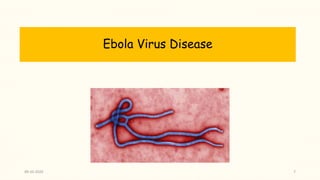
Ebola Virus Disease
09-10-2020 7
Introduction
• A serious viral hemorrhagic fever (EHF)
• Initially detected in 1976 around ebola river of Zaire (DRC)
• 35 outbreaks occurred from 1976 – 2016
• Largest outbreak in west Africa in 2014 – 2016
• In 2014, declared as PHEIC by WHO
09-10-2020 8
Epidemiological determinants
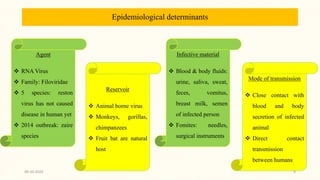
Agent
 RNA Virus
 Family: Filoviridae
 5 species: reston
virus has not caused
disease in human yet
 2014 outbreak: zaire
species
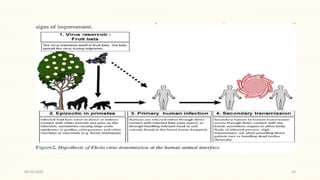
Reservoir
 Animal borne virus
 Monkeys, gorillas,
chimpanzees
 Fruit bat are natural
host
Infective material
 Blood & body fluids:
urine, saliva, sweat,
feces, vomitus,
breast milk, semen
of infected person
 Fomites: needles,
surgical instruments
Mode of transmission
 Close contact with
blood and body
secretion of infected
animal
 Direct contact
transmission
between humans
09-10-2020 9
09-10-2020 10
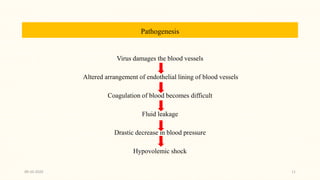
Pathogenesis
Virus damages the blood vessels
Altered arrangement of endothelial lining of blood vessels
Coagulation of blood becomes difficult
Fluid leakage
Drastic decrease in blood pressure
Hypovolemic shock
09-10-2020 11
09-10-2020 12
Treatment & Prevention
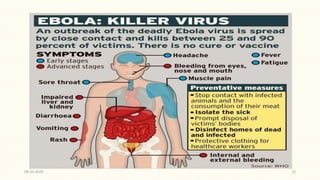
• No specific treatment available, only supportive care
• Vaccines are under different phases of trial
• PRECAUTIONS:
• Use of disposable medical equipments
• Sterilization of surgical instruments
• Personal precautions
• High standard of personal hygiene
• Avoid contact with bats, non human primates or blood, body fluid or raw meat from these
animals
• Avoid sexual contact with person who have recovered from ebola
• After returning from endemic areas, health should be monitored for 21 days09-10-2020 13
09-10-2020 14
Introduction
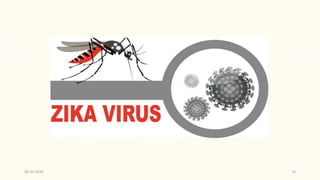
• Till 1952, zika virus was known to be the disease specific to monkeys
• The largest outbreak in 2015 – 2016 affected >33 countries
• Declared a PHEIC by WHO on 1st feb 2016
• India has recorded its biggest outbreak with > 100 cases in October 2018 from state of Rajasthan.
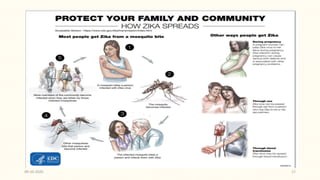
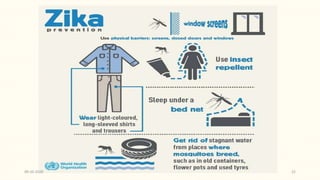
09-10-2020 15
The virus
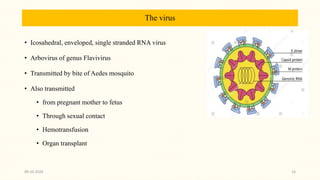
• Icosahedral, enveloped, single stranded RNA virus
• Arbovirus of genus Flavivirus
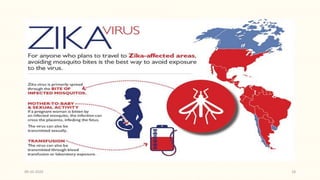
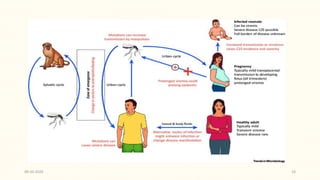
• Transmitted by bite of Aedes mosquito
• Also transmitted
• from pregnant mother to fetus
• Through sexual contact
• Hemotransfusion
• Organ transplant
09-10-2020 16
09-10-2020 17
09-10-2020 18
09-10-2020 19
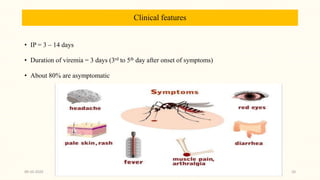
Clinical features
• IP = 3 – 14 days
• Duration of viremia = 3 days (3rd to 5th day after onset of symptoms)
• About 80% are asymptomatic
09-10-2020 20
09-10-2020 21
09-10-2020 22
09-10-2020 23
09-10-2020 24
09-10-2020 25
Introduction
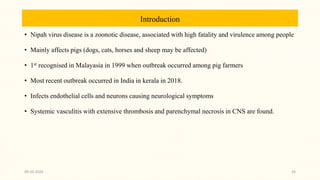
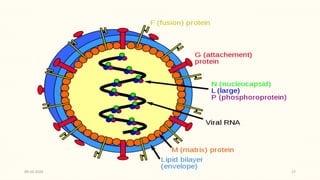
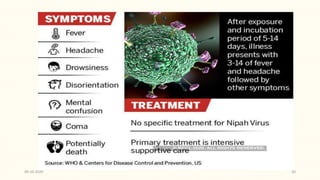
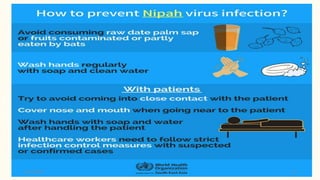
• Nipah virus disease is a zoonotic disease, associated with high fatality and virulence among people
• Mainly affects pigs (dogs, cats, horses and sheep may be affected)
• 1st recognised in Malayasia in 1999 when outbreak occurred among pig farmers
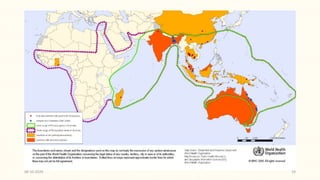
• Most recent outbreak occurred in India in kerala in 2018.
• Infects endothelial cells and neurons causing neurological symptoms
• Systemic vasculitis with extensive thrombosis and parenchymal necrosis in CNS are found.
09-10-2020 26
09-10-2020 27
Transmission
09-10-2020 28
09-10-2020 29
09-10-2020 30
09-10-2020 31
09-10-2020 32
Introduction
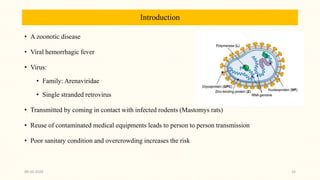
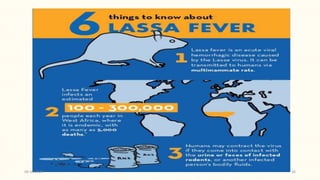
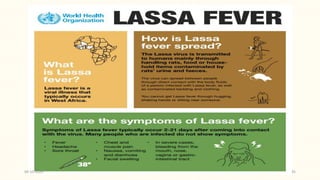
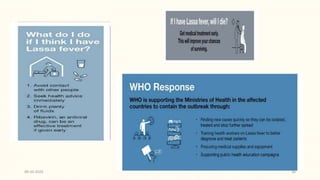
• A zoonotic disease
• Viral hemorrhagic fever
• Virus:
• Family: Arenaviridae
• Single stranded retrovirus
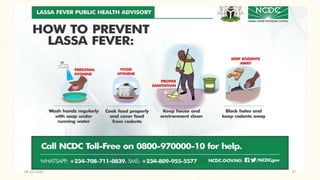
• Transmitted by coming in contact with infected rodents (Mastomys rats)
• Reuse of contaminated medical equipments leads to person to person transmission
• Poor sanitary condition and overcrowding increases the risk
09-10-2020 33
09-10-2020 34
09-10-2020 35
09-10-2020 36
09-10-2020 37
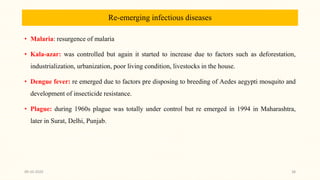
Re-emerging infectious diseases
• Malaria: resurgence of malaria
• Kala-azar: was controlled but again it started to increase due to factors such as deforestation,
industrialization, urbanization, poor living condition, livestocks in the house.
• Dengue fever: re emerged due to factors pre disposing to breeding of Aedes aegypti mosquito and
development of insecticide resistance.
• Plague: during 1960s plague was totally under control but re emerged in 1994 in Maharashtra,
later in Surat, Delhi, Punjab.
09-10-2020 38
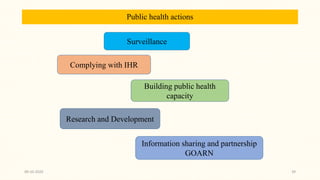
Public health actions
Surveillance
Complying with IHR
Building public health
capacity
Research and Development
Information sharing and partnership
GOARN
09-10-2020 39
09-10-2020 40

Emerging & re emerging infections

  • 1.
    Emerging & Re-emerging Infections DrSwati Shikha Assistant Professor Dept. of Community Medicine
  • 2.
    Learning objectives • Whatis emerging and re emerging infections • Factors responsible for emergence and re-emergence of infections • Emerging infectious diseases: Ebola virus, Zika virus, Nipah virus, Lassa fever • Examples of re-emerging infectious diseases • Public health actions to be taken 09-10-2020 2
  • 3.
    Emerging infectious diseases (Newdiseases; New Threats) Defined as: • Those which were not experienced previously • Those with already known causative agents but – • Not previously known to infect humans OR • Occuring in new regions where previously they were not existent OR • Occuring in new age group with new clinical features AND • Developing resistance to existing treatment • Examples : • AIDS after 1981 • Vibrio cholera O139 emerged in 1992 • ACT resistant malaria • MDR and XDR tuberculosis 09-10-2020 3
  • 4.
    Re-emerging Infectious Diseases (Olddiseases; New Threats) • Re emerging infectious diseases are those which was previously controlled and efficaciously treated but have recurred in a new epidemiological setting with increased frequency and mortality or in a more virulent form to be a significant public health problem. • Due to development of resistance by the organism for the drugs OR by the vector for the pesticides/insecticides • Example: Malaria, dengue 09-10-2020 4
  • 5.
    Factors • Improper planningof township • Population explosion, poor living condition with overcrowding • Industrialization/urbanization • Lack of proper health care services • Intense international travel • Indiscriminate use of antibiotics • Increase contact with animals • Environmental degradation with changing weather pattern 09-10-2020 5
  • 6.
    Emerging infectious diseases Theycan be grouped into 2 groups D/t new agents d/t new variant of old pathogen Ebola virus disease * 0157.HF strain of E.coli Zika * Exanthem subitum Nipah and hanta virus * 0139 strain of cholera Lassa fever MERS SARS RVF CCHF 09-10-2020 6
  • 7.
  • 8.
    Introduction • A seriousviral hemorrhagic fever (EHF) • Initially detected in 1976 around ebola river of Zaire (DRC) • 35 outbreaks occurred from 1976 – 2016 • Largest outbreak in west Africa in 2014 – 2016 • In 2014, declared as PHEIC by WHO 09-10-2020 8
  • 9.
    Epidemiological determinants Agent  RNAVirus  Family: Filoviridae  5 species: reston virus has not caused disease in human yet  2014 outbreak: zaire species Reservoir  Animal borne virus  Monkeys, gorillas, chimpanzees  Fruit bat are natural host Infective material  Blood & body fluids: urine, saliva, sweat, feces, vomitus, breast milk, semen of infected person  Fomites: needles, surgical instruments Mode of transmission  Close contact with blood and body secretion of infected animal  Direct contact transmission between humans 09-10-2020 9
  • 10.
  • 11.
    Pathogenesis Virus damages theblood vessels Altered arrangement of endothelial lining of blood vessels Coagulation of blood becomes difficult Fluid leakage Drastic decrease in blood pressure Hypovolemic shock 09-10-2020 11
  • 12.
  • 13.
    Treatment & Prevention •No specific treatment available, only supportive care • Vaccines are under different phases of trial • PRECAUTIONS: • Use of disposable medical equipments • Sterilization of surgical instruments • Personal precautions • High standard of personal hygiene • Avoid contact with bats, non human primates or blood, body fluid or raw meat from these animals • Avoid sexual contact with person who have recovered from ebola • After returning from endemic areas, health should be monitored for 21 days09-10-2020 13
  • 14.
  • 15.
    Introduction • Till 1952,zika virus was known to be the disease specific to monkeys • The largest outbreak in 2015 – 2016 affected >33 countries • Declared a PHEIC by WHO on 1st feb 2016 • India has recorded its biggest outbreak with > 100 cases in October 2018 from state of Rajasthan. 09-10-2020 15
  • 16.
    The virus • Icosahedral,enveloped, single stranded RNA virus • Arbovirus of genus Flavivirus • Transmitted by bite of Aedes mosquito • Also transmitted • from pregnant mother to fetus • Through sexual contact • Hemotransfusion • Organ transplant 09-10-2020 16
  • 17.
  • 18.
  • 19.
  • 20.
    Clinical features • IP= 3 – 14 days • Duration of viremia = 3 days (3rd to 5th day after onset of symptoms) • About 80% are asymptomatic 09-10-2020 20
  • 21.
  • 22.
  • 23.
  • 24.
  • 25.
  • 26.
    Introduction • Nipah virusdisease is a zoonotic disease, associated with high fatality and virulence among people • Mainly affects pigs (dogs, cats, horses and sheep may be affected) • 1st recognised in Malayasia in 1999 when outbreak occurred among pig farmers • Most recent outbreak occurred in India in kerala in 2018. • Infects endothelial cells and neurons causing neurological symptoms • Systemic vasculitis with extensive thrombosis and parenchymal necrosis in CNS are found. 09-10-2020 26
  • 27.
  • 28.
  • 29.
  • 30.
  • 31.
  • 32.
  • 33.
    Introduction • A zoonoticdisease • Viral hemorrhagic fever • Virus: • Family: Arenaviridae • Single stranded retrovirus • Transmitted by coming in contact with infected rodents (Mastomys rats) • Reuse of contaminated medical equipments leads to person to person transmission • Poor sanitary condition and overcrowding increases the risk 09-10-2020 33
  • 34.
  • 35.
  • 36.
  • 37.
  • 38.
    Re-emerging infectious diseases •Malaria: resurgence of malaria • Kala-azar: was controlled but again it started to increase due to factors such as deforestation, industrialization, urbanization, poor living condition, livestocks in the house. • Dengue fever: re emerged due to factors pre disposing to breeding of Aedes aegypti mosquito and development of insecticide resistance. • Plague: during 1960s plague was totally under control but re emerged in 1994 in Maharashtra, later in Surat, Delhi, Punjab. 09-10-2020 38
  • 39.
    Public health actions Surveillance Complyingwith IHR Building public health capacity Research and Development Information sharing and partnership GOARN 09-10-2020 39
  • 40.