
Acid Base
Titration
Muhammad Mubashar Noor
04051813035
Sir Noor ud Din
Titration
A titration is a technique where a solution of known
concentration is used to determine the concentration of an
unknown solution.
 A solution whose concentration is known is called as Standard
Solution.
 The solution whose concentration is unknown is called as
Sample Solution.
Principle of Titration
M1V1=M2V2
where
M1 Molarity of Unknown Solution
V1 Volume of Unknown Solution
M2 Molarity of Known Solution
V2 Volume of Known Solution
Acid Base Titration
An acid–base titration is a method of quantitative
analysis for determining the concentration of
an acid or base by exactly neutralizing it with a standard
solution of base or acid having known concentration.
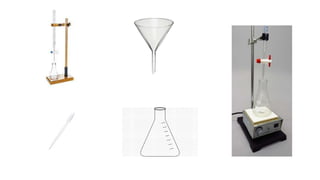
Instruements
 Burette
 Conical Flask
 Magnetic Stirrer
 Pipette
 Funnel
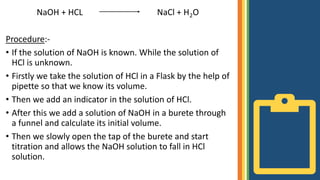
NaOH + HCL NaCl + H2O
Procedure:-
• If the solution of NaOH is known. While the solution of
HCl is unknown.
• Firstly we take the solution of HCl in a Flask by the help of
pipette so that we know its volume.
• Then we add an indicator in the solution of HCl.
• After this we add a solution of NaOH in a burete through
a funnel and calculate its initial volume.
• Then we slowly open the tap of the burete and start
titration and allows the NaOH solution to fall in HCl
solution.
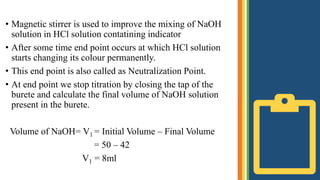
• Magnetic stirrer is used to improve the mixing of NaOH
solution in HCl solution contatining indicator
• After some time end point occurs at which HCl solution
starts changing its colour permanently.
• This end point is also called as Neutralization Point.
• At end point we stop titration by closing the tap of the
burete and calculate the final volume of NaOH solution
present in the burete.
Volume of NaOH= V1 = Initial Volume – Final Volume
= 50 – 42
V1 = 8ml
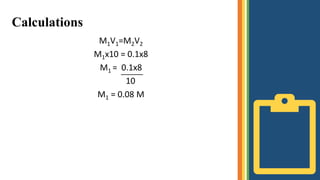
Calculations
M1V1=M2V2
M1x10 = 0.1x8
M1 = 0.1x8
10
M1 = 0.08 M
Thank
You
Any
Question ?

Acid base titration

  • 1.
    Acid Base Titration Muhammad MubasharNoor 04051813035 Sir Noor ud Din
  • 2.
    Titration A titration isa technique where a solution of known concentration is used to determine the concentration of an unknown solution.  A solution whose concentration is known is called as Standard Solution.  The solution whose concentration is unknown is called as Sample Solution.
  • 3.
    Principle of Titration M1V1=M2V2 where M1Molarity of Unknown Solution V1 Volume of Unknown Solution M2 Molarity of Known Solution V2 Volume of Known Solution
  • 4.
    Acid Base Titration Anacid–base titration is a method of quantitative analysis for determining the concentration of an acid or base by exactly neutralizing it with a standard solution of base or acid having known concentration. Instruements  Burette  Conical Flask  Magnetic Stirrer  Pipette  Funnel
  • 6.
    NaOH + HCLNaCl + H2O Procedure:- • If the solution of NaOH is known. While the solution of HCl is unknown. • Firstly we take the solution of HCl in a Flask by the help of pipette so that we know its volume. • Then we add an indicator in the solution of HCl. • After this we add a solution of NaOH in a burete through a funnel and calculate its initial volume. • Then we slowly open the tap of the burete and start titration and allows the NaOH solution to fall in HCl solution.
  • 7.
    • Magnetic stirreris used to improve the mixing of NaOH solution in HCl solution contatining indicator • After some time end point occurs at which HCl solution starts changing its colour permanently. • This end point is also called as Neutralization Point. • At end point we stop titration by closing the tap of the burete and calculate the final volume of NaOH solution present in the burete. Volume of NaOH= V1 = Initial Volume – Final Volume = 50 – 42 V1 = 8ml
  • 8.
  • 9.