

Candida albicans
Muhammad Mubashar Noor
04051813035
Microbiology
BS 6th
Commensal yeast
Opportunistic pathogenic
yeast
Species name, albicans,
comes from the Latin word
for “white.”
Phylum
Ascomycota
Family
Sachharomycetaceae
Commonly cause an
infection known as
Candidiasis
Candida
albicans
Muhammad Mubashar Noor 1
There are several different types of infections caused by Candida albicans
• Urinary yeast infection
• Genital yeast infection (Genital Candidiasis)
• Oral thrush (Oropharyngeal Candidiasis)
• Mucocutaneous candidiasis
• Invasive Candidiasis
Types of Candida albicans infections
Muhammad Mubashar Noor 2
Candida species are the most common cause of fungal urinary tract infections
(UTIs). Candida UTIs can occur in the lower portion of the urinary tract or in
some cases can ascend up to the kidneys.
Many people with a Candida UTI don’t have symptoms. If symptoms are
present, they can include:
• an increased need to urinate
• a painful or burning sensation while urination
• abdominal or pelvic pain
• blood in urine
Urinary yeast infection
Muhammad Mubashar Noor 3
Candida albicans is the most common cause of genital yeast infections.
Normally, a type of bacteria called Lactobacillus keeps the amount
of Candida in the genital area under control. However,
when Lactobacillus levels are disrupted due to pregnancy, diabetes, use of
some medicines, lubricants, or spermicides, or a weakened immune
system Candida can overgrow and cause an infection.
Three out of four adult women will get at least one yeast infection during
their lifetime. This occurs when too much yeast grows in the vagina. (Men
also can get a genital yeast infection, but it's much less common).
Genital Yeast Infection (Genital Candidiasis)
Muhammad Mubashar Noor 4
Symptoms of a genital Candida infection can include:
• A burning feeling while urinating
• An itchy or painful feeling in or around the vagina
• Redness, irritation, or swelling around the vagina
• A rash around the vagina
• A rash on the penis
 Candida species can also infect the male genitals, often if their partner
has a vaginal Candida infection. The infection may be asymptomatic but
can cause an itchy or burning rash around the head of the penis.
Genital Yeast Infection (Genital Candidiasis)
Muhammad Mubashar Noor 5
When the candida yeast spreads in the mouth and throat, it can cause an infection
called thrush. It’s most common in newborns, the elderly and people with weakened
immune systems. Also, more likely to get it are adults who
• Are being treated for cancer
• Take medications like corticosteroids and wide-spectrum antibiotics
The symptoms include:
• White or yellow patches on the tongue, lips, roof of mouth, and inner cheeks
• Redness or soreness in the mouth and throat
• Cracking at the corners of the mouth
• Pain when swallowing, if it spreads to the throat
Oral thrush (Oropharyngeal Candidiasis)
Muhammad Mubashar Noor 6
Candida species can also infect skin and mucus membranes.
Candida albicans is most often the cause of a fungal skin infection, although
other Candida strains can also cause it.
Areas that are warm, moist, or sweaty provide good environments for yeast to
thrive.
The most common symptom of a Candida skin infection is a red rash that
forms in the affected area.
In some cases, blister-like lesions can form. The skin may also become
thickened or produce a white substance that has a curd-like appearance.
Mucocutaneous candidiasis
Muhammad Mubashar Noor 7
If Candida yeast enters the bloodstream or body (usually through medical
equipment or devices), it can travel to the heart, brain, blood, eyes, and bones.
This can cause a serious, life-threatening infections which include
• Candidemia
• Endocarditis
• Endophthalmitis
• Fungal meningitis
Invasive Candidiasis
Muhammad Mubashar Noor 8
Epidemiology
• Over 75% of women suffer from C. albicans infection,
usually vulvovaginal candidiasis, in their lifetimes, and 40-
50% of them will have additional occurrences(s).
• Interestingly, C. albicans is the 4th leading cause for
nosocomial infections in patients' bloodstreams.
• This could result in an extremely life-threatening, systemic
infection in hospital patients with amortality rate of 30%.
Muhammad Mubashar Noor 9
Risk factor
• Babies with a nappy rash
• People with a metabolic disorder, including diabetics
• Overweight people
• Pregnant women
• People who work in wet conditions.
• People who are HIV-positive or suffer from another type of
immunodeficiency
• Neutropenia
Muhammad Mubashar Noor 10
Clinical Manifestations of Candida
Candidiasis Mucocutaneous
manifestations
Cutaneous
manifestations
Systemic
manifestations
Infectious
diseases
Allergic
diseases
Muhammad Mubashar Noor 11
Mucocutaneous Manifestations
Mucocutaneous
manifestations
Oral candidiasis
Angular cheilitis
Oesophagitis
Vulvovaginitis,
Chronic
mucocutaneous
candidiasis (CMC)
Ocular candidiasis
Muhammad Mubashar Noor 12
Cutaneous Manifestations
Cutaneous
Manifestations
Intertrigo
Paronychia and
Onychomycosis
Diaper dermatitis
Candidial
granuloma
Muhammad Mubashar Noor 13
Systemic Manifestations
Systemic
manifestations
Urinary tract candidiasis
Candiduria
Endocarditis
Pulmonary candidiasis
Meningitis
Candidemia and Septicemia
Disseminated candidiasis
Osteomyelitis
Endopthalmitis
Nosocomial candidiasis
Muhammad Mubashar Noor 14
Allergic Diseases
Allergic
diseases
Candidids
Eczema
Asthma
Gastritis
Muhammad Mubashar Noor 15
Specimen is collected depends on the type of infection
• Urine (in case of UTI)
• Vaginal discharge (suspected cases of vaginal thrush)
• CSF (when meningitis is suspected)
• Sputum (when oral thrush is suspected)
• Other exudates from mucosal surface
LABORATORY DIAGNOSIS
Muhammad Mubashar Noor 16
Microscopy
and Staining
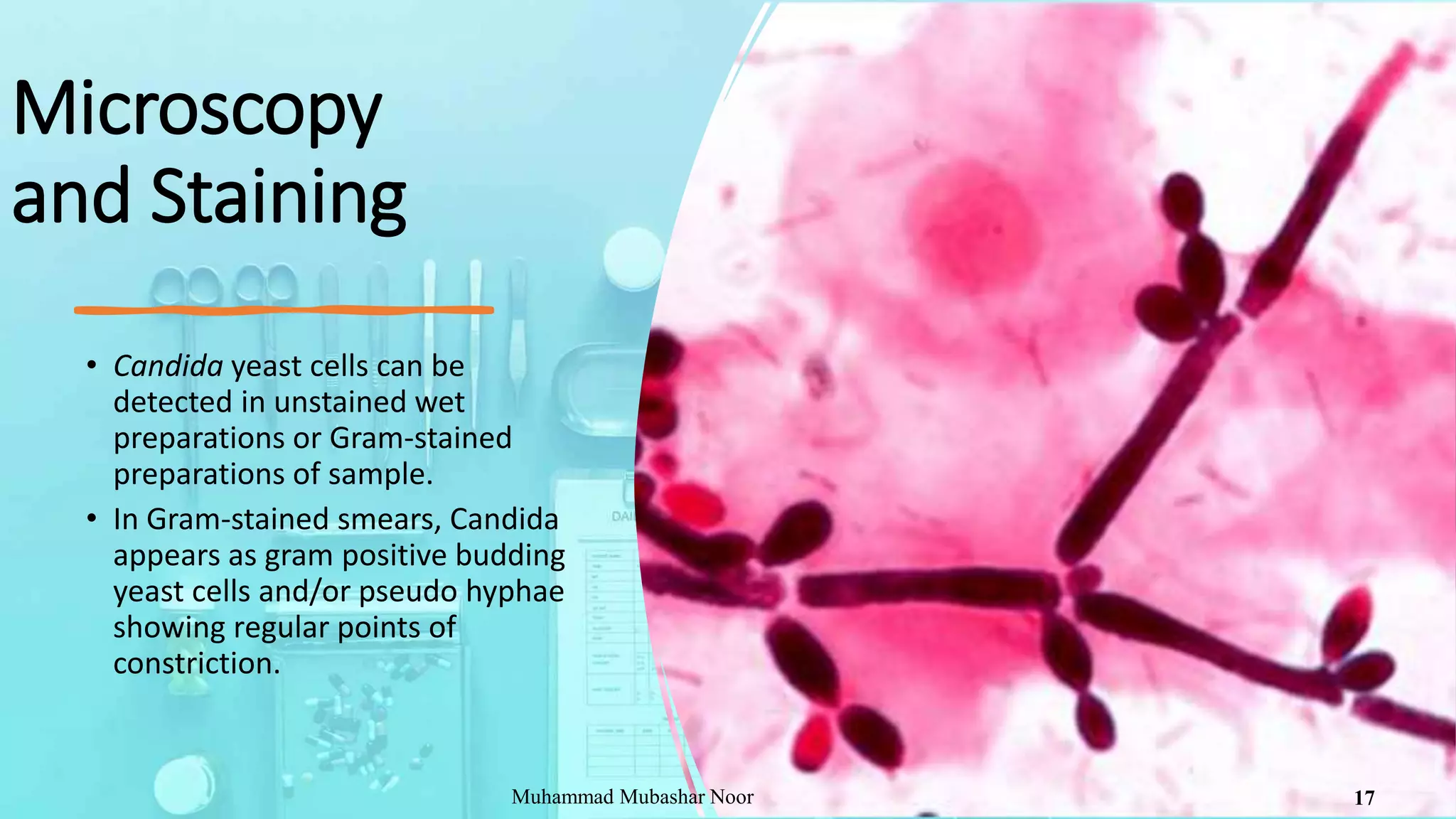
• Candida yeast cells can be
detected in unstained wet
preparations or Gram-stained
preparations of sample.
• In Gram-stained smears, Candida
appears as gram positive budding
yeast cells and/or pseudo hyphae
showing regular points of
constriction.
Muhammad Mubashar Noor 17
• Candida albicans grows well on Sabouraud dextrose agar and most
routinely used bacteriological media. Cream-colored pasty colonies
usually appear after 24-48 hours of incubation at 25-37°C. The colonies
have a distinctive yeast smell, and the budding cells can be easily seen by
direct microscopy in stained or unstained preparations.
• In Blood Agar, Candida albicans gives white, creamy colored colonies
which can be sometime mistaken for Staphylococcus spp. Whenever
analyzing the culture report of ‘high vaginal swab’, take extra care as the
colony we are observing can be of Candida albicans instead
of Staphylococcus aureus or vice versa (quick solution for this is to
perform wet mount or gram staining and observing under microscope).
Culture
Muhammad Mubashar Noor 18
Culture
Muhammad Mubashar Noor 19
Suspected strains of Candida isolates grown on CMA or rice starch agar
and incubate at 25°C.
Formation of large highly refractile, thick walled, terminal chlamydospore
in 2-3 days of incubation.
Biochemical tests
Muhammad Mubashar Noor 20
• Biochemical tests are also routinely done following the initial
phenotypic identification of the cultures on agar media and microscopy.
• Tests using single enzyme are able to detect the presence or absence of
an enzyme or a biochemical reactions.
• Various Candida species can be detected by observing the changes in
the indicator colour when the yeast cultures utilize 1% carbohydrates
such as glucose, maltose, sucrose.
• Glucose and maltose is fermented with acid and gas production, sucrose
and lactose is nor fermented by Candida albicans in triple sugar iron
agar test.
• Candida albicans can be identified presumptively by a simple germ tube
test.
Further tests:
Muhammad Mubashar Noor 21
Germ tube test
• Germ tube test is the confirmatory test for Candida albicans.
• Germ tube formation was first reported by Reynolds and Braude and hence
the germ tube test is also known as Reynolds-Braude phenomenon.
• This is a rapid method for identifying and differentiating Candida
albicans from another Candida spp.
Principle of Germ Tube Test
• Germ tubes are short outgrowths, non-septate
germinating hyphae. They are ½ the width and 3 –
4 times the length of the cell from which they
arise.
• When cells of Candida are incubated in serum at
37°C for 2-3 hours Candida albicans produce short,
slender, tube-like structures called germ tubes.
• The formation of germ tubes is associated with
increased synthesis of protein and ribonucleic acid.
• Various media like fetal bovine serum or human
pooled serum may be used.
Muhammad Mubashar Noor 22
Treatment
Localized infection
• For infection of the skin, there is an antifungal cream or powder or prescription of antifungal
drug by doctor.
• In case of oral candidiasis topical treatments or oral medication is used.
• For vaginal yeast infections, treatment consists of antifungal medications that are
administereddirectly into the vagina as tablets, creams, ointments, or suppositories, or
administered by mouth (e.g., fluconazole).
• A one-time dose of fluconazole is 90% effective in treating a vaginal yeast infection.
• For vaginal yeast infection in pregnancy, topical imidazole or
triazole antifungals is prescribed.
Blood infection
• Intravenous fluconazole or an echinocandin such as caspofungin may be used.
Amphotericin B can also be used
Muhammad Mubashar Noor 23
Prevention
• In general, Candida infections can be prevented by keeping our skin
clean and dry.
• Use antibiotics only as doctor prescribed
• Follow a healthy lifestyle, including proper nutrition
• People with diabetes should try to keep their blood sugar under
tightcontrol.
• If anyone have HIV or another cause of recurrent episodes of
thrush, then antifungal drugs such as clotrimazole can help to
minimize flare-ups (but take medication by consulting with
doctor).
Muhammad Mubashar Noor 24
Candida albicans

Candida albicans

  • 1.
    Candida albicans Muhammad MubasharNoor 04051813035 Microbiology BS 6th
  • 2.
    Commensal yeast Opportunistic pathogenic yeast Speciesname, albicans, comes from the Latin word for “white.” Phylum Ascomycota Family Sachharomycetaceae Commonly cause an infection known as Candidiasis Candida albicans Muhammad Mubashar Noor 1
  • 3.
    There are severaldifferent types of infections caused by Candida albicans • Urinary yeast infection • Genital yeast infection (Genital Candidiasis) • Oral thrush (Oropharyngeal Candidiasis) • Mucocutaneous candidiasis • Invasive Candidiasis Types of Candida albicans infections Muhammad Mubashar Noor 2
  • 4.
    Candida species arethe most common cause of fungal urinary tract infections (UTIs). Candida UTIs can occur in the lower portion of the urinary tract or in some cases can ascend up to the kidneys. Many people with a Candida UTI don’t have symptoms. If symptoms are present, they can include: • an increased need to urinate • a painful or burning sensation while urination • abdominal or pelvic pain • blood in urine Urinary yeast infection Muhammad Mubashar Noor 3
  • 5.
    Candida albicans isthe most common cause of genital yeast infections. Normally, a type of bacteria called Lactobacillus keeps the amount of Candida in the genital area under control. However, when Lactobacillus levels are disrupted due to pregnancy, diabetes, use of some medicines, lubricants, or spermicides, or a weakened immune system Candida can overgrow and cause an infection. Three out of four adult women will get at least one yeast infection during their lifetime. This occurs when too much yeast grows in the vagina. (Men also can get a genital yeast infection, but it's much less common). Genital Yeast Infection (Genital Candidiasis) Muhammad Mubashar Noor 4
  • 6.
    Symptoms of agenital Candida infection can include: • A burning feeling while urinating • An itchy or painful feeling in or around the vagina • Redness, irritation, or swelling around the vagina • A rash around the vagina • A rash on the penis  Candida species can also infect the male genitals, often if their partner has a vaginal Candida infection. The infection may be asymptomatic but can cause an itchy or burning rash around the head of the penis. Genital Yeast Infection (Genital Candidiasis) Muhammad Mubashar Noor 5
  • 7.
    When the candidayeast spreads in the mouth and throat, it can cause an infection called thrush. It’s most common in newborns, the elderly and people with weakened immune systems. Also, more likely to get it are adults who • Are being treated for cancer • Take medications like corticosteroids and wide-spectrum antibiotics The symptoms include: • White or yellow patches on the tongue, lips, roof of mouth, and inner cheeks • Redness or soreness in the mouth and throat • Cracking at the corners of the mouth • Pain when swallowing, if it spreads to the throat Oral thrush (Oropharyngeal Candidiasis) Muhammad Mubashar Noor 6
  • 8.
    Candida species canalso infect skin and mucus membranes. Candida albicans is most often the cause of a fungal skin infection, although other Candida strains can also cause it. Areas that are warm, moist, or sweaty provide good environments for yeast to thrive. The most common symptom of a Candida skin infection is a red rash that forms in the affected area. In some cases, blister-like lesions can form. The skin may also become thickened or produce a white substance that has a curd-like appearance. Mucocutaneous candidiasis Muhammad Mubashar Noor 7
  • 9.
    If Candida yeastenters the bloodstream or body (usually through medical equipment or devices), it can travel to the heart, brain, blood, eyes, and bones. This can cause a serious, life-threatening infections which include • Candidemia • Endocarditis • Endophthalmitis • Fungal meningitis Invasive Candidiasis Muhammad Mubashar Noor 8
  • 10.
    Epidemiology • Over 75%of women suffer from C. albicans infection, usually vulvovaginal candidiasis, in their lifetimes, and 40- 50% of them will have additional occurrences(s). • Interestingly, C. albicans is the 4th leading cause for nosocomial infections in patients' bloodstreams. • This could result in an extremely life-threatening, systemic infection in hospital patients with amortality rate of 30%. Muhammad Mubashar Noor 9
  • 11.
    Risk factor • Babieswith a nappy rash • People with a metabolic disorder, including diabetics • Overweight people • Pregnant women • People who work in wet conditions. • People who are HIV-positive or suffer from another type of immunodeficiency • Neutropenia Muhammad Mubashar Noor 10
  • 12.
    Clinical Manifestations ofCandida Candidiasis Mucocutaneous manifestations Cutaneous manifestations Systemic manifestations Infectious diseases Allergic diseases Muhammad Mubashar Noor 11
  • 13.
    Mucocutaneous Manifestations Mucocutaneous manifestations Oral candidiasis Angularcheilitis Oesophagitis Vulvovaginitis, Chronic mucocutaneous candidiasis (CMC) Ocular candidiasis Muhammad Mubashar Noor 12
  • 14.
  • 15.
    Systemic Manifestations Systemic manifestations Urinary tractcandidiasis Candiduria Endocarditis Pulmonary candidiasis Meningitis Candidemia and Septicemia Disseminated candidiasis Osteomyelitis Endopthalmitis Nosocomial candidiasis Muhammad Mubashar Noor 14
  • 16.
  • 17.
    Specimen is collecteddepends on the type of infection • Urine (in case of UTI) • Vaginal discharge (suspected cases of vaginal thrush) • CSF (when meningitis is suspected) • Sputum (when oral thrush is suspected) • Other exudates from mucosal surface LABORATORY DIAGNOSIS Muhammad Mubashar Noor 16
  • 18.
    Microscopy and Staining • Candidayeast cells can be detected in unstained wet preparations or Gram-stained preparations of sample. • In Gram-stained smears, Candida appears as gram positive budding yeast cells and/or pseudo hyphae showing regular points of constriction. Muhammad Mubashar Noor 17
  • 19.
    • Candida albicansgrows well on Sabouraud dextrose agar and most routinely used bacteriological media. Cream-colored pasty colonies usually appear after 24-48 hours of incubation at 25-37°C. The colonies have a distinctive yeast smell, and the budding cells can be easily seen by direct microscopy in stained or unstained preparations. • In Blood Agar, Candida albicans gives white, creamy colored colonies which can be sometime mistaken for Staphylococcus spp. Whenever analyzing the culture report of ‘high vaginal swab’, take extra care as the colony we are observing can be of Candida albicans instead of Staphylococcus aureus or vice versa (quick solution for this is to perform wet mount or gram staining and observing under microscope). Culture Muhammad Mubashar Noor 18
  • 20.
    Culture Muhammad Mubashar Noor19 Suspected strains of Candida isolates grown on CMA or rice starch agar and incubate at 25°C. Formation of large highly refractile, thick walled, terminal chlamydospore in 2-3 days of incubation.
  • 21.
    Biochemical tests Muhammad MubasharNoor 20 • Biochemical tests are also routinely done following the initial phenotypic identification of the cultures on agar media and microscopy. • Tests using single enzyme are able to detect the presence or absence of an enzyme or a biochemical reactions. • Various Candida species can be detected by observing the changes in the indicator colour when the yeast cultures utilize 1% carbohydrates such as glucose, maltose, sucrose. • Glucose and maltose is fermented with acid and gas production, sucrose and lactose is nor fermented by Candida albicans in triple sugar iron agar test.
  • 22.
    • Candida albicanscan be identified presumptively by a simple germ tube test. Further tests: Muhammad Mubashar Noor 21 Germ tube test • Germ tube test is the confirmatory test for Candida albicans. • Germ tube formation was first reported by Reynolds and Braude and hence the germ tube test is also known as Reynolds-Braude phenomenon. • This is a rapid method for identifying and differentiating Candida albicans from another Candida spp.
  • 23.
    Principle of GermTube Test • Germ tubes are short outgrowths, non-septate germinating hyphae. They are ½ the width and 3 – 4 times the length of the cell from which they arise. • When cells of Candida are incubated in serum at 37°C for 2-3 hours Candida albicans produce short, slender, tube-like structures called germ tubes. • The formation of germ tubes is associated with increased synthesis of protein and ribonucleic acid. • Various media like fetal bovine serum or human pooled serum may be used. Muhammad Mubashar Noor 22
  • 24.
    Treatment Localized infection • Forinfection of the skin, there is an antifungal cream or powder or prescription of antifungal drug by doctor. • In case of oral candidiasis topical treatments or oral medication is used. • For vaginal yeast infections, treatment consists of antifungal medications that are administereddirectly into the vagina as tablets, creams, ointments, or suppositories, or administered by mouth (e.g., fluconazole). • A one-time dose of fluconazole is 90% effective in treating a vaginal yeast infection. • For vaginal yeast infection in pregnancy, topical imidazole or triazole antifungals is prescribed. Blood infection • Intravenous fluconazole or an echinocandin such as caspofungin may be used. Amphotericin B can also be used Muhammad Mubashar Noor 23
  • 25.
    Prevention • In general,Candida infections can be prevented by keeping our skin clean and dry. • Use antibiotics only as doctor prescribed • Follow a healthy lifestyle, including proper nutrition • People with diabetes should try to keep their blood sugar under tightcontrol. • If anyone have HIV or another cause of recurrent episodes of thrush, then antifungal drugs such as clotrimazole can help to minimize flare-ups (but take medication by consulting with doctor). Muhammad Mubashar Noor 24