EMBEDDED
SYSTEM
AGENDA
• Introduction
• Components and characteristics of embedded system
• Basic Structure of Embedded System
• Types of Embedded system
• Classifications and applications of Embedded system
• Advantages and Disadvantages
• Conclusion
What is Embedded System?
• An Embedded system is a combination of computer hardware and software
• It may or not be programmable, depending on the application
Components of Embedded System
HARDWARE
Application
SoftwareRTO
S
Characteristics of an Embedded System
• Single –functioned
• Tightly constrained
• Reactive and Real time
• Microprocessors based
• Memory
• Connected
• Hardware – Software Systems
Basic Structure of Embedded System
A-D
Converter
Memory
Sensor
D-A
Converter
ActuatorProcessor &
ASIC
SENSOR D –A CONVERTERPROCESSOR & ASICsA-D CONVERTER ACTUATOR
A sensor stores the
measured quantity
to the memory.
Converts the
analog signal
sent by the
sensor in to a
digital signal.
Process the data
to measure the
output and store
it to the memory.
Converts the digital
data
fed by the
processor to analog
data
Compares the
output given by the
D-A Converter to
the actual
(expected) output
stored in it and
stores the
approved output
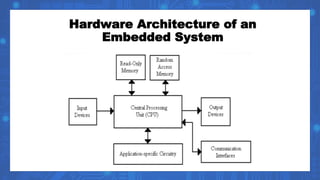
Hardware of an Embedded System
• Central Processing Unit
• Memory(RAM & ROM)
• Input Device
• Output Device
• Communication Interfaces
Software of an Embedded System
• C
• C++
• Python
• Etc..
Processors in a System
• Processor is the heart of an embedded system
• It is the basic unit that takes inputs and produces an output after
processing the data.
Microprocessor Microcontroller
Processors
Microprocessor
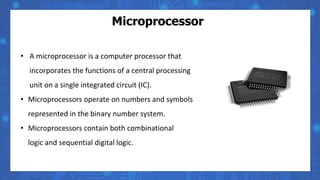
• A microprocessor is a computer processor that
incorporates the functions of a central processing
unit on a single integrated circuit (IC).
• Microprocessors operate on numbers and symbols
represented in the binary number system.
• Microprocessors contain both combinational
logic and sequential digital logic.
Microcontroller
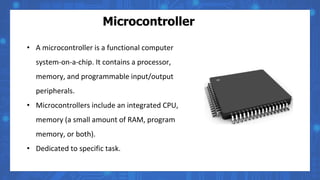
• A microcontroller is a functional computer
system-on-a-chip. It contains a processor,
memory, and programmable input/output
peripherals.
• Microcontrollers include an integrated CPU,
memory (a small amount of RAM, program
memory, or both).
• Dedicated to specific task.
Microprocessor vs Microcontroller
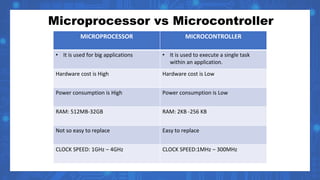
MICROPROCESSOR MICROCONTROLLER
• It is used for big applications • It is used to execute a single task
within an application.
Hardware cost is High Hardware cost is Low
Power consumption is High Power consumption is Low
RAM: 512MB-32GB RAM: 2KB -256 KB
Not so easy to replace Easy to replace
CLOCK SPEED: 1GHz – 4GHz CLOCK SPEED:1MHz – 300MHz
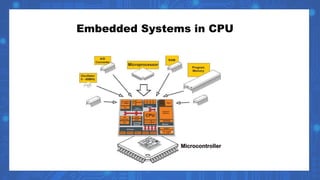
Embedded Systems in CPU
Peripheral Devices in Embedded Systems
• Serial Communication Interfaces (SCI).
• Synchronous Serial Communication Interface
• Universal Serial Bus (USB)
• Multimedia Cards (SD Cards)
• Networks like Ethernet
• Analog to Digital/Digital to Analog (ADC/DAC)
Hardware Architecture of an
Embedded System
What makes embedded systems different?
EMBEDDED
SYSTEM
SIZE
COST
TIME
RELIABILITY
SAFETY
ENERGYSECURITY
SIZE
COST
TIME
RELIABILITY
SAFETY
ENERGYSECURITY
TYPES OF EMBEDDED
SYSTEM
EMBEDDED
STSTEM
PERFORMANCE
&
FUNCTIONAL
MICRO-
CONTROLLER
REAL TIME
STAND
ALONE
NETWORK
MOBILE
SOPHISTICATED
MEDIUM
SCALE
SMALL
SCALE
REAL TIME EMBEDDED SYSTEM
• Quick response to critical situations.
• Control external environment-input and output interfaces and
sensor.
• elevators
• robots
• traffic lights
• patient monitoring system etc.,
STANDALONE EMBEDDED SYSTEM
• Works for itself as a device without need of interconnected
computer.
• Takes data in form of analog or digital signal
• First processes data and outputs data by displaying on the screen
• Can also output data to any attached device
• Example-microwave ovens ,digital camera,Mp3 players, etc.,
NETWORK EMBEDDED SYSTEM
• Connected to network(LAN/WAN)-network interfaces
• Connected to network to give output to attached resources
• Connection-wireless or wired
• Example-office security system
MOBILE EMBEDDED SYSTEM
• Limited in resources-memory
• Example- PDA, cellular phones
SMALL SCALE EMBEDDED SYSTEM
• 8-16 bit microcontroller
• One chip RAM,ROM
• Activated –battery
• Behaves as a component of computer
• Does not compute
• Little hardware and software complexity
• Example-digital watch
MEDIUM SCALE EMBEDDED SYSTEM
• 16-32 bit microprocessor or micro controller
• External RAM ,ROM
• Integration between hardware and software-complex
SOPHISTICATED EMBEDDED SYSTEM
• 32-64 bit chips
• Large scale work
• Complexity of hardware and software-very high
• Example-washing machine
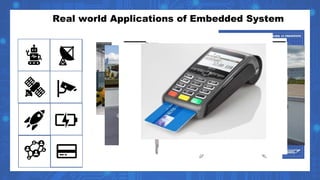
Real world Applications of Embedded System
Trends in Embedded Development
1.Artificial Intelligence (AI)
• It is a branch of computer science that aims to create intelligent machines.
• It has become an essential part of the technology industry
• The core problems of artificial intelligence :
• Knowledge
• Reasoning
• Problem solving
• Perception
• Learning
• Planning
• Ability to manipulate and move objects
2. Wearable technology
• It is a technology devices that can be
tracking information related to health
and fitness.
• They have devices that have small
motion sensors to take photos and sync
with your mobile devices.
3. Healthcare
• MRI and CT scanner
• Sonography
• Blood pressure device and
glucose test set
• Fetal heart monitoring machine
4. Internet of Things(IoT)
• It is a network of interconnected things/devices which
are embedded with sensors, software, network
connectivity and necessary electronics that enables
them to collect and exchange data making them
responsive.
• Smart thermostats
• Mimo Monitor
• Philips-Hue Bulbs
• Apple Watch and Home Kit
• Smart Refrigerator
• They are convenient for mass production. This results in low price per
piece.
• These systems are highly stable and reliable.
• Embedded systems are made for specific tasks.
• The embedded systems are very small in size, hence can be carried
and loaded anywhere.
• These systems are fast. They also use less power.
• The embedded systems optimize the use or resources available.
• They improve the product quality.
ADVANTAGES
DISADVANTAGES
• They are hard to maintain. It is also difficult to take a back-up of
embedded files.
• Transferring data from one system to another is also quite
problematic.
• Embedded systems are made for specific tasks, hardware is limited.
• Hard to upgrade and repair.
• The embedded system will lose a substantial amount of money if it
shuts off
Conclusion
● The world of embedded system is a dreamers paradise with unlimited
possibilities.
● it make controlling all the system around just by simple gesture and the
things respond to you as if it was some magic.
● As microprocessor are becoming smaller cheaper, more and more products
are becoming smart with microprocessors embedded in them
Reference
• https://www.resourcology.com/blog/what-is-embedded-software-
testing/
• https://store.digilentinc.com/internet-of-things-iot/
• http://www.wikiforu.com/2012/10/what-is-microcontroller-how-it-
works.html
Thank You

Embedded systems

  • 1.
  • 2.
    AGENDA • Introduction • Componentsand characteristics of embedded system • Basic Structure of Embedded System • Types of Embedded system • Classifications and applications of Embedded system • Advantages and Disadvantages • Conclusion
  • 3.
    What is EmbeddedSystem? • An Embedded system is a combination of computer hardware and software • It may or not be programmable, depending on the application
  • 4.
    Components of EmbeddedSystem HARDWARE Application SoftwareRTO S
  • 5.
    Characteristics of anEmbedded System • Single –functioned • Tightly constrained • Reactive and Real time • Microprocessors based • Memory • Connected • Hardware – Software Systems
  • 6.
    Basic Structure ofEmbedded System A-D Converter Memory Sensor D-A Converter ActuatorProcessor & ASIC
  • 7.
    SENSOR D –ACONVERTERPROCESSOR & ASICsA-D CONVERTER ACTUATOR A sensor stores the measured quantity to the memory. Converts the analog signal sent by the sensor in to a digital signal. Process the data to measure the output and store it to the memory. Converts the digital data fed by the processor to analog data Compares the output given by the D-A Converter to the actual (expected) output stored in it and stores the approved output
  • 8.
    Hardware of anEmbedded System • Central Processing Unit • Memory(RAM & ROM) • Input Device • Output Device • Communication Interfaces Software of an Embedded System • C • C++ • Python • Etc..
  • 9.
    Processors in aSystem • Processor is the heart of an embedded system • It is the basic unit that takes inputs and produces an output after processing the data. Microprocessor Microcontroller Processors
  • 10.
    Microprocessor • A microprocessoris a computer processor that incorporates the functions of a central processing unit on a single integrated circuit (IC). • Microprocessors operate on numbers and symbols represented in the binary number system. • Microprocessors contain both combinational logic and sequential digital logic.
  • 11.
    Microcontroller • A microcontrolleris a functional computer system-on-a-chip. It contains a processor, memory, and programmable input/output peripherals. • Microcontrollers include an integrated CPU, memory (a small amount of RAM, program memory, or both). • Dedicated to specific task.
  • 12.
    Microprocessor vs Microcontroller MICROPROCESSORMICROCONTROLLER • It is used for big applications • It is used to execute a single task within an application. Hardware cost is High Hardware cost is Low Power consumption is High Power consumption is Low RAM: 512MB-32GB RAM: 2KB -256 KB Not so easy to replace Easy to replace CLOCK SPEED: 1GHz – 4GHz CLOCK SPEED:1MHz – 300MHz
  • 13.
  • 14.
    Peripheral Devices inEmbedded Systems • Serial Communication Interfaces (SCI). • Synchronous Serial Communication Interface • Universal Serial Bus (USB) • Multimedia Cards (SD Cards) • Networks like Ethernet • Analog to Digital/Digital to Analog (ADC/DAC)
  • 15.
    Hardware Architecture ofan Embedded System
  • 16.
    What makes embeddedsystems different? EMBEDDED SYSTEM SIZE COST TIME RELIABILITY SAFETY ENERGYSECURITY SIZE COST TIME RELIABILITY SAFETY ENERGYSECURITY
  • 17.
    TYPES OF EMBEDDED SYSTEM EMBEDDED STSTEM PERFORMANCE & FUNCTIONAL MICRO- CONTROLLER REALTIME STAND ALONE NETWORK MOBILE SOPHISTICATED MEDIUM SCALE SMALL SCALE
  • 18.
    REAL TIME EMBEDDEDSYSTEM • Quick response to critical situations. • Control external environment-input and output interfaces and sensor. • elevators • robots • traffic lights • patient monitoring system etc.,
  • 19.
    STANDALONE EMBEDDED SYSTEM •Works for itself as a device without need of interconnected computer. • Takes data in form of analog or digital signal • First processes data and outputs data by displaying on the screen • Can also output data to any attached device • Example-microwave ovens ,digital camera,Mp3 players, etc.,
  • 20.
    NETWORK EMBEDDED SYSTEM •Connected to network(LAN/WAN)-network interfaces • Connected to network to give output to attached resources • Connection-wireless or wired • Example-office security system
  • 21.
    MOBILE EMBEDDED SYSTEM •Limited in resources-memory • Example- PDA, cellular phones
  • 22.
    SMALL SCALE EMBEDDEDSYSTEM • 8-16 bit microcontroller • One chip RAM,ROM • Activated –battery • Behaves as a component of computer • Does not compute • Little hardware and software complexity • Example-digital watch
  • 23.
    MEDIUM SCALE EMBEDDEDSYSTEM • 16-32 bit microprocessor or micro controller • External RAM ,ROM • Integration between hardware and software-complex
  • 24.
    SOPHISTICATED EMBEDDED SYSTEM •32-64 bit chips • Large scale work • Complexity of hardware and software-very high • Example-washing machine
  • 25.
    Real world Applicationsof Embedded System
  • 26.
    Trends in EmbeddedDevelopment 1.Artificial Intelligence (AI) • It is a branch of computer science that aims to create intelligent machines. • It has become an essential part of the technology industry • The core problems of artificial intelligence : • Knowledge • Reasoning • Problem solving • Perception • Learning • Planning • Ability to manipulate and move objects
  • 27.
    2. Wearable technology •It is a technology devices that can be tracking information related to health and fitness. • They have devices that have small motion sensors to take photos and sync with your mobile devices.
  • 28.
    3. Healthcare • MRIand CT scanner • Sonography • Blood pressure device and glucose test set • Fetal heart monitoring machine
  • 29.
    4. Internet ofThings(IoT) • It is a network of interconnected things/devices which are embedded with sensors, software, network connectivity and necessary electronics that enables them to collect and exchange data making them responsive. • Smart thermostats • Mimo Monitor • Philips-Hue Bulbs • Apple Watch and Home Kit • Smart Refrigerator
  • 30.
    • They areconvenient for mass production. This results in low price per piece. • These systems are highly stable and reliable. • Embedded systems are made for specific tasks. • The embedded systems are very small in size, hence can be carried and loaded anywhere. • These systems are fast. They also use less power. • The embedded systems optimize the use or resources available. • They improve the product quality. ADVANTAGES
  • 31.
    DISADVANTAGES • They arehard to maintain. It is also difficult to take a back-up of embedded files. • Transferring data from one system to another is also quite problematic. • Embedded systems are made for specific tasks, hardware is limited. • Hard to upgrade and repair. • The embedded system will lose a substantial amount of money if it shuts off
  • 32.
    Conclusion ● The worldof embedded system is a dreamers paradise with unlimited possibilities. ● it make controlling all the system around just by simple gesture and the things respond to you as if it was some magic. ● As microprocessor are becoming smaller cheaper, more and more products are becoming smart with microprocessors embedded in them
  • 33.
  • 34.