EMBEDDED SYSTEM
CONTENT
WHAT IS EMBEDDED SYSTEM
CLASSIFICATION OF EMBEDDED SYSTEM
APPLICATIONS OF EMBEDDED SYSTEM
HOW DO WE IMPLEMENT THEM
What is an Embedded System?
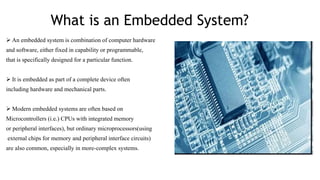
 An embedded system is combination of computer hardware
and software, either fixed in capability or programmable,
that is specifically designed for a particular function.
 It is embedded as part of a complete device often
including hardware and mechanical parts.
 Modern embedded systems are often based on
Microcontrollers (i.e.) CPUs with integrated memory
or peripheral interfaces), but ordinary microprocessors(using
external chips for memory and peripheral interface circuits)
are also common, especially in more-complex systems.
WHAT IS INSIDE THE EMBEDDED SYSTEM?
HARDWARE
oCPU
oMEMORY
oI/O DEVICES
SOFTWARE
oAPPLICATION
oOS
oDEVICE DRIVERS
HARDWARE ARCHITECTURE OF AN EMBEDDED SYSTEM
Examples of Embedded Systems
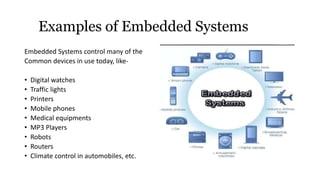
Embedded Systems control many of the
Common devices in use today, like-
• Digital watches
• Traffic lights
• Printers
• Mobile phones
• Medical equipments
• MP3 Players
• Robots
• Routers
• Climate control in automobiles, etc.
CLASSIFICATION OF EMBEDDED SYSTEMS
TYPES OF EMBEDDED
SYSTEMS
BASED ON PERFORMANCE AND
FUNCTIONAL REQUIREMENTS
BASED ON PERFORMANCE OF
MICRO CONTROLLER
REAL
TIME
STAND
ALONE
NETWORKED SMALL SCALE MEDIUM SCALE SOPHISTICATED
BASED ON PERFORMANCE AND FUNCTIONAL REQUIREMENT
1.REAL TIME EMBEDDED SYSTEM
Real-time embedded systems are defined as those systems in which the correctness of
the system depends not only on the logical result of computation, but also on the time at
which the results are produced.
Hard real-time systems (e.g.Avionic control).
Firm real-time systems(e.g.,Banking).
Soft real-time systems(e.g.,Video on demand).
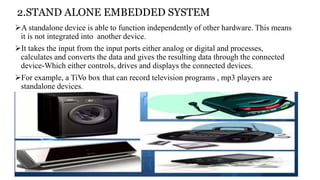
2.STAND ALONE EMBEDDED SYSTEM
A standalone device is able to function independently of other hardware. This means
it is not integrated into another device.
It takes the input from the input ports either analog or digital and processes,
calculates and converts the data and gives the resulting data through the connected
device-Which either controls, drives and displays the connected devices.
For example, a TiVo box that can record television programs , mp3 players are
standalone devices.
3.NETWORK EMBEDDED SYSTEM
These types of embedded systems are related to a network to access the
resources.
The connected network can be LAN, WAN or the internet. The
connection can be any wired or wireless. This type of embedded system
is the fastest growing area in embedded system applications.
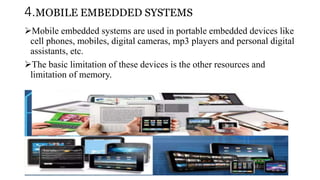
4.MOBILE EMBEDDED SYSTEMS
Mobile embedded systems are used in portable embedded devices like
cell phones, mobiles, digital cameras, mp3 players and personal digital
assistants, etc.
The basic limitation of these devices is the other resources and
limitation of memory.
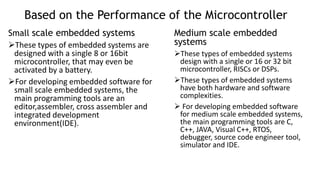
Based on the Performance of the Microcontroller
Small scale embedded systems
These types of embedded systems are
designed with a single 8 or 16bit
microcontroller, that may even be
activated by a battery.
For developing embedded software for
small scale embedded systems, the
main programming tools are an
editor,assembler, cross assembler and
integrated development
environment(IDE).
Medium scale embedded
systems
These types of embedded systems
design with a single or 16 or 32 bit
microcontroller, RISCs or DSPs.
These types of embedded systems
have both hardware and software
complexities.
 For developing embedded software
for medium scale embedded systems,
the main programming tools are C,
C++, JAVA, Visual C++, RTOS,
debugger, source code engineer tool,
simulator and IDE.
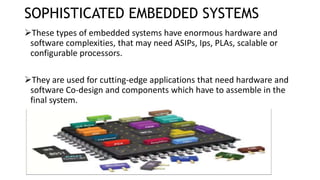
SOPHISTICATED EMBEDDED SYSTEMS
These types of embedded systems have enormous hardware and
software complexities, that may need ASIPs, Ips, PLAs, scalable or
configurable processors.
They are used for cutting-edge applications that need hardware and
software Co-design and components which have to assemble in the
final system.
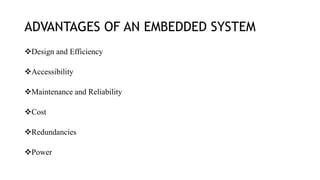
ADVANTAGES OF AN EMBEDDED SYSTEM
Design and Efficiency
Accessibility
Maintenance and Reliability
Cost
Redundancies
Power
DISADVANTAGES OF AN EMBEDDED SYSTEM
• Issue of Scalability
• Limitation of Hardware
• Difficult to change Configuration and Features
• Applied for a Specific Purpose
Applications
• Household appliances.
• Audio player.
• Cellular telephones.
• Engine controller in automobiles.
• Calculators.
• Videogames.
• Aircrafts.
• Medical equipments.
• Defense systems, etc.
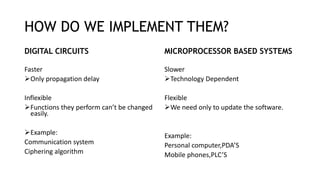
HOW DO WE IMPLEMENT THEM?
DIGITAL CIRCUITS
Faster
Only propagation delay
Inflexible
Functions they perform can’t be changed
easily.
Example:
Communication system
Ciphering algorithm
MICROPROCESSOR BASED SYSTEMS
Slower
Technology Dependent
Flexible
We need only to update the software.
Example:
Personal computer,PDA’S
Mobile phones,PLC’S
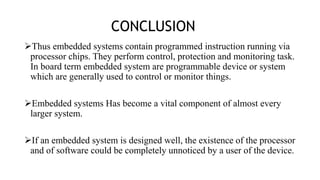
CONCLUSION
Thus embedded systems contain programmed instruction running via
processor chips. They perform control, protection and monitoring task.
In board term embedded system are programmable device or system
which are generally used to control or monitor things.
Embedded systems Has become a vital component of almost every
larger system.
If an embedded system is designed well, the existence of the processor
and of software could be completely unnoticed by a user of the device.
EMBEDDED SYSTEM-2.pptx

EMBEDDED SYSTEM-2.pptx

  • 1.
  • 2.
    CONTENT WHAT IS EMBEDDEDSYSTEM CLASSIFICATION OF EMBEDDED SYSTEM APPLICATIONS OF EMBEDDED SYSTEM HOW DO WE IMPLEMENT THEM
  • 3.
    What is anEmbedded System?  An embedded system is combination of computer hardware and software, either fixed in capability or programmable, that is specifically designed for a particular function.  It is embedded as part of a complete device often including hardware and mechanical parts.  Modern embedded systems are often based on Microcontrollers (i.e.) CPUs with integrated memory or peripheral interfaces), but ordinary microprocessors(using external chips for memory and peripheral interface circuits) are also common, especially in more-complex systems.
  • 4.
    WHAT IS INSIDETHE EMBEDDED SYSTEM? HARDWARE oCPU oMEMORY oI/O DEVICES SOFTWARE oAPPLICATION oOS oDEVICE DRIVERS
  • 5.
    HARDWARE ARCHITECTURE OFAN EMBEDDED SYSTEM
  • 6.
    Examples of EmbeddedSystems Embedded Systems control many of the Common devices in use today, like- • Digital watches • Traffic lights • Printers • Mobile phones • Medical equipments • MP3 Players • Robots • Routers • Climate control in automobiles, etc.
  • 7.
    CLASSIFICATION OF EMBEDDEDSYSTEMS TYPES OF EMBEDDED SYSTEMS BASED ON PERFORMANCE AND FUNCTIONAL REQUIREMENTS BASED ON PERFORMANCE OF MICRO CONTROLLER REAL TIME STAND ALONE NETWORKED SMALL SCALE MEDIUM SCALE SOPHISTICATED
  • 8.
    BASED ON PERFORMANCEAND FUNCTIONAL REQUIREMENT 1.REAL TIME EMBEDDED SYSTEM Real-time embedded systems are defined as those systems in which the correctness of the system depends not only on the logical result of computation, but also on the time at which the results are produced. Hard real-time systems (e.g.Avionic control). Firm real-time systems(e.g.,Banking). Soft real-time systems(e.g.,Video on demand).
  • 9.
    2.STAND ALONE EMBEDDEDSYSTEM A standalone device is able to function independently of other hardware. This means it is not integrated into another device. It takes the input from the input ports either analog or digital and processes, calculates and converts the data and gives the resulting data through the connected device-Which either controls, drives and displays the connected devices. For example, a TiVo box that can record television programs , mp3 players are standalone devices.
  • 10.
    3.NETWORK EMBEDDED SYSTEM Thesetypes of embedded systems are related to a network to access the resources. The connected network can be LAN, WAN or the internet. The connection can be any wired or wireless. This type of embedded system is the fastest growing area in embedded system applications.
  • 11.
    4.MOBILE EMBEDDED SYSTEMS Mobileembedded systems are used in portable embedded devices like cell phones, mobiles, digital cameras, mp3 players and personal digital assistants, etc. The basic limitation of these devices is the other resources and limitation of memory.
  • 12.
    Based on thePerformance of the Microcontroller Small scale embedded systems These types of embedded systems are designed with a single 8 or 16bit microcontroller, that may even be activated by a battery. For developing embedded software for small scale embedded systems, the main programming tools are an editor,assembler, cross assembler and integrated development environment(IDE). Medium scale embedded systems These types of embedded systems design with a single or 16 or 32 bit microcontroller, RISCs or DSPs. These types of embedded systems have both hardware and software complexities.  For developing embedded software for medium scale embedded systems, the main programming tools are C, C++, JAVA, Visual C++, RTOS, debugger, source code engineer tool, simulator and IDE.
  • 13.
    SOPHISTICATED EMBEDDED SYSTEMS Thesetypes of embedded systems have enormous hardware and software complexities, that may need ASIPs, Ips, PLAs, scalable or configurable processors. They are used for cutting-edge applications that need hardware and software Co-design and components which have to assemble in the final system.
  • 14.
    ADVANTAGES OF ANEMBEDDED SYSTEM Design and Efficiency Accessibility Maintenance and Reliability Cost Redundancies Power
  • 15.
    DISADVANTAGES OF ANEMBEDDED SYSTEM • Issue of Scalability • Limitation of Hardware • Difficult to change Configuration and Features • Applied for a Specific Purpose
  • 16.
    Applications • Household appliances. •Audio player. • Cellular telephones. • Engine controller in automobiles. • Calculators. • Videogames. • Aircrafts. • Medical equipments. • Defense systems, etc.
  • 17.
    HOW DO WEIMPLEMENT THEM? DIGITAL CIRCUITS Faster Only propagation delay Inflexible Functions they perform can’t be changed easily. Example: Communication system Ciphering algorithm MICROPROCESSOR BASED SYSTEMS Slower Technology Dependent Flexible We need only to update the software. Example: Personal computer,PDA’S Mobile phones,PLC’S
  • 18.
    CONCLUSION Thus embedded systemscontain programmed instruction running via processor chips. They perform control, protection and monitoring task. In board term embedded system are programmable device or system which are generally used to control or monitor things. Embedded systems Has become a vital component of almost every larger system. If an embedded system is designed well, the existence of the processor and of software could be completely unnoticed by a user of the device.