Session 4: Cutting edge cloud
technologies: 5G, Cloud and IoT
SERGIO TAKEO KOFUJI, PROF. EPUSP
CLOUDSCAPE 2016, PORTO ALEGRE BR
S.T. KOFUJI CLOUDSCAPE 2016 PORTO ALEGRE BR
Session 4: Cutting edge cloud
technologies: 5G, Cloud and IoT,
Fog computing
The European Commission, in a recent communication (April 19th), has identified
5G and Internet of Things (IoT) amongst the ICT standardization priorities for the
Digital Single Market (DSM). This session will discuss the emergence of the
mobile edge computing paradigm to reduce the latency for processing near the
source large quantities of data and the need of the emerging 5G technology to
satisfy the requirements of different verticals. Mobile Edge Clouds have the
potential to provide an enormous amount of resources, but it raises several
research challenges related to the resilience, security, data portability and usage
due to the presence of multiple trusted domains, as well as energy consumption
of battery powered devices. Large and centralized clouds have been deployed and
have shown how this paradigm can greatly improve performance and flexibility
while reducing costs. However, there are many issues requiring solutions that are
user and context aware, dynamic, and with the capability to handle
heterogeneous demands and systems. This is a challenge triggered by the
Internet of Things (IoT) scenario, which strongly requires cloud-based solutions
that can be dynamically located and managed, on demand and with self-
organization capabilities to serve the purposes of different verticals.
S.T. KOFUJI CLOUDSCAPE 2016 PORTO ALEGRE BR
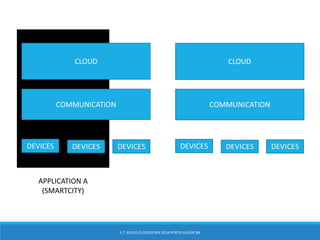
CLOUD
COMMUNICATION
DEVICES
APPLICATION A
(SMARTCITY)
Cloud, Fog, Edge
 Reduce Data Communication and Data Processing Demands
Data Storage and Data Processing Outside the Cloud
Network
Devices
Proposals/Solutions
Cisco
MEC - The European Telecommunications Standards Institute ETSI launched an
industry specification for Mobile Edge Computing (MEC) in Sept 2014
A team at Carnegie Mellon University (CMU) has developed Cloudlets
Microsoft Research (Victor Bahl): micro datacenter in AZURE
Etc.
S.T. KOFUJI CLOUDSCAPE 2016 PORTO ALEGRE BR
Some Fog Computing Related
Concepts
Mobile Cloud Computing (MCC): data storage and data processing
happen outside mobile device
Mobile Edge-Computing (MEC): cloud server running at the edge of a
mobile network and performing specific tasks that could not be
accomplished with traditional network infrastructure
FC >> MCC + MEC
S.T. KOFUJI CLOUDSCAPE 2016 PORTO ALEGRE BR
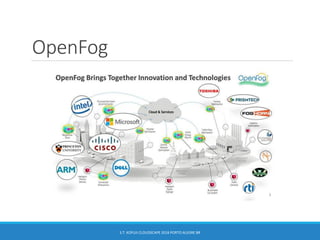
OpenFog
S.T. KOFUJI CLOUDSCAPE 2016 PORTO ALEGRE BR
Question 1
5G and fog computing are meant to impact the vertical industries and
contribute to provide new or enhanced services. Do you think that the
European and Brazilian economy and technology infrastructure is ready
to integrate such solutions? What are the main barriers to be addressed
by 2020 and opportunities?
Yes, the economic challenges can be addressed in European and
Brazilian market. It means that operators are deploying technologies
oriented to evolution 4.5G and 5G paths. Mainly the key infrastructure
barriers are related to backhaul side, it means that we should have last
mile fiber solution to carry the baseband protocols to radio units with
low latency and delays between the edge and antennas.
S.T. KOFUJI CLOUDSCAPE 2016 PORTO ALEGRE BR
Question 2
Pushing computation and storage to the edge addresses potential
infrastructure and connectivity limitations of cloud-only IoT
architectures. Trust, service and application orchestration, resilience, and
analytics still remain important challenges. In your opinion, what should
be the role of the industry in driving academia to investigate new
innovative solutions to address these challenges?
It is clear that the main role is to work in a Cloud environment. The
integration between the IoT system architecture should be ready for Big
Data Analytics and simple to integrate with third party systems. It
means that orchestration part should be capable to enable network
level by easily integrated and managed by client system (third party).
S.T. KOFUJI CLOUDSCAPE 2016 PORTO ALEGRE BR
Question 3
The EU sees 5G as the main driver for the Digitalization of industry and
society. In your opinion, what are the main security challenges? Since the
5G standardization are looking for a system capable to slice network in
different services oriented to different customer’s needs, the self-service
part that open the structure to outdoor world it is a key part of the
system that can provide security challenges. Keep the system protected
can be not only trough operators’ door but also trough customer door,
since customer will be able to adjust the network as requested.
The interoperability between 3G, 4G and 5G will be also a challenge, it
means that from terminal side we also have open door to be addressed
and solved.
S.T. KOFUJI CLOUDSCAPE 2016 PORTO ALEGRE BR
Question 4
How do you think 5G will change security and trust relationships?
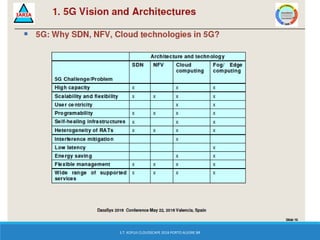
In 5G we have in place the cloud structure as new IT technologies,
SDN/NFV those solution will require different security changes. Privacy
will be a concern since we will have different kinds of end services, such
as, smarthome, health care, smart transportation, etc.
S.T. KOFUJI CLOUDSCAPE 2016 PORTO ALEGRE BR
Question 5
Standardization helps towards interoperable solutions. How is Brazil
cooperating with Europe on 5G and how is contributing to
standardization through 5G America?
S.T. KOFUJI CLOUDSCAPE 2016 PORTO ALEGRE BR
Question 6
The standardization landscape is very fragmented with many SDOs and
standards proposed in cloud and even more in IoT. What should be role
of policy makers and industry to avoid a potential fragmented market
hindering interoperability?
At this moment industry is working to build different alliances to speed
up the 5G standardization, this also include research and development
phase and tests.
For standardization is health to have a single and unified SDO to enable
the standards and discussion on 5G.
Usually, 3GPPP is a key group to lead the 4G standards and can keep or
adjust to provide the guidance in 5G.
S.T. KOFUJI CLOUDSCAPE 2016 PORTO ALEGRE BR
Adittional Slides
S.T. KOFUJI CLOUDSCAPE 2016 PORTO ALEGRE BR
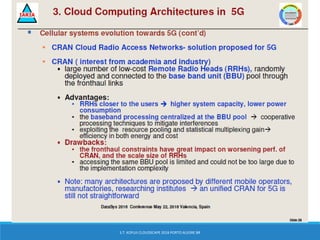
C-RAN or Cloud-RAN
It applies recent Data Centre Network technology to allow a low cost,
high reliability, low latency and high bandwidth interconnect network in
the BBU pool. It utilises open platforms and real-time virtualisation
technology rooted in cloud computing to achieve dynamic shared
resource allocation and support of multi-vendor, multi-technology
environments.
China Mobile Research Institute: C-RAN
Korea: CCC (Cloud Computing Center)
S.T. KOFUJI CLOUDSCAPE 2016 PORTO ALEGRE BR

Cloud, Fog & Edge Computing

  • 1.
    Session 4: Cuttingedge cloud technologies: 5G, Cloud and IoT SERGIO TAKEO KOFUJI, PROF. EPUSP CLOUDSCAPE 2016, PORTO ALEGRE BR S.T. KOFUJI CLOUDSCAPE 2016 PORTO ALEGRE BR
  • 2.
    Session 4: Cuttingedge cloud technologies: 5G, Cloud and IoT, Fog computing The European Commission, in a recent communication (April 19th), has identified 5G and Internet of Things (IoT) amongst the ICT standardization priorities for the Digital Single Market (DSM). This session will discuss the emergence of the mobile edge computing paradigm to reduce the latency for processing near the source large quantities of data and the need of the emerging 5G technology to satisfy the requirements of different verticals. Mobile Edge Clouds have the potential to provide an enormous amount of resources, but it raises several research challenges related to the resilience, security, data portability and usage due to the presence of multiple trusted domains, as well as energy consumption of battery powered devices. Large and centralized clouds have been deployed and have shown how this paradigm can greatly improve performance and flexibility while reducing costs. However, there are many issues requiring solutions that are user and context aware, dynamic, and with the capability to handle heterogeneous demands and systems. This is a challenge triggered by the Internet of Things (IoT) scenario, which strongly requires cloud-based solutions that can be dynamically located and managed, on demand and with self- organization capabilities to serve the purposes of different verticals. S.T. KOFUJI CLOUDSCAPE 2016 PORTO ALEGRE BR
  • 3.
    S.T. KOFUJI CLOUDSCAPE2016 PORTO ALEGRE BR CLOUD COMMUNICATION DEVICES APPLICATION A (SMARTCITY)
  • 4.
    Cloud, Fog, Edge Reduce Data Communication and Data Processing Demands Data Storage and Data Processing Outside the Cloud Network Devices Proposals/Solutions Cisco MEC - The European Telecommunications Standards Institute ETSI launched an industry specification for Mobile Edge Computing (MEC) in Sept 2014 A team at Carnegie Mellon University (CMU) has developed Cloudlets Microsoft Research (Victor Bahl): micro datacenter in AZURE Etc. S.T. KOFUJI CLOUDSCAPE 2016 PORTO ALEGRE BR
  • 5.
    Some Fog ComputingRelated Concepts Mobile Cloud Computing (MCC): data storage and data processing happen outside mobile device Mobile Edge-Computing (MEC): cloud server running at the edge of a mobile network and performing specific tasks that could not be accomplished with traditional network infrastructure FC >> MCC + MEC S.T. KOFUJI CLOUDSCAPE 2016 PORTO ALEGRE BR
  • 6.
    OpenFog S.T. KOFUJI CLOUDSCAPE2016 PORTO ALEGRE BR
  • 7.
    Question 1 5G andfog computing are meant to impact the vertical industries and contribute to provide new or enhanced services. Do you think that the European and Brazilian economy and technology infrastructure is ready to integrate such solutions? What are the main barriers to be addressed by 2020 and opportunities? Yes, the economic challenges can be addressed in European and Brazilian market. It means that operators are deploying technologies oriented to evolution 4.5G and 5G paths. Mainly the key infrastructure barriers are related to backhaul side, it means that we should have last mile fiber solution to carry the baseband protocols to radio units with low latency and delays between the edge and antennas. S.T. KOFUJI CLOUDSCAPE 2016 PORTO ALEGRE BR
  • 8.
    Question 2 Pushing computationand storage to the edge addresses potential infrastructure and connectivity limitations of cloud-only IoT architectures. Trust, service and application orchestration, resilience, and analytics still remain important challenges. In your opinion, what should be the role of the industry in driving academia to investigate new innovative solutions to address these challenges? It is clear that the main role is to work in a Cloud environment. The integration between the IoT system architecture should be ready for Big Data Analytics and simple to integrate with third party systems. It means that orchestration part should be capable to enable network level by easily integrated and managed by client system (third party). S.T. KOFUJI CLOUDSCAPE 2016 PORTO ALEGRE BR
  • 9.
    Question 3 The EUsees 5G as the main driver for the Digitalization of industry and society. In your opinion, what are the main security challenges? Since the 5G standardization are looking for a system capable to slice network in different services oriented to different customer’s needs, the self-service part that open the structure to outdoor world it is a key part of the system that can provide security challenges. Keep the system protected can be not only trough operators’ door but also trough customer door, since customer will be able to adjust the network as requested. The interoperability between 3G, 4G and 5G will be also a challenge, it means that from terminal side we also have open door to be addressed and solved. S.T. KOFUJI CLOUDSCAPE 2016 PORTO ALEGRE BR
  • 10.
    Question 4 How doyou think 5G will change security and trust relationships? In 5G we have in place the cloud structure as new IT technologies, SDN/NFV those solution will require different security changes. Privacy will be a concern since we will have different kinds of end services, such as, smarthome, health care, smart transportation, etc. S.T. KOFUJI CLOUDSCAPE 2016 PORTO ALEGRE BR
  • 11.
    Question 5 Standardization helpstowards interoperable solutions. How is Brazil cooperating with Europe on 5G and how is contributing to standardization through 5G America? S.T. KOFUJI CLOUDSCAPE 2016 PORTO ALEGRE BR
  • 12.
    Question 6 The standardizationlandscape is very fragmented with many SDOs and standards proposed in cloud and even more in IoT. What should be role of policy makers and industry to avoid a potential fragmented market hindering interoperability? At this moment industry is working to build different alliances to speed up the 5G standardization, this also include research and development phase and tests. For standardization is health to have a single and unified SDO to enable the standards and discussion on 5G. Usually, 3GPPP is a key group to lead the 4G standards and can keep or adjust to provide the guidance in 5G. S.T. KOFUJI CLOUDSCAPE 2016 PORTO ALEGRE BR
  • 13.
    Adittional Slides S.T. KOFUJICLOUDSCAPE 2016 PORTO ALEGRE BR
  • 14.
    S.T. KOFUJI CLOUDSCAPE2016 PORTO ALEGRE BR
  • 15.
    S.T. KOFUJI CLOUDSCAPE2016 PORTO ALEGRE BR
  • 16.
    S.T. KOFUJI CLOUDSCAPE2016 PORTO ALEGRE BR
  • 17.
    S.T. KOFUJI CLOUDSCAPE2016 PORTO ALEGRE BR
  • 18.
    S.T. KOFUJI CLOUDSCAPE2016 PORTO ALEGRE BR
  • 19.
    S.T. KOFUJI CLOUDSCAPE2016 PORTO ALEGRE BR
  • 20.
    S.T. KOFUJI CLOUDSCAPE2016 PORTO ALEGRE BR
  • 21.
    C-RAN or Cloud-RAN Itapplies recent Data Centre Network technology to allow a low cost, high reliability, low latency and high bandwidth interconnect network in the BBU pool. It utilises open platforms and real-time virtualisation technology rooted in cloud computing to achieve dynamic shared resource allocation and support of multi-vendor, multi-technology environments. China Mobile Research Institute: C-RAN Korea: CCC (Cloud Computing Center) S.T. KOFUJI CLOUDSCAPE 2016 PORTO ALEGRE BR
  • 22.
    S.T. KOFUJI CLOUDSCAPE2016 PORTO ALEGRE BR
  • 23.
    S.T. KOFUJI CLOUDSCAPE2016 PORTO ALEGRE BR
  • 24.
    S.T. KOFUJI CLOUDSCAPE2016 PORTO ALEGRE BR
  • 25.
    S.T. KOFUJI CLOUDSCAPE2016 PORTO ALEGRE BR
  • 26.
    S.T. KOFUJI CLOUDSCAPE2016 PORTO ALEGRE BR