HIGH PERFORMANCE
COMPUTERS
INTRODUCTION
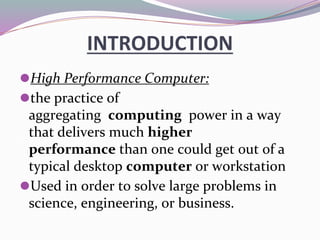
⚫High Performance Computer:
⚫the practice of
aggregating computing power in a way
that delivers much higher
performance than one could get out of a
typical desktop computer or workstation
⚫Used in order to solve large problems in
science, engineering, or business.
INTRODUCTION
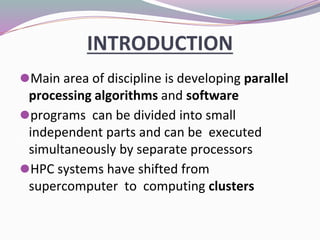
⚫Main area of discipline is developing parallel
processing algorithms and software
⚫programs can be divided into small
independent parts and can be executed
simultaneously by separate processors
⚫HPC systems have shifted from
supercomputer to computing clusters
APPLICATIONS
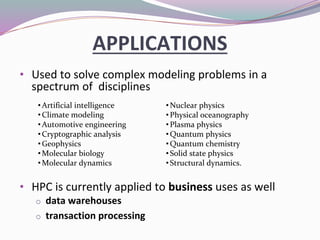
• Used to solve complex modeling problems in a
spectrum of disciplines
• HPC is currently applied to business uses as well
o data warehouses
o transaction processing
•Nuclear physics
•Physical oceanography
•Plasma physics
•Quantum physics
•Quantum chemistry
•Solid state physics
•Structural dynamics.
•Artificial intelligence
•Climate modeling
•Automotive engineering
•Cryptographic analysis
•Geophysics
•Molecular biology
•Molecular dynamics
CLUSTERS
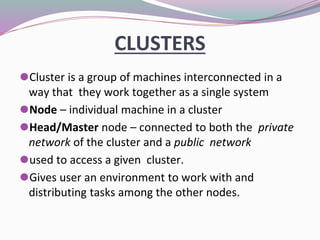
⚫Cluster is a group of machines interconnected in a
way that they work together as a single system
⚫Node – individual machine in a cluster
⚫Head/Master node – connected to both the private
network of the cluster and a public network
⚫used to access a given cluster.
⚫Gives user an environment to work with and
distributing tasks among the other nodes.
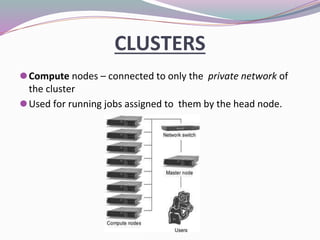
⚫Compute nodes – connected to only the private network of
the cluster
⚫Used for running jobs assigned to them by the head node.
CLUSTERS
⚫Reduced Cost
❖ Single HPC can compute complex problems requiring
lesser no. of personnels and offers greater accuracy.
⚫ Processing Power
❖ The parallel processing power of a high‐performance
cluster can, in many cases, prove more cost effective
than a mainframe with similar power.
⚫ Scalability
❖ mainframe computers have a fixed processing capacity
❖ computer clusters can be expanded as per requirements
by adding additional nodes to the network
BENEFITS OF CLUSTERS
⚫Improved Network Technology
❖In clusters, computers are typically connected via a single
virtual local area network (VLAN)
❖Information can be passed throughout these networks
with very little lag, ensuring that data doesn’t bottleneck
between nodes.
⚫Availability
❖When a mainframe computer fails, the entire system fails.
❖if a node in a computer cluster fails, its operations can be
simply transferred to another node within the cluster,
ensuring that there is no interruption in service.
BENEFITS OF CLUSTERS
NEED FOR HPC
⚫Perform a high number of operations per
seconds
⚫Complete a time‐consuming operation in less
time
⚫Save on Operational Costs.
⚫Complete an operation under a tight deadline.
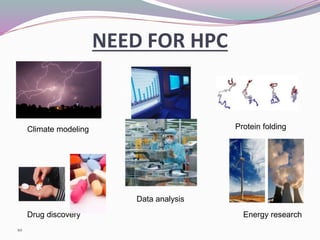
NEED FOR HPC
Climate modeling Protein folding
Drug discovery Energy research
Data analysis
10
DRAWBACKS
⚫Very expensive
⚫HPC use lot of electricity
⚫Can’t be transported easily
⚫Virus and malwares can spread via computer network
⚫Security aspects
⚫Can heat up randomly – making processors
unreliable.
NEED FOR PARALLEL COMPUTING
⚫Real world data needs more dynamic simulation and
modelling
⚫Provides concurrency and saves time and money
⚫Complex, large datasets, and their management can
be organized
⚫Ensures the effective utilization of the resources
⚫Hardware is guaranteed to be used effectively
PARALLEL COMPUTING
⚫Form of computation in which many calculations are
carried out simultaneously
⚫A problem is broken down into discrete parts that
can be solved concurrently.
⚫Instructions from each part execute simultaneously
on different processors.
⚫An overall control or coordination mechanism is
employed.
⚫Most super computers employ parallel computing
principles to operate.
ADVANTAGES OF PARALLEL
COMPUTING
⚫Saves time, allowing the execution of applications in a
shorter wall-clock time
⚫Solve Larger Problems in a short point of time
⚫Can do many things simultaneously by using multiple
computing resources
⚫It has massive data storage and quick data computations
⚫Main advantages are total performance and total memory
⚫it is impractical to implement real-time systems using
serial computing
DISADVANTAGES OF PARALLEL
COMPUTING
⚫There are different models of parallel computing and
each model is programmed in different way.
⚫Power consumption is huge by these computing.
⚫Better cooling technologies are required in case of
clusters.
⚫It is hard to implement and to debug.
DIFFERENCES BETWEEN
⚫NORMAL COMPUTERS
⚫Single Mainframe
⚫Multi-Core (CPU)
⚫Doesn’t communicate
with other systems even
if present within a
network (to complete a
task)
⚫HPC
⚫Combinations of single
mainframe
⚫Many-Core (GPU)
⚫Communicates with
every other node within
it’s private network to
complete any given task.
DIFFERENCES BETWEEN
⚫Supercomputer
⚫Built for a specific
application
⚫ Supercomputers are
designed for continuous
usage with production
applications and are
most economical for
continuous-production
users.
⚫HPC
⚫Is modular
⚫provide capacity cluster
technologies that are
economical at delivering
compute capacity for
irregular workloads.
REFERENCE
⚫https://portal.ictp.it/icts/hpc-appointments/HPC-
Appointment-3.pdf
⚫https://www.geekboots.com/story/parallel-
computing-and-its-advantage-and-disadvantage
THANK YOU ☺

High Performance Computer

  • 1.
  • 2.
    INTRODUCTION ⚫High Performance Computer: ⚫thepractice of aggregating computing power in a way that delivers much higher performance than one could get out of a typical desktop computer or workstation ⚫Used in order to solve large problems in science, engineering, or business.
  • 3.
    INTRODUCTION ⚫Main area ofdiscipline is developing parallel processing algorithms and software ⚫programs can be divided into small independent parts and can be executed simultaneously by separate processors ⚫HPC systems have shifted from supercomputer to computing clusters
  • 4.
    APPLICATIONS • Used tosolve complex modeling problems in a spectrum of disciplines • HPC is currently applied to business uses as well o data warehouses o transaction processing •Nuclear physics •Physical oceanography •Plasma physics •Quantum physics •Quantum chemistry •Solid state physics •Structural dynamics. •Artificial intelligence •Climate modeling •Automotive engineering •Cryptographic analysis •Geophysics •Molecular biology •Molecular dynamics
  • 5.
    CLUSTERS ⚫Cluster is agroup of machines interconnected in a way that they work together as a single system ⚫Node – individual machine in a cluster ⚫Head/Master node – connected to both the private network of the cluster and a public network ⚫used to access a given cluster. ⚫Gives user an environment to work with and distributing tasks among the other nodes.
  • 6.
    ⚫Compute nodes –connected to only the private network of the cluster ⚫Used for running jobs assigned to them by the head node. CLUSTERS
  • 7.
    ⚫Reduced Cost ❖ SingleHPC can compute complex problems requiring lesser no. of personnels and offers greater accuracy. ⚫ Processing Power ❖ The parallel processing power of a high‐performance cluster can, in many cases, prove more cost effective than a mainframe with similar power. ⚫ Scalability ❖ mainframe computers have a fixed processing capacity ❖ computer clusters can be expanded as per requirements by adding additional nodes to the network BENEFITS OF CLUSTERS
  • 8.
    ⚫Improved Network Technology ❖Inclusters, computers are typically connected via a single virtual local area network (VLAN) ❖Information can be passed throughout these networks with very little lag, ensuring that data doesn’t bottleneck between nodes. ⚫Availability ❖When a mainframe computer fails, the entire system fails. ❖if a node in a computer cluster fails, its operations can be simply transferred to another node within the cluster, ensuring that there is no interruption in service. BENEFITS OF CLUSTERS
  • 9.
    NEED FOR HPC ⚫Performa high number of operations per seconds ⚫Complete a time‐consuming operation in less time ⚫Save on Operational Costs. ⚫Complete an operation under a tight deadline.
  • 10.
    NEED FOR HPC Climatemodeling Protein folding Drug discovery Energy research Data analysis 10
  • 11.
    DRAWBACKS ⚫Very expensive ⚫HPC uselot of electricity ⚫Can’t be transported easily ⚫Virus and malwares can spread via computer network ⚫Security aspects ⚫Can heat up randomly – making processors unreliable.
  • 12.
    NEED FOR PARALLELCOMPUTING ⚫Real world data needs more dynamic simulation and modelling ⚫Provides concurrency and saves time and money ⚫Complex, large datasets, and their management can be organized ⚫Ensures the effective utilization of the resources ⚫Hardware is guaranteed to be used effectively
  • 13.
    PARALLEL COMPUTING ⚫Form ofcomputation in which many calculations are carried out simultaneously ⚫A problem is broken down into discrete parts that can be solved concurrently. ⚫Instructions from each part execute simultaneously on different processors. ⚫An overall control or coordination mechanism is employed. ⚫Most super computers employ parallel computing principles to operate.
  • 14.
    ADVANTAGES OF PARALLEL COMPUTING ⚫Savestime, allowing the execution of applications in a shorter wall-clock time ⚫Solve Larger Problems in a short point of time ⚫Can do many things simultaneously by using multiple computing resources ⚫It has massive data storage and quick data computations ⚫Main advantages are total performance and total memory ⚫it is impractical to implement real-time systems using serial computing
  • 15.
    DISADVANTAGES OF PARALLEL COMPUTING ⚫Thereare different models of parallel computing and each model is programmed in different way. ⚫Power consumption is huge by these computing. ⚫Better cooling technologies are required in case of clusters. ⚫It is hard to implement and to debug.
  • 16.
    DIFFERENCES BETWEEN ⚫NORMAL COMPUTERS ⚫SingleMainframe ⚫Multi-Core (CPU) ⚫Doesn’t communicate with other systems even if present within a network (to complete a task) ⚫HPC ⚫Combinations of single mainframe ⚫Many-Core (GPU) ⚫Communicates with every other node within it’s private network to complete any given task.
  • 17.
    DIFFERENCES BETWEEN ⚫Supercomputer ⚫Built fora specific application ⚫ Supercomputers are designed for continuous usage with production applications and are most economical for continuous-production users. ⚫HPC ⚫Is modular ⚫provide capacity cluster technologies that are economical at delivering compute capacity for irregular workloads.
  • 18.
  • 19.