Email Investigation
Presented By
Animesh Shaw
(Psycho_Coder)
Digital Evidence Analyst Trainee
Discussion Objectives
• Working Process of Email
• Explain the role of e-mail in investigations
• Describe client and server roles in e-mail
• Describe tasks in investigating e-mail crimes and
violations
• Explain the use of e-mail server logs
• Describe some available e-mail computer forensics
tools
HOW EMAIL WORKS
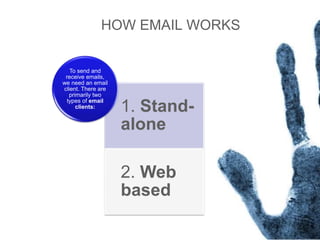
HOW EMAIL WORKS
1. Stand-
alone
2. Web
based
To send and
receive emails,
we need an email
client. There are
primarily two
types of email
clients:
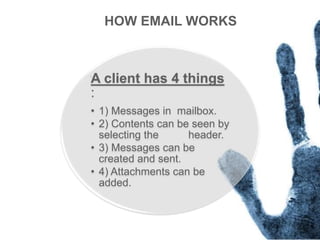
A client has 4 things
:
• 1) Messages in mailbox.
• 2) Contents can be seen by
selecting the header.
• 3) Messages can be
created and sent.
• 4) Attachments can be
added.
HOW EMAIL WORKS
HOW EMAIL WORKS
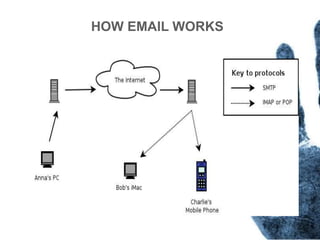
KEY PROTOCOLS
HOW EMAIL WORKS
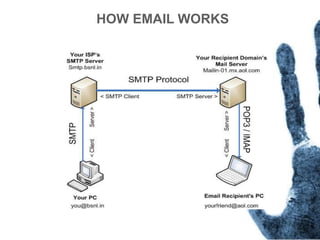
PROCEDURE OF EMAIL
TRANSMISSION
HOW EMAIL WORKS
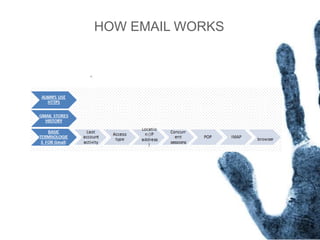
BASIC TERMS
Exploring the Role of E-mail in
Investigations
• With the increase in e-mail scams and fraud
attempts with phishing or spoofing
– Investigators need to know how to examine and
interpret the unique content of e-mail messages
• Phishing e-mails are in HTML format
– Which allows creating links to text on a Web page
• One of the most noteworthy e-mail scams was 419,
or the Nigerian Scam
• Spoofing e-mail can be used to commit fraud
Exploring the Roles of the Client and
Server in E-mail
• Send and receive e-mail in two environments
– Internet
– Controlled LAN, MAN, or WAN
• Client/server architecture
– Server OS and e-mail software differs from those on
the client side
• Protected accounts
– Require usernames and passwords
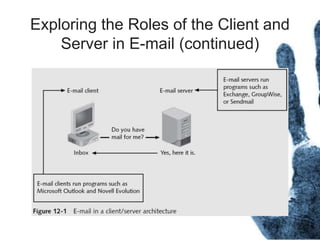
Exploring the Roles of the Client and
Server in E-mail (continued)
12
Exploring the Roles of the Client and
Server in E-mail (continued)
• Name conventions
– Corporate: john.smith@somecompany.com
– Public: whatever@hotmail.com
– Everything after @ belongs to the domain name
• Tracing corporate e-mails is easier
– Because accounts use standard names the
administrator establishes
Investigating E-mail Crimes and
Violations
• Similar to other types of investigations
• Goals
– Find who is behind the crime
– Collect the evidence
– Present your findings
– Build a case
Investigating E-mail Crimes and
Violations (continued)
• Depend on the city, state, or country
– Example: spam
– Always consult with an attorney
• Becoming commonplace
• Examples of crimes involving e-mails
– Narcotics trafficking
– Extortion
– Sexual harassment
– Child abductions and pornography
Examining E-mail Messages
• Access victim’s computer to recover the evidence
• Using the victim’s e-mail client
– Find and copy evidence in the e-mail
– Access protected or encrypted material
– Print e-mails
• Guide victim on the phone
– Open and copy e-mail including headers
• Sometimes you will deal with deleted e-mails
Examining E-mail Messages
(continued)
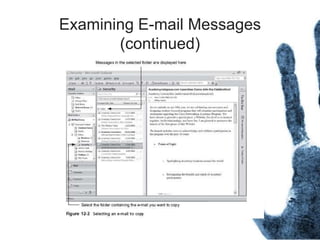
• Copying an e-mail message
– Before you start an e-mail investigation
• You need to copy and print the e-mail involved in the
crime or policy violation
– You might also want to forward the message as an
attachment to another e-mail address
• With many GUI e-mail programs, you can copy an
e-mail by dragging it to a storage medium
– Or by saving it in a different location
Examining E-mail Messages
(continued)
Viewing E-mail Headers
• Learn how to find e-mail headers
– GUI clients
– Command-line clients
– Web-based clients
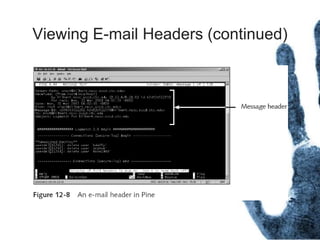
• After you open e-mail headers, copy and paste
them into a text document
– So that you can read them with a text editor
• Headers contain useful information
– Unique identifying numbers, IP address of sending
server, and sending time
Viewing E-mail Headers (continued)
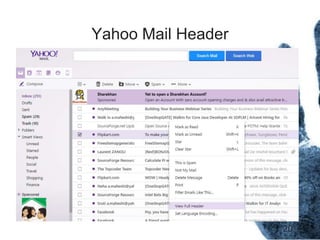
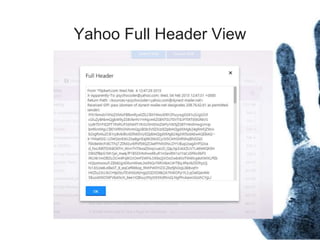
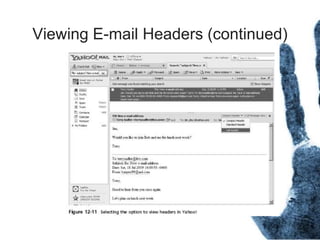
• Yahoo (Client)
– Click Mail Options
– Click General Preferences and Show All headers on
incoming messages
– Copy and paste headers
Yahoo Mail Header
20
Yahoo Full Header View
Viewing E-mail Headers (continued)
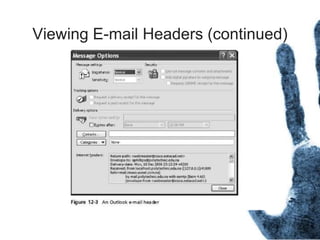
• Outlook
– Open the Message Options dialog box
– Copy headers
– Paste them to any text editor
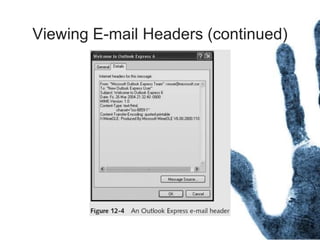
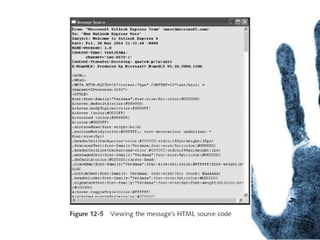
• Outlook Express
– Open the message Properties dialog box
– Select Message Source
– Copy and paste the headers to any text editor
Viewing E-mail Headers (continued)
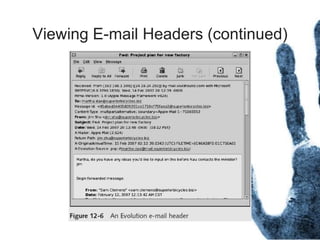
• Novell Evolution
– Click View, All Message Headers
– Copy and paste the e-mail header
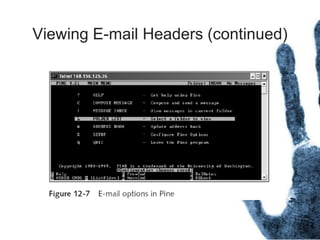
• Pine and ELM
– Check enable-full-headers
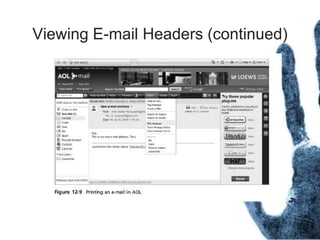
• AOL headers
– Click Action, View Message Source
– Copy and paste headers
Viewing E-mail Headers (continued)
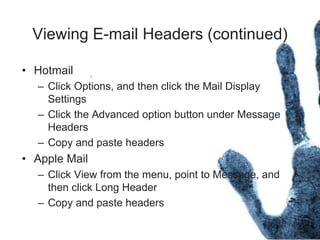
• Hotmail
– Click Options, and then click the Mail Display
Settings
– Click the Advanced option button under Message
Headers
– Copy and paste headers
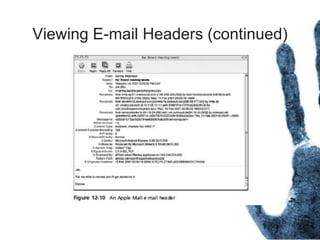
• Apple Mail
– Click View from the menu, point to Message, and
then click Long Header
– Copy and paste headers
Viewing E-mail Headers (continued)
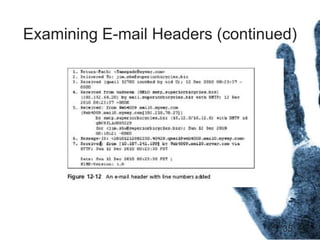
Examining E-mail Headers
• Gather supporting evidence and track suspect
– Return path
– Recipient’s e-mail address
– Type of sending e-mail service
– IP address of sending server
– Name of the e-mail server
– Unique message number
– Date and time e-mail was sent
– Attachment files information
35
Examining E-mail Headers (continued)
36
Examining Additional E-mail Files
• E-mail messages are saved on the client side or
left at the server
• Microsoft Outlook uses .pst and .ost files
• Most e-mail programs also include an electronic
address book
• In Web-based e-mail
– Messages are displayed and saved as Web pages in
the browser’s cache folders
– Many Web-based e-mail providers also offer instant
messaging (IM) services
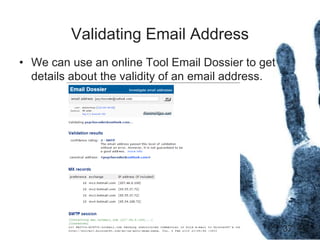
Validating Email Address
• We can use an online Tool Email Dossier to get
details about the validity of an email address.
37
Tracing an E-mail Message
• Contact the administrator responsible for the
sending server
• Finding domain name’s point of contact
– www.arin.net
– www.internic.com
– www.freeality.com
– www.google.com
• Find suspect’s contact information
• Verify your findings by checking network e-mail
logs against e-mail addresses
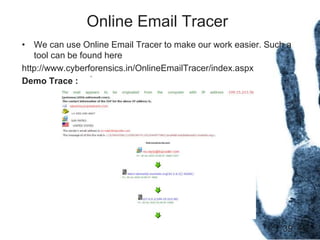
Online Email Tracer
• We can use Online Email Tracer to make our work easier. Such a
tool can be found here
http://www.cyberforensics.in/OnlineEmailTracer/index.aspx
Demo Trace :
39
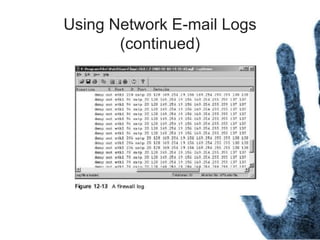
Using Network E-mail Logs
• Router logs
– Record all incoming and outgoing traffic
– Have rules to allow or disallow traffic
– You can resolve the path a transmitted e-mail has
taken
• Firewall logs
– Filter e-mail traffic
– Verify whether the e-mail passed through
• You can use any text editor or specialized tools
Using Network E-mail Logs
(continued)
Understanding E-mail Servers
• Computer loaded with software that uses e-mail
protocols for its services
– And maintains logs you can examine and use in your
investigation
• E-mail storage
– Database
– Flat file
• Logs
– Default or manual
– Continuous and circular
Understanding E-mail Servers
(continued)
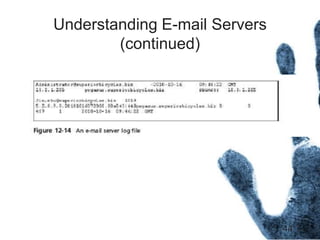
• Log information
– E-mail content
– Sending IP address
– Receiving and reading date and time
– System-specific information
• Contact suspect’s network e-mail administrator as
soon as possible
• Servers can recover deleted e-mails
– Similar to deletion of files on a hard drive
44
Understanding E-mail Servers
(continued)
45
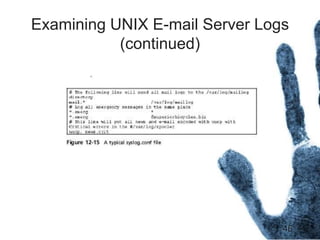
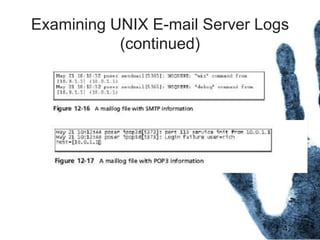
Examining UNIX E-mail Server Logs
• /etc/sendmail.cf
– Configuration information for Sendmail
• /etc/syslog.conf
– Specifies how and which events Sendmail logs
• /var/log/maillog
– SMTP and POP3 communications
• IP address and time stamp
• Check UNIX man pages for more information
46
Examining UNIX E-mail Server Logs
(continued)
47
Examining UNIX E-mail Server Logs
(continued)
48
Examining Microsoft E-mail Server
Logs
• Microsoft Exchange Server (Exchange)
– Uses a database
– Based on Microsoft Extensible Storage Engine
• Information Store files
– Database files *.edb
• Responsible for MAPI information
– Database files *.stm
• Responsible for non-MAPI information
49
Examining Microsoft E-mail Server
Logs (continued)
• Transaction logs
– Keep track of e-mail databases
• Checkpoints
– Keep track of transaction logs
• Temporary files
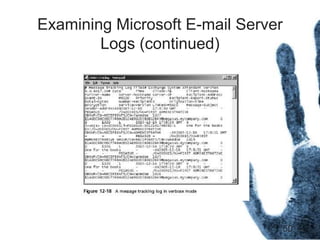
• E-mail communication logs
– res#.log
• Tracking.log
– Tracks messages
50
Examining Microsoft E-mail Server
Logs (continued)
Examining Microsoft E-mail Server
Logs (continued)
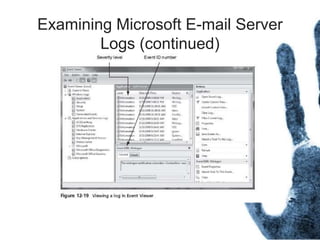
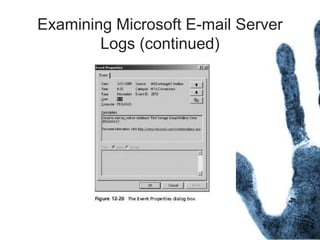
• Troubleshooting or diagnostic log
– Logs events
– Use Windows Event Viewer
– Open the Event Properties dialog box for more
details about an event
Examining Microsoft E-mail Server
Logs (continued)
Examining Microsoft E-mail Server
Logs (continued)
Using Specialized E-mail Forensics
Tools
• Tools include:
– AccessData’s Forensic Toolkit (FTK)
– ProDiscover Basic
– FINALeMAIL
– Sawmill-GroupWise
– DBXtract
– Fookes Aid4Mail and MailBag Assistant
– Paraben E-Mail Examiner
– Ontrack Easy Recovery EmailRepair
– R-Tools R-Mail
55
Using Specialized E-mail Forensics
Tools (continued)
• Tools allow you to find:
– E-mail database files
– Personal e-mail files
– Offline storage files
– Log files
• Advantage
– Do not need to know how e-mail servers and clients
work
Using Specialized E-mail Forensics
Tools (continued)
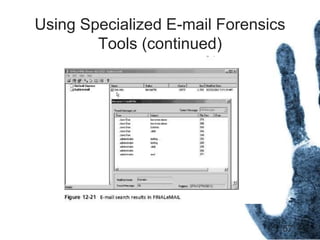
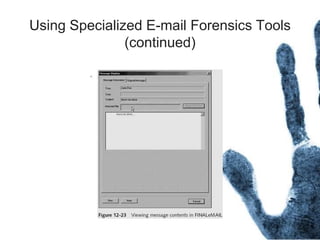
• FINALeMAIL
– Scans e-mail database files
– Recovers deleted e-mails
– Searches computer for other files associated with e-
mail
57
Using Specialized E-mail Forensics
Tools (continued)
Using Specialized E-mail Forensics Tools
(continued)
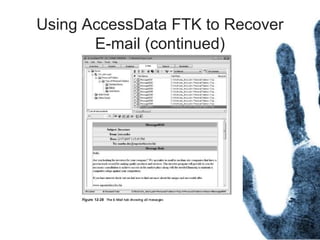
Using AccessData FTK to Recover
E-mail
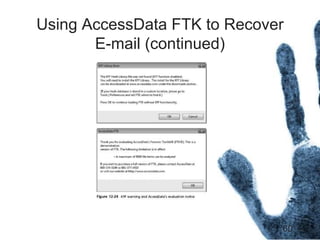
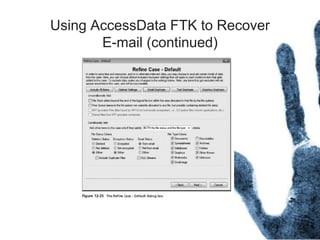
• FTK
– Can index data on a disk image or an entire drive for
faster data retrieval
– Filters and finds files specific to e-mail clients and
servers
• To recover e-mail from Outlook and Outlook
Express
– AccessData integrated dtSearch
• dtSearch builds a b-tree index of all text data in a
drive, an image file, or a group of files
60
Using AccessData FTK to Recover
E-mail (continued)
Using AccessData FTK to Recover
E-mail (continued)
Using AccessData FTK to Recover
E-mail (continued)
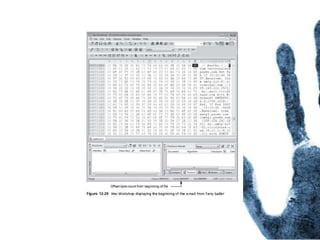
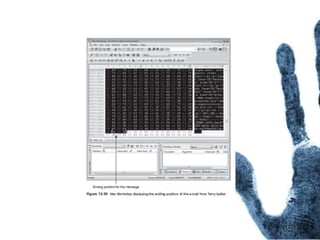
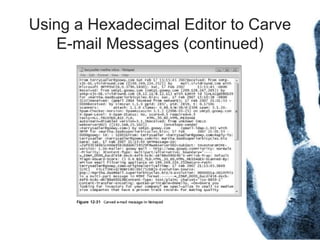
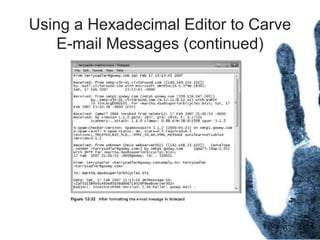
Using a Hexadecimal Editor to Carve
E-mail Messages
• Very few vendors have products for analyzing e-
mail in systems other than Microsoft
• mbox format
– Stores e-mails in flat plaintext files
• Multipurpose Internet Mail Extensions (MIME)
format
– Used by vendor-unique e-mail file systems, such as
Microsoft .pst or .ost
• Example: carve e-mail messages from Evolution
65
Using a Hexadecimal Editor to Carve
E-mail Messages (continued)
67
Using a Hexadecimal Editor to Carve
E-mail Messages (continued)
Summary
• E-mail fraudsters use phishing and spoofing scam
techniques
• Send and receive e-mail via Internet or a LAN
– Both environments use client/server architecture
• E-mail investigations are similar to other kinds of
investigations
• Access victim’s computer to recover evidence
– Copy and print the e-mail message involved in the
crime or policy violation
• Find e-mail headers
Summary (continued)
• Investigating e-mail abuse
– Be familiar with e-mail servers and clients’
operations
• Check
– E-mail message files, headers, and server log files
• Currently, only a few forensics tools can recover
deleted Outlook and Outlook Express messages
• For e-mail applications that use the mbox format, a
hexadecimal editor can be used to carve messages
manually
Summary (continued)
• Advanced tools are available for recovering deleted
Outlook files
QUESTIONS ? DOUBTS ?
THANK YOU

Email investigation

  • 1.
    Email Investigation Presented By AnimeshShaw (Psycho_Coder) Digital Evidence Analyst Trainee
  • 2.
    Discussion Objectives • WorkingProcess of Email • Explain the role of e-mail in investigations • Describe client and server roles in e-mail • Describe tasks in investigating e-mail crimes and violations • Explain the use of e-mail server logs • Describe some available e-mail computer forensics tools
  • 3.
  • 4.
    HOW EMAIL WORKS 1.Stand- alone 2. Web based To send and receive emails, we need an email client. There are primarily two types of email clients:
  • 5.
    A client has4 things : • 1) Messages in mailbox. • 2) Contents can be seen by selecting the header. • 3) Messages can be created and sent. • 4) Attachments can be added. HOW EMAIL WORKS
  • 6.
  • 7.
    HOW EMAIL WORKS PROCEDUREOF EMAIL TRANSMISSION
  • 8.
  • 9.
    Exploring the Roleof E-mail in Investigations • With the increase in e-mail scams and fraud attempts with phishing or spoofing – Investigators need to know how to examine and interpret the unique content of e-mail messages • Phishing e-mails are in HTML format – Which allows creating links to text on a Web page • One of the most noteworthy e-mail scams was 419, or the Nigerian Scam • Spoofing e-mail can be used to commit fraud
  • 10.
    Exploring the Rolesof the Client and Server in E-mail • Send and receive e-mail in two environments – Internet – Controlled LAN, MAN, or WAN • Client/server architecture – Server OS and e-mail software differs from those on the client side • Protected accounts – Require usernames and passwords
  • 11.
    Exploring the Rolesof the Client and Server in E-mail (continued)
  • 12.
    12 Exploring the Rolesof the Client and Server in E-mail (continued) • Name conventions – Corporate: john.smith@somecompany.com – Public: whatever@hotmail.com – Everything after @ belongs to the domain name • Tracing corporate e-mails is easier – Because accounts use standard names the administrator establishes
  • 13.
    Investigating E-mail Crimesand Violations • Similar to other types of investigations • Goals – Find who is behind the crime – Collect the evidence – Present your findings – Build a case
  • 14.
    Investigating E-mail Crimesand Violations (continued) • Depend on the city, state, or country – Example: spam – Always consult with an attorney • Becoming commonplace • Examples of crimes involving e-mails – Narcotics trafficking – Extortion – Sexual harassment – Child abductions and pornography
  • 15.
    Examining E-mail Messages •Access victim’s computer to recover the evidence • Using the victim’s e-mail client – Find and copy evidence in the e-mail – Access protected or encrypted material – Print e-mails • Guide victim on the phone – Open and copy e-mail including headers • Sometimes you will deal with deleted e-mails
  • 16.
    Examining E-mail Messages (continued) •Copying an e-mail message – Before you start an e-mail investigation • You need to copy and print the e-mail involved in the crime or policy violation – You might also want to forward the message as an attachment to another e-mail address • With many GUI e-mail programs, you can copy an e-mail by dragging it to a storage medium – Or by saving it in a different location
  • 17.
  • 18.
    Viewing E-mail Headers •Learn how to find e-mail headers – GUI clients – Command-line clients – Web-based clients • After you open e-mail headers, copy and paste them into a text document – So that you can read them with a text editor • Headers contain useful information – Unique identifying numbers, IP address of sending server, and sending time
  • 19.
    Viewing E-mail Headers(continued) • Yahoo (Client) – Click Mail Options – Click General Preferences and Show All headers on incoming messages – Copy and paste headers
  • 20.
  • 21.
  • 22.
    Viewing E-mail Headers(continued) • Outlook – Open the Message Options dialog box – Copy headers – Paste them to any text editor • Outlook Express – Open the message Properties dialog box – Select Message Source – Copy and paste the headers to any text editor
  • 23.
  • 24.
  • 26.
    Viewing E-mail Headers(continued) • Novell Evolution – Click View, All Message Headers – Copy and paste the e-mail header • Pine and ELM – Check enable-full-headers • AOL headers – Click Action, View Message Source – Copy and paste headers
  • 27.
  • 28.
  • 29.
  • 30.
  • 31.
    Viewing E-mail Headers(continued) • Hotmail – Click Options, and then click the Mail Display Settings – Click the Advanced option button under Message Headers – Copy and paste headers • Apple Mail – Click View from the menu, point to Message, and then click Long Header – Copy and paste headers
  • 32.
  • 33.
  • 34.
    Examining E-mail Headers •Gather supporting evidence and track suspect – Return path – Recipient’s e-mail address – Type of sending e-mail service – IP address of sending server – Name of the e-mail server – Unique message number – Date and time e-mail was sent – Attachment files information
  • 35.
  • 36.
    36 Examining Additional E-mailFiles • E-mail messages are saved on the client side or left at the server • Microsoft Outlook uses .pst and .ost files • Most e-mail programs also include an electronic address book • In Web-based e-mail – Messages are displayed and saved as Web pages in the browser’s cache folders – Many Web-based e-mail providers also offer instant messaging (IM) services
  • 37.
    Validating Email Address •We can use an online Tool Email Dossier to get details about the validity of an email address. 37
  • 38.
    Tracing an E-mailMessage • Contact the administrator responsible for the sending server • Finding domain name’s point of contact – www.arin.net – www.internic.com – www.freeality.com – www.google.com • Find suspect’s contact information • Verify your findings by checking network e-mail logs against e-mail addresses
  • 39.
    Online Email Tracer •We can use Online Email Tracer to make our work easier. Such a tool can be found here http://www.cyberforensics.in/OnlineEmailTracer/index.aspx Demo Trace : 39
  • 40.
    Using Network E-mailLogs • Router logs – Record all incoming and outgoing traffic – Have rules to allow or disallow traffic – You can resolve the path a transmitted e-mail has taken • Firewall logs – Filter e-mail traffic – Verify whether the e-mail passed through • You can use any text editor or specialized tools
  • 41.
    Using Network E-mailLogs (continued)
  • 42.
    Understanding E-mail Servers •Computer loaded with software that uses e-mail protocols for its services – And maintains logs you can examine and use in your investigation • E-mail storage – Database – Flat file • Logs – Default or manual – Continuous and circular
  • 43.
    Understanding E-mail Servers (continued) •Log information – E-mail content – Sending IP address – Receiving and reading date and time – System-specific information • Contact suspect’s network e-mail administrator as soon as possible • Servers can recover deleted e-mails – Similar to deletion of files on a hard drive
  • 44.
  • 45.
    45 Examining UNIX E-mailServer Logs • /etc/sendmail.cf – Configuration information for Sendmail • /etc/syslog.conf – Specifies how and which events Sendmail logs • /var/log/maillog – SMTP and POP3 communications • IP address and time stamp • Check UNIX man pages for more information
  • 46.
    46 Examining UNIX E-mailServer Logs (continued)
  • 47.
    47 Examining UNIX E-mailServer Logs (continued)
  • 48.
    48 Examining Microsoft E-mailServer Logs • Microsoft Exchange Server (Exchange) – Uses a database – Based on Microsoft Extensible Storage Engine • Information Store files – Database files *.edb • Responsible for MAPI information – Database files *.stm • Responsible for non-MAPI information
  • 49.
    49 Examining Microsoft E-mailServer Logs (continued) • Transaction logs – Keep track of e-mail databases • Checkpoints – Keep track of transaction logs • Temporary files • E-mail communication logs – res#.log • Tracking.log – Tracks messages
  • 50.
    50 Examining Microsoft E-mailServer Logs (continued)
  • 51.
    Examining Microsoft E-mailServer Logs (continued) • Troubleshooting or diagnostic log – Logs events – Use Windows Event Viewer – Open the Event Properties dialog box for more details about an event
  • 52.
    Examining Microsoft E-mailServer Logs (continued)
  • 53.
    Examining Microsoft E-mailServer Logs (continued)
  • 54.
    Using Specialized E-mailForensics Tools • Tools include: – AccessData’s Forensic Toolkit (FTK) – ProDiscover Basic – FINALeMAIL – Sawmill-GroupWise – DBXtract – Fookes Aid4Mail and MailBag Assistant – Paraben E-Mail Examiner – Ontrack Easy Recovery EmailRepair – R-Tools R-Mail
  • 55.
    55 Using Specialized E-mailForensics Tools (continued) • Tools allow you to find: – E-mail database files – Personal e-mail files – Offline storage files – Log files • Advantage – Do not need to know how e-mail servers and clients work
  • 56.
    Using Specialized E-mailForensics Tools (continued) • FINALeMAIL – Scans e-mail database files – Recovers deleted e-mails – Searches computer for other files associated with e- mail
  • 57.
    57 Using Specialized E-mailForensics Tools (continued)
  • 58.
    Using Specialized E-mailForensics Tools (continued)
  • 59.
    Using AccessData FTKto Recover E-mail • FTK – Can index data on a disk image or an entire drive for faster data retrieval – Filters and finds files specific to e-mail clients and servers • To recover e-mail from Outlook and Outlook Express – AccessData integrated dtSearch • dtSearch builds a b-tree index of all text data in a drive, an image file, or a group of files
  • 60.
    60 Using AccessData FTKto Recover E-mail (continued)
  • 61.
    Using AccessData FTKto Recover E-mail (continued)
  • 62.
    Using AccessData FTKto Recover E-mail (continued)
  • 63.
    Using a HexadecimalEditor to Carve E-mail Messages • Very few vendors have products for analyzing e- mail in systems other than Microsoft • mbox format – Stores e-mails in flat plaintext files • Multipurpose Internet Mail Extensions (MIME) format – Used by vendor-unique e-mail file systems, such as Microsoft .pst or .ost • Example: carve e-mail messages from Evolution
  • 65.
  • 66.
    Using a HexadecimalEditor to Carve E-mail Messages (continued)
  • 67.
    67 Using a HexadecimalEditor to Carve E-mail Messages (continued)
  • 68.
    Summary • E-mail fraudstersuse phishing and spoofing scam techniques • Send and receive e-mail via Internet or a LAN – Both environments use client/server architecture • E-mail investigations are similar to other kinds of investigations • Access victim’s computer to recover evidence – Copy and print the e-mail message involved in the crime or policy violation • Find e-mail headers
  • 69.
    Summary (continued) • Investigatinge-mail abuse – Be familiar with e-mail servers and clients’ operations • Check – E-mail message files, headers, and server log files • Currently, only a few forensics tools can recover deleted Outlook and Outlook Express messages • For e-mail applications that use the mbox format, a hexadecimal editor can be used to carve messages manually
  • 70.
    Summary (continued) • Advancedtools are available for recovering deleted Outlook files
  • 71.
  • 72.