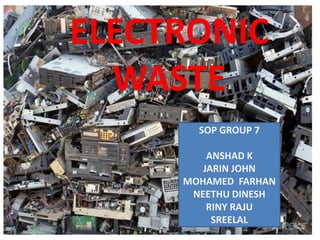
ELECTRONIC
  WASTE
       SOP GROUP 7

         ANSHAD K
        JARIN JOHN
     MOHAMED FARHAN
      NEETHU DINESH
         RINY RAJU
          SREELAL
INTRODUCTION

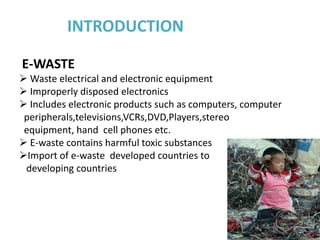
E-WASTE
 Waste electrical and electronic equipment
 Improperly disposed electronics
 Includes electronic products such as computers, computer
 peripherals,televisions,VCRs,DVD,Players,stereo
 equipment, hand cell phones etc.
 E-waste contains harmful toxic substances
Import of e-waste developed countries to
 developing countries
E-WASTE INDIAN SCENARIO
E- waste market is unorganized
Municipal waste
Unskilled workers, absence of adequate technology,
 improper handling
More focused on profit
No mechanism to check the flow of E- waste
0.1-0.2% municipal waste
Business accounts for 78%
800000 tone E- waste is generated in 2012
Sale of computer & laptop has been grown 18% in 09-10
Self organized
Reasons for E- waste generation
E-WASTE MANAGEMENT

Recycling
Processing techniques
Benefits of recycling
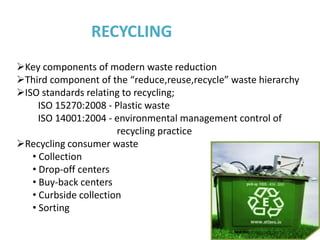
RECYCLING
Key components of modern waste reduction
Third component of the “reduce,reuse,recycle” waste hierarchy
ISO standards relating to recycling;
     ISO 15270:2008 - Plastic waste
     ISO 14001:2004 - environmental management control of
                       recycling practice
Recycling consumer waste
   • Collection
   • Drop-off centers
   • Buy-back centers
   • Curbside collection
   • Sorting
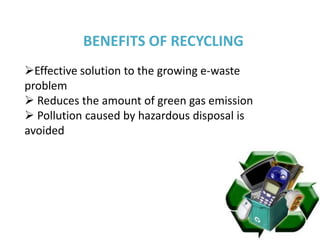
BENEFITS OF RECYCLING
Effective solution to the growing e-waste
problem
 Reduces the amount of green gas emission
 Pollution caused by hazardous disposal is
avoided
PROCESSING TECHNIQUE
DISMANTLING
  • To disassemble or to tear down

REUSE
  • Use an item more than once
HOW E-WASTE AFFECTS OUR ENVIRONMENT?

 It has become a uncontrollable issue
 Contaminated leachates pollute the ground water
 Uncontrolled burning and disposal are environment problems
 Causes acidification of soil
 Not only leaching of the mercury poses serious problems
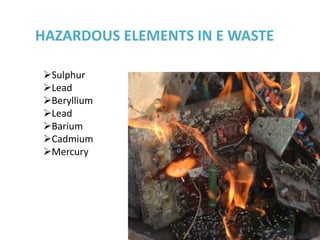
HAZARDOUS ELEMENTS IN E WASTE

Sulphur
Lead
Beryllium
Lead
Barium
Cadmium
Mercury
HOW E-WASTE AFFECTS OUR HEALTH


Several health issues associated with the toxins found in the e waste
Damages kidney & liver
Cause retardation, high blood pressure
Disrupts endocrine system functions
Cause eye and throat irritation
LAWS AND RULES BY GOVERNMENT OF
                INDIA
E-waste (management & handling) rules 2011
  These shall apply to:
  • Producer, consumer or bulk consumers involved
     in the manufacture
  • Sale, purchase and processing of electrical and
     electronic equipment
  • Collection centers, dismantles and recycles of e-waste
AUTHORISATION DEALING WITH LAWS

Central Pollution Control Board, Delhi
State Pollution Control Board/ Committees Of Union
 Territories
Urban Local Bodies(Municipal Committee/Council)
GLOBAL ORGANISATIONS
 STEP(Solve The E-waste Problem)
•Initiative in late 2004 which has grown to a 50+ members
   initiative today
• Includes member from industry, international organizations,
   governments, NGO’s etc.

 Address The Mess. Com
•Increasing the awareness
•Encourage recycling
•Utilization of renewable energy and carbon offsets
Silicon Valley Toxics(svtc.org)
•Promoting human health and addresses environmental justice

Basel Action Network(ban.org)
•Addressing global environmental injustices
•Economic inefficiency of toxic trade
•Promoting sustainable solutions and attempts to ban waste trade
•Works for human rights and environment

The World Reuse, Repair And Recycling Association
•Improving the quality of exported electronics
•Improving trade practices through fair trade principles
•Encouraging letter recycling standard.
CONCLUSION

WHAT CAN CONSUMERS DO?

  Keep your old electronics longer instead of replacing them.
  If discarding old electronics, be sure to recycle them at a
   trusted recycling center
  Purchase electronics that do not contain hazardous
  materials
WHAT CAN PRODUCERS DO?

  Extended producer responsibility
  Design for environment
  Take back offer & incentives
WHAT CAN GOVTS/REGULATORS DO?

 Provide subsidy for e-cycling to producers
 Keep track of collection & recycling
 Regulate recyclers
 Create public awareness
 Eco-labeling

Electronic waste

  • 1.
    ELECTRONIC WASTE SOP GROUP 7 ANSHAD K JARIN JOHN MOHAMED FARHAN NEETHU DINESH RINY RAJU SREELAL
  • 2.
    INTRODUCTION E-WASTE  Waste electricaland electronic equipment  Improperly disposed electronics  Includes electronic products such as computers, computer peripherals,televisions,VCRs,DVD,Players,stereo equipment, hand cell phones etc.  E-waste contains harmful toxic substances Import of e-waste developed countries to developing countries
  • 3.
    E-WASTE INDIAN SCENARIO E-waste market is unorganized Municipal waste Unskilled workers, absence of adequate technology, improper handling More focused on profit No mechanism to check the flow of E- waste 0.1-0.2% municipal waste Business accounts for 78% 800000 tone E- waste is generated in 2012 Sale of computer & laptop has been grown 18% in 09-10 Self organized Reasons for E- waste generation
  • 4.
  • 5.
    RECYCLING Key components ofmodern waste reduction Third component of the “reduce,reuse,recycle” waste hierarchy ISO standards relating to recycling; ISO 15270:2008 - Plastic waste ISO 14001:2004 - environmental management control of recycling practice Recycling consumer waste • Collection • Drop-off centers • Buy-back centers • Curbside collection • Sorting
  • 6.
    BENEFITS OF RECYCLING Effectivesolution to the growing e-waste problem  Reduces the amount of green gas emission  Pollution caused by hazardous disposal is avoided
  • 7.
    PROCESSING TECHNIQUE DISMANTLING • To disassemble or to tear down REUSE • Use an item more than once
  • 8.
    HOW E-WASTE AFFECTSOUR ENVIRONMENT? It has become a uncontrollable issue Contaminated leachates pollute the ground water Uncontrolled burning and disposal are environment problems Causes acidification of soil Not only leaching of the mercury poses serious problems
  • 9.
    HAZARDOUS ELEMENTS INE WASTE Sulphur Lead Beryllium Lead Barium Cadmium Mercury
  • 10.
    HOW E-WASTE AFFECTSOUR HEALTH Several health issues associated with the toxins found in the e waste Damages kidney & liver Cause retardation, high blood pressure Disrupts endocrine system functions Cause eye and throat irritation
  • 11.
    LAWS AND RULESBY GOVERNMENT OF INDIA E-waste (management & handling) rules 2011 These shall apply to: • Producer, consumer or bulk consumers involved in the manufacture • Sale, purchase and processing of electrical and electronic equipment • Collection centers, dismantles and recycles of e-waste
  • 12.
    AUTHORISATION DEALING WITHLAWS Central Pollution Control Board, Delhi State Pollution Control Board/ Committees Of Union Territories Urban Local Bodies(Municipal Committee/Council)
  • 13.
    GLOBAL ORGANISATIONS  STEP(SolveThe E-waste Problem) •Initiative in late 2004 which has grown to a 50+ members initiative today • Includes member from industry, international organizations, governments, NGO’s etc.  Address The Mess. Com •Increasing the awareness •Encourage recycling •Utilization of renewable energy and carbon offsets
  • 14.
    Silicon Valley Toxics(svtc.org) •Promotinghuman health and addresses environmental justice Basel Action Network(ban.org) •Addressing global environmental injustices •Economic inefficiency of toxic trade •Promoting sustainable solutions and attempts to ban waste trade •Works for human rights and environment The World Reuse, Repair And Recycling Association •Improving the quality of exported electronics •Improving trade practices through fair trade principles •Encouraging letter recycling standard.
  • 15.
    CONCLUSION WHAT CAN CONSUMERSDO?  Keep your old electronics longer instead of replacing them.  If discarding old electronics, be sure to recycle them at a trusted recycling center  Purchase electronics that do not contain hazardous materials
  • 16.
    WHAT CAN PRODUCERSDO?  Extended producer responsibility  Design for environment  Take back offer & incentives
  • 17.
    WHAT CAN GOVTS/REGULATORSDO? Provide subsidy for e-cycling to producers Keep track of collection & recycling Regulate recyclers Create public awareness Eco-labeling