 SOP   GROUP:11
GROUP MEMBERS:
AKHIL P
FINNY TOM
LAKSHMI PRIYA
REYAN JOHNY
SONY ROY
   A deposit account held at a bank or other
    financial institution that provides principal
    security and a modest interest rate.
   Most liquid investments outside of demand
    accounts and cash.
   Combination of current account and term
    deposits.
   Number of free withdrawals are generally
    stipulated on a half-yearly/quarterly basis.
   No ceiling has been stipulated on the
    maximum amount drawn per transaction.
   There is generally no limit on the number of
    cheques that can be drawn per month.
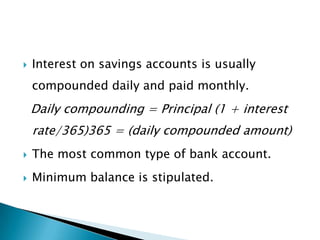
   Interest on savings accounts is usually
    compounded daily and paid monthly.
    Daily compounding = Principal (1 + interest
    rate/365)365 = (daily compounded amount)
   The most common type of bank account.
   Minimum balance is stipulated.
   Banks usually offer two types of savings
     accounts:
a)   Basic savings account or passbook savings
     account.
b)   Money market account.
   Early 1990’s – India pursued financial sector
    reforms as a part of structural reforms.
   Major components of financial sector reform
    process are,
•     Deregulation of complex structure of deposit
•     Lending interest rates
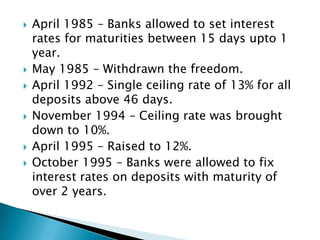
   April 1985 – Banks allowed to set interest
    rates for maturities between 15 days upto 1
    year.
   May 1985 – Withdrawn the freedom.
   April 1992 – Single ceiling rate of 13% for all
    deposits above 46 days.
   November 1994 – Ceiling rate was brought
    down to 10%.
   April 1995 – Raised to 12%.
   October 1995 – Banks were allowed to fix
    interest rates on deposits with maturity of
    over 2 years.
   July 1996 – Relaxed to maturity of over 1 year.
   April 1997 – Ceiling rate for deposits of 30
    days upto 1 year was linked to Bank rate.
   October 1997 – Deposits rate were fully
    deregulated by removing the linkage to Bank
    rate.
   April 1998 – RBI gave freedom to commercial
    banks to fix their own interest.
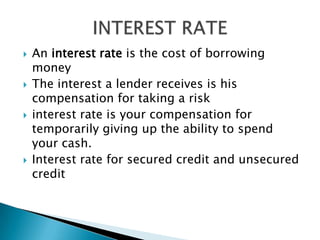
   An interest rate is the cost of borrowing
    money
   The interest a lender receives is his
    compensation for taking a risk
   interest rate is your compensation for
    temporarily giving up the ability to spend
    your cash.
   Interest rate for secured credit and unsecured
    credit
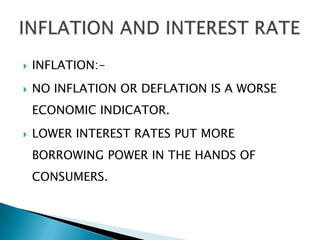
   INFLATION:-
   NO INFLATION OR DEFLATION IS A WORSE
    ECONOMIC INDICATOR.
   LOWER INTEREST RATES PUT MORE
    BORROWING POWER IN THE HANDS OF
    CONSUMERS.
   The process of deregulation started in
    October 1997.
   Deregulation – prior to this the interest rate
    was 3% to 4% .
   It was fixed and regulated by RBI .
   As a result of deregulation the interest rates
    are higher for deposits of more than Rs 1
    lakh.
   Interest rate for the amount upto 1
    lakh,banks are supposed to maintain same
    interest rate.
   Interest rates on savings account in
    developed countries determined by the
    commercial banks according to market
    conditions.
   Savings bank accounts may carry customer
    charges.
   Many Asian countries deregulated interest
    rates to support
         - overall development and growth
    policies.
 May     Enhance Attractiveness of
     Savings Deposits
a.    There was no changes in the
      interest rate in response to
      changing market condition
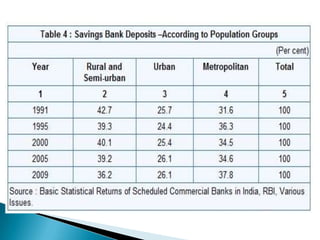
b.    Since savings bank deposits in
      rural, semi-urban areas and urban
      areas are held largely for savings
      purposes, deregulation of interest
      rate is likely to enhance its
      attractiveness in these areas.
 Will Improve Transmission of
     Monetary Policy
a.   transmission of monetary policy to be
     effective, it is necessary that all rates move
     in tandem with the policy rates
b.   overall cost of deposits does not move in
     sync with changes in the policy rates,
     thereby affecting the monetary transmission
   Product innovations may include a variety of
    modes of operations such as branches, web-
    based channels, ATMs etc
   combined savings and checking accounts
    launched in Hong Kong
   Possibility of an Unhealthy Competition
   Risk of Asset Liability Mismatches
   May Lead to Financial Exclusion
   Could Adversely Affect Small
    Savers/Pensioners
   Possibility of Introduction of Complex and
    not so Easily Understood Savings Products
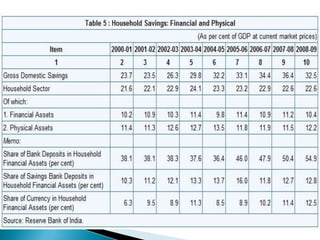
a.   low cost source of fund
b.   49 banks, which have below average CASA
     deposits, constitute about 50 per cent of
     total asset of the banking sector.
a.   a large part of savings deposits is treated as
     ‘core’ deposits, which together with term
     deposits have been used by banks
b.   as an asset-liability mismatch wherein assets
     (loans) have a longer maturity compared to
     liabilities (deposits).
c.   shift funds from one bank to another in
     search of returns.
   High transaction cost
   This will discourage small savers, especially
    in rural and semi- urban areas from opening
    savings deposits accounts.
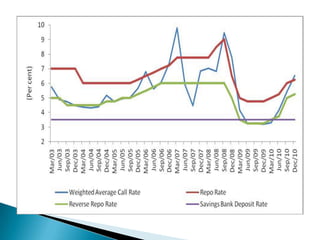
   when the liquidity is in surplus, when savings
    deposit interest rates may decline even below
    the present level.
 DEREGULATION    IMPACT ON BANKS

 Increased costs and decreased profitability
 Less takers for short term fixed deposits
 Increased competition
 Asset and liability of banks
 Higher earnings from saving accounts
 Short term investment option
 Increased cost of loans for borrowers
 Increased charges
   LIQUID FUNDS ARE MUTUAL FUNDS
   SOME INVESTORS MIGHT MOVE THEIR FUNDS
    TOWARDS SAVINGS ACCOUNT AS IT OFFERS
    HIGHER LIQUIDITY AND SAFETY OF THE
    PRINCIPAL AMOUNT.
   liquid funds yield better returns if we take tax
    rate into account.
   With deregulation, this category of mutual
    fund will definitely offer more innovation.
   Savings deposit interest rate can not be
    regulated for all times to come when all other
    interest rates have already been deregulated
    as it creates distortions in the system.
   The RBI said that deregulation of interest
    rates in India since the early 1990s has
    improved the competitive environment in the
    financial system, imparted greater efficiency
    in resource allocation and strengthened the
    transmission mechanism of monetary policy.
   Deregulation of interest rates on savings
    bank account will only prompt customers to
    move from one bank to another, rather than
    bringing in new customers into the banking
    system.
   Banks wishing to enjoy cheaper (savings
    bank) funds will, therefore, have to work
    much harder on non-interest factors like
    service quality, ease of access and other
    related services on offer to retain customers
    and ensure their loyalty

Deregulation

  • 1.
     SOP GROUP:11 GROUP MEMBERS: AKHIL P FINNY TOM LAKSHMI PRIYA REYAN JOHNY SONY ROY
  • 2.
    A deposit account held at a bank or other financial institution that provides principal security and a modest interest rate.  Most liquid investments outside of demand accounts and cash.  Combination of current account and term deposits.
  • 3.
    Number of free withdrawals are generally stipulated on a half-yearly/quarterly basis.  No ceiling has been stipulated on the maximum amount drawn per transaction.  There is generally no limit on the number of cheques that can be drawn per month.
  • 4.
    Interest on savings accounts is usually compounded daily and paid monthly. Daily compounding = Principal (1 + interest rate/365)365 = (daily compounded amount)  The most common type of bank account.  Minimum balance is stipulated.
  • 5.
    Banks usually offer two types of savings accounts: a) Basic savings account or passbook savings account. b) Money market account.
  • 6.
    Early 1990’s – India pursued financial sector reforms as a part of structural reforms.  Major components of financial sector reform process are, • Deregulation of complex structure of deposit • Lending interest rates
  • 7.
    April 1985 – Banks allowed to set interest rates for maturities between 15 days upto 1 year.  May 1985 – Withdrawn the freedom.  April 1992 – Single ceiling rate of 13% for all deposits above 46 days.  November 1994 – Ceiling rate was brought down to 10%.  April 1995 – Raised to 12%.  October 1995 – Banks were allowed to fix interest rates on deposits with maturity of over 2 years.
  • 8.
    July 1996 – Relaxed to maturity of over 1 year.  April 1997 – Ceiling rate for deposits of 30 days upto 1 year was linked to Bank rate.  October 1997 – Deposits rate were fully deregulated by removing the linkage to Bank rate.  April 1998 – RBI gave freedom to commercial banks to fix their own interest.
  • 14.
    An interest rate is the cost of borrowing money  The interest a lender receives is his compensation for taking a risk  interest rate is your compensation for temporarily giving up the ability to spend your cash.  Interest rate for secured credit and unsecured credit
  • 15.
    INFLATION:-  NO INFLATION OR DEFLATION IS A WORSE ECONOMIC INDICATOR.  LOWER INTEREST RATES PUT MORE BORROWING POWER IN THE HANDS OF CONSUMERS.
  • 16.
    The process of deregulation started in October 1997.  Deregulation – prior to this the interest rate was 3% to 4% .  It was fixed and regulated by RBI .  As a result of deregulation the interest rates are higher for deposits of more than Rs 1 lakh.  Interest rate for the amount upto 1 lakh,banks are supposed to maintain same interest rate.
  • 17.
    Interest rates on savings account in developed countries determined by the commercial banks according to market conditions.  Savings bank accounts may carry customer charges.  Many Asian countries deregulated interest rates to support - overall development and growth policies.
  • 18.
     May Enhance Attractiveness of Savings Deposits a. There was no changes in the interest rate in response to changing market condition b. Since savings bank deposits in rural, semi-urban areas and urban areas are held largely for savings purposes, deregulation of interest rate is likely to enhance its attractiveness in these areas.
  • 20.
     Will ImproveTransmission of Monetary Policy a. transmission of monetary policy to be effective, it is necessary that all rates move in tandem with the policy rates b. overall cost of deposits does not move in sync with changes in the policy rates, thereby affecting the monetary transmission
  • 21.
    Product innovations may include a variety of modes of operations such as branches, web- based channels, ATMs etc  combined savings and checking accounts launched in Hong Kong
  • 22.
    Possibility of an Unhealthy Competition  Risk of Asset Liability Mismatches  May Lead to Financial Exclusion  Could Adversely Affect Small Savers/Pensioners  Possibility of Introduction of Complex and not so Easily Understood Savings Products
  • 23.
    a. low cost source of fund b. 49 banks, which have below average CASA deposits, constitute about 50 per cent of total asset of the banking sector.
  • 24.
    a. a large part of savings deposits is treated as ‘core’ deposits, which together with term deposits have been used by banks b. as an asset-liability mismatch wherein assets (loans) have a longer maturity compared to liabilities (deposits). c. shift funds from one bank to another in search of returns.
  • 25.
    High transaction cost  This will discourage small savers, especially in rural and semi- urban areas from opening savings deposits accounts.
  • 26.
    when the liquidity is in surplus, when savings deposit interest rates may decline even below the present level.
  • 27.
     DEREGULATION IMPACT ON BANKS  Increased costs and decreased profitability  Less takers for short term fixed deposits  Increased competition  Asset and liability of banks
  • 28.
     Higher earningsfrom saving accounts  Short term investment option  Increased cost of loans for borrowers  Increased charges
  • 29.
    LIQUID FUNDS ARE MUTUAL FUNDS  SOME INVESTORS MIGHT MOVE THEIR FUNDS TOWARDS SAVINGS ACCOUNT AS IT OFFERS HIGHER LIQUIDITY AND SAFETY OF THE PRINCIPAL AMOUNT.  liquid funds yield better returns if we take tax rate into account.  With deregulation, this category of mutual fund will definitely offer more innovation.
  • 30.
    Savings deposit interest rate can not be regulated for all times to come when all other interest rates have already been deregulated as it creates distortions in the system.  The RBI said that deregulation of interest rates in India since the early 1990s has improved the competitive environment in the financial system, imparted greater efficiency in resource allocation and strengthened the transmission mechanism of monetary policy.
  • 31.
    Deregulation of interest rates on savings bank account will only prompt customers to move from one bank to another, rather than bringing in new customers into the banking system.  Banks wishing to enjoy cheaper (savings bank) funds will, therefore, have to work much harder on non-interest factors like service quality, ease of access and other related services on offer to retain customers and ensure their loyalty