Submitted to :- Presented by :-
Mr. Suraj Sharma Bhavik Jain
Mr. Saurabh Sharma (13EIAEC015)
INSTITUTE OF ENGINEERING & TECHNOLOGY , ALWAR
A
SEMINAR PRESENTATION
ON
Electronics Waste
CONTENTS
 What is Electronic Waste?
 Sources of E-Waste
 How these become E-Waste?
 Facts and Figures
 Recycling Units
 Recycling Scenario
 Advantages of Recycling E-Waste
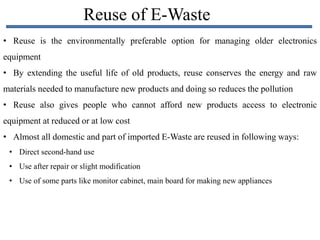
 Reuse of E-Waste
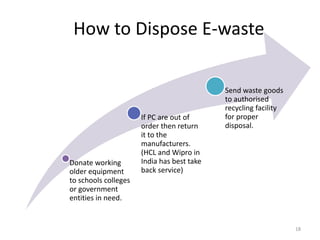
 How to E-waste Disposal
 Probable Solutions
 Recycling and Reprocessing units in India
 Conclusion
What is Electronic Waste?
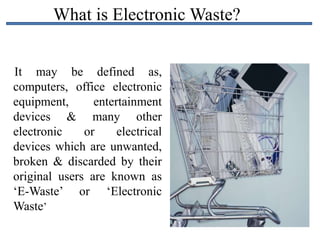
It may be defined as,
computers, office electronic
equipment, entertainment
devices & many other
electronic or electrical
devices which are unwanted,
broken & discarded by their
original users are known as
‘E-Waste’ or ‘Electronic
Waste’
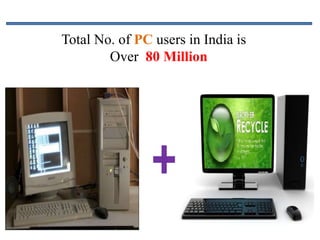
Total No. of PC users in India is
Over 80 Million
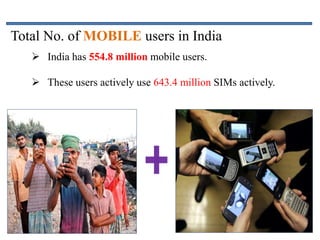
Total No. of MOBILE users in India
 India has 554.8 million mobile users.
 These users actively use 643.4 million SIMs actively.
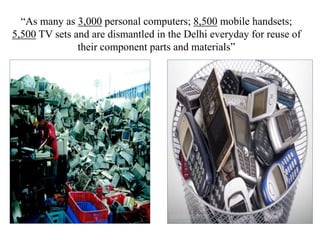
“As many as 3,000 personal computers; 8,500 mobile handsets;
5,500 TV sets and are dismantled in the Delhi everyday for reuse of
their component parts and materials”
E-Waste??
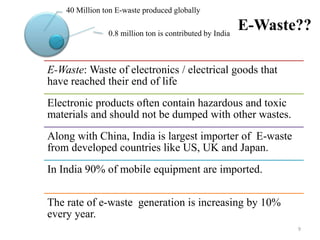
E-Waste: Waste of electronics / electrical goods that
have reached their end of life
Electronic products often contain hazardous and toxic
materials and should not be dumped with other wastes.
Along with China, India is largest importer of E-waste
from developed countries like US, UK and Japan.
In India 90% of mobile equipment are imported.
The rate of e-waste generation is increasing by 10%
every year.
9
0.8 million ton is contributed by India
40 Million ton E-waste produced globally
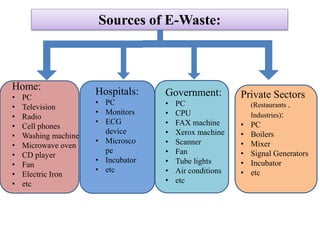
Sources of E-Waste:
Home:
• PC
• Television
• Radio
• Cell phones
• Washing machine
• Microwave oven
• CD player
• Fan
• Electric Iron
• etc
Hospitals:
• PC
• Monitors
• ECG
device
• Microsco
pe
• Incubator
• etc
Government:
• PC
• CPU
• FAX machine
• Xerox machine
• Scanner
• Fan
• Tube lights
• Air conditions
• etc
Private Sectors
(Restaurants ,
Industries):
• PC
• Boilers
• Mixer
• Signal Generators
• Incubator
• etc
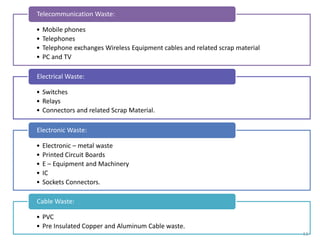
• Mobile phones
• Telephones
• Telephone exchanges Wireless Equipment cables and related scrap material
• PC and TV
Telecommunication Waste:
• Switches
• Relays
• Connectors and related Scrap Material.
Electrical Waste:
• Electronic – metal waste
• Printed Circuit Boards
• E – Equipment and Machinery
• IC
• Sockets Connectors.
Electronic Waste:
• PVC
• Pre Insulated Copper and Aluminum Cable waste.
Cable Waste:
11
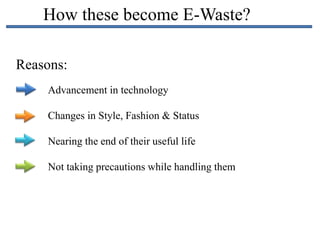
How these become E-Waste?
Reasons:
Advancement in technology
Changes in Style, Fashion & Status
Nearing the end of their useful life
Not taking precautions while handling them
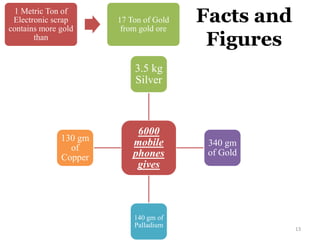
Facts and
Figures
6000
mobile
phones
gives
3.5 kg
Silver
340 gm
of Gold
140 gm of
Palladium
130 gm
of
Copper
13
1 Metric Ton of
Electronic scrap
contains more gold
than
17 Ton of Gold
from gold ore
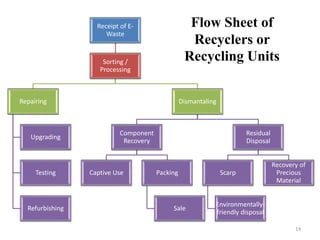
Flow Sheet of
Recyclers or
Recycling Units
Receipt of E-
Waste
Sorting /
Processing
Repairing
Upgrading
Testing
Refurbishing
Dismantaling
Component
Recovery
Captive Use Packing
Sale
Residual
Disposal
Scarp
Environmentally-
friendly disposal
Recovery of
Precious
Material
14
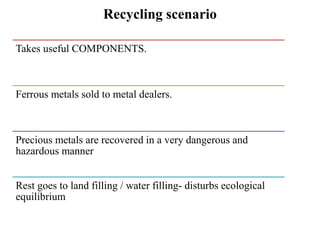
Recycling scenario
Takes useful COMPONENTS.
Ferrous metals sold to metal dealers.
Precious metals are recovered in a very dangerous and
hazardous manner
Rest goes to land filling / water filling- disturbs ecological
equilibrium
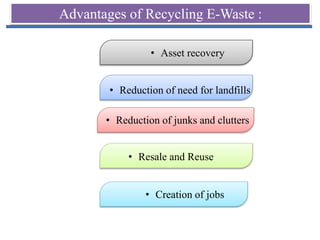
Advantages of Recycling E-Waste :
• Asset recovery
• Reduction of need for landfills
• Reduction of junks and clutters
• Resale and Reuse
• Creation of jobs
Reuse of E-Waste
• Reuse is the environmentally preferable option for managing older electronics
equipment
• By extending the useful life of old products, reuse conserves the energy and raw
materials needed to manufacture new products and doing so reduces the pollution
• Reuse also gives people who cannot afford new products access to electronic
equipment at reduced or at low cost
• Almost all domestic and part of imported E-Waste are reused in following ways:
• Direct second-hand use
• Use after repair or slight modification
• Use of some parts like monitor cabinet, main board for making new appliances
How to Dispose E-waste
Donate working
older equipment
to schools colleges
or government
entities in need.
If PC are out of
order then return
it to the
manufacturers.
(HCL and Wipro in
India has best take
back service)
Send waste goods
to authorised
recycling facility
for proper
disposal.
18
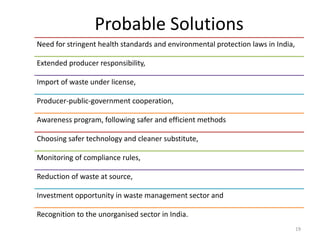
Probable Solutions
Need for stringent health standards and environmental protection laws in India,
Extended producer responsibility,
Import of waste under license,
Producer-public-government cooperation,
Awareness program, following safer and efficient methods
Choosing safer technology and cleaner substitute,
Monitoring of compliance rules,
Reduction of waste at source,
Investment opportunity in waste management sector and
Recognition to the unorganised sector in India.
19
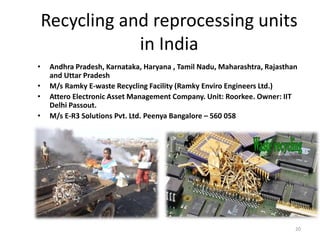
Recycling and reprocessing units
in India
• Andhra Pradesh, Karnataka, Haryana , Tamil Nadu, Maharashtra, Rajasthan
and Uttar Pradesh
• M/s Ramky E-waste Recycling Facility (Ramky Enviro Engineers Ltd.)
• Attero Electronic Asset Management Company. Unit: Roorkee. Owner: IIT
Delhi Passout.
• M/s E-R3 Solutions Pvt. Ltd. Peenya Bangalore – 560 058
20
CONCLUSION
1. As far as e-waste is concerned, it has emerged as one of the fastest
growing waste streams world wide today.
2. Electronic equipment is one of the largest know sources of heavy
metals without effective collection, reuse, and recycling systems, they
will be dangerous to environment
3. Reuse and recycling of electronic equipment is a beneficial alternative
than disposal
4. Product design by using safe and environment friendly raw materials
and most emerging technologies
5. Awareness of e-waste
6. Implementation of legislation
Electronic waste

Electronic waste

  • 1.
    Submitted to :-Presented by :- Mr. Suraj Sharma Bhavik Jain Mr. Saurabh Sharma (13EIAEC015) INSTITUTE OF ENGINEERING & TECHNOLOGY , ALWAR
  • 2.
  • 4.
    CONTENTS  What isElectronic Waste?  Sources of E-Waste  How these become E-Waste?  Facts and Figures  Recycling Units  Recycling Scenario  Advantages of Recycling E-Waste  Reuse of E-Waste  How to E-waste Disposal  Probable Solutions  Recycling and Reprocessing units in India  Conclusion
  • 5.
    What is ElectronicWaste? It may be defined as, computers, office electronic equipment, entertainment devices & many other electronic or electrical devices which are unwanted, broken & discarded by their original users are known as ‘E-Waste’ or ‘Electronic Waste’
  • 6.
    Total No. ofPC users in India is Over 80 Million
  • 7.
    Total No. ofMOBILE users in India  India has 554.8 million mobile users.  These users actively use 643.4 million SIMs actively.
  • 8.
    “As many as3,000 personal computers; 8,500 mobile handsets; 5,500 TV sets and are dismantled in the Delhi everyday for reuse of their component parts and materials”
  • 9.
    E-Waste?? E-Waste: Waste ofelectronics / electrical goods that have reached their end of life Electronic products often contain hazardous and toxic materials and should not be dumped with other wastes. Along with China, India is largest importer of E-waste from developed countries like US, UK and Japan. In India 90% of mobile equipment are imported. The rate of e-waste generation is increasing by 10% every year. 9 0.8 million ton is contributed by India 40 Million ton E-waste produced globally
  • 10.
    Sources of E-Waste: Home: •PC • Television • Radio • Cell phones • Washing machine • Microwave oven • CD player • Fan • Electric Iron • etc Hospitals: • PC • Monitors • ECG device • Microsco pe • Incubator • etc Government: • PC • CPU • FAX machine • Xerox machine • Scanner • Fan • Tube lights • Air conditions • etc Private Sectors (Restaurants , Industries): • PC • Boilers • Mixer • Signal Generators • Incubator • etc
  • 11.
    • Mobile phones •Telephones • Telephone exchanges Wireless Equipment cables and related scrap material • PC and TV Telecommunication Waste: • Switches • Relays • Connectors and related Scrap Material. Electrical Waste: • Electronic – metal waste • Printed Circuit Boards • E – Equipment and Machinery • IC • Sockets Connectors. Electronic Waste: • PVC • Pre Insulated Copper and Aluminum Cable waste. Cable Waste: 11
  • 12.
    How these becomeE-Waste? Reasons: Advancement in technology Changes in Style, Fashion & Status Nearing the end of their useful life Not taking precautions while handling them
  • 13.
    Facts and Figures 6000 mobile phones gives 3.5 kg Silver 340gm of Gold 140 gm of Palladium 130 gm of Copper 13 1 Metric Ton of Electronic scrap contains more gold than 17 Ton of Gold from gold ore
  • 14.
    Flow Sheet of Recyclersor Recycling Units Receipt of E- Waste Sorting / Processing Repairing Upgrading Testing Refurbishing Dismantaling Component Recovery Captive Use Packing Sale Residual Disposal Scarp Environmentally- friendly disposal Recovery of Precious Material 14
  • 15.
    Recycling scenario Takes usefulCOMPONENTS. Ferrous metals sold to metal dealers. Precious metals are recovered in a very dangerous and hazardous manner Rest goes to land filling / water filling- disturbs ecological equilibrium
  • 16.
    Advantages of RecyclingE-Waste : • Asset recovery • Reduction of need for landfills • Reduction of junks and clutters • Resale and Reuse • Creation of jobs
  • 17.
    Reuse of E-Waste •Reuse is the environmentally preferable option for managing older electronics equipment • By extending the useful life of old products, reuse conserves the energy and raw materials needed to manufacture new products and doing so reduces the pollution • Reuse also gives people who cannot afford new products access to electronic equipment at reduced or at low cost • Almost all domestic and part of imported E-Waste are reused in following ways: • Direct second-hand use • Use after repair or slight modification • Use of some parts like monitor cabinet, main board for making new appliances
  • 18.
    How to DisposeE-waste Donate working older equipment to schools colleges or government entities in need. If PC are out of order then return it to the manufacturers. (HCL and Wipro in India has best take back service) Send waste goods to authorised recycling facility for proper disposal. 18
  • 19.
    Probable Solutions Need forstringent health standards and environmental protection laws in India, Extended producer responsibility, Import of waste under license, Producer-public-government cooperation, Awareness program, following safer and efficient methods Choosing safer technology and cleaner substitute, Monitoring of compliance rules, Reduction of waste at source, Investment opportunity in waste management sector and Recognition to the unorganised sector in India. 19
  • 20.
    Recycling and reprocessingunits in India • Andhra Pradesh, Karnataka, Haryana , Tamil Nadu, Maharashtra, Rajasthan and Uttar Pradesh • M/s Ramky E-waste Recycling Facility (Ramky Enviro Engineers Ltd.) • Attero Electronic Asset Management Company. Unit: Roorkee. Owner: IIT Delhi Passout. • M/s E-R3 Solutions Pvt. Ltd. Peenya Bangalore – 560 058 20
  • 21.
    CONCLUSION 1. As faras e-waste is concerned, it has emerged as one of the fastest growing waste streams world wide today. 2. Electronic equipment is one of the largest know sources of heavy metals without effective collection, reuse, and recycling systems, they will be dangerous to environment 3. Reuse and recycling of electronic equipment is a beneficial alternative than disposal 4. Product design by using safe and environment friendly raw materials and most emerging technologies 5. Awareness of e-waste 6. Implementation of legislation

Editor's Notes

  • #10 Reason of increase in ewaste generation: Rising quality of life and high rate of resource consumption Ewaste is hard to handle because of its composition as it is made of multiple component. Technology change, software compatability and Lack of efficient recovery, reuse technologies
  • #12 E waste: waste of electronics / electrical goods that use or have reached their end of life Contains valuable material like copper, silver, gold that can be recovered