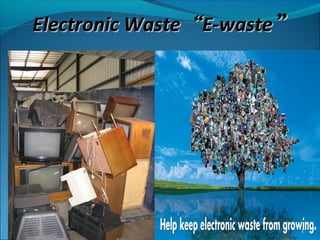
Electronic WasteElectronic Waste ““E-wasteE-waste””
1
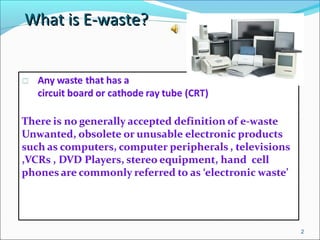
What is E-waste?What is E-waste?
2
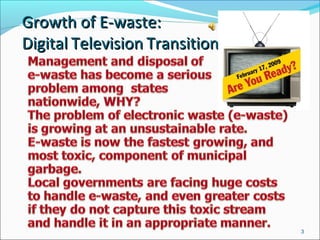
Growth of E-waste:Growth of E-waste:
DigitalDigital TelevisionTelevision TransitionTransition
3
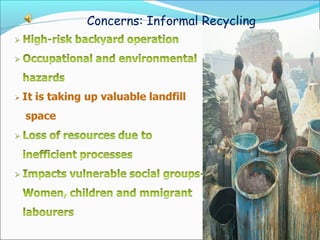
Concerns: Informal Recycling
4
Other problemsIllegal exporting especially to Asia
Uncontrolled burning and disposal
are causing problems
The toxicity of some of the substance,
Eg= mercury , cadmium may also pose
an environmental and health
challenge
5
6
Various legislations cover different aspects of e-
waste
 The hazardous waste (management and handling ) rules, 1998 as
amended in 2008 for Toxic content – registration mandatory for
recyclers
 Municipal Solid Waste Management & Handling Rules for non-Toxic
content
 Basel convention for regulating transboundary movement
 Foreign Trade policy restricts import of second-hand computers
and does not permit import of e-waste
 ‘Guidelines’ by Central Pollution Control Board ( 2008)
Proposed e-Waste Rules
Title: E-waste (Management & Handling) Rules to be published under
the Environment Protection Act
 OBJECTIVE :To put in place an effective mechanism to regulate
the generation, collection, storage, transportation, import,
export, environmentally sound recycling, treatment and disposal of
e-waste. This includes refurbishment, collection system and
producer responsibility thereby reducing the wastes destined for
final disposal.
ESSENCE: the producer of electrical and electronic equipments is
responsible for the entire life cycle of its own branded product
and in particular the environmentally sound end-of-life
management and facilitating collection and take back.
7
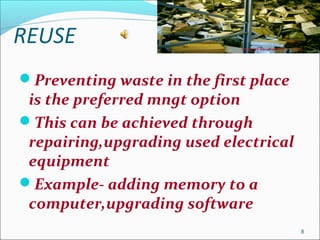
REUSE
Preventing waste in the first place
is the preferred mngt option
This can be achieved through
repairing,upgrading used electrical
equipment
Example- adding memory to a
computer,upgrading software
8
RECYCLE
 Make use of take back programs
 Through recycling units are
either reused or dismantled for
recycling.
 The silver,gold,lead and other
heavy metal are recyclable
9
DISPOSE
 The least preferred option is to
landfill electronic waste
 This should only come as a last
option but care to consult with
state regulations on disposal of
any hazardous waste
10
What Can You Do?
• Raise AwarenessRaise Awareness
• Promote Recycling OpportunitiesPromote Recycling Opportunities
• Awareness programme on e-wasteAwareness programme on e-waste
forschool children and generalforschool children and general
publicpublic
• Encourage and facilitate organizedEncourage and facilitate organized
recycling systemsrecycling systems
11
12

Electronic waste

  • 1.
    Electronic WasteElectronic Waste““E-wasteE-waste”” 1
  • 2.
    What is E-waste?Whatis E-waste? 2
  • 3.
    Growth of E-waste:Growthof E-waste: DigitalDigital TelevisionTelevision TransitionTransition 3
  • 4.
  • 5.
    Other problemsIllegal exportingespecially to Asia Uncontrolled burning and disposal are causing problems The toxicity of some of the substance, Eg= mercury , cadmium may also pose an environmental and health challenge 5
  • 6.
    6 Various legislations coverdifferent aspects of e- waste  The hazardous waste (management and handling ) rules, 1998 as amended in 2008 for Toxic content – registration mandatory for recyclers  Municipal Solid Waste Management & Handling Rules for non-Toxic content  Basel convention for regulating transboundary movement  Foreign Trade policy restricts import of second-hand computers and does not permit import of e-waste  ‘Guidelines’ by Central Pollution Control Board ( 2008)
  • 7.
    Proposed e-Waste Rules Title:E-waste (Management & Handling) Rules to be published under the Environment Protection Act  OBJECTIVE :To put in place an effective mechanism to regulate the generation, collection, storage, transportation, import, export, environmentally sound recycling, treatment and disposal of e-waste. This includes refurbishment, collection system and producer responsibility thereby reducing the wastes destined for final disposal. ESSENCE: the producer of electrical and electronic equipments is responsible for the entire life cycle of its own branded product and in particular the environmentally sound end-of-life management and facilitating collection and take back. 7
  • 8.
    REUSE Preventing waste inthe first place is the preferred mngt option This can be achieved through repairing,upgrading used electrical equipment Example- adding memory to a computer,upgrading software 8
  • 9.
    RECYCLE  Make useof take back programs  Through recycling units are either reused or dismantled for recycling.  The silver,gold,lead and other heavy metal are recyclable 9
  • 10.
    DISPOSE  The leastpreferred option is to landfill electronic waste  This should only come as a last option but care to consult with state regulations on disposal of any hazardous waste 10
  • 11.
    What Can YouDo? • Raise AwarenessRaise Awareness • Promote Recycling OpportunitiesPromote Recycling Opportunities • Awareness programme on e-wasteAwareness programme on e-waste forschool children and generalforschool children and general publicpublic • Encourage and facilitate organizedEncourage and facilitate organized recycling systemsrecycling systems 11
  • 12.

Editor's Notes

  • #3 Other electronics---cell phones and stereos can and Should be recycled but are not covered by the 2007 MN electronic recycling act.
  • #4 Certain populations will be disproportionately affected See GAO report Seniors, low-income, minority and non-English speaking, rural, persons with disabilities Implementation of the converter box Subsidy Program is underway. Outreach tool kit at DTV2009.gov