imadityaraman@gmail.com
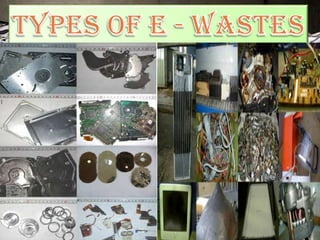
OfficeInformationAndCommunicationEquipment
•DiscardedComputers(CPUwithInputandOutputdevices)
Lightening Equipment
•FluorescentTubes,SodiumLamps,etc..
EntertainmentAndConsumerElectronics
•MobilePhones,Telephones,VCR/DVD/CDPlayers,Hi-FiSets,Radios,etc..
CathodeRayTubes(CRTs)
LargeHousehold Appliances
•WashingMachines,Dryers,AirConditioners,TelevisionSets,Refrigerators
SmallHouseholdAppliances
•Vacuum,Coffee Machines,Irons,Toasters,etc..
ElectricAndElectronicTools
•Drills,ElectricSaws,SewingMachines,LawnMowersetc..
Toys,Leisure,SportsAndRecreationEquipment
•ElectricTrainSets,CoinSlotMachines,Treadmillsetc..
•CADMIUM
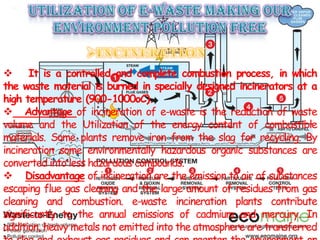
 It is a controlled and complete combustion process, in which
the waste material is burned in specially designed incinerators at a
high temperature (900-1000oC).
 Advantage of incineration of e-waste is the reduction of waste
volume and the Utilization of the energy content of combustible
materials. Some plants remove iron from the slag for recycling. By
incineration some environmentally hazardous organic substances are
converted into less hazardous compounds.
 Disadvantage of incineration are the emission to air of substances
escaping flue gas cleaning and the large amount of residues from gas
cleaning and combustion. e-waste incineration plants contribute
significantly to the annual emissions of cadmium and mercury. In
addition, heavy metals not emitted into the atmosphere are transferred
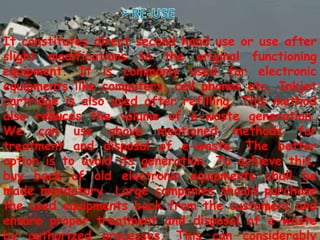
It constitutes direct second hand use or use after
slight modifications to the original functioning
equipment. It is commonly used for electronic
equipments like computers, cell phones etc. Inkjet
cartridge is also used after refilling. This method
also reduces the volume of e-waste generation.
We can use above mentioned methods for
treatment and disposal of e-waste. The better
option is to avoid its generation. To achieve this,
buy back of old electronic equipments shall be
made mandatory. Large companies should purchase
the used equipments back from the customers and
ensure proper treatment and disposal of e-waste
by authorized processes. This can considerably
 In landfilling, trenches are made on the flat surfaces. Soil is
excavated from the trenches and waste material is buried in it, which
is covered by a thick layer of soil. Modern techniques like secure
landfill are provided with some facilities like, impervious liner made up
of plastic or clay, leachate collection basin that collects and transfer
the leachate to wastewater treatment plant. The degradation
processes in landfills are very complicated and run over a wide time
span.
 The environmental risks from landfilling of e-waste cannot be
neglected because the conditions in a landfill site are different from a
native soil, particularly concerning the leaching behavior of metals.
Mercury, cadmium and lead are the most toxic leachates. Lead has
been found to leach from broken lead-containing glass, such as the
cone glass of cathode ray tubes from TVs and monitors. Cadmium also
leaches into soil and ground water. In addition, it is known that
cadmium and mercury are emitted in diffuse form or via the landfill
gas combustion plant. Landfills are also prone to uncontrolled fires,
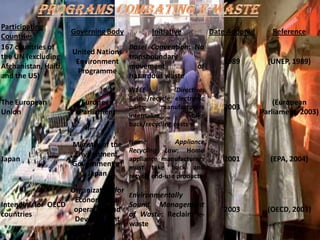
Participating
Countries
Governing Body Initiative Date Adopted Reference
167 countries of
the UN (excluding
Afghanistan, Haiti,
and the US)
United Nations
Environment
Programme
Basel Convention: No
transboundary
movement of
hazardous waste
1989 (UNEP, 1989)
The European
Union
European
Parliament
WEEE Directive:
Reuse/recycle electronic
parts; manufacturers
internalize take
back/recycling costs
2003
(European
Parliament, 2003)
Japan
Ministry of the
Environment,
Government of
Japan
Home Appliance
Recycling Law: Home
appliance manufacturers
must take back and
recycle end-use products
2001 (EPA, 2004)
Intended for OECD
countries
Organization for
Economic Co-
operation and
Development
(OECD)
Environmentally
Sound Management
of Waste: Reclaim e-
waste
2003 (OECD, 2003)
E-WASTE POWERPOINT PRESENTATION

E-WASTE POWERPOINT PRESENTATION

  • 1.
  • 3.
  • 4.
  • 9.
     It isa controlled and complete combustion process, in which the waste material is burned in specially designed incinerators at a high temperature (900-1000oC).  Advantage of incineration of e-waste is the reduction of waste volume and the Utilization of the energy content of combustible materials. Some plants remove iron from the slag for recycling. By incineration some environmentally hazardous organic substances are converted into less hazardous compounds.  Disadvantage of incineration are the emission to air of substances escaping flue gas cleaning and the large amount of residues from gas cleaning and combustion. e-waste incineration plants contribute significantly to the annual emissions of cadmium and mercury. In addition, heavy metals not emitted into the atmosphere are transferred
  • 11.
    It constitutes directsecond hand use or use after slight modifications to the original functioning equipment. It is commonly used for electronic equipments like computers, cell phones etc. Inkjet cartridge is also used after refilling. This method also reduces the volume of e-waste generation. We can use above mentioned methods for treatment and disposal of e-waste. The better option is to avoid its generation. To achieve this, buy back of old electronic equipments shall be made mandatory. Large companies should purchase the used equipments back from the customers and ensure proper treatment and disposal of e-waste by authorized processes. This can considerably
  • 12.
     In landfilling,trenches are made on the flat surfaces. Soil is excavated from the trenches and waste material is buried in it, which is covered by a thick layer of soil. Modern techniques like secure landfill are provided with some facilities like, impervious liner made up of plastic or clay, leachate collection basin that collects and transfer the leachate to wastewater treatment plant. The degradation processes in landfills are very complicated and run over a wide time span.  The environmental risks from landfilling of e-waste cannot be neglected because the conditions in a landfill site are different from a native soil, particularly concerning the leaching behavior of metals. Mercury, cadmium and lead are the most toxic leachates. Lead has been found to leach from broken lead-containing glass, such as the cone glass of cathode ray tubes from TVs and monitors. Cadmium also leaches into soil and ground water. In addition, it is known that cadmium and mercury are emitted in diffuse form or via the landfill gas combustion plant. Landfills are also prone to uncontrolled fires,
  • 13.
    Participating Countries Governing Body InitiativeDate Adopted Reference 167 countries of the UN (excluding Afghanistan, Haiti, and the US) United Nations Environment Programme Basel Convention: No transboundary movement of hazardous waste 1989 (UNEP, 1989) The European Union European Parliament WEEE Directive: Reuse/recycle electronic parts; manufacturers internalize take back/recycling costs 2003 (European Parliament, 2003) Japan Ministry of the Environment, Government of Japan Home Appliance Recycling Law: Home appliance manufacturers must take back and recycle end-use products 2001 (EPA, 2004) Intended for OECD countries Organization for Economic Co- operation and Development (OECD) Environmentally Sound Management of Waste: Reclaim e- waste 2003 (OECD, 2003)