ELECTRONIC WASTESOURCES AND CHARACTERSTICSJYOTI VERMA I M.Tech10519002
PRESENTATION OUTLINEIntroduction
E-Waste
Composition
Impacts of e-waste
Indian E-waste scenario
Conclusion INTRODUCTIONElectronics industry is the world's largest and fastest growing manufacturing industry.
Rapid growth, combined with rapid product obsolescence and discarded electronics is now the fastest growing waste fraction, accounting for 8% of all municipal waste in European Union (The Economist, 2005).
In developing countries, on an average it equals to 1% of total solid waste and is expected to grow to 2% by 2010 (UNEP, 2009)E-WasteThere is no generally accepted definition of e-waste
Electronic waste commonly known as E-waste or Waste Electrical and Electronic Equipment (WEEE), or end-of-life electronic are the electronic appliances such as computers, laptops, TVs, DVD players, mobile phones, MP3 players etc. including their assembly, sub-assembly, components and consumables, which have been disposed of or unwanted by their original users(Bhuie et al.,2004).
Mobile phones; factsAccording to TRAI-India added 113.26 million new cellular customers in 2008,
an average 9.5 million customers added every month. Cellular market grew from 168.11 million in 2003–2004 to 261.97 million in 2007–2008 (TRAI, 2007–2008).
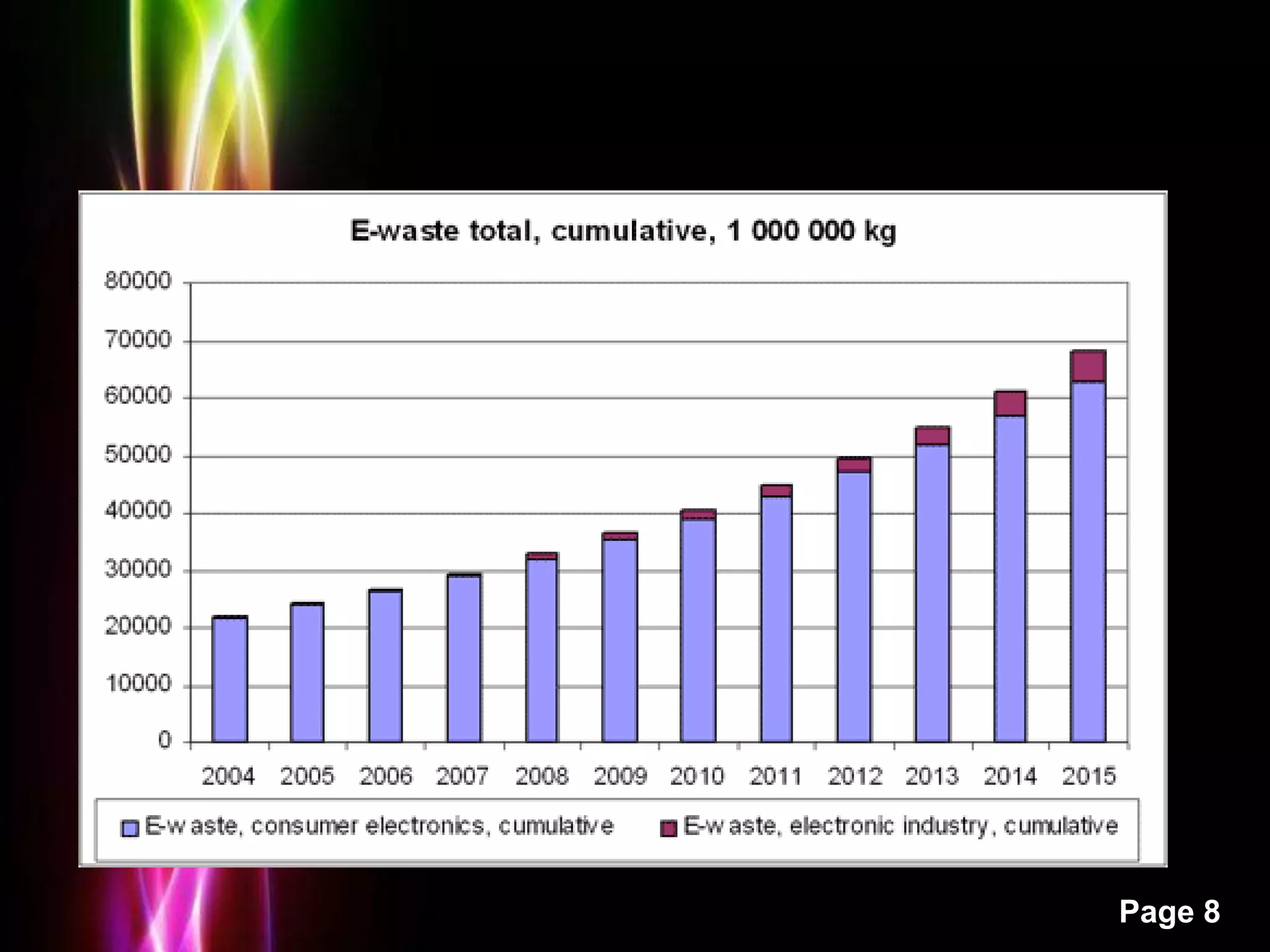
E-waste accumulation in China
Composition of E-waste     Electronic appliances are composed of hundreds of different materials that can be both toxic but also of high value . It consist of-    1.Valuable material2.Hazardous material    (DEFRA, 2004)
Valuable Materials     Gold, silver, copper, platinum etc. are valuable substances which turn recycling of e-waste into a lucrative business opportunity.
Hazardous Material    The recycling of hazardous substances, e.g. carcinogens such as lead and arsenic ,CRT, Capacitors, Mercury switches and relays, Batteries, Liquid crystal displays is critical and poses serious health risks and environment dangers of not properly handled
Of particular concern is Lead in e-waste Lead is a toxic substances which may cause lead poisoning and can be especially harmful young children.
A typical 17-inch computer monitor contains approximately 2.2 pounds of lead
the 500 million computers that  became obsolete between 1997 and 2007 will contain nearly 1.6 billion pounds of lead
Impacts Of E-waste Electronic wastes can cause widespread environmental damage due to the use of toxic materials
Toxic Materials releases highly toxic dioxins and furans when burned
Land filling of e wastes can lead to the leaching of lead into the ground water.
If the CRT is crushed and burned, it emits toxic fumes into the air (Ramachandra and Saira, 2004)
The cadmium from one mobile phone battery is enough to pollute 600 m3 of water (Trick, 2002).Indian E-waste ScenarioIncreasing quantity of e-waste
WEEE generation is about 146000 tonne per year
The top states in order of highest contribution to WEEE include Maharashtra, Andhra Pradesh, Tamil Nadu, Uttar Pradesh, West Bengal, Delhi, Karnataka, Gujarat. The ranked list of cities as WEEE generators are Mumbai, Delhi, Bangalore, Chennai, Kolkata, AhmadabadHyderabad (IRGSSA, 2005)Contd....Most of the e-waste is dumped from developed countries.
at recycling units in New Delhi (India) itself, 70% of the total electronic waste collected was actually exported or dumped by developed countries (Toxic Link,2004)
by 2020, E-waste from old computers in India will jumped by 500%; from discarded mobile phones will be about 18 times high(UNEP 2010 report)E-waste trade cycle in IndiaE-waste management system is notdeveloped.

E Waste And Management

  • 1.
    ELECTRONIC WASTESOURCES ANDCHARACTERSTICSJYOTI VERMA I M.Tech10519002
  • 2.
  • 3.
  • 4.
  • 5.
  • 6.
  • 7.
    Conclusion INTRODUCTIONElectronics industryis the world's largest and fastest growing manufacturing industry.
  • 8.
    Rapid growth, combinedwith rapid product obsolescence and discarded electronics is now the fastest growing waste fraction, accounting for 8% of all municipal waste in European Union (The Economist, 2005).
  • 9.
    In developing countries,on an average it equals to 1% of total solid waste and is expected to grow to 2% by 2010 (UNEP, 2009)E-WasteThere is no generally accepted definition of e-waste
  • 10.
    Electronic waste commonlyknown as E-waste or Waste Electrical and Electronic Equipment (WEEE), or end-of-life electronic are the electronic appliances such as computers, laptops, TVs, DVD players, mobile phones, MP3 players etc. including their assembly, sub-assembly, components and consumables, which have been disposed of or unwanted by their original users(Bhuie et al.,2004).
  • 12.
    Mobile phones; factsAccordingto TRAI-India added 113.26 million new cellular customers in 2008,
  • 13.
    an average 9.5million customers added every month. Cellular market grew from 168.11 million in 2003–2004 to 261.97 million in 2007–2008 (TRAI, 2007–2008).
  • 14.
  • 15.
    Composition of E-waste Electronic appliances are composed of hundreds of different materials that can be both toxic but also of high value . It consist of- 1.Valuable material2.Hazardous material (DEFRA, 2004)
  • 16.
    Valuable Materials Gold, silver, copper, platinum etc. are valuable substances which turn recycling of e-waste into a lucrative business opportunity.
  • 17.
    Hazardous Material The recycling of hazardous substances, e.g. carcinogens such as lead and arsenic ,CRT, Capacitors, Mercury switches and relays, Batteries, Liquid crystal displays is critical and poses serious health risks and environment dangers of not properly handled
  • 18.
    Of particular concernis Lead in e-waste Lead is a toxic substances which may cause lead poisoning and can be especially harmful young children.
  • 19.
    A typical 17-inchcomputer monitor contains approximately 2.2 pounds of lead
  • 20.
    the 500 millioncomputers that became obsolete between 1997 and 2007 will contain nearly 1.6 billion pounds of lead
  • 21.
    Impacts Of E-wasteElectronic wastes can cause widespread environmental damage due to the use of toxic materials
  • 22.
    Toxic Materials releaseshighly toxic dioxins and furans when burned
  • 23.
    Land filling ofe wastes can lead to the leaching of lead into the ground water.
  • 24.
    If the CRTis crushed and burned, it emits toxic fumes into the air (Ramachandra and Saira, 2004)
  • 25.
    The cadmium fromone mobile phone battery is enough to pollute 600 m3 of water (Trick, 2002).Indian E-waste ScenarioIncreasing quantity of e-waste
  • 26.
    WEEE generation isabout 146000 tonne per year
  • 27.
    The top statesin order of highest contribution to WEEE include Maharashtra, Andhra Pradesh, Tamil Nadu, Uttar Pradesh, West Bengal, Delhi, Karnataka, Gujarat. The ranked list of cities as WEEE generators are Mumbai, Delhi, Bangalore, Chennai, Kolkata, AhmadabadHyderabad (IRGSSA, 2005)Contd....Most of the e-waste is dumped from developed countries.
  • 28.
    at recycling unitsin New Delhi (India) itself, 70% of the total electronic waste collected was actually exported or dumped by developed countries (Toxic Link,2004)
  • 29.
    by 2020, E-wastefrom old computers in India will jumped by 500%; from discarded mobile phones will be about 18 times high(UNEP 2010 report)E-waste trade cycle in IndiaE-waste management system is notdeveloped.
  • 30.
  • 31.
    The life cycleof the EEE in India can broadly be divided in to three levels-
  • 32.
    Level I —EEE generation
  • 33.
  • 34.
    Level III-WEEE re-processingLevelI-EEE generationmarks the actual entry of the new electrical and electronic equipments, raw materials, components, assemblies and sub-assemblies in India either in the form of production by the producers and manufacturers who are located in India, or in the form of its import from the foreign countries by the importers.
  • 35.
    Up to thislevel the sector is well organized in India.Level II-WEEE GenerationThe domestic as well as official consumers are the real users of EEE, who purchases the generated new EEE from the actors of first level, in order to serve their present need.
  • 36.
    Level III-WEEE ReprocessingThisstage can be divided into two stages-Pre-reprocessing stageReprocessing stage
  • 37.
    In pre-reprocessing andreprocessing stage
  • 38.
    Problems with e-wasteProblemsassociated with the e-waste management-its ever increasing quantumits scientific and environment friendly disposal
  • 39.
    Management and disposalof e-waste has become a serious problem among states nationwide.
  • 40.
    The problem ofelectronic waste (e-waste) is growing at an unsustainable rate.
  • 41.
    E-waste is nowthe fastest growing, and most toxic, component of municipal garbage.
  • 42.
    Local governments arefacing huge costs to handle e-waste, and even greater costs if they do not capture this toxic stream and handle it in an appropriate manner. Problems specific to developing countriesAlthough the quantity of e-waste per capita is still relatively small, populous countries such as China and India are already huge producers of e-waste in absolute terms (Empa, 2005)
  • 43.
    These countries alsodisplay the fastest growing markets for electrical and electronic equipment.
  • 44.
    Some developingand transition countries are importing considerable quantities of e-waste. Some of them arrive as donations meant to help the poor, while others are simply mislabelled.Each one of us has a role to play!Need for a e-waste policy and legislation
  • 45.
    Encourage and facilitateorganized recycling systems
  • 46.
    Should subsidies recyclingand disposal industries
  • 47.
    Collect fee frommanufactured/consumers for the disposal of toxic material
  • 48.
    Incentive schemes forgarbage collectors and general public for collecting and handling over e-waste
  • 49.
    Awareness programs one-waste for school children and general publiccontinuationTransparency and accountability to the public Handling large amounts of e-waste poses risks of toxic contamination to workers and surrounding communities if conducted carelessly.
  • 50.
    Thus, the mostbasic criterion that employees and citizens should rightfully expect from any recycling operation is that it be open to public inspection. continuationGeneral compliance with occupational health and safety standards Observance of health and safety standards in the workplace is important for protecting workers from exposure to toxics whilst handling e-waste
  • 51.
    Well-trained workers,who are fully protected by the law to seek advice and take action to protect their health and the environment without fear of reprisal from their employer, are the most effective environmental protection. ConclusionIt is important that we create a national framework for the environmentally sound management of e-waste including wide public awareness and education
  • 52.
  • 53.
    Initiate pilot schemeson collection and sorting of e-wastes , including take back schemes and schemes for repair refurbishment and recyclingReferencesA roadmap for development of sustainable E-waste management system in India Sushant B. Wath ⁎, Atul N. Vaidya, P.S. Dutt, TapanChakrabartiNational Environmental Engineering Research Institute (NEERI), Nehru Marg, Nagpur-440 020, India
  • 54.