SPECIAL ECONOMIC
 ZONE’S IN INDIA
PRESENTED BY,
     SOP 2- MBA A BATCH


                ABIN THOMAS
                AKHIL VIJAYAN
                MANU CHACKO
                PRASANTH.C.NAIR
                JIMSHIYA ASARIPPARAMBIL
                SINU RAJ
SPECIAL ECONOMIC ZONE

• Geographical region that economic and other

  laws are free market oriented

• Nation wide rules suspended inside SEZ
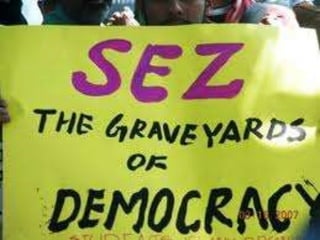
• Main goal is increase in FDI and GDP

It covers a broad range of specific zones such as:

• Free Trade Zone(FTZ)

• Economic Processing Zones(EPZ)

• Industrial Parks

• Free Ports
SALIENT FEATURES OF SEZ
• Self certification for export and import

       Import and export movements of goods are based on
         self declaration

       No routine examination is made unless specific order
         from    Development Commissioner or authority.

• Sub contracting

       A SEZ unit may sub contract a part of it’s product or
        production process to different units, even in abroad
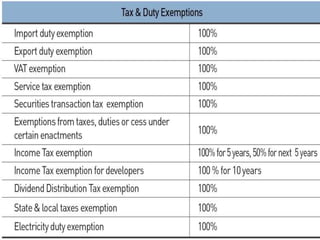
• Fiscal incentives-Tax
   Exemption from excise        and customers duty on
     procurement of capital assets, consumable stores,
     raw-materials from domestic market
   Exemption from sales tax, import duty, Income tax,
     minimum alternative tax and dividend distribution tax

• Single Window Clearance
   Submit regularity documents at single
     locations
   Less proceedings and save time
• Sales in DTA permitted
     Domestic Tariff Are
     Are within India and outside SEZ
     Goods,rejects,remnants etc arising
      during manufacturing can be sold on DTA
    Duties applicable
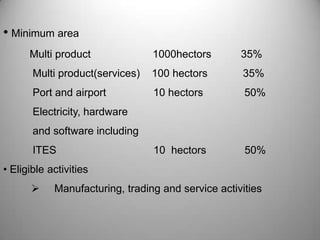
• Minimum area
      Multi product              1000hectors        35%
       Multi product(services)   100 hectors        35%
       Port and airport          10 hectors          50%
       Electricity, hardware
       and software including
       ITES                      10 hectors          50%
• Eligible activities
           Manufacturing, trading and service activities
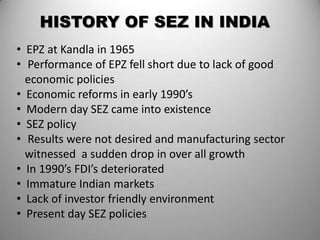
HISTORY OF SEZ IN INDIA
• EPZ at Kandla in 1965
• Performance of EPZ fell short due to lack of good
  economic policies
• Economic reforms in early 1990’s
• Modern day SEZ came into existence
• SEZ policy
• Results were not desired and manufacturing sector
  witnessed a sudden drop in over all growth
• In 1990’s FDI’s deteriorated
• Immature Indian markets
• Lack of investor friendly environment
• Present day SEZ policies
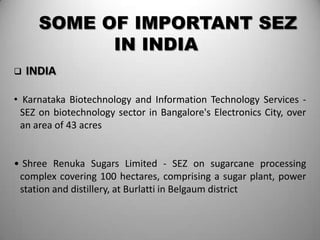
SOME OF IMPORTANT SEZ
            IN INDIA
   INDIA

• Karnataka Biotechnology and Information Technology Services -
  SEZ on biotechnology sector in Bangalore's Electronics City, over
  an area of 43 acres


• Shree Renuka Sugars Limited - SEZ on sugarcane processing
 complex covering 100 hectares, comprising a sugar plant, power
 station and distillery, at Burlatti in Belgaum district
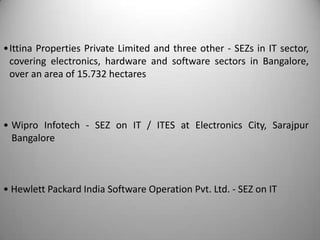
•Ittina Properties Private Limited and three other - SEZs in IT sector,
 covering electronics, hardware and software sectors in Bangalore,
 over an area of 15.732 hectares


• Wipro Infotech - SEZ on IT / ITES at Electronics City, Sarajpur
  Bangalore


• Hewlett Packard India Software Operation Pvt. Ltd. - SEZ on IT
• Food processing and related SEZ services in Hassan, over an
 area of 157.91 hectares

• SEZs on pharmaceuticals, biotechnology and chemical
  sectors in Hassan, covering of 281.21 hectares

•   SEEPZ - Andheri (East), Mumbai
•   Khopata - Multi-product, Mumbai
•   Navi Mumbai - Multi-product, Mumbai
•   Salt Lake Electronic City, West Bengal
•   Manikanchan - Jems and jewelery, West Bengal
•   Calcutta Leather Complex, West Bengal
•   Falta food processing unit, West Bengal
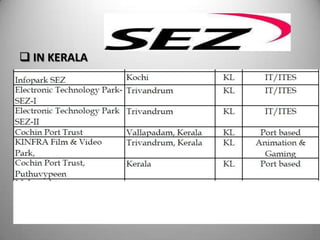
 IN KERALA
 NAME OF DEVELOPERS   LOCATION   STATE   TYPE OF SEZ
OBJECTIVES OF SEZ ACT

• Generation of additional economic activity
• Promotion of exports of goods and services
• Promotion of investment from domestic and
  foreign sources
• Creation of employment opportunities
• Development of infrastructure facilities
ROLE OF SEZ IN INDIAN
             ECONOMY
• To provide internationally competitive environment
• To encourage FDI and enhance GDP
• To increase share in global exports
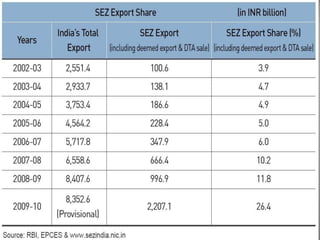
 SEZ exports accounting for 26% of India’s total export in
  2011.


                                                              15
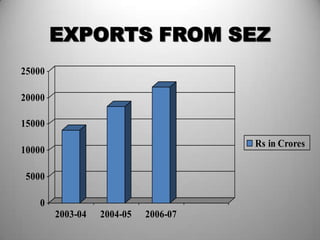
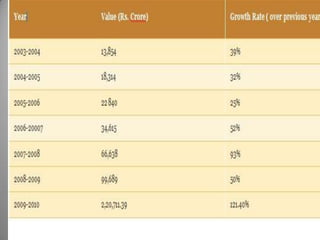
EXPORTS FROM SEZ
25000

20000

15000
                                      Rs in Crores
10000

 5000

    0
        2003-04   2004-05   2006-07
                                             16
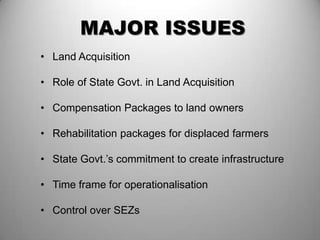
MAJOR ISSUES
• Land Acquisition

• Role of State Govt. in Land Acquisition

• Compensation Packages to land owners

• Rehabilitation packages for displaced farmers

• State Govt.’s commitment to create infrastructure

• Time frame for operationalisation

• Control over SEZs
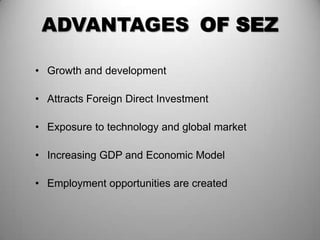
ADVANTAGES OF SEZ

• Growth and development

• Attracts Foreign Direct Investment

• Exposure to technology and global market

• Increasing GDP and Economic Model

• Employment opportunities are created
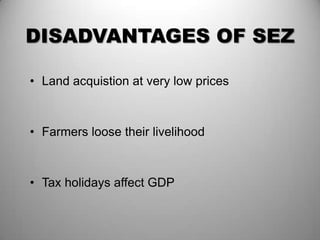
DISADVANTAGES OF SEZ

• Land acquistion at very low prices


• Farmers loose their livelihood


• Tax holidays affect GDP
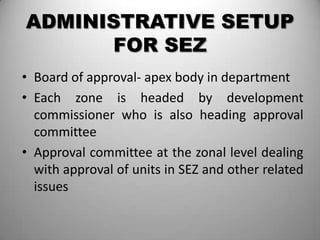
ADMINISTRATIVE SETUP
      FOR SEZ
• Board of approval- apex body in department
• Each zone is headed by development
  commissioner who is also heading approval
  committee
• Approval committee at the zonal level dealing
  with approval of units in SEZ and other related
  issues
BOARD OF APPROVAL

• Duty   to     promote    and    ensure    orderly
 development of SEZ

• Chairperson    of   board-special   secretary   to
 government of India in ministry of commerce and
 industry, dept of commerce consists of 18
 members and nominee of each state govt.
MAJOR FUNCTIONS OF THE
          BOARD
• Granting approval or rejecting proposal or modifying the
  approvals for establishment of SEZ

• Granting   approval    of   authorised   operations   by   the
  developer in the SEZ

• Granting approval to the developers or units for foreign
  collaborations and FDI in SEZ for its development
  ,operations and maintenance

• Granting approval or rejecting of proposal for providing
  infrastructure facilities in SEZ
DEVELOPMENT COMMISSIONER
• Central government may appoint any of its
  officers not below the rank of Deputy Secretary
  to government of India as the development
  commissioner of one or more special economic
  zone
• Every development commissioner shall take all
  steps in order to discharge his function to insure
  speedy development of SEZ and promotion of
  exports
MAJOR FUNCTIONS OF
 DEVELOPMENT COMMISSIONER
• Guide the entrepreneurs for setting up of units in SEZ

• Ensure and take suitable steps for effective promotion of
  exports for SEZ

• Ensure    proper coordination with central government or
  State Government departments concerned

• Monitor the performance of the developer and units in a
  SEZ
APPROVAL COMMITTE

• Every SEZ has one approval committee

• 9 members

• Chairperson- Development commissioner
MAJOR FUNCTIONS OF APPROVAL
         COMMITTE
• Approve the import or procurement of goods from
  the Domestic Traffic Area, in the SEZ for carrying
  on the authorised operations by the developer
• Approve of services by a service provider, from
  outside or from the D.T.A
• Monitor the utilisation of goods and services or
  warehousing of trading in SEZ
• Approve, modify or reject proposals for setting up
  units for manufacturing or rendering services or
  warehousing trading in the SEZ
SWOT ANALYSIS OF INDIAN SEZ
 STRENGTH
• Based on Western model or SEZ in China
• An established legal redress system
• Relatively low labour costs
• Employment opportunities
• India’s large English speaking and skilled
  workforce
• Exposure to technology and global market
• Worldwide acceptance of capabilities in fields
  like
  • Pharmaceutical manufacturing & research
  • Clinical trials
  • Manufacturing auto parts
  • Engineering designing & consultancy, IT & ITES
  • Malls and hotels
  • Hospital

• Financial & other institutional Networks like
  Insurance Companies
 WEAKNESS


•   Poor infrastructure and transport
    facilities
• High cost of capital
• Inadequate institutional support
• Political changes
• Inappropriate locations
 OPPORTUNITIES

• An alternative manufacturing base, particularly

 compared to Chinese SEZs
• Investments in core strength areas like IT and
 software products and services.
• New small ports & airports are also being
 developed keeping SEZ concept in mind
• A large NRI base who have traditionally invested
 less in Greenfield development in India
 THREATS
• The pattern of buying & selling may not
 continue. With relocations of industries in other
 third world countries, new competitors will
 emerge
• opposing interests
• Prospect of even more restrictive labour laws
  being introduced
• Increasing rejection rate for proposals to
  establish SEZs
CONCLUSION
• scope of human capital formation and technology upgrading
        •
   effects will widen.
• Government to play a pro active role in strengthening these
   effects.
• linkages between the domestic economy and Special
  Economic Zones.
• Effects of Special Economic Zones are contingent upon the
  success of these zones in attracting Foreign Direct
  Investment.
THANK YOU…

Final sez

  • 1.
  • 2.
    PRESENTED BY, SOP 2- MBA A BATCH ABIN THOMAS AKHIL VIJAYAN MANU CHACKO PRASANTH.C.NAIR JIMSHIYA ASARIPPARAMBIL SINU RAJ
  • 3.
    SPECIAL ECONOMIC ZONE •Geographical region that economic and other laws are free market oriented • Nation wide rules suspended inside SEZ • Main goal is increase in FDI and GDP
  • 4.
    It covers abroad range of specific zones such as: • Free Trade Zone(FTZ) • Economic Processing Zones(EPZ) • Industrial Parks • Free Ports
  • 5.
    SALIENT FEATURES OFSEZ • Self certification for export and import  Import and export movements of goods are based on self declaration  No routine examination is made unless specific order from Development Commissioner or authority. • Sub contracting  A SEZ unit may sub contract a part of it’s product or production process to different units, even in abroad
  • 6.
    • Fiscal incentives-Tax  Exemption from excise and customers duty on procurement of capital assets, consumable stores, raw-materials from domestic market  Exemption from sales tax, import duty, Income tax, minimum alternative tax and dividend distribution tax • Single Window Clearance  Submit regularity documents at single locations  Less proceedings and save time
  • 7.
    • Sales inDTA permitted  Domestic Tariff Are  Are within India and outside SEZ  Goods,rejects,remnants etc arising during manufacturing can be sold on DTA Duties applicable
  • 8.
    • Minimum area Multi product 1000hectors 35% Multi product(services) 100 hectors 35% Port and airport 10 hectors 50% Electricity, hardware and software including ITES 10 hectors 50% • Eligible activities  Manufacturing, trading and service activities
  • 9.
    HISTORY OF SEZIN INDIA • EPZ at Kandla in 1965 • Performance of EPZ fell short due to lack of good economic policies • Economic reforms in early 1990’s • Modern day SEZ came into existence • SEZ policy • Results were not desired and manufacturing sector witnessed a sudden drop in over all growth • In 1990’s FDI’s deteriorated • Immature Indian markets • Lack of investor friendly environment • Present day SEZ policies
  • 10.
    SOME OF IMPORTANTSEZ IN INDIA  INDIA • Karnataka Biotechnology and Information Technology Services - SEZ on biotechnology sector in Bangalore's Electronics City, over an area of 43 acres • Shree Renuka Sugars Limited - SEZ on sugarcane processing complex covering 100 hectares, comprising a sugar plant, power station and distillery, at Burlatti in Belgaum district
  • 11.
    •Ittina Properties PrivateLimited and three other - SEZs in IT sector, covering electronics, hardware and software sectors in Bangalore, over an area of 15.732 hectares • Wipro Infotech - SEZ on IT / ITES at Electronics City, Sarajpur Bangalore • Hewlett Packard India Software Operation Pvt. Ltd. - SEZ on IT
  • 12.
    • Food processingand related SEZ services in Hassan, over an area of 157.91 hectares • SEZs on pharmaceuticals, biotechnology and chemical sectors in Hassan, covering of 281.21 hectares • SEEPZ - Andheri (East), Mumbai • Khopata - Multi-product, Mumbai • Navi Mumbai - Multi-product, Mumbai • Salt Lake Electronic City, West Bengal • Manikanchan - Jems and jewelery, West Bengal • Calcutta Leather Complex, West Bengal • Falta food processing unit, West Bengal
  • 13.
     IN KERALA NAME OF DEVELOPERS LOCATION STATE TYPE OF SEZ
  • 14.
    OBJECTIVES OF SEZACT • Generation of additional economic activity • Promotion of exports of goods and services • Promotion of investment from domestic and foreign sources • Creation of employment opportunities • Development of infrastructure facilities
  • 15.
    ROLE OF SEZIN INDIAN ECONOMY • To provide internationally competitive environment • To encourage FDI and enhance GDP • To increase share in global exports  SEZ exports accounting for 26% of India’s total export in 2011. 15
  • 16.
    EXPORTS FROM SEZ 25000 20000 15000 Rs in Crores 10000 5000 0 2003-04 2004-05 2006-07 16
  • 19.
    MAJOR ISSUES • LandAcquisition • Role of State Govt. in Land Acquisition • Compensation Packages to land owners • Rehabilitation packages for displaced farmers • State Govt.’s commitment to create infrastructure • Time frame for operationalisation • Control over SEZs
  • 21.
    ADVANTAGES OF SEZ •Growth and development • Attracts Foreign Direct Investment • Exposure to technology and global market • Increasing GDP and Economic Model • Employment opportunities are created
  • 22.
    DISADVANTAGES OF SEZ •Land acquistion at very low prices • Farmers loose their livelihood • Tax holidays affect GDP
  • 23.
    ADMINISTRATIVE SETUP FOR SEZ • Board of approval- apex body in department • Each zone is headed by development commissioner who is also heading approval committee • Approval committee at the zonal level dealing with approval of units in SEZ and other related issues
  • 24.
    BOARD OF APPROVAL •Duty to promote and ensure orderly development of SEZ • Chairperson of board-special secretary to government of India in ministry of commerce and industry, dept of commerce consists of 18 members and nominee of each state govt.
  • 25.
    MAJOR FUNCTIONS OFTHE BOARD • Granting approval or rejecting proposal or modifying the approvals for establishment of SEZ • Granting approval of authorised operations by the developer in the SEZ • Granting approval to the developers or units for foreign collaborations and FDI in SEZ for its development ,operations and maintenance • Granting approval or rejecting of proposal for providing infrastructure facilities in SEZ
  • 26.
    DEVELOPMENT COMMISSIONER • Centralgovernment may appoint any of its officers not below the rank of Deputy Secretary to government of India as the development commissioner of one or more special economic zone • Every development commissioner shall take all steps in order to discharge his function to insure speedy development of SEZ and promotion of exports
  • 27.
    MAJOR FUNCTIONS OF DEVELOPMENT COMMISSIONER • Guide the entrepreneurs for setting up of units in SEZ • Ensure and take suitable steps for effective promotion of exports for SEZ • Ensure proper coordination with central government or State Government departments concerned • Monitor the performance of the developer and units in a SEZ
  • 28.
    APPROVAL COMMITTE • EverySEZ has one approval committee • 9 members • Chairperson- Development commissioner
  • 29.
    MAJOR FUNCTIONS OFAPPROVAL COMMITTE • Approve the import or procurement of goods from the Domestic Traffic Area, in the SEZ for carrying on the authorised operations by the developer • Approve of services by a service provider, from outside or from the D.T.A • Monitor the utilisation of goods and services or warehousing of trading in SEZ • Approve, modify or reject proposals for setting up units for manufacturing or rendering services or warehousing trading in the SEZ
  • 30.
    SWOT ANALYSIS OFINDIAN SEZ  STRENGTH • Based on Western model or SEZ in China • An established legal redress system • Relatively low labour costs • Employment opportunities • India’s large English speaking and skilled workforce • Exposure to technology and global market
  • 31.
    • Worldwide acceptanceof capabilities in fields like • Pharmaceutical manufacturing & research • Clinical trials • Manufacturing auto parts • Engineering designing & consultancy, IT & ITES • Malls and hotels • Hospital • Financial & other institutional Networks like Insurance Companies
  • 32.
     WEAKNESS • Poor infrastructure and transport facilities • High cost of capital • Inadequate institutional support • Political changes • Inappropriate locations
  • 33.
     OPPORTUNITIES • Analternative manufacturing base, particularly compared to Chinese SEZs • Investments in core strength areas like IT and software products and services. • New small ports & airports are also being developed keeping SEZ concept in mind • A large NRI base who have traditionally invested less in Greenfield development in India
  • 34.
     THREATS • Thepattern of buying & selling may not continue. With relocations of industries in other third world countries, new competitors will emerge • opposing interests • Prospect of even more restrictive labour laws being introduced • Increasing rejection rate for proposals to establish SEZs
  • 35.
    CONCLUSION • scope ofhuman capital formation and technology upgrading • effects will widen. • Government to play a pro active role in strengthening these effects. • linkages between the domestic economy and Special Economic Zones. • Effects of Special Economic Zones are contingent upon the success of these zones in attracting Foreign Direct Investment.
  • 41.