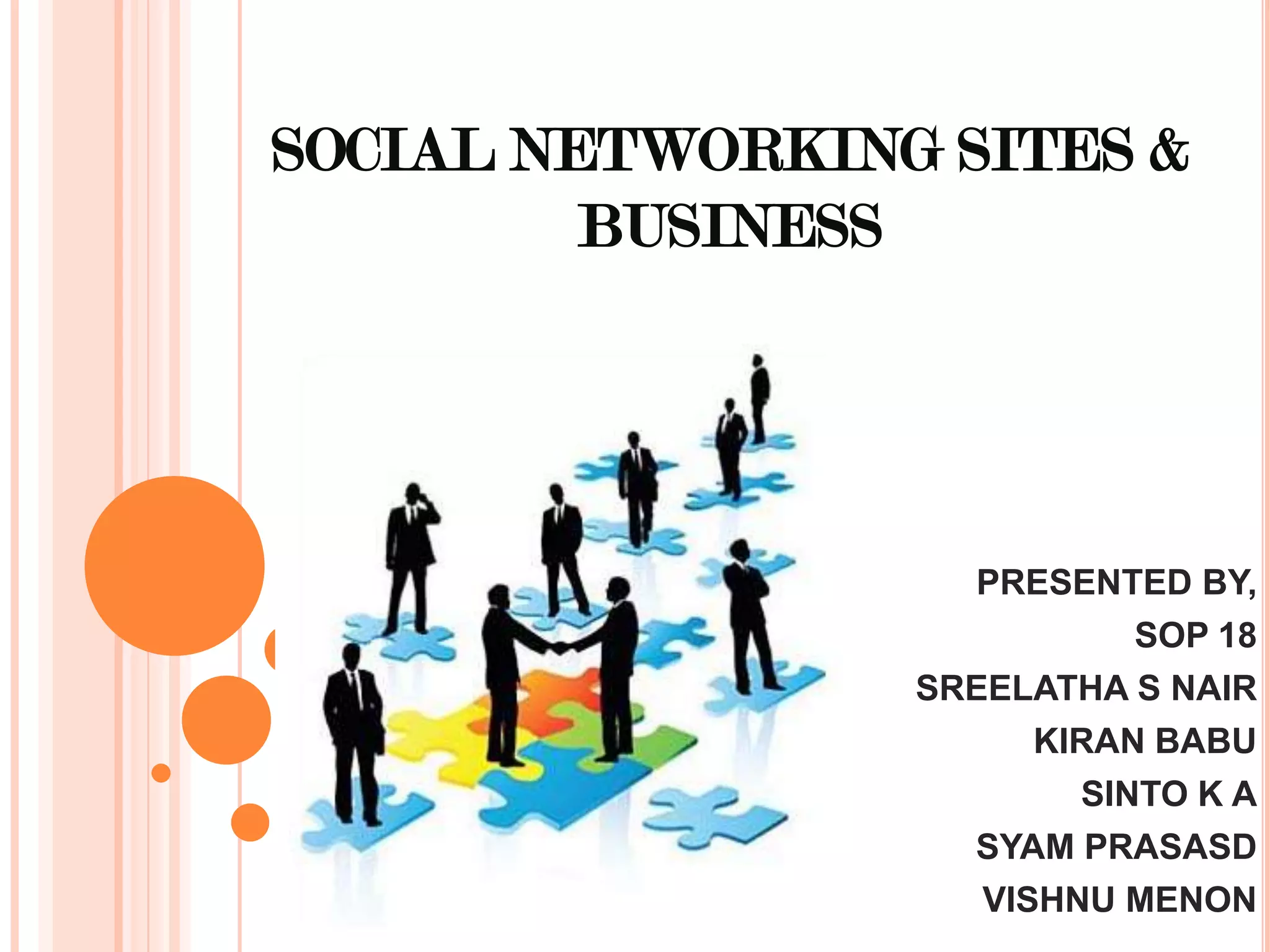
SOCIAL NETWORKING SITES &
         BUSINESS


                   PRESENTED BY,
                            SOP 18
                 SREELATHA S NAIR
                       KIRAN BABU
                         SINTO K A
                   SYAM PRASASD
                    VISHNU MENON
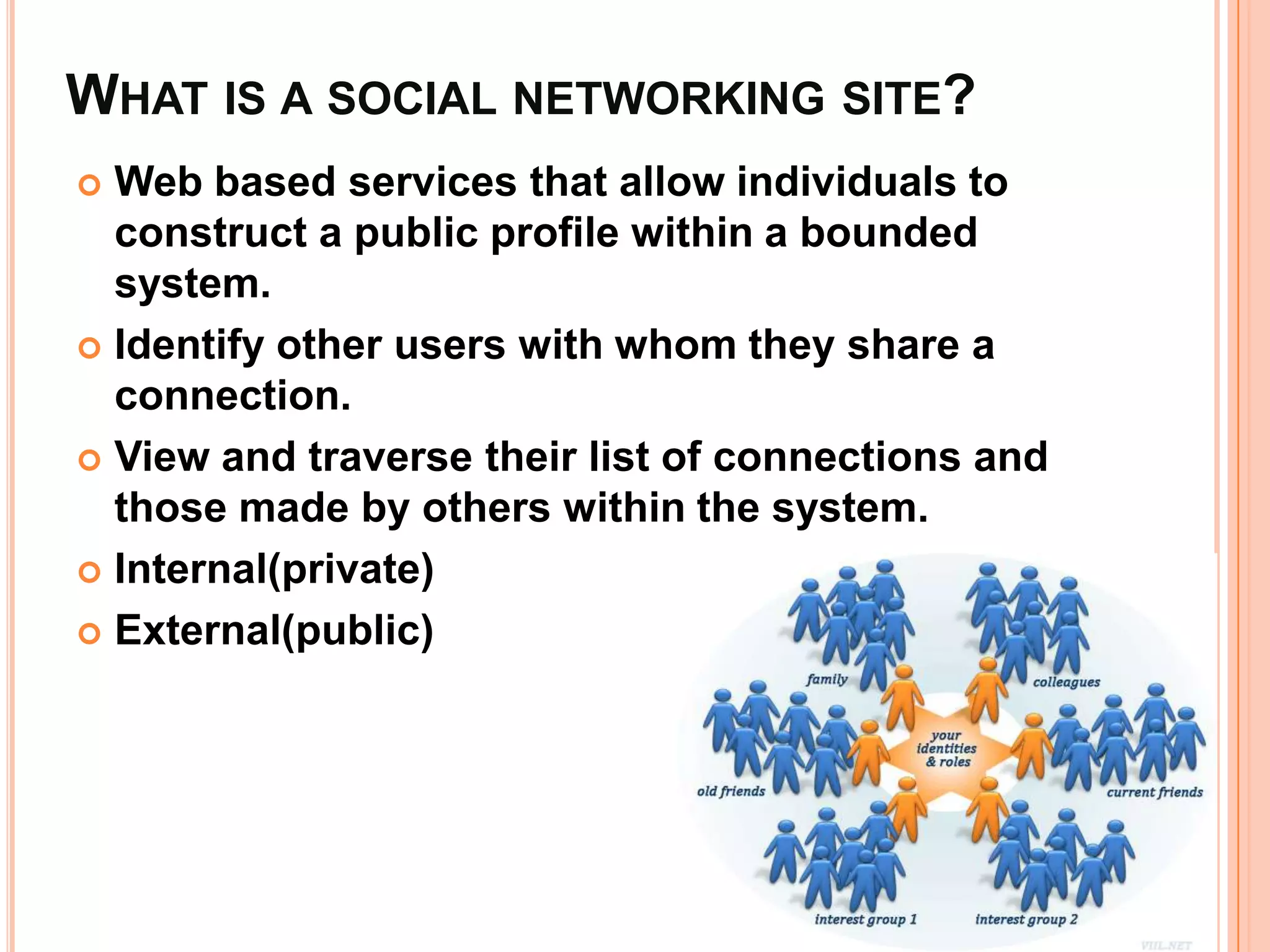
WHAT IS A SOCIAL NETWORKING SITE?
 Web based services that allow individuals to
  construct a public profile within a bounded
  system.
 Identify other users with whom they share a
  connection.
 View and traverse their list of connections and
  those made by others within the system.
 Internal(private)

 External(public)
HISTORY OF SNS
THE EARLY YEARS…

SIX DEGREES
 1st recognizable social network site launched in
  1997 – sixdegrees.com
 Allowed creation of profiles and listing friends

 Helped to send messages and attracted millions
  of users
 2000-service closed
HISTORY (CONT.)
FRIENDSTER
 Launched in 2002
 Designed to compete with Match.com

 Gained wide popularity

 Later on encountered technical and social
  difficulties
 2000 onwards many new SNSs were launched.
  While socially organized SNSs solicit broad
  audiences, professional sites such as LinkedIn,
  Visible path and Xing focus on business people.
HISTORY (CONT.)
MYSPACE
 Begun in 2003
 Regularly added new features

 Teenagers joined in mass in 2004

 User policy allows minors

 Safety issues plagued MySpace after 2005
HISTORY (CONT.)

FACEBOOK
 Started in early 2004 as a Harvard only SNS
 Gradually spread to
  schools, colleges, institutions, professionals
  inside corporate networks and eventually
  everyone
 Users are unable to make full profile public

 Features differentiating FB
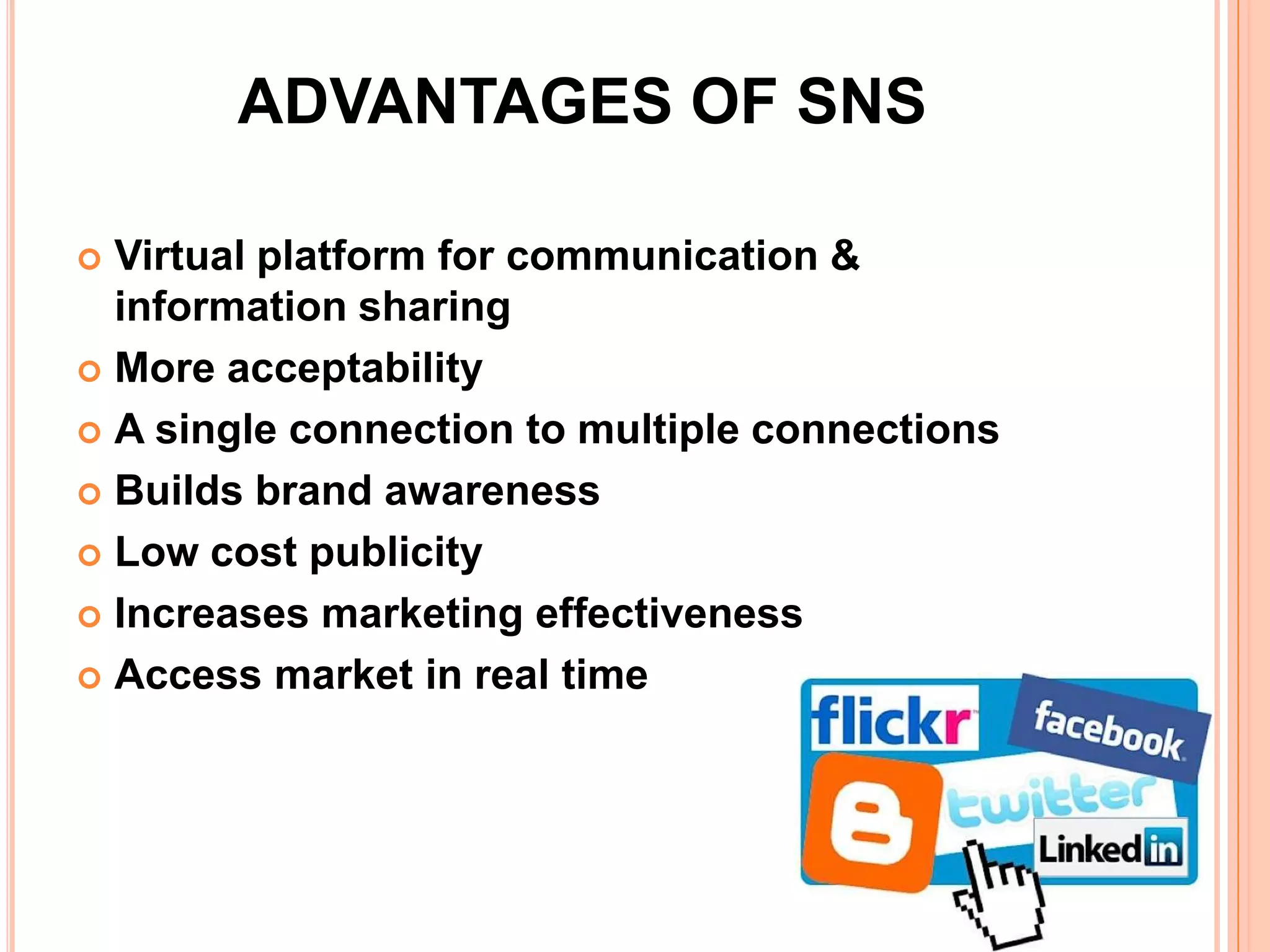
ADVANTAGES OF SNS

 Virtual platform for communication &
  information sharing
 More acceptability

 A single connection to multiple connections

 Builds brand awareness

 Low cost publicity

 Increases marketing effectiveness

 Access market in real time
ADVANTAGES (CONTD.)

 Makes people with common interest under one
  roof
 Taking word of mouth to another level
  communication
 Open environment – Easy gathering of right
  customers
 Research platform
DISADVANTAGES OF SNS
 Lack of Anonymity
 Scams

 Harassments

 Lack of privacy

 Chance of loss of personal data

 Time consuming
BUSINESS OUTLOOK WITH SNS
   Effective on SNS personal users
   Direct connection with World- Wide Customers
   Business Networking & Expansion
   Important Marketing Tool
   Entertainment Marketing
   Low Cost publicity
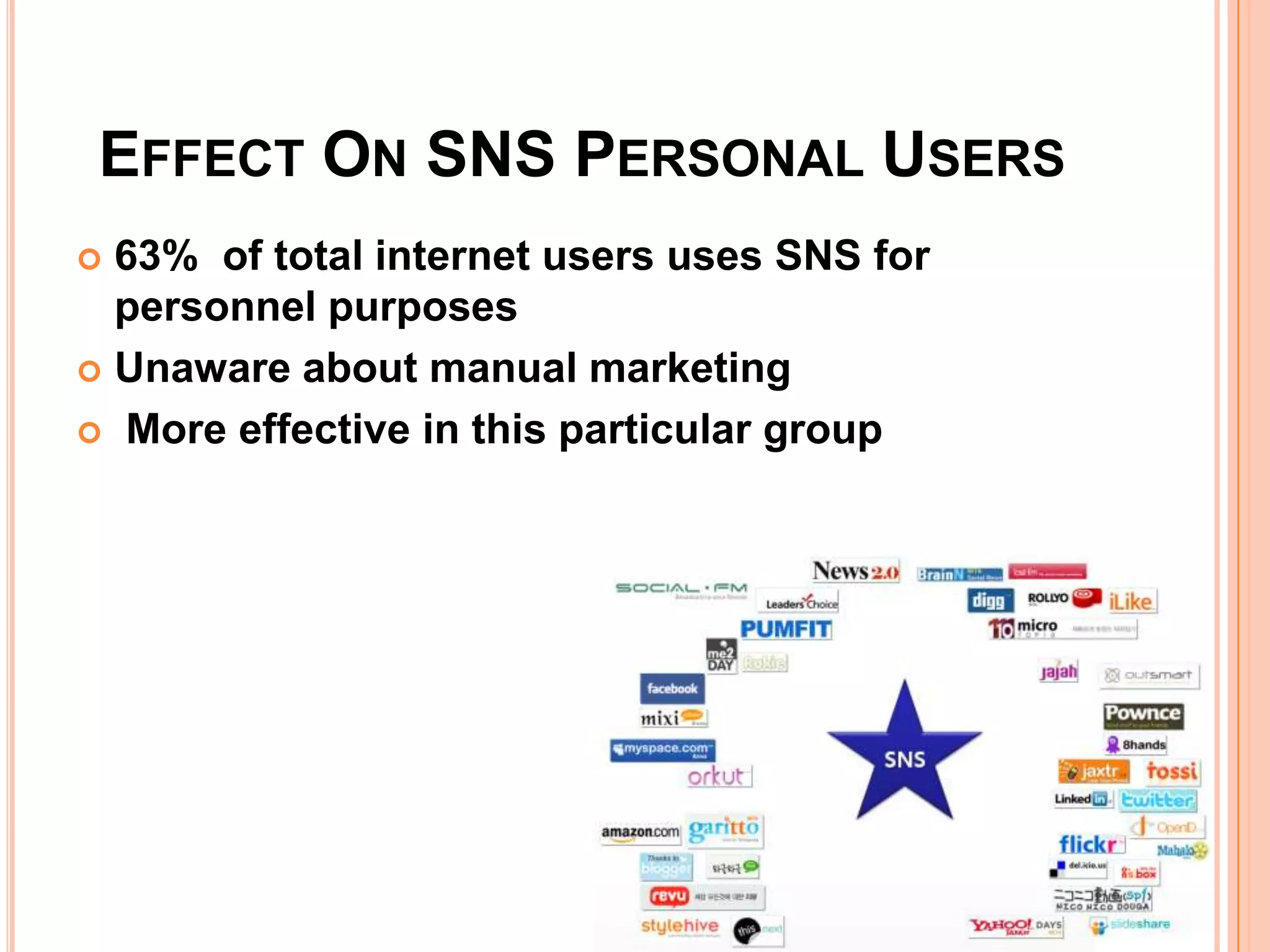
EFFECT ON SNS PERSONAL USERS
 63% of total internet users uses SNS for
  personnel purposes
 Unaware about manual marketing

 More effective in this particular group
DIRECT CONNECTION WITH WORLD WIDE
           CUSTOMERS
 Rise of internet marketing
 Considers SNS marketing as best direct
  communication
 No barriers regarding places or countries

 World communication under one umbrella

 Comfortable feedback device

 E.g.: Virgin Train & Twitter
MARKETING TOOL
 Chance to make trail experiments
 Researching tool

 Single networking system

 Low cost

 Attracts customers by discount coupons

 E.g.: Dell & Twitter generates 6.5 million $
MAJOR SOCIAL NETWORKING
         SITES

 FACEBOOK
 TWITTER

 MYSPACE

 NING

 GOOGLE PLUS
FACEBOOK
  Launched in February 2004, operated and
  privately owned by Facebook, Inc.
 700 million monthly users
 Facebook was founded by Mark
  Zuckerberg with his college roommates and
  fellow computer science students
 In January 2009 Compete.com study ranked
  Facebook as the most used social networking
  service by worldwide monthly active users.
 Most of Facebook's revenue comes from
  advertising. Microsoft is Facebook's exclusive
  partner for serving banner advertising
 Created in March 2006 by Jack Dorsey
 Online social networking and micro
  blogging service, enables its users to send and
  read text-based posts of up to 140 characters.
 200 million users in 2011, generating over 200
  million tweets and handling over 1.6
  billion search queries per day.
 SMS of the Internet.
 Launched in August 2003 and is headquartered
  in Beverly Hills, California.
 Owned by Specific Media LLC and pop
  star Justin Timberlake.
 80 million monthly users

 From 2005 until early 2008, Myspace was the
  most visited social networking site in the world.
  In June 2006 Google surpassed myspace
 But on April 19, 2008, Facebook overtook
  Myspace in the Alexa rankings
   Online platform for people and organizations to
    create custom social networks
   Launched in October 2005
   Offers customers the ability to create a community
    website with a customized appearance and feel.
   There are over 90,000 (as of June 2011) social
    websites, known as Ning Networks, running on the
    Ning Platform.
   As of June 2011, Ning has 65 million monthly
    unique visitors globally on its platform
   Ning was co-founded by Marc Andreessen and Gina
    Bianchins.
   On September 21, 2011, the company announced its
    merger with Glam Media.
GOOGLE PLUS
 A social network operated by Google.
 Launched on June 28th, 2011 with integrations
  across a number of Google products, including
  Buzz and Profiles.
 Key element is ‘CIRCLES’

 I t has a section specifically for viewing,
  managing and editing multimedia
 ‘Hangout Feature’
SOME BUSINESS SNS

   XING

   RYZE

   LINKEDIN

   ECADEMY
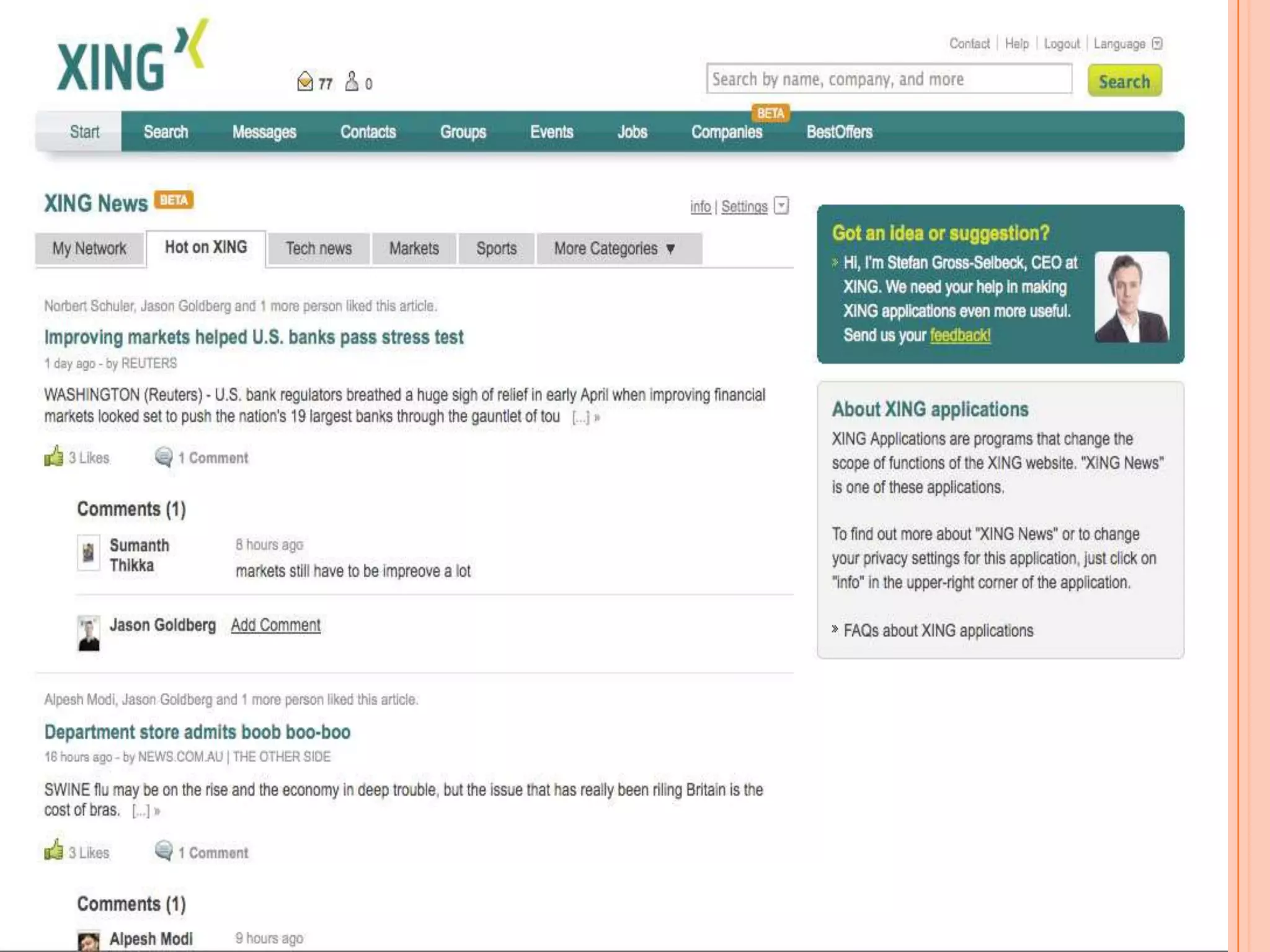
XING
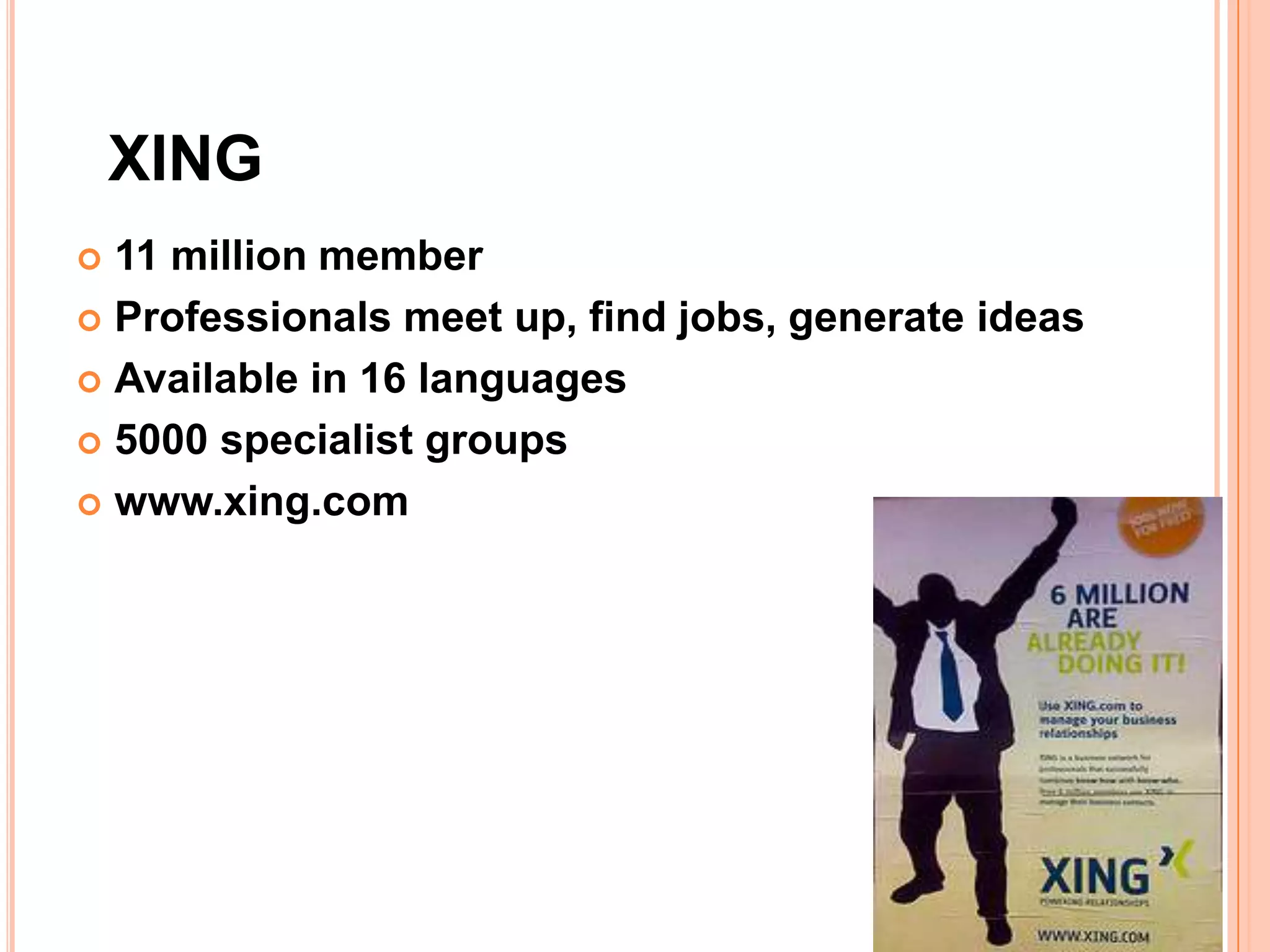
 11 million member
 Professionals meet up, find jobs, generate ideas

 Available in 16 languages

 5000 specialist groups

 www.xing.com
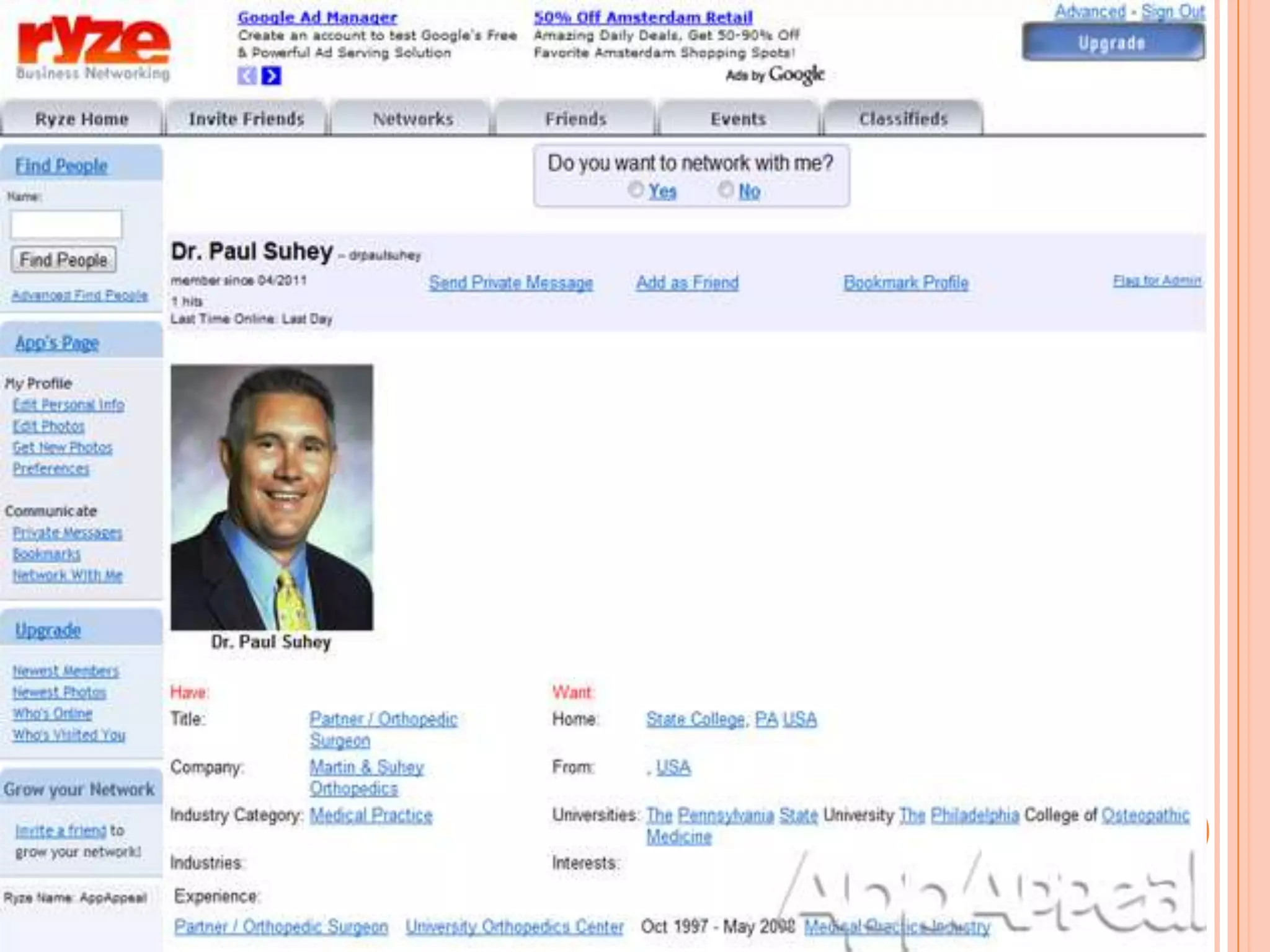
RYZE
 5,00,000+ users,200 countries
 Helps people make connections and grow their
  networks
 Build career, find job, make sales

 Networking among business firms

 www.ryze.com
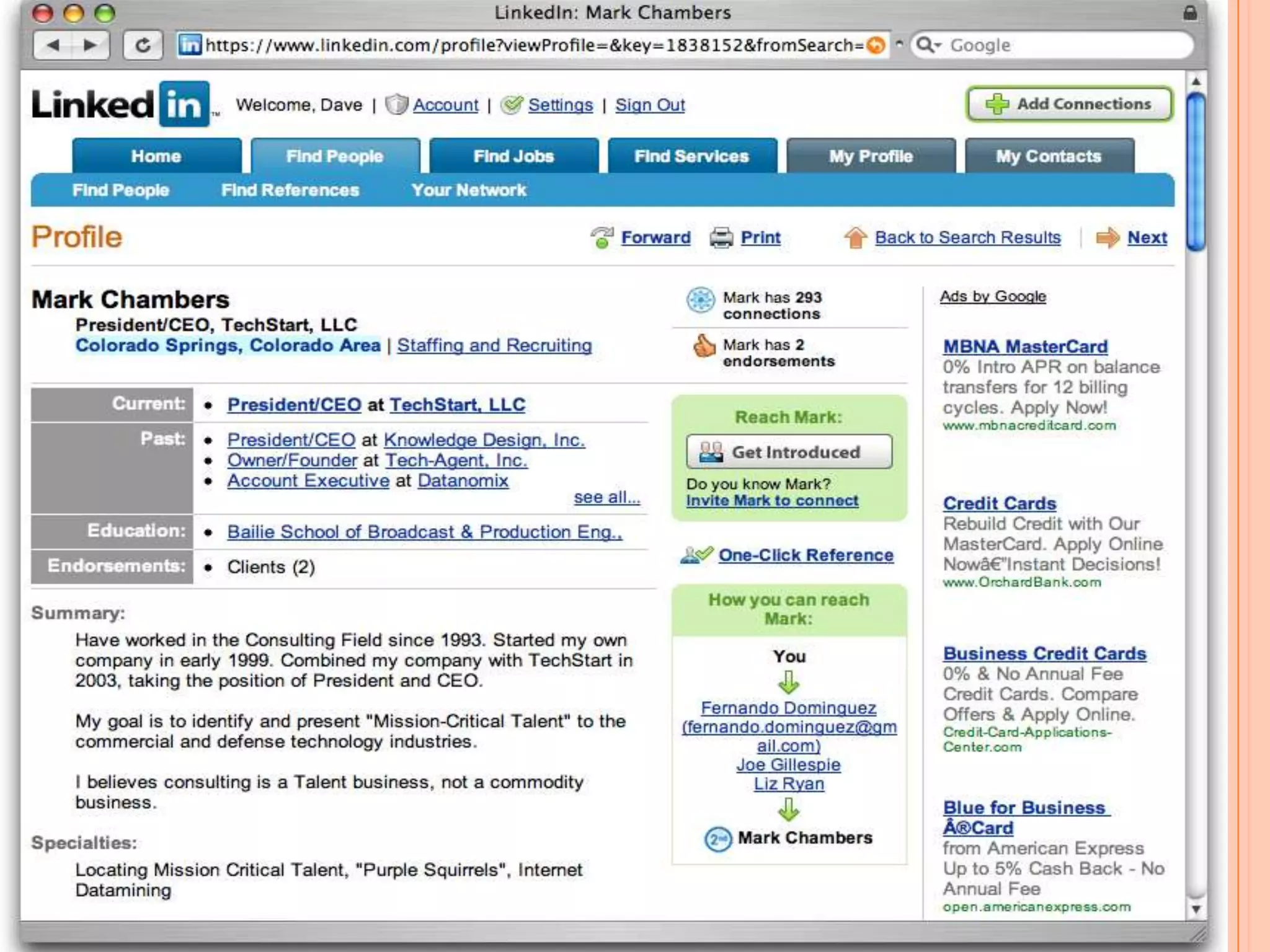
LINKEDIN
 Launched in may 2003
 120 million registered users,200+ countries

 Available in 9 languages

 10 million+ members from India

 More than 2 million companies have LinkedIn
  pages
 For building professional business
  relationships
 Formal communication

 www.linkedin.com/
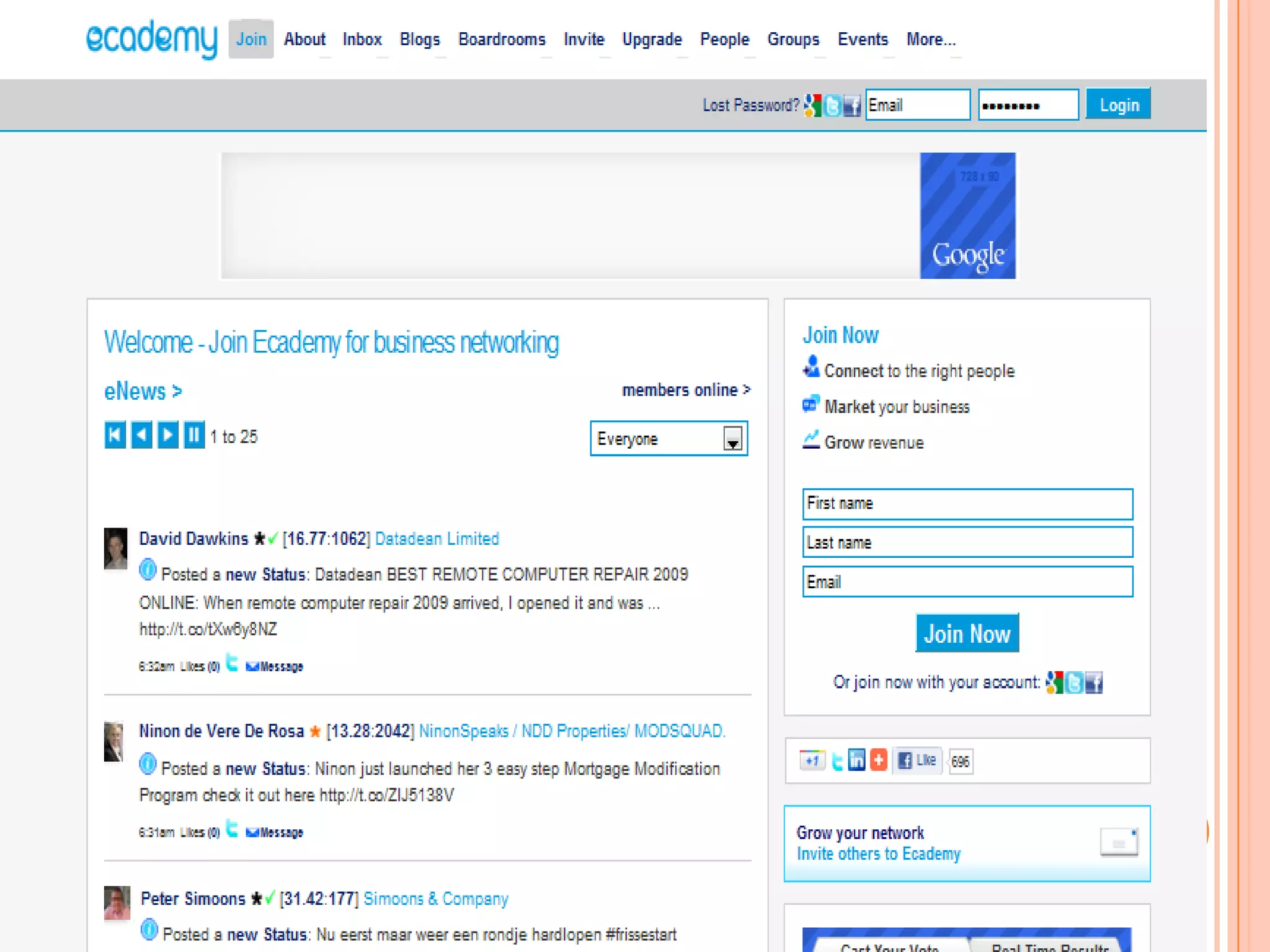
ECADEMY
 Began in 1998
 1,00,000+ members

 Meant for business owners and entrepreneurs

 Simple learning steps-know me, like me, follow
  me
SOME FACTS ABOUT SNS
 70% SNS users access SNS everyday
 According to telecom regulatory authority of
  India, there are 83 million internet users in India
 Mobile devices comes with a built in SNS

 SNS through mobiles expected to reach 72
  million by 2014
 SNS is a fast emerging medium for seeking
  information
COMPANIES THAT SUCCESSFULLY MADE
USE OF SNS
1) JET AIRWAYS
 Launched their facebook page in January,2010
  (www.facebook.com/jetairways)
 Extended its presence to LinkedIn &
  foursquare(a location based mobile SNS)
 Saw an immense response,1.5 lakh fans
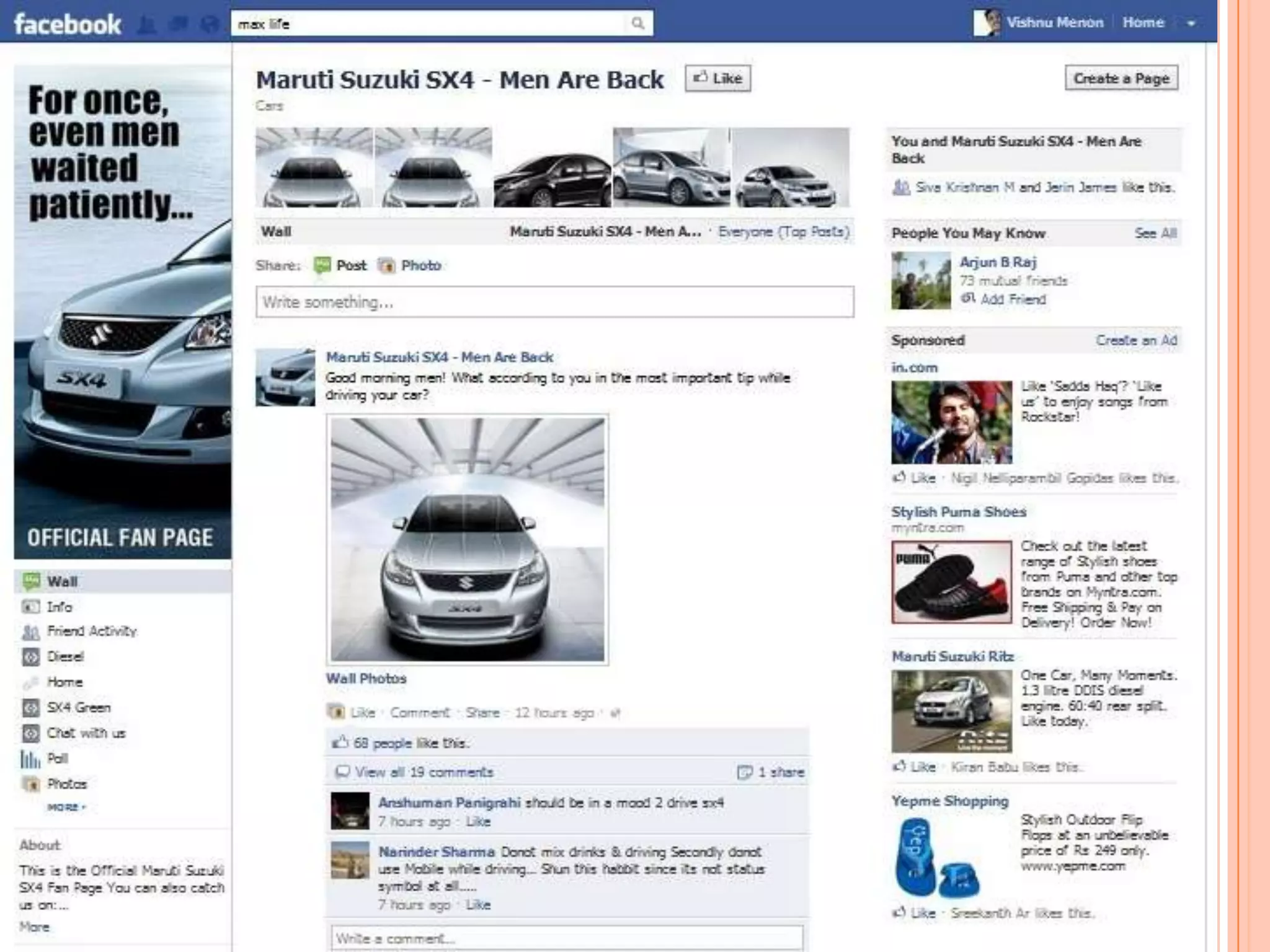
2)MARUTI SUZUKI
 largest selling automobile manufacturer in
  INDIA
 Common man’s first preference

 Maruti’s Brands in SNS – SX4, SWIFT
  DESIRE, RITZ, ALTO, A STAR
 Targeted youth who spends time in SNS


3)MAX NEWYORK LIFE INSURANCE
 Started an SNS page to attract customers and
  answer to their queries
4)HBO – Largest fan base in entertainment
  channels category
 ADIDAS took over from NIKE & REEBOK during
  2011
 Leads with 7 lakh+ fans


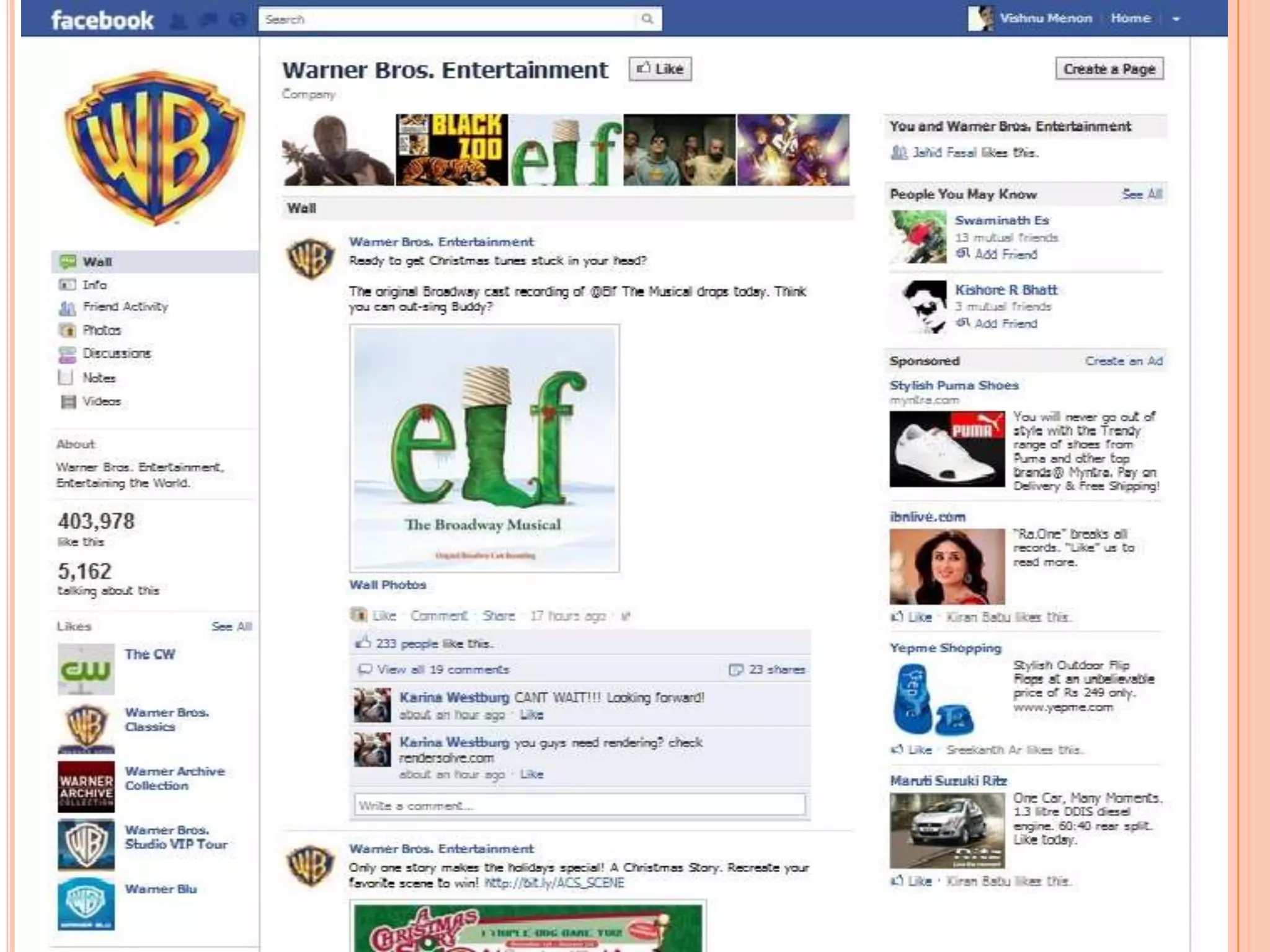
5) Warner Bros.
 Launched ‘batman’ in facebook

 Viewed with the help of facebook credits
SNS AS A BUSINESS TOOL
 Seeking and exchanging of information
 interaction with customers

 building relationship and trust

 improving internal communication

 business performance

 More valuable connection with customers

 branding

 Comparatively cheaper means of brand
  promotion
POINTS TO BE CONSIDERED
 Understand the fundamentals of communication
  and technology
 Never create pages just on the buzz

 Have knowledge on SNS marketing

 Have to be more about conversations than
  declarations
 Should involve free expression and &
  relationship building
 Has to be frequently updated

 Should use SNS with traditional means of
  Marketing intelligence and communication
SNS AS A BUSINESS TOOL(CONT.)
 Competitive insights
 Recruitment and retention of customers &
  business partners
 Reputation building

 Helps to gain customer support

 Helps to handle complaints, questions and
  delivers real time solutions
 Influences revenue & market shares
CONCLUSION
 In this present age of increased
  consumerism, business are trying to bring in
  new strategies to attract customers. As a
  result, the relevance and use of social media by
  the business has been on a rise in the recent
  years.
 It’s a cheaper marketing strategy

 Consumers promote the brand

 Forms an important part of a ‘netizens’ life

 SNS has been the most desirable platform to
  share and connect with friends, family or online
  community at large.

Social networking sites_business_sop_18

  • 1.
    SOCIAL NETWORKING SITES& BUSINESS PRESENTED BY, SOP 18 SREELATHA S NAIR KIRAN BABU SINTO K A SYAM PRASASD VISHNU MENON
  • 2.
    WHAT IS ASOCIAL NETWORKING SITE?  Web based services that allow individuals to construct a public profile within a bounded system.  Identify other users with whom they share a connection.  View and traverse their list of connections and those made by others within the system.  Internal(private)  External(public)
  • 3.
    HISTORY OF SNS THEEARLY YEARS… SIX DEGREES  1st recognizable social network site launched in 1997 – sixdegrees.com  Allowed creation of profiles and listing friends  Helped to send messages and attracted millions of users  2000-service closed
  • 4.
    HISTORY (CONT.) FRIENDSTER  Launchedin 2002  Designed to compete with Match.com  Gained wide popularity  Later on encountered technical and social difficulties  2000 onwards many new SNSs were launched. While socially organized SNSs solicit broad audiences, professional sites such as LinkedIn, Visible path and Xing focus on business people.
  • 5.
    HISTORY (CONT.) MYSPACE  Begunin 2003  Regularly added new features  Teenagers joined in mass in 2004  User policy allows minors  Safety issues plagued MySpace after 2005
  • 6.
    HISTORY (CONT.) FACEBOOK  Startedin early 2004 as a Harvard only SNS  Gradually spread to schools, colleges, institutions, professionals inside corporate networks and eventually everyone  Users are unable to make full profile public  Features differentiating FB
  • 7.
    ADVANTAGES OF SNS Virtual platform for communication & information sharing  More acceptability  A single connection to multiple connections  Builds brand awareness  Low cost publicity  Increases marketing effectiveness  Access market in real time
  • 8.
    ADVANTAGES (CONTD.)  Makespeople with common interest under one roof  Taking word of mouth to another level communication  Open environment – Easy gathering of right customers  Research platform
  • 9.
    DISADVANTAGES OF SNS Lack of Anonymity  Scams  Harassments  Lack of privacy  Chance of loss of personal data  Time consuming
  • 10.
    BUSINESS OUTLOOK WITHSNS  Effective on SNS personal users  Direct connection with World- Wide Customers  Business Networking & Expansion  Important Marketing Tool  Entertainment Marketing  Low Cost publicity
  • 11.
    EFFECT ON SNSPERSONAL USERS  63% of total internet users uses SNS for personnel purposes  Unaware about manual marketing  More effective in this particular group
  • 12.
    DIRECT CONNECTION WITHWORLD WIDE CUSTOMERS  Rise of internet marketing  Considers SNS marketing as best direct communication  No barriers regarding places or countries  World communication under one umbrella  Comfortable feedback device  E.g.: Virgin Train & Twitter
  • 13.
    MARKETING TOOL  Chanceto make trail experiments  Researching tool  Single networking system  Low cost  Attracts customers by discount coupons  E.g.: Dell & Twitter generates 6.5 million $
  • 14.
    MAJOR SOCIAL NETWORKING SITES  FACEBOOK  TWITTER  MYSPACE  NING  GOOGLE PLUS
  • 15.
    FACEBOOK  Launchedin February 2004, operated and privately owned by Facebook, Inc.  700 million monthly users  Facebook was founded by Mark Zuckerberg with his college roommates and fellow computer science students  In January 2009 Compete.com study ranked Facebook as the most used social networking service by worldwide monthly active users.  Most of Facebook's revenue comes from advertising. Microsoft is Facebook's exclusive partner for serving banner advertising
  • 16.
     Created inMarch 2006 by Jack Dorsey  Online social networking and micro blogging service, enables its users to send and read text-based posts of up to 140 characters.  200 million users in 2011, generating over 200 million tweets and handling over 1.6 billion search queries per day.  SMS of the Internet.
  • 17.
     Launched inAugust 2003 and is headquartered in Beverly Hills, California.  Owned by Specific Media LLC and pop star Justin Timberlake.  80 million monthly users  From 2005 until early 2008, Myspace was the most visited social networking site in the world. In June 2006 Google surpassed myspace  But on April 19, 2008, Facebook overtook Myspace in the Alexa rankings
  • 18.
    Online platform for people and organizations to create custom social networks  Launched in October 2005  Offers customers the ability to create a community website with a customized appearance and feel.  There are over 90,000 (as of June 2011) social websites, known as Ning Networks, running on the Ning Platform.  As of June 2011, Ning has 65 million monthly unique visitors globally on its platform  Ning was co-founded by Marc Andreessen and Gina Bianchins.  On September 21, 2011, the company announced its merger with Glam Media.
  • 19.
    GOOGLE PLUS  Asocial network operated by Google.  Launched on June 28th, 2011 with integrations across a number of Google products, including Buzz and Profiles.  Key element is ‘CIRCLES’  I t has a section specifically for viewing, managing and editing multimedia  ‘Hangout Feature’
  • 20.
    SOME BUSINESS SNS  XING  RYZE  LINKEDIN  ECADEMY
  • 21.
    XING  11 millionmember  Professionals meet up, find jobs, generate ideas  Available in 16 languages  5000 specialist groups  www.xing.com
  • 23.
    RYZE  5,00,000+ users,200countries  Helps people make connections and grow their networks  Build career, find job, make sales  Networking among business firms  www.ryze.com
  • 25.
    LINKEDIN  Launched inmay 2003  120 million registered users,200+ countries  Available in 9 languages  10 million+ members from India  More than 2 million companies have LinkedIn pages  For building professional business relationships  Formal communication  www.linkedin.com/
  • 27.
    ECADEMY  Began in1998  1,00,000+ members  Meant for business owners and entrepreneurs  Simple learning steps-know me, like me, follow me
  • 29.
    SOME FACTS ABOUTSNS  70% SNS users access SNS everyday  According to telecom regulatory authority of India, there are 83 million internet users in India  Mobile devices comes with a built in SNS  SNS through mobiles expected to reach 72 million by 2014  SNS is a fast emerging medium for seeking information
  • 30.
    COMPANIES THAT SUCCESSFULLYMADE USE OF SNS 1) JET AIRWAYS  Launched their facebook page in January,2010 (www.facebook.com/jetairways)  Extended its presence to LinkedIn & foursquare(a location based mobile SNS)  Saw an immense response,1.5 lakh fans
  • 31.
    2)MARUTI SUZUKI  largestselling automobile manufacturer in INDIA  Common man’s first preference  Maruti’s Brands in SNS – SX4, SWIFT DESIRE, RITZ, ALTO, A STAR  Targeted youth who spends time in SNS 3)MAX NEWYORK LIFE INSURANCE  Started an SNS page to attract customers and answer to their queries
  • 32.
    4)HBO – Largestfan base in entertainment channels category  ADIDAS took over from NIKE & REEBOK during 2011  Leads with 7 lakh+ fans 5) Warner Bros.  Launched ‘batman’ in facebook  Viewed with the help of facebook credits
  • 35.
    SNS AS ABUSINESS TOOL  Seeking and exchanging of information  interaction with customers  building relationship and trust  improving internal communication  business performance  More valuable connection with customers  branding  Comparatively cheaper means of brand promotion
  • 36.
    POINTS TO BECONSIDERED  Understand the fundamentals of communication and technology  Never create pages just on the buzz  Have knowledge on SNS marketing  Have to be more about conversations than declarations  Should involve free expression and & relationship building  Has to be frequently updated  Should use SNS with traditional means of Marketing intelligence and communication
  • 37.
    SNS AS ABUSINESS TOOL(CONT.)  Competitive insights  Recruitment and retention of customers & business partners  Reputation building  Helps to gain customer support  Helps to handle complaints, questions and delivers real time solutions  Influences revenue & market shares
  • 38.
    CONCLUSION  In thispresent age of increased consumerism, business are trying to bring in new strategies to attract customers. As a result, the relevance and use of social media by the business has been on a rise in the recent years.  It’s a cheaper marketing strategy  Consumers promote the brand  Forms an important part of a ‘netizens’ life  SNS has been the most desirable platform to share and connect with friends, family or online community at large.