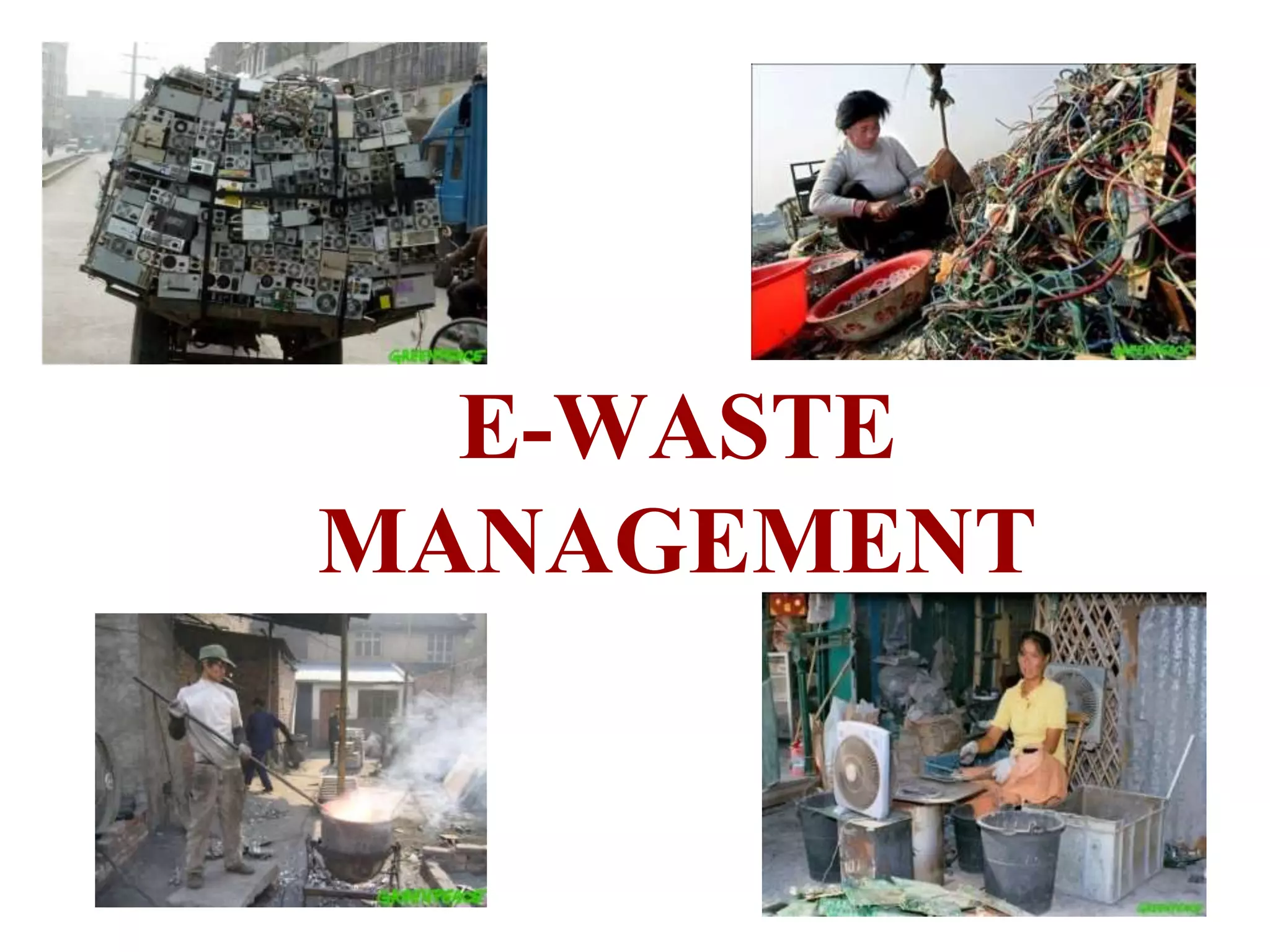
E-WASTE 
MANAGEMENT
E-Waste Topics of Importance 
 What exactly is E-waste? 
 Categories and components of E-waste 
 Dangers of E-waste 
 The sensitive nature of E-waste 
 Laws and regulations 
 Stakeholders in E-waste 
 What can be done with E-waste? 
 E-Waste management initiatives (International) 
 The de-manufacturing and recycle processes
What exactly is E-waste?
E-Waste Items 
 All types of computers and accessories 
 Cell, smart, and home phones 
 Answering machines, tapes and accessories 
 Office equipment (fax machines, printers, & 
copiers) 
 Digital cameras & associated storage devices 
 TVs, DVRs, cable boxes & video equipment 
 Audio equipment and accessories 
 Navigation devices 
 All other electronic devices & storage media
E-Waste Generators 
 Homes & Residences 
 Commercial Businesses 
 Professional Offices 
 Financial Institutions 
 Health Care Industries 
 Large Manufacturing Industries 
 Utilities & Public Services 
 Local, State & Central Governments
Background 
 Obsolescence of technology: outdated within 18 
months 
 Upcoming analog to digital conversion 
 Electronic Waste [Waste EEE (Electric, Electronic 
Equipment)] one of the fast growing waste streams 
all over the world 
 E-waste has been identified as the fastest growing 
waste stream in the world; forecast to soon reach 40 
million tonnes a year. 
 The European Environment Agency has calculated 
that the volume of e-waste is rising about three times 
faster than any other form of municipal waste.
Background 
 Average 1-3% of total solid waste in developed 
countries 
 Increases by 16-28% every 5 years 
 Electric and electronic equipment contain over 1,000 
different substances including toxic heavy metals and 
organics which can pose serious environmental 
pollution problem upon irresponsible disposal 
 E-waste as source hazardous wastes 
 E-waste can be an overland mine for specific metals 
 E-waste is a GLOBAL CRISIS to be challenged
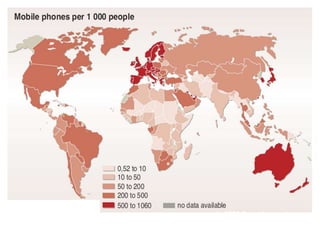
In 2009 Egypt jumped to 
500-1060 mobile phones 
per 1000 people category. 
Source World Bank 2002
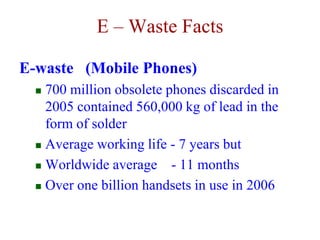
E – Waste Facts 
E-waste (Mobile Phones) 
 700 million obsolete phones discarded in 
2005 contained 560,000 kg of lead in the 
form of solder 
 Average working life - 7 years but 
 Worldwide average - 11 months 
 Over one billion handsets in use in 2006
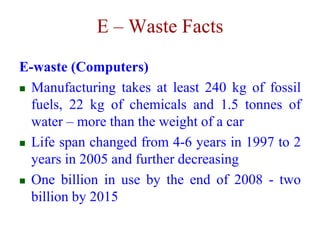
E – Waste Facts 
E-waste (Computers) 
 Manufacturing takes at least 240 kg of fossil 
fuels, 22 kg of chemicals and 1.5 tonnes of 
water – more than the weight of a car 
 Life span changed from 4-6 years in 1997 to 2 
years in 2005 and further decreasing 
 One billion in use by the end of 2008 - two 
billion by 2015
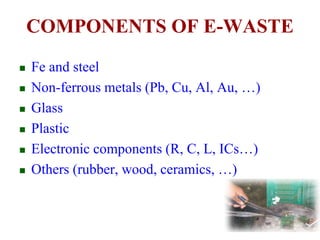
COMPONENTS OF E-WASTE 
 Fe and steel 
 Non-ferrous metals (Pb, Cu, Al, Au, …) 
 Glass 
 Plastic 
 Electronic components (R, C, L, ICs…) 
 Others (rubber, wood, ceramics, …)
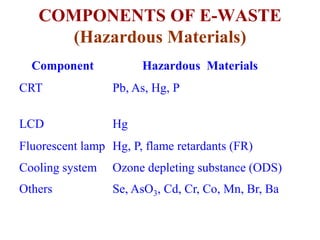
COMPONENTS OF E-WASTE 
(Hazardous Materials) 
Component Hazardous Materials 
CRT Pb, As, Hg, P 
LCD Hg 
Fluorescent lamp Hg, P, flame retardants (FR) 
Cooling system Ozone depleting substance (ODS) 
Others Se, AsO3, Cd, Cr, Co, Mn, Br, Ba
COMPONENTS OF E-WASTE 
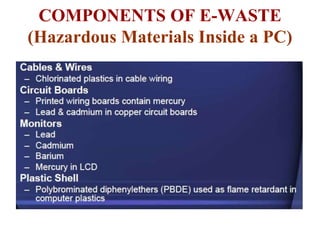
(Hazardous Materials Inside a PC)
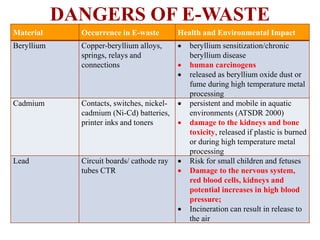
DANGERS OF E-WASTE 
Material Occurrence in E-waste Health and Environmental Impact 
Beryllium Copper-beryllium alloys, 
springs, relays and 
connections 
 beryllium sensitization/chronic 
beryllium disease 
 human carcinogens 
 released as beryllium oxide dust or 
fume during high temperature metal 
processing 
Cadmium Contacts, switches, nickel-cadmium 
(Ni-Cd) batteries, 
printer inks and toners 
 persistent and mobile in aquatic 
environments (ATSDR 2000) 
 damage to the kidneys and bone 
toxicity, released if plastic is burned 
or during high temperature metal 
processing 
Lead Circuit boards/ cathode ray 
tubes CTR 
 Risk for small children and fetuses 
 Damage to the nervous system, 
red blood cells, kidneys and 
potential increases in high blood 
pressure; 
 Incineration can result in release to 
the air
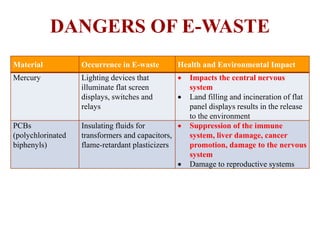
DANGERS OF E-WASTE 
Material Occurrence in E-waste Health and Environmental Impact 
Mercury Lighting devices that 
illuminate flat screen 
displays, switches and 
relays 
 Impacts the central nervous 
system 
 Land filling and incineration of flat 
panel displays results in the release 
to the environment 
PCBs 
(polychlorinated 
biphenyls) 
Insulating fluids for 
transformers and capacitors, 
flame-retardant plasticizers 
 Suppression of the immune 
system, liver damage, cancer 
promotion, damage to the nervous 
system 
 Damage to reproductive systems
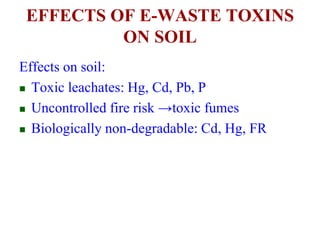
EFFECTS OF E-WASTE TOXINS 
ON SOIL 
Effects on soil: 
 Toxic leachates: Hg, Cd, Pb, P 
 Uncontrolled fire risk →toxic fumes 
 Biologically non-degradable: Cd, Hg, FR
Policies & Regulations 
19
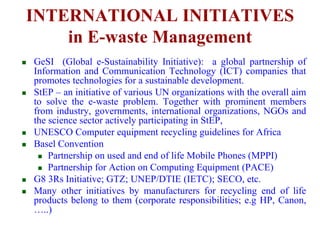
INTERNATIONAL INITIATIVES 
in E-waste Management 
 GeSI (Global e-Sustainability Initiative): a global partnership of 
Information and Communication Technology (ICT) companies that 
promotes technologies for a sustainable development. 
 StEP – an initiative of various UN organizations with the overall aim 
to solve the e-waste problem. Together with prominent members 
from industry, governments, international organizations, NGOs and 
the science sector actively participating in StEP, 
 UNESCO Computer equipment recycling guidelines for Africa 
 Basel Convention 
 Partnership on used and end of life Mobile Phones (MPPI) 
 Partnership for Action on Computing Equipment (PACE) 
 G8 3Rs Initiative; GTZ; UNEP/DTIE (IETC); SECO, etc. 
 Many other initiatives by manufacturers for recycling end of life 
products belong to them (corporate responsibilities; e.g HP, Canon, 
…..)
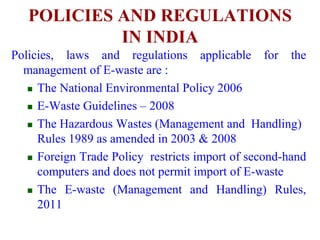
POLICIES AND REGULATIONS 
IN INDIA 
Policies, laws and regulations applicable for the 
management of E-waste are : 
 The National Environmental Policy 2006 
 E-Waste Guidelines – 2008 
 The Hazardous Wastes (Management and Handling) 
Rules 1989 as amended in 2003 & 2008 
 Foreign Trade Policy restricts import of second-hand 
computers and does not permit import of E-waste 
 The E-waste (Management and Handling) Rules, 
2011
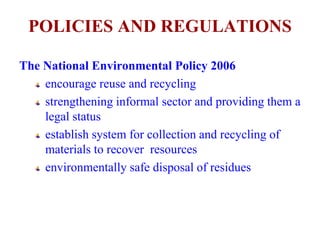
POLICIES AND REGULATIONS 
The National Environmental Policy 2006 
encourage reuse and recycling 
strengthening informal sector and providing them a 
legal status 
establish system for collection and recycling of 
materials to recover resources 
environmentally safe disposal of residues
POLICIES AND REGULATIONS 
E-Waste Guidelines - 2008 
 Basic guidance document recognizing fundamental 
principles: 
 Producer Responsibility (EPR) 
 RoHS (Restriction on Hazardous Substances) 
 Best practices 
 Insight into technologies for various levels of 
recycling 
 Need for a separate legislation mentioned in the 
guidelines for effective implementation of the 
principles governing the E-waste management
POLICIES AND REGULATIONS 
The E-waste (Management and Handling) Rules, 2011 
Rules entrusts responsibilities on each stakeholder in the e-waste 
value chain: 
 Producers: Producer Responsibility, Extended (EPR) & 
Individual (IPR) to ensure environmentally sound management 
of end of use electrical and electronic equipments. 
 Collection Centres: organized agencies for e-waste collection. 
 Consumer and bulk consumers: responsible to return post 
consumer e- waste. 
 Dismantler: de-manufacturing 1st step in recycling to separate 
the parts for recovery 
 Recycler: recycling to recover valuable resources using EST. 
distinct role and responsibility for each stakeholder
E-Waste Management 
25
STAKEHOLDERS IN E-WASTE 
MANAGEMENT 
 Industry-manufacturers, Producers 
 Product supply chain Links 
 Corporate/Bulk Users 
 Recyclers – Informal & Formal 
 Government & Regulatory Agencies 
 Municipalities 
 Industry Associations 
 Research Institutions & Experts 
 General Public/Consumers/Users 
 NGOs 
 Financial Institutions
E-Waste Management: 
Two Main Aspects 
 Recycling and/or Reuse 
 Keeping hazardous materials found in electronics 
from disposal into landfills. 
 Data Security 
 Insuring all electronic data storage devices and 
media are cleaned. 
 Insuring all data storage devices and media in all 
electronics are completely sanitized. 
 Insuring all data sanitation is fully documented and 
auditable.
E-Waste Management 
In industries management of e-waste should begin at the point 
of generation. This can be done by waste minimization 
techniques and by sustainable product design. Waste 
minimization in industries involves adopting: 
 Inventory management: Purchase procedures, Inventory 
tracking system 
 Production-process modification: Operation change, Material 
change, Process equipment modification 
 Volume reduction: Source segregation, waste concentration 
 Recovery and reuse: Inter-industry exchange, on-site and off-site 
recovery
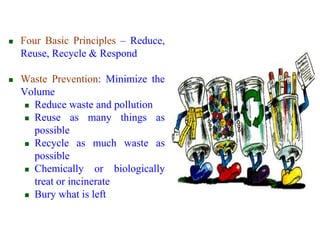
 Four Basic Principles – Reduce, 
Reuse, Recycle & Respond 
 Waste Prevention: Minimize the 
Volume 
 Reduce waste and pollution 
 Reuse as many things as 
possible 
 Recycle as much waste as 
possible 
 Chemically or biologically 
treat or incinerate 
 Bury what is left
 Re-use: Reuse is the environmentally preferable option for 
managing older electronic equipment. Extending the life of old 
products minimizes the pollution and resource consumption 
associated with making new products. ( MAXIMIZE RE-USE) 
 Electronic equipments which are too old and commercially & 
practically not viable for reuse or is broken beyond repair, 
may be sent for disassembly i.e. salvaging parts, and selling 
reclaimed materials. 
 Several electronic equipment, such as computers, monitors, 
printers, and scanners, contain materials suitable for 
reclamation and use in new products. These may include 
plastic, glass, copper, gold, silver, and other metals.
E-Waste Recycling 
 Equipment refurbishment and resale 
 De-manufacturing and disassembly 
 Recovering valuable components 
 Hazardous and base metal recovery 
 Hazardous component management
Issues in E-waste 
recycling 
32
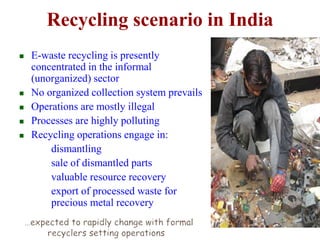
Recycling scenario in India 
 E-waste recycling is presently 
concentrated in the informal 
(unorganized) sector 
 No organized collection system prevails 
 Operations are mostly illegal 
 Processes are highly polluting 
 Recycling operations engage in: 
dismantling 
sale of dismantled parts 
valuable resource recovery 
export of processed waste for 
precious metal recovery
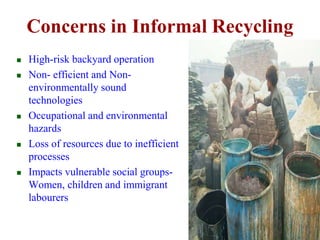
Concerns in Informal Recycling 
 High-risk backyard operation 
 Non- efficient and Non-environmentally 
sound 
technologies 
 Occupational and environmental 
hazards 
 Loss of resources due to inefficient 
processes 
 Impacts vulnerable social groups- 
Women, children and immigrant 
labourers
E-waste recycling - Informal sector 
 More than 90% of the E-waste recycling in India 
takes place in the Informal sector 
 Informal sector widespread 
 Have active and efficient network 
 Labour intensive - cheap labour, child labour 
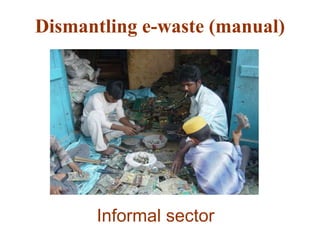
 Manual dismantling no machines required 
 Material recovery by crude methods 
 Operations in small congested unsafe areas 
 No personal protection equipment used 
 Occupational health & safety neglected 
 Adverse impact on environment and health
Dismantling e-waste (manual) 
Informal sector
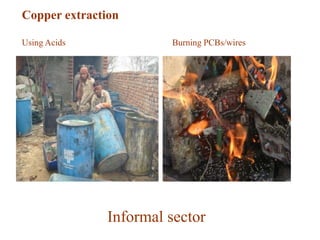
Copper extraction 
Using Acids Burning PCBs/wires 
Informal sector
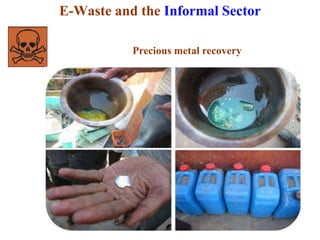
E-Waste and the Informal Sector 
Precious metal recovery
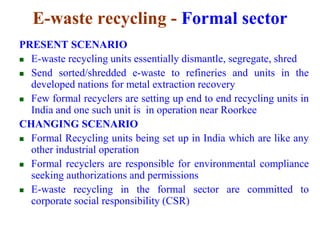
E-waste recycling - Formal sector 
PRESENT SCENARIO 
 E-waste recycling units essentially dismantle, segregate, shred 
 Send sorted/shredded e-waste to refineries and units in the 
developed nations for metal extraction recovery 
 Few formal recyclers are setting up end to end recycling units in 
India and one such unit is in operation near Roorkee 
CHANGING SCENARIO 
 Formal Recycling units being set up in India which are like any 
other industrial operation 
 Formal recyclers are responsible for environmental compliance 
seeking authorizations and permissions 
 E-waste recycling in the formal sector are committed to 
corporate social responsibility (CSR)
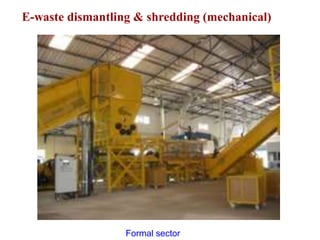
E-waste dismantling & shredding (mechanical) 
Formal sector
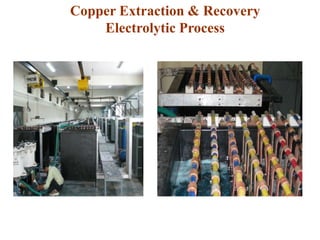
Copper Extraction & Recovery 
Electrolytic Process 
Formal sector
Integration of informal & formal – 
model for E- waste management 
The model for e-waste management in India ideally requires 
integration of the activities between the informal and formal 
sectors and bring them into the mainstream of e-waste 
recycling activity. 
Steps involved in Integration 
 Agreements/MOU between the stakeholders 
 Maintain entrepreneurship 
 Specify activities for informal sector 
 Identify activities for formal sector 
 Dovetail activities of informal & formal 
 Establish linkages and support systems 
 Formation of associations
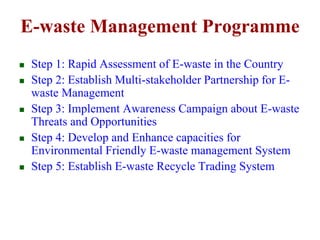
E-waste Management Programme 
 Step 1: Rapid Assessment of E-waste in the Country 
 Step 2: Establish Multi-stakeholder Partnership for E-waste 
Management 
 Step 3: Implement Awareness Campaign about E-waste 
Threats and Opportunities 
 Step 4: Develop and Enhance capacities for 
Environmental Friendly E-waste management System 
 Step 5: Establish E-waste Recycle Trading System
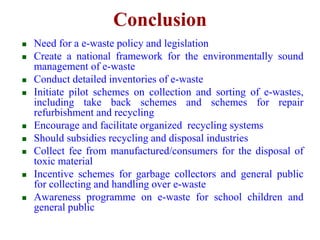
Conclusion 
 Need for a e-waste policy and legislation 
 Create a national framework for the environmentally sound 
management of e-waste 
 Conduct detailed inventories of e-waste 
 Initiate pilot schemes on collection and sorting of e-wastes, 
including take back schemes and schemes for repair 
refurbishment and recycling 
 Encourage and facilitate organized recycling systems 
 Should subsidies recycling and disposal industries 
 Collect fee from manufactured/consumers for the disposal of 
toxic material 
 Incentive schemes for garbage collectors and general public 
for collecting and handling over e-waste 
 Awareness programme on e-waste for school children and 
general public

Ce 105 e-waste - ce 105vcs

  • 1.
  • 2.
    E-Waste Topics ofImportance  What exactly is E-waste?  Categories and components of E-waste  Dangers of E-waste  The sensitive nature of E-waste  Laws and regulations  Stakeholders in E-waste  What can be done with E-waste?  E-Waste management initiatives (International)  The de-manufacturing and recycle processes
  • 3.
  • 4.
    E-Waste Items All types of computers and accessories  Cell, smart, and home phones  Answering machines, tapes and accessories  Office equipment (fax machines, printers, & copiers)  Digital cameras & associated storage devices  TVs, DVRs, cable boxes & video equipment  Audio equipment and accessories  Navigation devices  All other electronic devices & storage media
  • 5.
    E-Waste Generators Homes & Residences  Commercial Businesses  Professional Offices  Financial Institutions  Health Care Industries  Large Manufacturing Industries  Utilities & Public Services  Local, State & Central Governments
  • 6.
    Background  Obsolescenceof technology: outdated within 18 months  Upcoming analog to digital conversion  Electronic Waste [Waste EEE (Electric, Electronic Equipment)] one of the fast growing waste streams all over the world  E-waste has been identified as the fastest growing waste stream in the world; forecast to soon reach 40 million tonnes a year.  The European Environment Agency has calculated that the volume of e-waste is rising about three times faster than any other form of municipal waste.
  • 7.
    Background  Average1-3% of total solid waste in developed countries  Increases by 16-28% every 5 years  Electric and electronic equipment contain over 1,000 different substances including toxic heavy metals and organics which can pose serious environmental pollution problem upon irresponsible disposal  E-waste as source hazardous wastes  E-waste can be an overland mine for specific metals  E-waste is a GLOBAL CRISIS to be challenged
  • 8.
    In 2009 Egyptjumped to 500-1060 mobile phones per 1000 people category. Source World Bank 2002
  • 9.
    E – WasteFacts E-waste (Mobile Phones)  700 million obsolete phones discarded in 2005 contained 560,000 kg of lead in the form of solder  Average working life - 7 years but  Worldwide average - 11 months  Over one billion handsets in use in 2006
  • 10.
    E – WasteFacts E-waste (Computers)  Manufacturing takes at least 240 kg of fossil fuels, 22 kg of chemicals and 1.5 tonnes of water – more than the weight of a car  Life span changed from 4-6 years in 1997 to 2 years in 2005 and further decreasing  One billion in use by the end of 2008 - two billion by 2015
  • 11.
    COMPONENTS OF E-WASTE  Fe and steel  Non-ferrous metals (Pb, Cu, Al, Au, …)  Glass  Plastic  Electronic components (R, C, L, ICs…)  Others (rubber, wood, ceramics, …)
  • 12.
    COMPONENTS OF E-WASTE (Hazardous Materials) Component Hazardous Materials CRT Pb, As, Hg, P LCD Hg Fluorescent lamp Hg, P, flame retardants (FR) Cooling system Ozone depleting substance (ODS) Others Se, AsO3, Cd, Cr, Co, Mn, Br, Ba
  • 13.
    COMPONENTS OF E-WASTE (Hazardous Materials Inside a PC)
  • 14.
    DANGERS OF E-WASTE Material Occurrence in E-waste Health and Environmental Impact Beryllium Copper-beryllium alloys, springs, relays and connections  beryllium sensitization/chronic beryllium disease  human carcinogens  released as beryllium oxide dust or fume during high temperature metal processing Cadmium Contacts, switches, nickel-cadmium (Ni-Cd) batteries, printer inks and toners  persistent and mobile in aquatic environments (ATSDR 2000)  damage to the kidneys and bone toxicity, released if plastic is burned or during high temperature metal processing Lead Circuit boards/ cathode ray tubes CTR  Risk for small children and fetuses  Damage to the nervous system, red blood cells, kidneys and potential increases in high blood pressure;  Incineration can result in release to the air
  • 15.
    DANGERS OF E-WASTE Material Occurrence in E-waste Health and Environmental Impact Mercury Lighting devices that illuminate flat screen displays, switches and relays  Impacts the central nervous system  Land filling and incineration of flat panel displays results in the release to the environment PCBs (polychlorinated biphenyls) Insulating fluids for transformers and capacitors, flame-retardant plasticizers  Suppression of the immune system, liver damage, cancer promotion, damage to the nervous system  Damage to reproductive systems
  • 16.
    EFFECTS OF E-WASTETOXINS ON SOIL Effects on soil:  Toxic leachates: Hg, Cd, Pb, P  Uncontrolled fire risk →toxic fumes  Biologically non-degradable: Cd, Hg, FR
  • 17.
  • 18.
    INTERNATIONAL INITIATIVES inE-waste Management  GeSI (Global e-Sustainability Initiative): a global partnership of Information and Communication Technology (ICT) companies that promotes technologies for a sustainable development.  StEP – an initiative of various UN organizations with the overall aim to solve the e-waste problem. Together with prominent members from industry, governments, international organizations, NGOs and the science sector actively participating in StEP,  UNESCO Computer equipment recycling guidelines for Africa  Basel Convention  Partnership on used and end of life Mobile Phones (MPPI)  Partnership for Action on Computing Equipment (PACE)  G8 3Rs Initiative; GTZ; UNEP/DTIE (IETC); SECO, etc.  Many other initiatives by manufacturers for recycling end of life products belong to them (corporate responsibilities; e.g HP, Canon, …..)
  • 19.
    POLICIES AND REGULATIONS IN INDIA Policies, laws and regulations applicable for the management of E-waste are :  The National Environmental Policy 2006  E-Waste Guidelines – 2008  The Hazardous Wastes (Management and Handling) Rules 1989 as amended in 2003 & 2008  Foreign Trade Policy restricts import of second-hand computers and does not permit import of E-waste  The E-waste (Management and Handling) Rules, 2011
  • 20.
    POLICIES AND REGULATIONS The National Environmental Policy 2006 encourage reuse and recycling strengthening informal sector and providing them a legal status establish system for collection and recycling of materials to recover resources environmentally safe disposal of residues
  • 21.
    POLICIES AND REGULATIONS E-Waste Guidelines - 2008  Basic guidance document recognizing fundamental principles:  Producer Responsibility (EPR)  RoHS (Restriction on Hazardous Substances)  Best practices  Insight into technologies for various levels of recycling  Need for a separate legislation mentioned in the guidelines for effective implementation of the principles governing the E-waste management
  • 22.
    POLICIES AND REGULATIONS The E-waste (Management and Handling) Rules, 2011 Rules entrusts responsibilities on each stakeholder in the e-waste value chain:  Producers: Producer Responsibility, Extended (EPR) & Individual (IPR) to ensure environmentally sound management of end of use electrical and electronic equipments.  Collection Centres: organized agencies for e-waste collection.  Consumer and bulk consumers: responsible to return post consumer e- waste.  Dismantler: de-manufacturing 1st step in recycling to separate the parts for recovery  Recycler: recycling to recover valuable resources using EST. distinct role and responsibility for each stakeholder
  • 23.
  • 24.
    STAKEHOLDERS IN E-WASTE MANAGEMENT  Industry-manufacturers, Producers  Product supply chain Links  Corporate/Bulk Users  Recyclers – Informal & Formal  Government & Regulatory Agencies  Municipalities  Industry Associations  Research Institutions & Experts  General Public/Consumers/Users  NGOs  Financial Institutions
  • 25.
    E-Waste Management: TwoMain Aspects  Recycling and/or Reuse  Keeping hazardous materials found in electronics from disposal into landfills.  Data Security  Insuring all electronic data storage devices and media are cleaned.  Insuring all data storage devices and media in all electronics are completely sanitized.  Insuring all data sanitation is fully documented and auditable.
  • 26.
    E-Waste Management Inindustries management of e-waste should begin at the point of generation. This can be done by waste minimization techniques and by sustainable product design. Waste minimization in industries involves adopting:  Inventory management: Purchase procedures, Inventory tracking system  Production-process modification: Operation change, Material change, Process equipment modification  Volume reduction: Source segregation, waste concentration  Recovery and reuse: Inter-industry exchange, on-site and off-site recovery
  • 27.
     Four BasicPrinciples – Reduce, Reuse, Recycle & Respond  Waste Prevention: Minimize the Volume  Reduce waste and pollution  Reuse as many things as possible  Recycle as much waste as possible  Chemically or biologically treat or incinerate  Bury what is left
  • 28.
     Re-use: Reuseis the environmentally preferable option for managing older electronic equipment. Extending the life of old products minimizes the pollution and resource consumption associated with making new products. ( MAXIMIZE RE-USE)  Electronic equipments which are too old and commercially & practically not viable for reuse or is broken beyond repair, may be sent for disassembly i.e. salvaging parts, and selling reclaimed materials.  Several electronic equipment, such as computers, monitors, printers, and scanners, contain materials suitable for reclamation and use in new products. These may include plastic, glass, copper, gold, silver, and other metals.
  • 29.
    E-Waste Recycling Equipment refurbishment and resale  De-manufacturing and disassembly  Recovering valuable components  Hazardous and base metal recovery  Hazardous component management
  • 30.
    Issues in E-waste recycling 32
  • 31.
    Recycling scenario inIndia  E-waste recycling is presently concentrated in the informal (unorganized) sector  No organized collection system prevails  Operations are mostly illegal  Processes are highly polluting  Recycling operations engage in: dismantling sale of dismantled parts valuable resource recovery export of processed waste for precious metal recovery
  • 32.
    Concerns in InformalRecycling  High-risk backyard operation  Non- efficient and Non-environmentally sound technologies  Occupational and environmental hazards  Loss of resources due to inefficient processes  Impacts vulnerable social groups- Women, children and immigrant labourers
  • 33.
    E-waste recycling -Informal sector  More than 90% of the E-waste recycling in India takes place in the Informal sector  Informal sector widespread  Have active and efficient network  Labour intensive - cheap labour, child labour  Manual dismantling no machines required  Material recovery by crude methods  Operations in small congested unsafe areas  No personal protection equipment used  Occupational health & safety neglected  Adverse impact on environment and health
  • 34.
  • 35.
    Copper extraction UsingAcids Burning PCBs/wires Informal sector
  • 36.
    E-Waste and theInformal Sector Precious metal recovery
  • 37.
    E-waste recycling -Formal sector PRESENT SCENARIO  E-waste recycling units essentially dismantle, segregate, shred  Send sorted/shredded e-waste to refineries and units in the developed nations for metal extraction recovery  Few formal recyclers are setting up end to end recycling units in India and one such unit is in operation near Roorkee CHANGING SCENARIO  Formal Recycling units being set up in India which are like any other industrial operation  Formal recyclers are responsible for environmental compliance seeking authorizations and permissions  E-waste recycling in the formal sector are committed to corporate social responsibility (CSR)
  • 38.
    E-waste dismantling &shredding (mechanical) Formal sector
  • 39.
    Copper Extraction &Recovery Electrolytic Process Formal sector
  • 40.
    Integration of informal& formal – model for E- waste management The model for e-waste management in India ideally requires integration of the activities between the informal and formal sectors and bring them into the mainstream of e-waste recycling activity. Steps involved in Integration  Agreements/MOU between the stakeholders  Maintain entrepreneurship  Specify activities for informal sector  Identify activities for formal sector  Dovetail activities of informal & formal  Establish linkages and support systems  Formation of associations
  • 41.
    E-waste Management Programme  Step 1: Rapid Assessment of E-waste in the Country  Step 2: Establish Multi-stakeholder Partnership for E-waste Management  Step 3: Implement Awareness Campaign about E-waste Threats and Opportunities  Step 4: Develop and Enhance capacities for Environmental Friendly E-waste management System  Step 5: Establish E-waste Recycle Trading System
  • 42.
    Conclusion  Needfor a e-waste policy and legislation  Create a national framework for the environmentally sound management of e-waste  Conduct detailed inventories of e-waste  Initiate pilot schemes on collection and sorting of e-wastes, including take back schemes and schemes for repair refurbishment and recycling  Encourage and facilitate organized recycling systems  Should subsidies recycling and disposal industries  Collect fee from manufactured/consumers for the disposal of toxic material  Incentive schemes for garbage collectors and general public for collecting and handling over e-waste  Awareness programme on e-waste for school children and general public