on
Strategy of E-
Waste
Management
By
Prayakarrao Sukanya
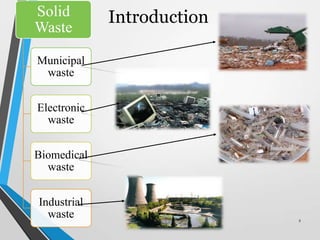
IntroductionSolid
Waste
Municipal
waste
Electronic
waste
Biomedical
waste
Industrial
waste 2
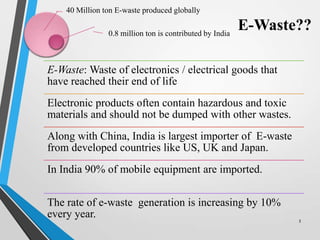
E-Waste??
E-Waste: Waste of electronics / electrical goods that
have reached their end of life
Electronic products often contain hazardous and toxic
materials and should not be dumped with other wastes.
Along with China, India is largest importer of E-waste
from developed countries like US, UK and Japan.
In India 90% of mobile equipment are imported.
The rate of e-waste generation is increasing by 10%
every year. 3
0.8 million ton is contributed by India
40 Million ton E-waste produced globally
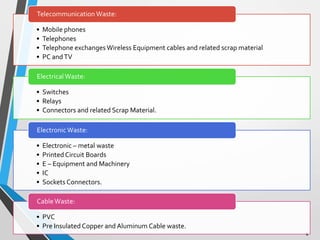
• Mobile phones
• Telephones
• Telephone exchanges Wireless Equipment cables and related scrap material
• PC andTV
Telecommunication Waste:
• Switches
• Relays
• Connectors and related Scrap Material.
Electrical Waste:
• Electronic – metal waste
• Printed Circuit Boards
• E – Equipment and Machinery
• IC
• Sockets Connectors.
ElectronicWaste:
• PVC
• Pre Insulated Copper and Aluminum Cable waste.
CableWaste:
4
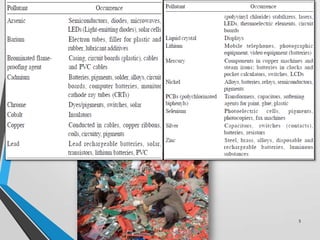
5
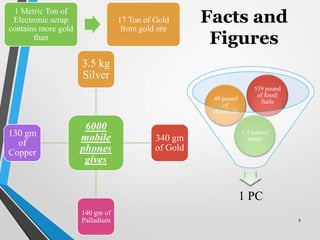
Facts and
Figures
6000
mobile
phones
gives
3.5 kg
Silver
340 gm
of Gold
140 gm of
Palladium
130 gm
of
Copper
6
1 Metric Ton of
Electronic scrap
contains more gold
than
17 Ton of Gold
from gold ore
1 PC
1.5 tons of
water
48 pound
of
chemicals
539 pound
of fossil
fuels
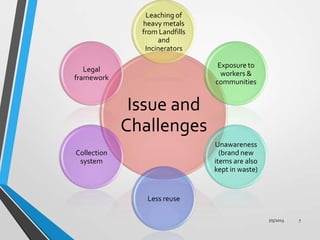
Issue and
Challenges
Leaching of
heavy metals
from Landfills
and
Incinerators
Exposure to
workers &
communities
Unawareness
(brand new
items are also
kept in waste)
Less reuse
Collection
system
Legal
framework
7/5/2013 7
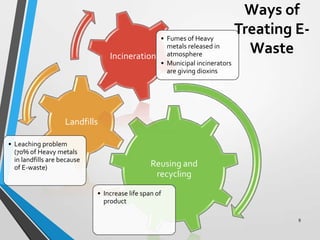
Reusing and
recycling
• Increase life span of
product
Landfills
• Leaching problem
(70% of Heavy metals
in landfills are because
of E-waste)
Incineration
• Fumes of Heavy
metals released in
atmosphere
• Municipal incinerators
are giving dioxins
Ways of
Treating E-
Waste
8
9
Receipt of E-
Waste
Sorting /
Processing
Repairing
Upgrading
Testing
Refurbishing
Dismantaling
Component
Recovery
Captive Use Packing
Sale
Residual Disposal
Scarp
Environmentally-
friendly disposal
Recovery of
Precious Material
Flow Sheet of
Recyclers or
Recycling Units
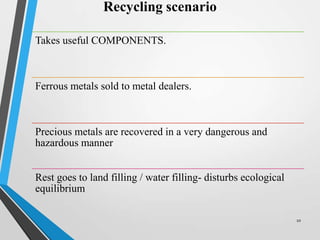
Recycling scenario
Takes useful COMPONENTS.
Ferrous metals sold to metal dealers.
Precious metals are recovered in a very dangerous and
hazardous manner
Rest goes to land filling / water filling- disturbs ecological
equilibrium
10
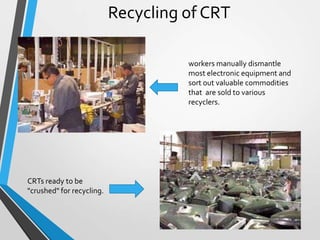
Recycling of CRT
workers manually dismantle
most electronic equipment and
sort out valuable commodities
that are sold to various
recyclers.
CRTs ready to be
"crushed" for recycling.
11
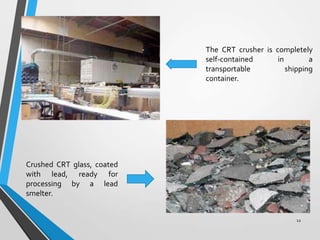
The CRT crusher is completely
self-contained in a
transportable shipping
container.
Crushed CRT glass, coated
with lead, ready for
processing by a lead
smelter.
12
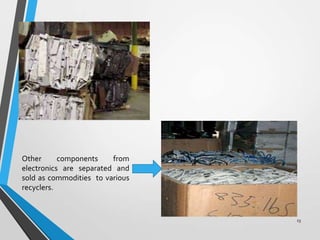
Other components from
electronics are separated and
sold as commodities to various
recyclers.
13
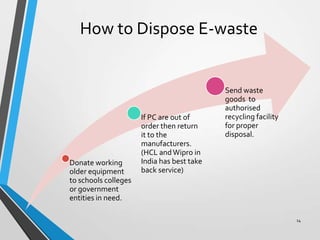
How to Dispose E-waste
Donate working
older equipment
to schools colleges
or government
entities in need.
If PC are out of
order then return
it to the
manufacturers.
(HCL andWipro in
India has best take
back service)
Send waste
goods to
authorised
recycling facility
for proper
disposal.
14
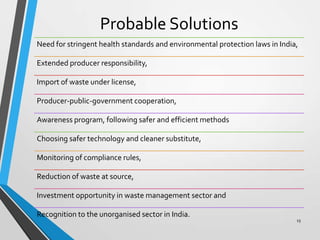
Probable Solutions
Need for stringent health standards and environmental protection laws in India,
Extended producer responsibility,
Import of waste under license,
Producer-public-government cooperation,
Awareness program, following safer and efficient methods
Choosing safer technology and cleaner substitute,
Monitoring of compliance rules,
Reduction of waste at source,
Investment opportunity in waste management sector and
Recognition to the unorganised sector in India.
15
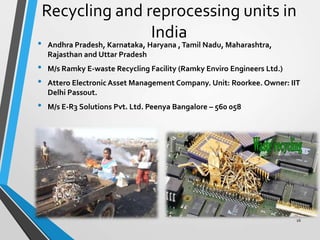
Recycling and reprocessing units in
India
• Andhra Pradesh, Karnataka, Haryana ,Tamil Nadu, Maharashtra,
Rajasthan and Uttar Pradesh
• M/s Ramky E-waste Recycling Facility (Ramky Enviro Engineers Ltd.)
• Attero Electronic Asset Management Company. Unit: Roorkee. Owner: IIT
Delhi Passout.
• M/s E-R3 Solutions Pvt. Ltd. Peenya Bangalore – 560 058
16
References
• A report on “Managing Electronics Waste (2007). Dumping old TV, First read the
rule”, The Hindustan Times, New Delhi Edition, , 15 October, p.1
http://www.industelegraph.com/story/2005/9/2/33438/ 17285.
• S. Chatterjee and Krishna Kumar (2009). “Effective electronic waste management
and recycling process involving formal and non-formal sectors”.
• LARRDIS (Research Unit), (2011) E-Waste In India, Rajya Sabha Secretariat.
• Gao Z, Li J, Zhang HC (2004). Electronics and the Environment, IEEE
international Symposium pp.234-241.
• http://www.attero.in/ E-wasteTreatment In Ghana: A Case Study
• Informal electronic waste recycling: A sector review with special focus on China
Xinwen Chi a,⇑, Martin Streicher-Porte b, Mark Y.L. Wang a, Markus A. Reuter c
• Contribution to resource conservation by reuse of electrical and electronic
household appliances Nina Truttm nn, Helmut Rechberger .
• Science direct
• Internet
• Google
17
E waste management

E waste management

  • 1.
  • 2.
  • 3.
    E-Waste?? E-Waste: Waste ofelectronics / electrical goods that have reached their end of life Electronic products often contain hazardous and toxic materials and should not be dumped with other wastes. Along with China, India is largest importer of E-waste from developed countries like US, UK and Japan. In India 90% of mobile equipment are imported. The rate of e-waste generation is increasing by 10% every year. 3 0.8 million ton is contributed by India 40 Million ton E-waste produced globally
  • 4.
    • Mobile phones •Telephones • Telephone exchanges Wireless Equipment cables and related scrap material • PC andTV Telecommunication Waste: • Switches • Relays • Connectors and related Scrap Material. Electrical Waste: • Electronic – metal waste • Printed Circuit Boards • E – Equipment and Machinery • IC • Sockets Connectors. ElectronicWaste: • PVC • Pre Insulated Copper and Aluminum Cable waste. CableWaste: 4
  • 5.
  • 6.
    Facts and Figures 6000 mobile phones gives 3.5 kg Silver 340gm of Gold 140 gm of Palladium 130 gm of Copper 6 1 Metric Ton of Electronic scrap contains more gold than 17 Ton of Gold from gold ore 1 PC 1.5 tons of water 48 pound of chemicals 539 pound of fossil fuels
  • 7.
    Issue and Challenges Leaching of heavymetals from Landfills and Incinerators Exposure to workers & communities Unawareness (brand new items are also kept in waste) Less reuse Collection system Legal framework 7/5/2013 7
  • 8.
    Reusing and recycling • Increaselife span of product Landfills • Leaching problem (70% of Heavy metals in landfills are because of E-waste) Incineration • Fumes of Heavy metals released in atmosphere • Municipal incinerators are giving dioxins Ways of Treating E- Waste 8
  • 9.
    9 Receipt of E- Waste Sorting/ Processing Repairing Upgrading Testing Refurbishing Dismantaling Component Recovery Captive Use Packing Sale Residual Disposal Scarp Environmentally- friendly disposal Recovery of Precious Material Flow Sheet of Recyclers or Recycling Units
  • 10.
    Recycling scenario Takes usefulCOMPONENTS. Ferrous metals sold to metal dealers. Precious metals are recovered in a very dangerous and hazardous manner Rest goes to land filling / water filling- disturbs ecological equilibrium 10
  • 11.
    Recycling of CRT workersmanually dismantle most electronic equipment and sort out valuable commodities that are sold to various recyclers. CRTs ready to be "crushed" for recycling. 11
  • 12.
    The CRT crusheris completely self-contained in a transportable shipping container. Crushed CRT glass, coated with lead, ready for processing by a lead smelter. 12
  • 13.
    Other components from electronicsare separated and sold as commodities to various recyclers. 13
  • 14.
    How to DisposeE-waste Donate working older equipment to schools colleges or government entities in need. If PC are out of order then return it to the manufacturers. (HCL andWipro in India has best take back service) Send waste goods to authorised recycling facility for proper disposal. 14
  • 15.
    Probable Solutions Need forstringent health standards and environmental protection laws in India, Extended producer responsibility, Import of waste under license, Producer-public-government cooperation, Awareness program, following safer and efficient methods Choosing safer technology and cleaner substitute, Monitoring of compliance rules, Reduction of waste at source, Investment opportunity in waste management sector and Recognition to the unorganised sector in India. 15
  • 16.
    Recycling and reprocessingunits in India • Andhra Pradesh, Karnataka, Haryana ,Tamil Nadu, Maharashtra, Rajasthan and Uttar Pradesh • M/s Ramky E-waste Recycling Facility (Ramky Enviro Engineers Ltd.) • Attero Electronic Asset Management Company. Unit: Roorkee. Owner: IIT Delhi Passout. • M/s E-R3 Solutions Pvt. Ltd. Peenya Bangalore – 560 058 16
  • 17.
    References • A reporton “Managing Electronics Waste (2007). Dumping old TV, First read the rule”, The Hindustan Times, New Delhi Edition, , 15 October, p.1 http://www.industelegraph.com/story/2005/9/2/33438/ 17285. • S. Chatterjee and Krishna Kumar (2009). “Effective electronic waste management and recycling process involving formal and non-formal sectors”. • LARRDIS (Research Unit), (2011) E-Waste In India, Rajya Sabha Secretariat. • Gao Z, Li J, Zhang HC (2004). Electronics and the Environment, IEEE international Symposium pp.234-241. • http://www.attero.in/ E-wasteTreatment In Ghana: A Case Study • Informal electronic waste recycling: A sector review with special focus on China Xinwen Chi a,⇑, Martin Streicher-Porte b, Mark Y.L. Wang a, Markus A. Reuter c • Contribution to resource conservation by reuse of electrical and electronic household appliances Nina Truttm nn, Helmut Rechberger . • Science direct • Internet • Google 17

Editor's Notes

  • #4 Reason of increase in ewaste generation:Rising quality of life and high rate of resource consumptionEwaste is hard to handle because of its composition as it is made of multiple component.Technology change, software compatability and Lack of efficient recovery, reuse technologies
  • #5 E waste: waste of electronics / electrical goods that use or have reached their end of lifeContains valuable material like copper, silver, gold that can be recovered
  • #8 Guiyu of shintou region in china, is world ewaste capitalUncontrolled burning, disassembling and disposal causes varity of environmental pblms in chinaIn guiyu 82% of kids have high lead in blood more than 100 in some cases about 149, which causes impact on IQ and ill development on nervous systemHeavy metal in road in this region have lead 300times than normal and Cu 100 times more.In india, Supreme court has given directives to build facilities for treatment of ewaste but only 23 are present in country.75% state bodies are not following the directives
  • #12 Convert (waste) into reusable material