Effective nuclear charge
Theeffective nuclear charge (Z-eff) is the net positive charge experienced by an
electron in a multi-electron atom. It accounts for the attraction from the nucleus
and the repulsion due to other electrons (called shielding or screening effect).
It is not the actual nuclear charge (Z) but the reduced charge felt by an electron
due to shielding by inner-shell electrons.
Electrons within a multi-electron atom interact with the nucleus and with all other
electrons. Each electron in a multi-electron atom experiences both attraction to the
nucleus and repulsion from interactions with other electrons. The presence of
multiple electrons decreases the nuclear attraction to some extent. Each electron
in a multi-electron atom experiences a different magnitude of (and attraction to)
the nuclear charge depending on what specific subshell the electron occupies. The
amount of positive charge experienced by any individual electron is the effective
nuclear charge (Z )
3.
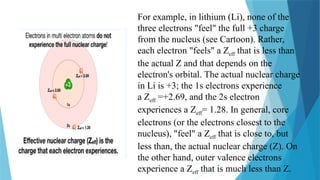
For example, inlithium (Li), none of the
three electrons "feel" the full +3 charge
from the nucleus (see Cartoon). Rather,
each electron "feels" a Zeff that is less than
the actual Z and that depends on the
electron's orbital. The actual nuclear charge
in Li is +3; the 1s electrons experience
a Zeff =+2.69, and the 2s electron
experiences a Zeff= 1.28. In general, core
electrons (or the electrons closest to the
nucleus), "feel" a Zeff that is close to, but
less than, the actual nuclear charge (Z). On
the other hand, outer valence electrons
experience a Zeff that is much less than Z.
4.
Importance of Zeff
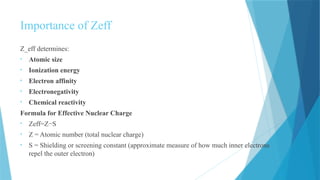
Z_effdetermines:
• Atomic size
• Ionization energy
• Electron affinity
• Electronegativity
• Chemical reactivity
Formula for Effective Nuclear Charge
• Zeff=Z−S
• Z = Atomic number (total nuclear charge)
• S = Shielding or screening constant (approximate measure of how much inner electrons
repel the outer electron)
5.
Calculation of EffectiveNuclear Charge
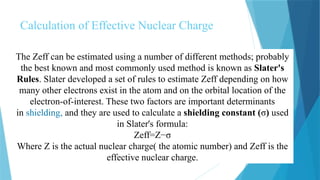
The Zeff can be estimated using a number of different methods; probably
the best known and most commonly used method is known as Slater's
Rules. Slater developed a set of rules to estimate Zeff depending on how
many other electrons exist in the atom and on the orbital location of the
electron-of-interest. These two factors are important determinants
in shielding, and they are used to calculate a shielding constant (σ) used
in Slater's formula:
Zeff=Z−σ
Where Z is the actual nuclear charge( the atomic number) and Zeff is the
effective nuclear charge.
6.
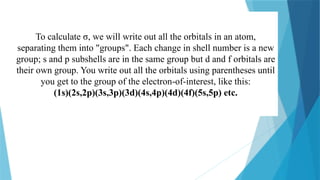
To calculate σ,we will write out all the orbitals in an atom,
separating them into "groups". Each change in shell number is a new
group; s and p subshells are in the same group but d and f orbitals are
their own group. You write out all the orbitals using parentheses until
you get to the group of the electron-of-interest, like this:
(1s)(2s,2p)(3s,3p)(3d)(4s,4p)(4d)(4f)(5s,5p) etc.
7.
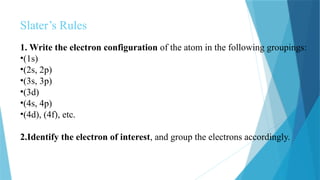
Slater’s Rules
1. Writethe electron configuration of the atom in the following groupings:
•(1s)
•(2s, 2p)
•(3s, 3p)
•(3d)
•(4s, 4p)
•(4d), (4f), etc.
2.Identify the electron of interest, and group the electrons accordingly.
8.
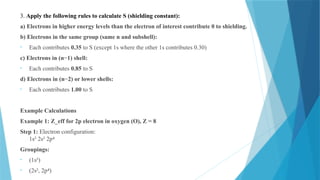
3. Apply thefollowing rules to calculate S (shielding constant):
a) Electrons in higher energy levels than the electron of interest contribute 0 to shielding.
b) Electrons in the same group (same n and subshell):
• Each contributes 0.35 to S (except 1s where the other 1s contributes 0.30)
c) Electrons in (n−1) shell:
• Each contributes 0.85 to S
d) Electrons in (n−2) or lower shells:
• Each contributes 1.00 to S
Example Calculations
Example 1: Z_eff for 2p electron in oxygen (O), Z = 8
Step 1: Electron configuration:
1s² 2s² 2p⁴
Groupings:
• (1s²)
• (2s², 2p )
⁴
9.
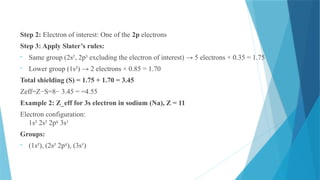
Step 2: Electronof interest: One of the 2p electrons
Step 3: Apply Slater’s rules:
• Same group (2s², 2p³ excluding the electron of interest) → 5 electrons × 0.35 = 1.75
• Lower group (1s²) → 2 electrons × 0.85 = 1.70
Total shielding (S) = 1.75 + 1.70 = 3.45
Zeff=Z−S=8− 3.45 = =4.55
Example 2: Z_eff for 3s electron in sodium (Na), Z = 11
Electron configuration:
1s² 2s² 2p 3s¹
⁶
Groups:
• (1s²), (2s² 2p ), (3s¹)
⁶
10.
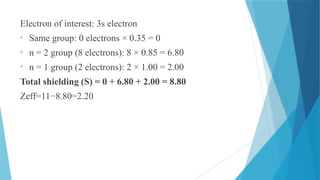
Electron of interest:3s electron
• Same group: 0 electrons × 0.35 = 0
• n = 2 group (8 electrons): 8 × 0.85 = 6.80
• n = 1 group (2 electrons): 2 × 1.00 = 2.00
Total shielding (S) = 0 + 6.80 + 2.00 = 8.80
Zeff=11−8.80=2.20
11.
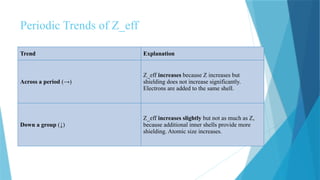
Periodic Trends ofZ_eff
Trend Explanation
Across a period (→)
Z_eff increases because Z increases but
shielding does not increase significantly.
Electrons are added to the same shell.
Down a group (↓)
Z_eff increases slightly but not as much as Z,
because additional inner shells provide more
shielding. Atomic size increases.
12.
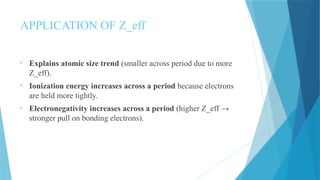
APPLICATION OF Z_eff
•Explains atomic size trend (smaller across period due to more
Z_eff).
• Ionization energy increases across a period because electrons
are held more tightly.
• Electronegativity increases across a period (higher Z_eff →
stronger pull on bonding electrons).
13.
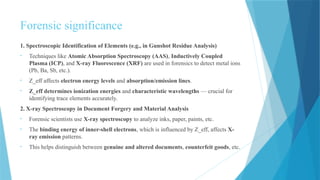
Forensic significance
1. SpectroscopicIdentification of Elements (e.g., in Gunshot Residue Analysis)
• Techniques like Atomic Absorption Spectroscopy (AAS), Inductively Coupled
Plasma (ICP), and X-ray Fluorescence (XRF) are used in forensics to detect metal ions
(Pb, Ba, Sb, etc.).
• Z_eff affects electron energy levels and absorption/emission lines.
• Z_eff determines ionization energies and characteristic wavelengths — crucial for
identifying trace elements accurately.
2. X-ray Spectroscopy in Document Forgery and Material Analysis
• Forensic scientists use X-ray spectroscopy to analyze inks, paper, paints, etc.
• The binding energy of inner-shell electrons, which is influenced by Z_eff, affects X-
ray emission patterns.
• This helps distinguish between genuine and altered documents, counterfeit goods, etc.
14.
3.Atomic and IonicRadii in Trace Evidence Comparison
• Z_eff influences atomic size and ionic size.
• Helps in distinguishing ions of similar mass but different chemical behavior.
• Important in hair, glass, soil, and fiber analysis where small elemental differences must be detected.
4.Ionization Energy and Forensic Mass Spectrometry
• In Mass Spectrometry (MS), Z_eff affects how easily an atom or molecule can be ionized.
• Helps forensic chemists:
• Choose appropriate ionization methods
• Identify unknown substances like drugs or explosives
15.
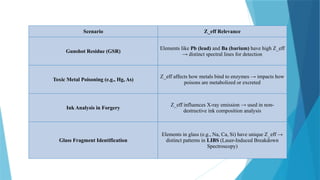
Scenario Z_eff Relevance
GunshotResidue (GSR)
Elements like Pb (lead) and Ba (barium) have high Z_eff
→ distinct spectral lines for detection
Toxic Metal Poisoning (e.g., Hg, As)
Z_eff affects how metals bind to enzymes → impacts how
poisons are metabolized or excreted
Ink Analysis in Forgery
Z_eff influences X-ray emission → used in non-
destructive ink composition analysis
Glass Fragment Identification
Elements in glass (e.g., Na, Ca, Si) have unique Z_eff →
distinct patterns in LIBS (Laser-Induced Breakdown
Spectroscopy)