Lesson Objective
Electronegativity andbonding
3.1.1 Students should be able to define electronegativity as the power of
an atom to attract electrons to itself.
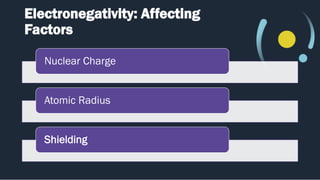
3.1.2 Students should be able to explain the factors influencing the
electronegativities of the elements in terms of nuclear charge, atomic
radius and shielding by inner shells and sub shells
3.1.3 Students should be able to State and explain the trends in
electronegativity across a period and down a group of the Periodic Table.
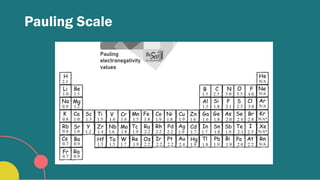
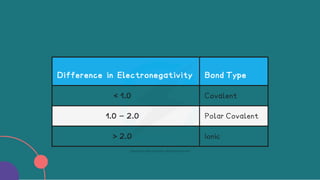
3.1.4 Students should be able to use the differences in Pauling
electronegativity values to predict the formation of ionic and covalent
bonds.
4.
Electronegativity
Electronegativity isthe ability of a particular atom, which is
covalently bonded to another atom, to attract the bond pair of
electrons towards itself.
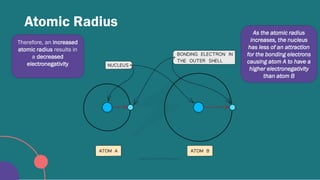
Atomic Radius
As theatomic radius
increases, the nucleus
has less of an attraction
for the bonding electrons
causing atom A to have a
higher electronegativity
than atom B
Therefore, an increased
atomic radius results in
a decreased
electronegativity
8.
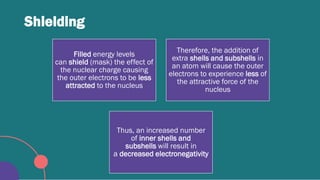
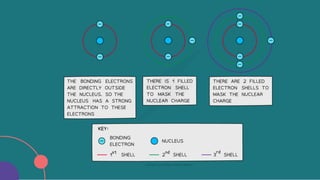
Shielding
Filled energy levels
canshield (mask) the effect of
the nuclear charge causing
the outer electrons to be less
attracted to the nucleus
Therefore, the addition of
extra shells and subshells in
an atom will cause the outer
electrons to experience less of
the attractive force of the
nucleus
Thus, an increased number
of inner shells and
subshells will result in
a decreased electronegativity
10.
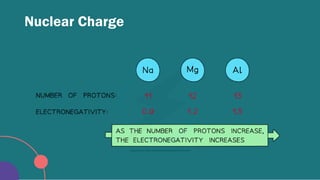
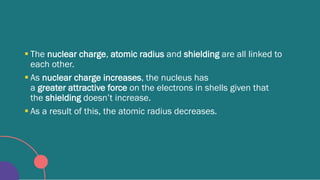
The nuclearcharge, atomic radius and shielding are all linked to
each other.
As nuclear charge increases, the nucleus has
a greater attractive force on the electrons in shells given that
the shielding doesn’t increase.
As a result of this, the atomic radius decreases.
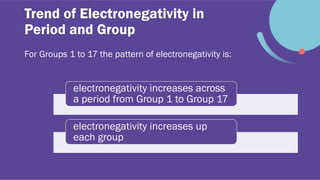
Trend of Electronegativityin
Period and Group
For Groups 1 to 17 the pattern of electronegativity is:
electronegativity increases across
a period from Group 1 to Group 17
electronegativity increases up
each group
14.
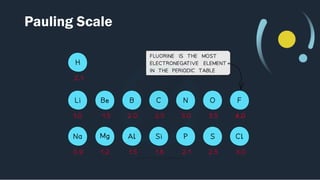
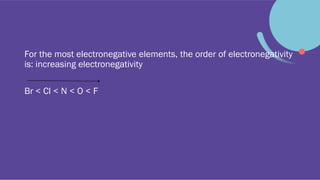
For the mostelectronegative elements, the order of electronegativity
is: increasing electronegativity
Br < Cl < N < O < F
15.
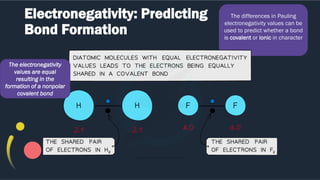
Electronegativity: Predicting
Bond Formation
Thedifferences in Pauling
electronegativity values can be
used to predict whether a bond
is covalent or ionic in character
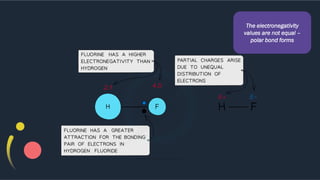
The electronegativity
values are equal
resulting in the
formation of a nonpolar
covalent bond
16.
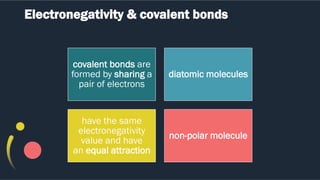
Electronegativity & covalentbonds
covalent bonds are
formed by sharing a
pair of electrons
diatomic molecules
have the same
electronegativity
value and have
an equal attraction
non-polar molecule
17.
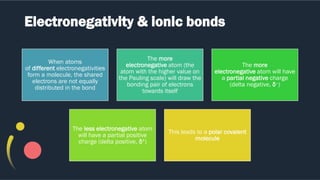
Electronegativity & ionicbonds
When atoms
of different electronegativities
form a molecule, the shared
electrons are not equally
distributed in the bond
The more
electronegative atom (the
atom with the higher value on
the Pauling scale) will draw the
bonding pair of electrons
towards itself
The more
electronegative atom will have
a partial negative charge
(delta negative, δ–)
The less electronegative atom
will have a partial positive
charge (delta positive, δ+)
This leads to a polar covalent
molecule