Presented by
Dr. Neelam
Department of chemistry
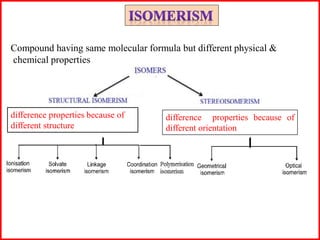
Compound having same molecular formula but different physical &
chemical properties
difference properties because of
different structure
difference properties because of
different orientation
STRUCTURAL ISOMERISM :
Compound having same mol. formula difference in physical properties because of
different structure.
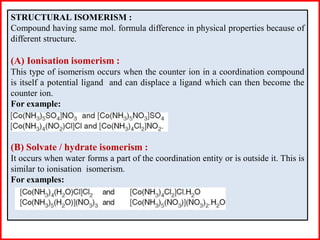
(A) Ionisation isomerism :
This type of isomerism occurs when the counter ion in a coordination compound
is itself a potential ligand and can displace a ligand which can then become the
counter ion.
For example:
(B) Solvate / hydrate isomerism :
It occurs when water forms a part of the coordination entity or is outside it. This is
similar to ionisation isomerism.
For examples:
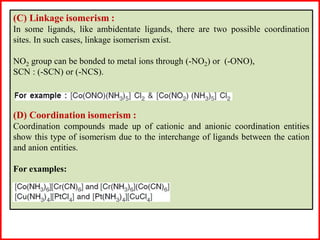
(C) Linkage isomerism :
In some ligands, like ambidentate ligands, there are two possible coordination
sites. In such cases, linkage isomerism exist.
NO2 group can be bonded to metal ions through (-NO2) or (-ONO),
SCN : (-SCN) or (-NCS).
(D) Coordination isomerism :
Coordination compounds made up of cationic and anionic coordination entities
show this type of isomerism due to the interchange of ligands between the cation
and anion entities.
For examples:
(E) Ligand isomerism :
Since many ligands are organic compounds which have possibilities for
isomerism, the resulting complexes can show isomerism from this source.
For example :
ligands 1,2-diaminopropane(propylenediamine or pn) and
1,3-diaminopropane(trimethylenediamine or tn)
(F) Polymerisation isomerism :
Considered to be a special case of coordination isomerism, in this the various
isomers differ in formula weight from one another
For example :
These all have the empirical formula [Pt(NH3)2Cl2] 1: 2 :2
[Pt(NH3)2Cl2] Pt:NH3:Cl 1: 2 :2
[Pt(NH3)4] [PtCl4] Pt:NH3:Cl 2: 4 :4
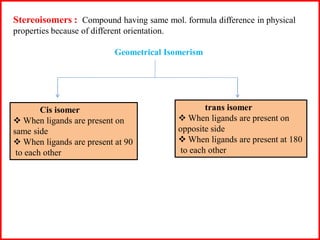
Stereoisomers : Compound having same mol. formula difference in physical
properties because of different orientation.
Geometrical Isomerism
Cis isomer
 When ligands are present on
same side
 When ligands are present at 90
to each other
trans isomer
 When ligands are present on
opposite side
 When ligands are present at 180
to each other
Coordination Number Four :
Tetrahedral Complex :
The tetrahedral compounds can not show geometrical isomerism as we all know
that all four positions are equivalent in tetrahedral geometry.
[MA4], [MA3B] not show G. I.
Square Planar Complex :
In a square planar complex of formula [MA2B2] [A and B are unidentate], the two
ligands .A. may be arranged adjacent to each other in a cis isomer, or opposite to
each other in a trans isomer as depicted.
[MA2B2], [M(AB)2], [MA2BC], [MABCD] show G. I.
Coordination Number 6 :
Geometrical isomerism is also possible in octahedral complexes.
[MA6], [MA5B], [M(AA)3] not show G. I.
[MA2B2C2], [MA2B2CD], [MA2BCE], [MABCDEF], [M(AB)3], [MA4B2], [MA3B3]
show G. I.
Optical Isomerism :
 Plane of symmetry
 Center of symmetry
 Axis of symmetry
Should not be present
• Tetrahedral complexes with formula [MABCD] show optical isomers and
octahedral complexes (cis form) exhibit optical isomerism.
• Optical isomerism is common in octahedral complexes involving didentate
ligands. Cis-isomer of [PtCl2(en)2]2+ show optical isomerism as shown below
because of the absence of plane of symmetry as well as centre of symmetry.
10

Isomerism

  • 1.
  • 2.
    Compound having samemolecular formula but different physical & chemical properties difference properties because of different structure difference properties because of different orientation
  • 3.
    STRUCTURAL ISOMERISM : Compoundhaving same mol. formula difference in physical properties because of different structure. (A) Ionisation isomerism : This type of isomerism occurs when the counter ion in a coordination compound is itself a potential ligand and can displace a ligand which can then become the counter ion. For example: (B) Solvate / hydrate isomerism : It occurs when water forms a part of the coordination entity or is outside it. This is similar to ionisation isomerism. For examples:
  • 4.
    (C) Linkage isomerism: In some ligands, like ambidentate ligands, there are two possible coordination sites. In such cases, linkage isomerism exist. NO2 group can be bonded to metal ions through (-NO2) or (-ONO), SCN : (-SCN) or (-NCS). (D) Coordination isomerism : Coordination compounds made up of cationic and anionic coordination entities show this type of isomerism due to the interchange of ligands between the cation and anion entities. For examples:
  • 5.
    (E) Ligand isomerism: Since many ligands are organic compounds which have possibilities for isomerism, the resulting complexes can show isomerism from this source. For example : ligands 1,2-diaminopropane(propylenediamine or pn) and 1,3-diaminopropane(trimethylenediamine or tn) (F) Polymerisation isomerism : Considered to be a special case of coordination isomerism, in this the various isomers differ in formula weight from one another For example : These all have the empirical formula [Pt(NH3)2Cl2] 1: 2 :2 [Pt(NH3)2Cl2] Pt:NH3:Cl 1: 2 :2 [Pt(NH3)4] [PtCl4] Pt:NH3:Cl 2: 4 :4
  • 6.
    Stereoisomers : Compoundhaving same mol. formula difference in physical properties because of different orientation. Geometrical Isomerism Cis isomer  When ligands are present on same side  When ligands are present at 90 to each other trans isomer  When ligands are present on opposite side  When ligands are present at 180 to each other
  • 7.
    Coordination Number Four: Tetrahedral Complex : The tetrahedral compounds can not show geometrical isomerism as we all know that all four positions are equivalent in tetrahedral geometry. [MA4], [MA3B] not show G. I. Square Planar Complex : In a square planar complex of formula [MA2B2] [A and B are unidentate], the two ligands .A. may be arranged adjacent to each other in a cis isomer, or opposite to each other in a trans isomer as depicted. [MA2B2], [M(AB)2], [MA2BC], [MABCD] show G. I.
  • 8.
    Coordination Number 6: Geometrical isomerism is also possible in octahedral complexes. [MA6], [MA5B], [M(AA)3] not show G. I. [MA2B2C2], [MA2B2CD], [MA2BCE], [MABCDEF], [M(AB)3], [MA4B2], [MA3B3] show G. I. Optical Isomerism :  Plane of symmetry  Center of symmetry  Axis of symmetry Should not be present
  • 9.
    • Tetrahedral complexeswith formula [MABCD] show optical isomers and octahedral complexes (cis form) exhibit optical isomerism. • Optical isomerism is common in octahedral complexes involving didentate ligands. Cis-isomer of [PtCl2(en)2]2+ show optical isomerism as shown below because of the absence of plane of symmetry as well as centre of symmetry.
  • 10.