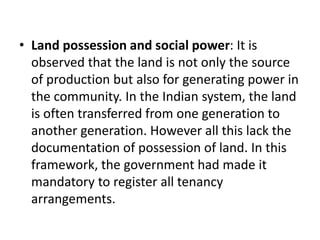
Land reform in India has involved abolishing intermediaries like rent collectors and establishing ceilings on land ownership to redistribute surplus land to the landless. The goals were to remove impediments to agricultural production from the previous feudal system and eliminate exploitation. Key reforms included abolishing rent collectors, regulating tenancy, imposing landholding ceilings, consolidating fragmented holdings, and promoting cooperative farming. Impacts included reducing disparities, giving ex-landlords other work, increasing revenue, and empowering small farmers and laborers. Land reform aimed to promote social justice and economic growth through a more equitable distribution of agricultural land.


![• Categories
• There are six main categories of reforms:
• Abolition of intermediaries (rent collectors under
the pre-Independence land revenue system);
• Tenancy regulation (to improve the contractual
terms including the security of tenure);
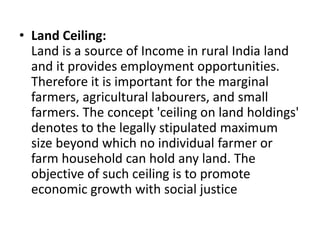
• A ceiling on landholdings (to redistributing
surplus land to the landless);
• Attempts to consolidate disparate landholdings;
• encouragement of cooperative joint farming;
• settlement and regulation of tenancy.[3]](https://image.slidesharecdn.com/landreform-201203095115/85/Land-reform-4-320.jpg)


![CHANGE_AND_DEVELOPMENT_IN_RURAL_SOCIETY[1].pptx](https://cdn.slidesharecdn.com/ss_thumbnails/changeanddevelopmentinruralsociety1-250501194008-e3d4f798-thumbnail.jpg?width=640&height=640&fit=bounds)


