1
“Environmentally Benign Synthetic Strategies
For Potentially Active Compounds.”
• Dr.Gurumeet C Wadhawa ,Assistant Professor,
Department of Chemistry.
Rayat Shikshan sansthas Veer Wajekar ASC
College,Phunde,Uran
2
Advantages of Non-conventional methods over
Conventional
• The non-conventional methods like Microwave induced
reactions, Ultrasound assisted synthesis, grinding etc. are now
a days used in Organic synthesis. These methods are preferred
owing to their various advantages e.g.
1) Cleaner Methods
2) Yields are higher
3) Eco-friendly.
3
• The heterocyclic compounds like chromone and their derivatives are
found to possess excellent physiological activities.
• Our strategy will be to combine various heterocycles with pyrazole,
benzo- -pyrone and quinoline moiety and study the combined effect
of the resulting products.
4
Sonochemistry- Green approach for Organic Synthesis
• What is Sonochemistry?
Study of chemical changes that occur in presence of sound or
ultra-sound.
• Some properties of sonochemical / Ultrasound radiations
. Frequency ranges from 20 KHz to 10 MHz
(Human hearing upper limit is 18 KHz)
. Region 20-100 KHz is best for chemical transformation
. Frequency range 1-10 MHz are suitable for ultrasound
imaging of body organs
5
• Various Organic transformations using Ultrasound radiations was reported those are
• Esterification
• Saponification
• Hydrolysis
• Substitution
RCOOH + R-OH RCOOR'
H2SO4,rt
))))))))
COOCH3 COOH
-
OH/ H2O
)))))) ,60 min.
Ar CN Ar COOH
-
OH/ H2O
)))))) ,60 min.
R Cl
O
R CN
O
KCN, MeCN
)))))))),50 C
6
Microwave assisted reactions as an greener approach in
Organic Chemistry
• Microwave induced organic reaction enhancement (MORE) chemistry are
extremely fast cleaner than conventional reactions and lead to higher atom
economy, because of -
• Short reaction time
• Ease of workability
• Eco-friendly
• Greener technique
• Higher Selectivity
7
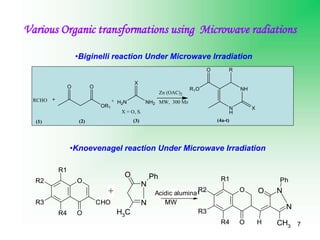
Various Organic transformations using Microwave radiations
OR1
O O
+ H2N NH2
X
N
H
NH
R
R1O
O
X
MW, 300 Mz
X = O, S.
RCHO
(1) (2) (3) (4a-t)
Zn (OAC)2
•Biginelli reaction Under Microwave Irradiation
•Knoevenagel reaction Under Microwave Irradiation
R1
R2
R3
R4
O
O
CHO N
N
C
H3
O Ph
O
R1
R2
R3
R4 O H
N
N
CH3
O
Ph
MW
Basic alumina
+
R1
R2
R3
R4
O
O
CHO N
N
C
H3
O Ph
O
R1
R2
R3
R4 O H
N
N
CH3
O
Ph
MW
+ Acidic alumina
8
Aims
The present investigation is aimed at
• Synthesizing some new heterocycles
• Establishing their structures and stereochemistry
• Evaluating their therapeutic values
• An attempts will be made to synthesize these
compounds by conventional as well as by non –
conventional methods like MWI, Ultrasonication etc..
9

Green Chemistry.ppt

  • 1.
    1 “Environmentally Benign SyntheticStrategies For Potentially Active Compounds.” • Dr.Gurumeet C Wadhawa ,Assistant Professor, Department of Chemistry. Rayat Shikshan sansthas Veer Wajekar ASC College,Phunde,Uran
  • 2.
    2 Advantages of Non-conventionalmethods over Conventional • The non-conventional methods like Microwave induced reactions, Ultrasound assisted synthesis, grinding etc. are now a days used in Organic synthesis. These methods are preferred owing to their various advantages e.g. 1) Cleaner Methods 2) Yields are higher 3) Eco-friendly.
  • 3.
    3 • The heterocycliccompounds like chromone and their derivatives are found to possess excellent physiological activities. • Our strategy will be to combine various heterocycles with pyrazole, benzo- -pyrone and quinoline moiety and study the combined effect of the resulting products.
  • 4.
    4 Sonochemistry- Green approachfor Organic Synthesis • What is Sonochemistry? Study of chemical changes that occur in presence of sound or ultra-sound. • Some properties of sonochemical / Ultrasound radiations . Frequency ranges from 20 KHz to 10 MHz (Human hearing upper limit is 18 KHz) . Region 20-100 KHz is best for chemical transformation . Frequency range 1-10 MHz are suitable for ultrasound imaging of body organs
  • 5.
    5 • Various Organictransformations using Ultrasound radiations was reported those are • Esterification • Saponification • Hydrolysis • Substitution RCOOH + R-OH RCOOR' H2SO4,rt )))))))) COOCH3 COOH - OH/ H2O )))))) ,60 min. Ar CN Ar COOH - OH/ H2O )))))) ,60 min. R Cl O R CN O KCN, MeCN )))))))),50 C
  • 6.
    6 Microwave assisted reactionsas an greener approach in Organic Chemistry • Microwave induced organic reaction enhancement (MORE) chemistry are extremely fast cleaner than conventional reactions and lead to higher atom economy, because of - • Short reaction time • Ease of workability • Eco-friendly • Greener technique • Higher Selectivity
  • 7.
    7 Various Organic transformationsusing Microwave radiations OR1 O O + H2N NH2 X N H NH R R1O O X MW, 300 Mz X = O, S. RCHO (1) (2) (3) (4a-t) Zn (OAC)2 •Biginelli reaction Under Microwave Irradiation •Knoevenagel reaction Under Microwave Irradiation R1 R2 R3 R4 O O CHO N N C H3 O Ph O R1 R2 R3 R4 O H N N CH3 O Ph MW Basic alumina + R1 R2 R3 R4 O O CHO N N C H3 O Ph O R1 R2 R3 R4 O H N N CH3 O Ph MW + Acidic alumina
  • 8.
    8 Aims The present investigationis aimed at • Synthesizing some new heterocycles • Establishing their structures and stereochemistry • Evaluating their therapeutic values • An attempts will be made to synthesize these compounds by conventional as well as by non – conventional methods like MWI, Ultrasonication etc..
  • 9.