Ion specIfIc electrodes
Tapeshwar Yadav
(Lecturer)
BMLT, DNHE,
M.Sc. Medical Biochemistry
Ion Selective Electrodes
• It is a well known fact that metal ions have a
profound effect on cellular processes
• The importance or the role that ions play in cellular
activity can be gauged by the fact that most cells
maintain a very critical Na+ & k+ balance between
the extracellular and the intracellular spaces.
• Any distribution in this critical balance is to the
cellular metabolism through a drastic change in the
osmotic pressure resulting in cellular swelling.
ISE
• Another metal ions, Ca2+
is known to act as a
minatory intracellular message stimulating
such diverse process as
 Insulin secretion
Chemotaxis
Endocytosis
Cellular proliferation
Basic principles
• An ISE operates an exactly the same principles
as a PH electrode
In fact, a PH electrode is a type of ion
selective electrode sensitive to hydrogen ion.
Just like a PH electrode, the electrode body
contains a reference solution and an metal
reference electrode
Contd…
On to this electrode body is sealed an ion
selective membrane which act as the ion
sensor
Four different types of ion selective
membranes are in use
They are:-
1.Specially formulated glass
2.An ion exchanger dispersed in an innert matrix
Contd…
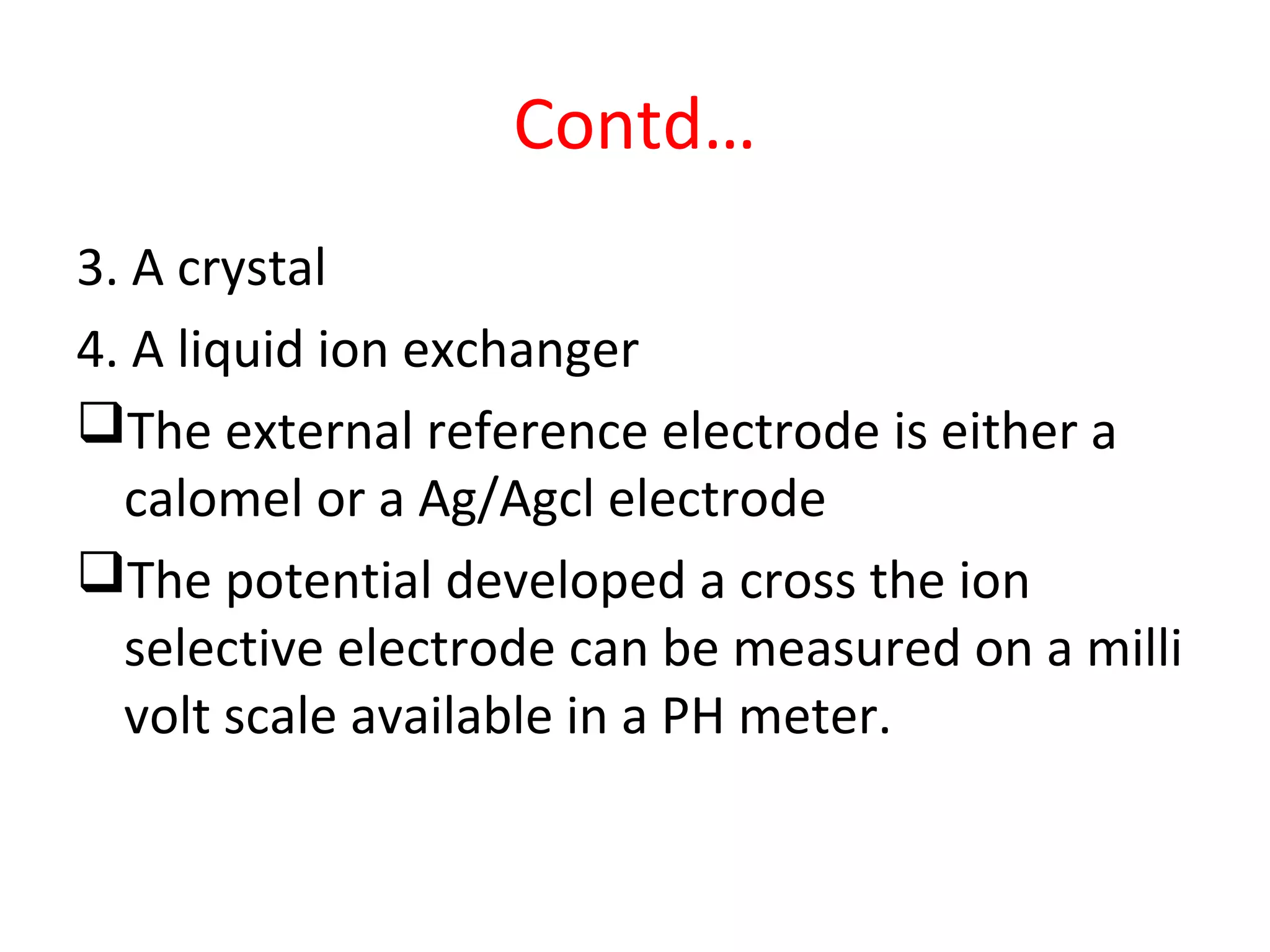
3. A crystal
4. A liquid ion exchanger
The external reference electrode is either a
calomel or a Ag/Agcl electrode
The potential developed a cross the ion
selective electrode can be measured on a milli
volt scale available in a PH meter.
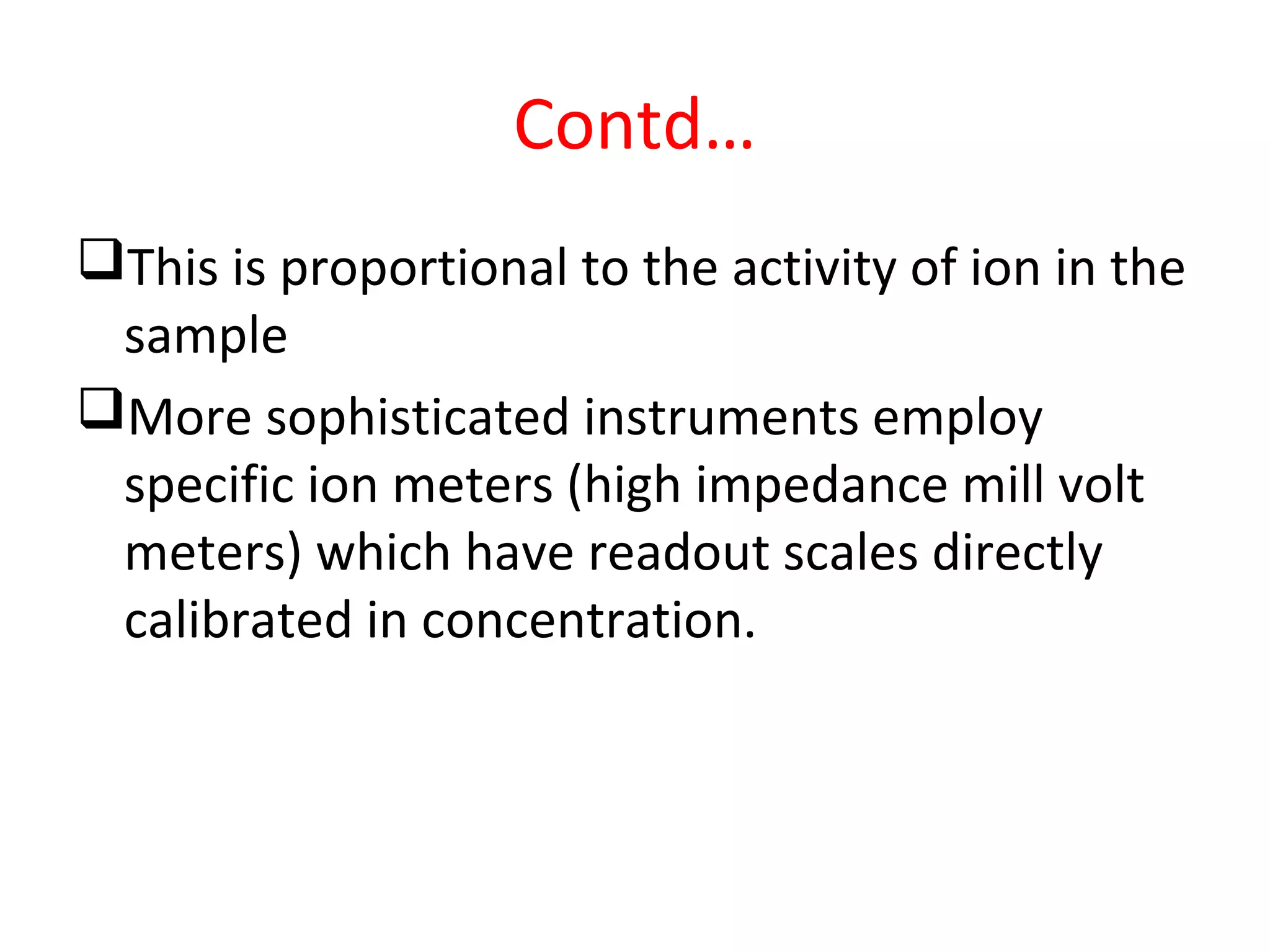
Contd…
This is proportional to the activity of ion in the
sample
More sophisticated instruments employ
specific ion meters (high impedance mill volt
meters) which have readout scales directly
calibrated in concentration.
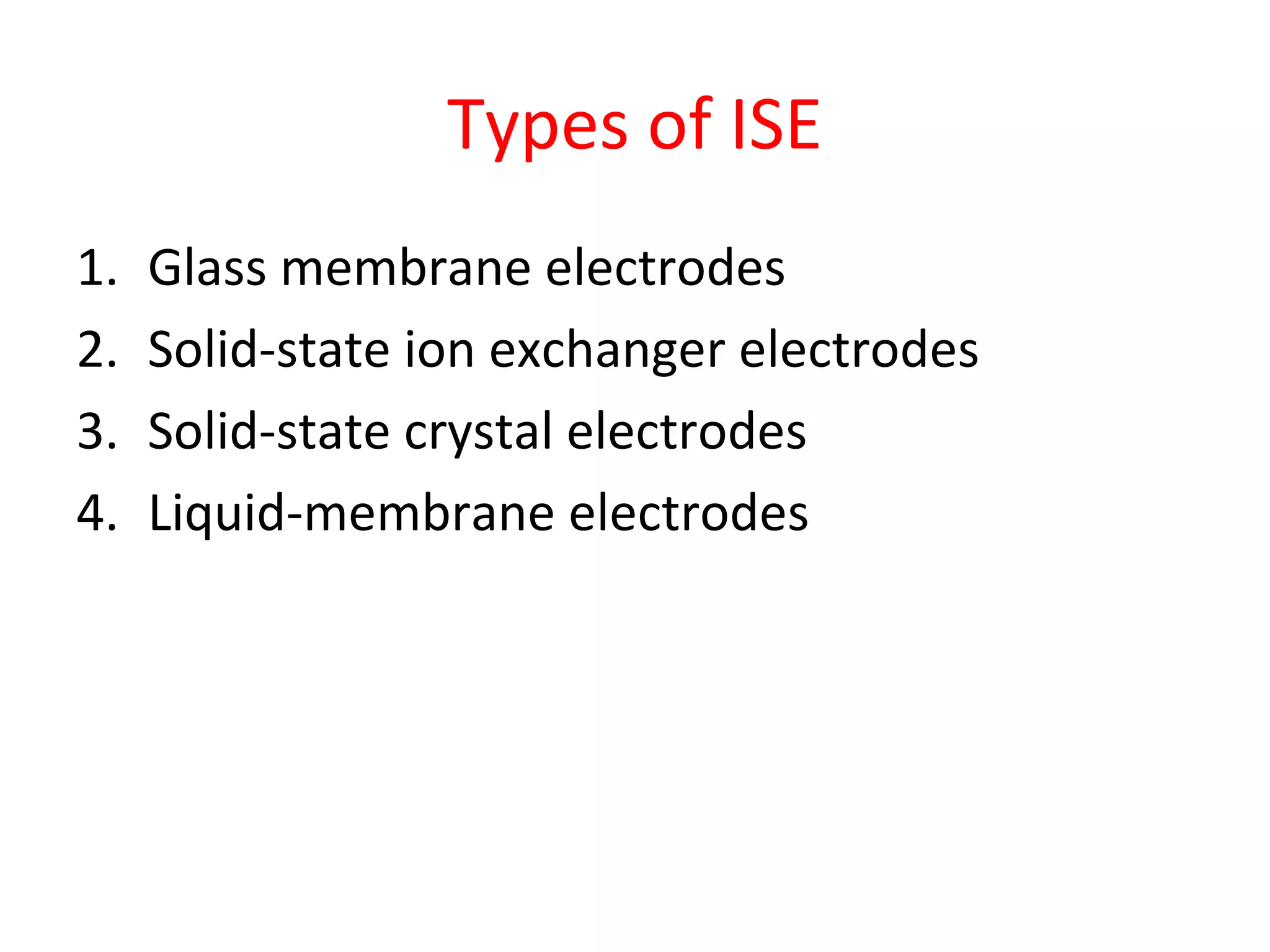
Types of ISE
1. Glass membrane electrodes
2. Solid-state ion exchanger electrodes
3. Solid-state crystal electrodes
4. Liquid-membrane electrodes
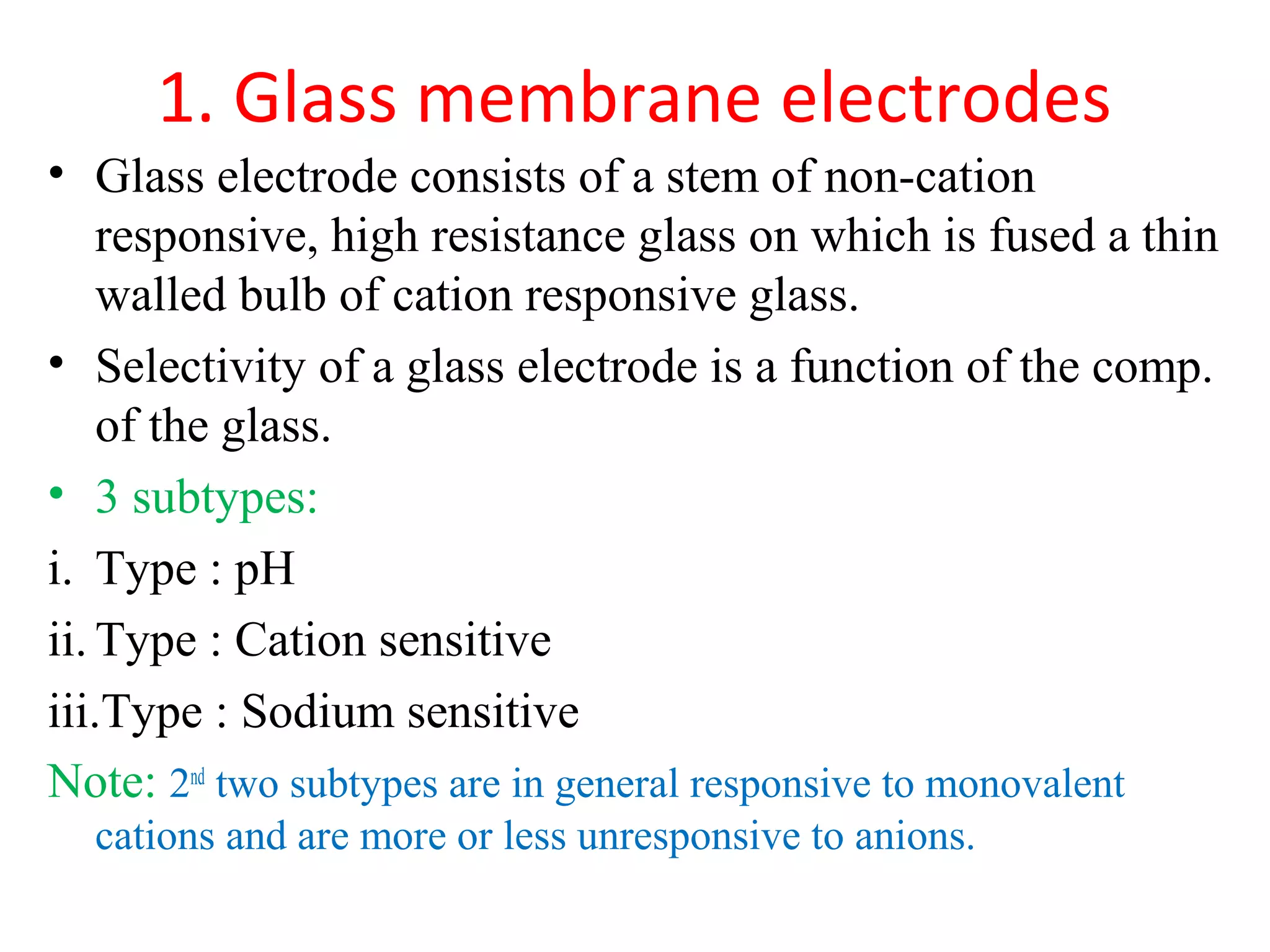
1. Glass membrane electrodes
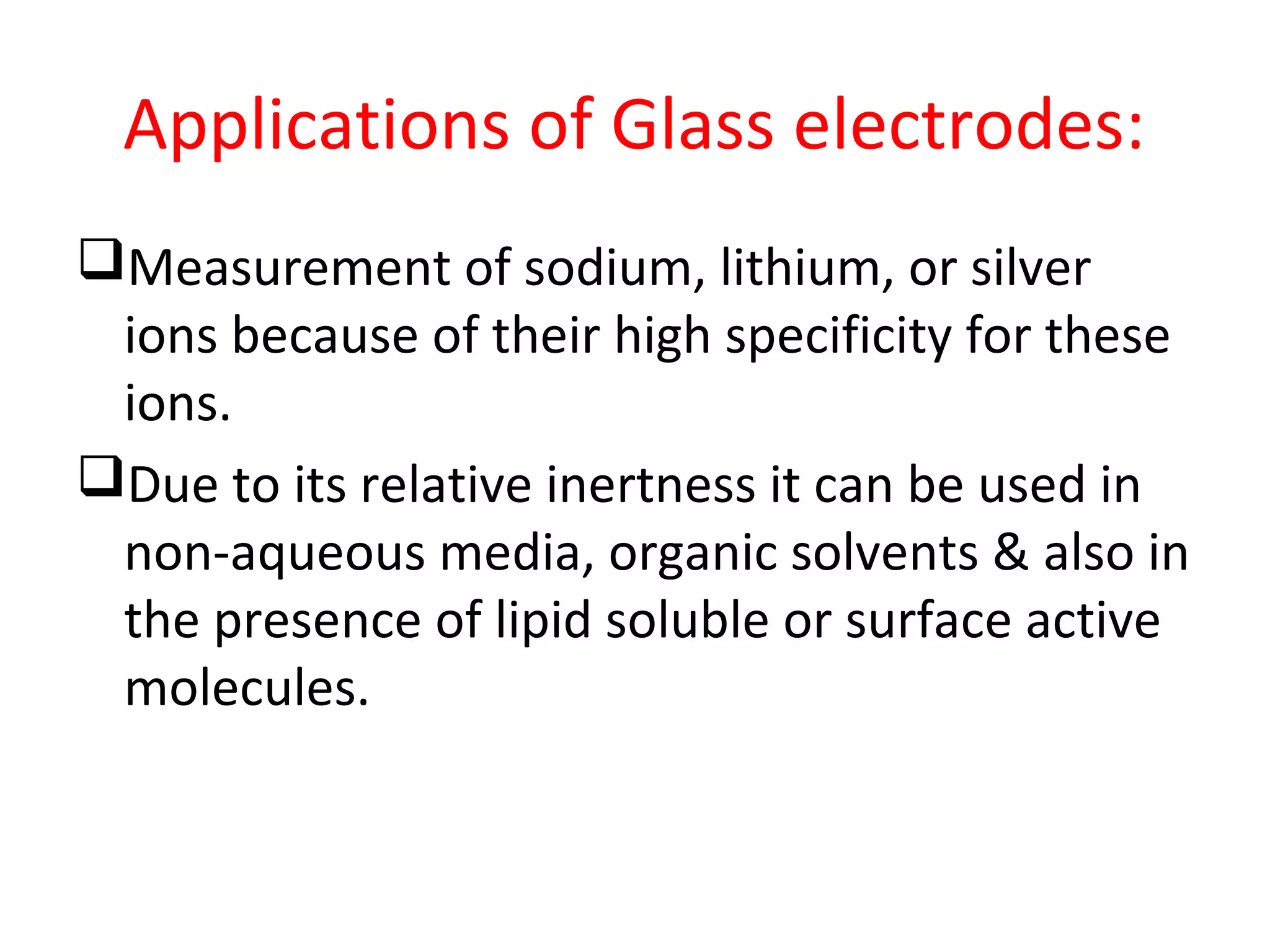
• Glass electrode consists of a stem of non-cation
responsive, high resistance glass on which is fused a thin
walled bulb of cation responsive glass.
• Selectivity of a glass electrode is a function of the comp.
of the glass.
• 3 subtypes:
i. Type : pH
ii. Type : Cation sensitive
iii.Type : Sodium sensitive
Note: 2nd
two subtypes are in general responsive to monovalent
cations and are more or less unresponsive to anions.
Contd…
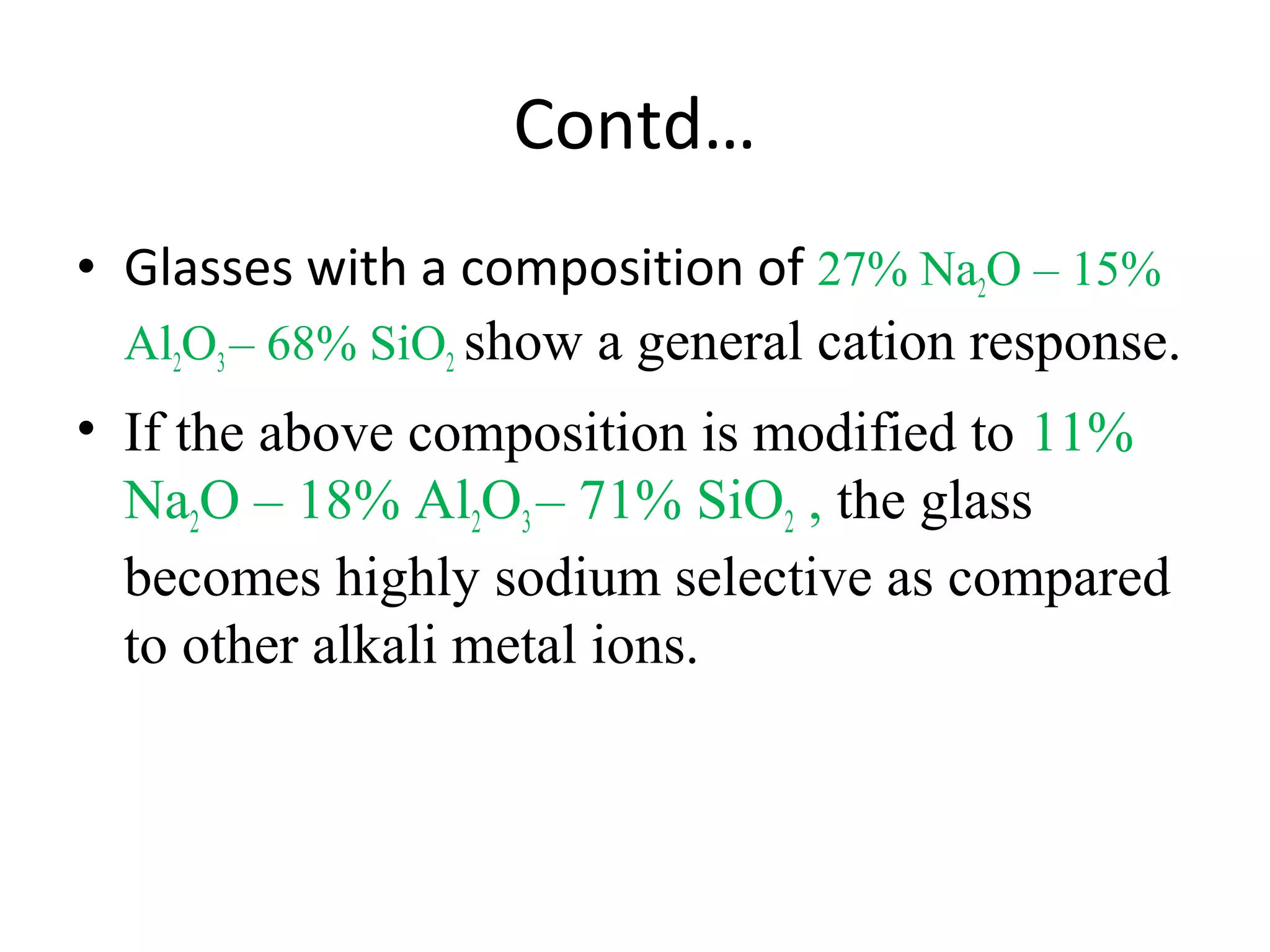
• Appropriate adjustments of glass composition
change the degree of electrode selectivity.
• Thus, glass can be made more responsive to
cations by adding to it elements which have co-
ordination numbers greater than oxidation
numbers to alkali metal-silicate glasses (20%
Na2O – 10% CaO – 70% SiO2).
• It usually imparts an excessive negative change to
the glass making it suitable to attract cations
having a proper charge-size ratio.
Contd…
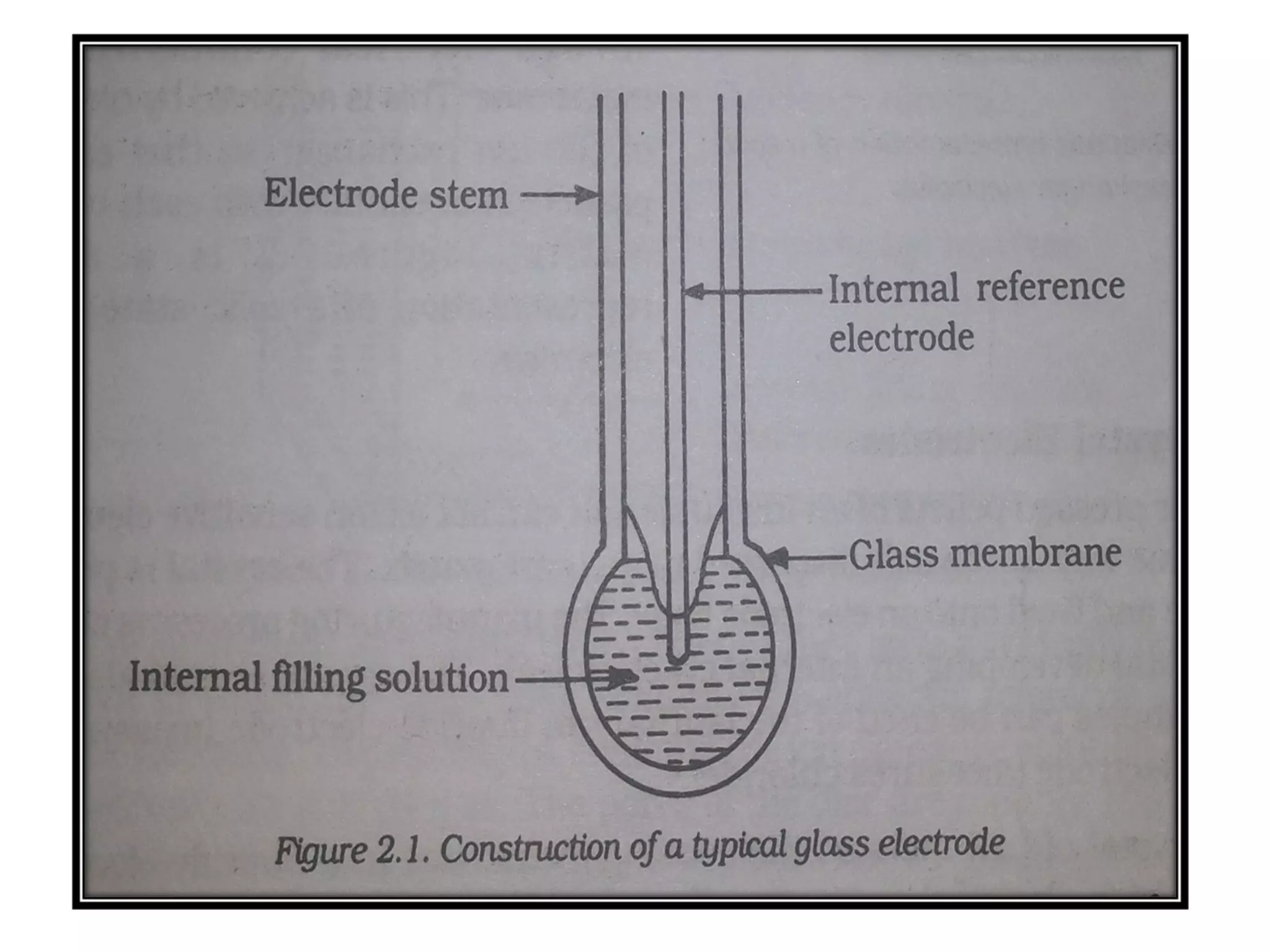
• Glasses with a composition of 27% Na2O – 15%
Al2O3– 68% SiO2 show a general cation response.
• If the above composition is modified to 11%
Na2O – 18% Al2O3– 71% SiO2 , the glass
becomes highly sodium selective as compared
to other alkali metal ions.
Applications of Glass electrodes:
Measurement of sodium, lithium, or silver
ions because of their high specificity for these
ions.
Due to its relative inertness it can be used in
non-aqueous media, organic solvents & also in
the presence of lipid soluble or surface active
molecules.
2. Solid-State Ion Exchange
Electrodes
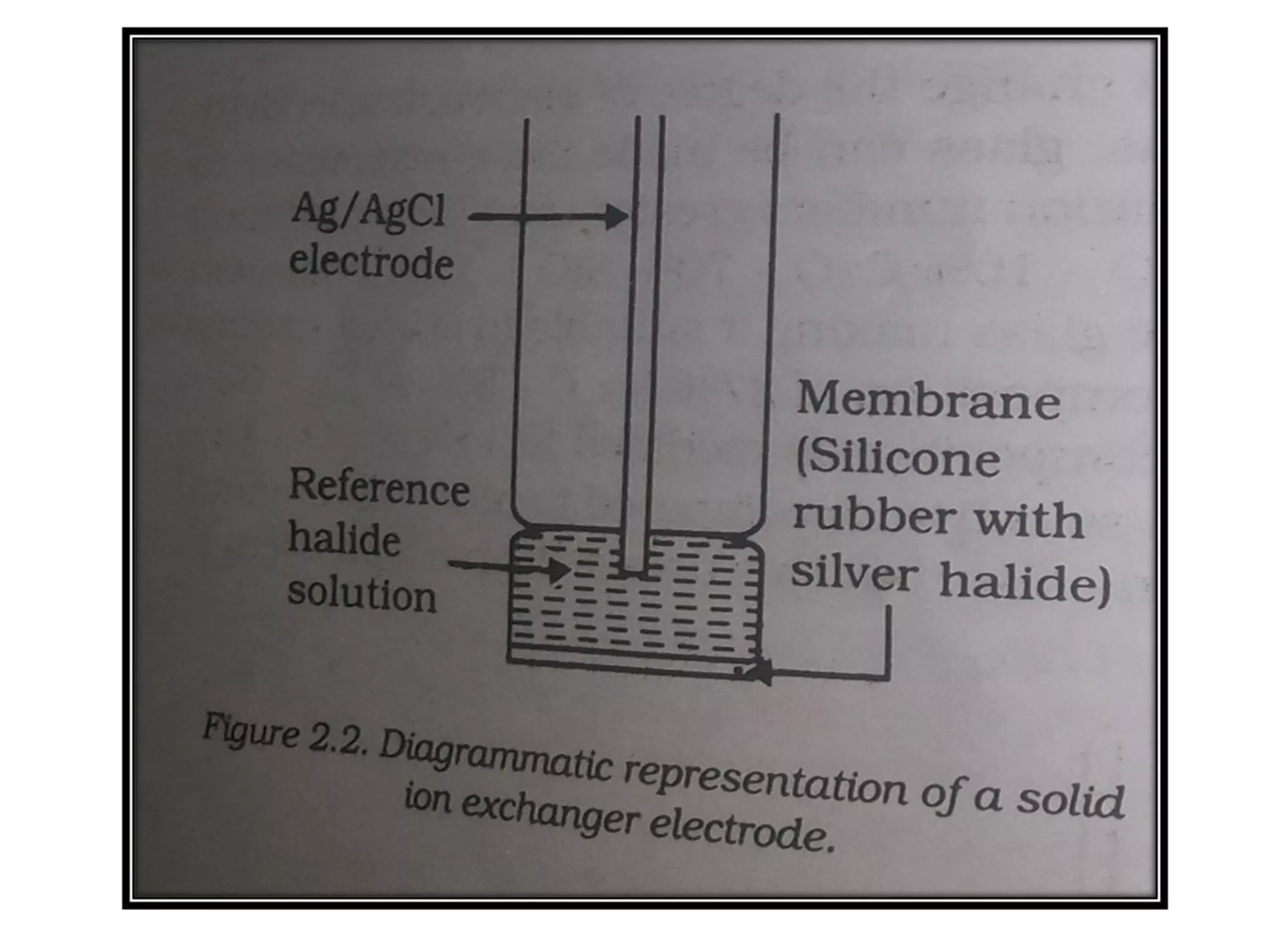
• In these electrodes, the glass membrane is
replaced with a solid-state ionically
conducting membrane.
• Ion responsive material is an insoluble or
sparingly soluble salt dispersed in an inert
matrix.
• Often used inert matrices include silicon
rubber, polyvinyl chloride & other polymeric
materials.
Contd…
• Membrane have good mechanical properties and
give reproducible potentials.
• The membrane so prepared is then cemented to a
glass or epoxy resin electrode body.
• The body holds an internal-reference solution and
a reference electrode .
• Sometimes, the back of an ion responsive
membrane is coated with mercury and platinum
wire is connected to it which works as the
reference electrode.
Contd…
Solid-state ion exchanger electrodes have 2
drawbacks:
1.Relatively short working life.
2.Concerns itself with the extremely high
resistance of silicone robber & other matrices.
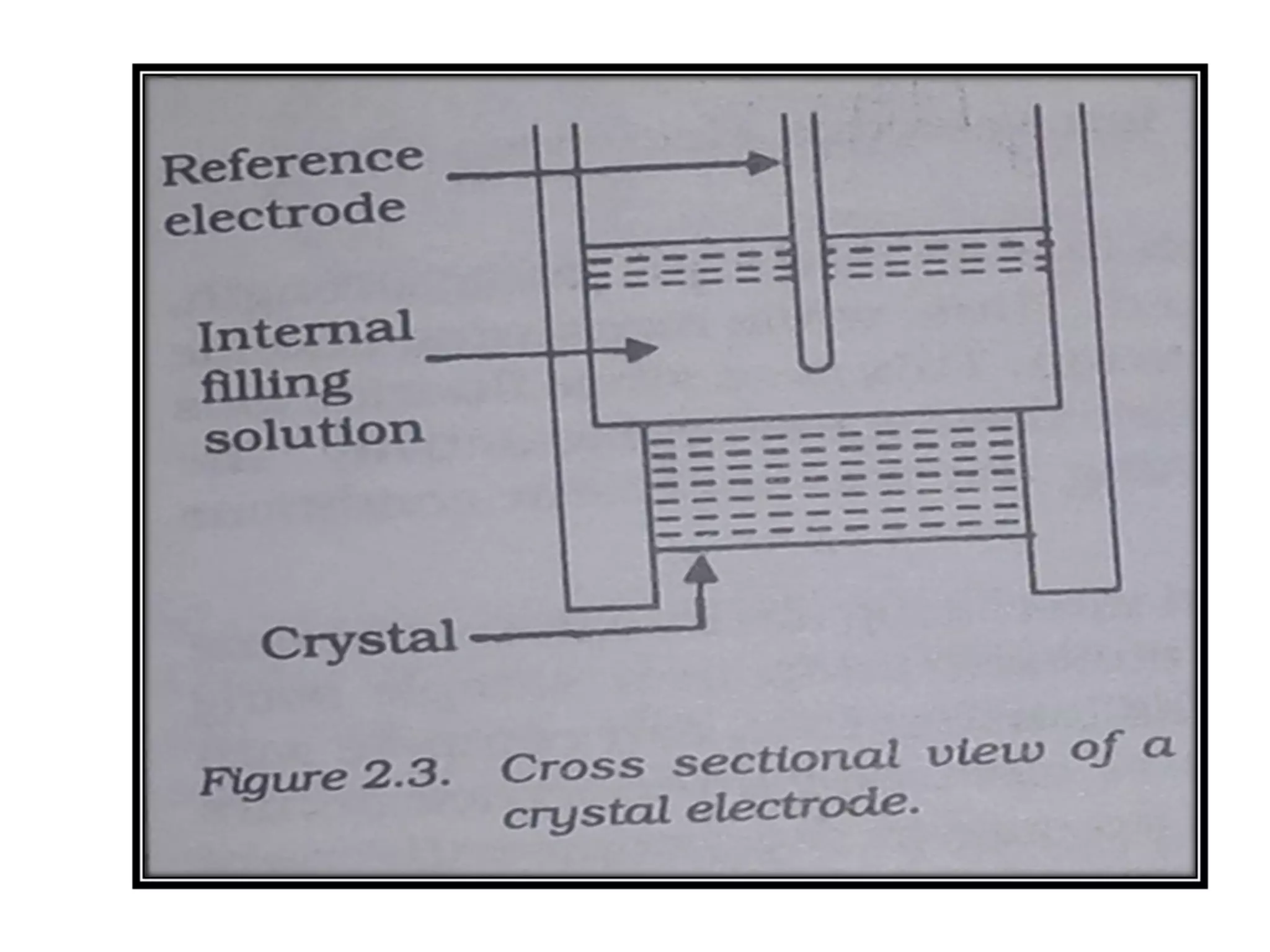
3. Solid-State Crystal Electrodes:
• Crystal of an insoluble salt can act as ion sensitive
elements operating in much the same way as the salt
dispersed in an inert matrix.
• Crystal should not have high resistance.
• Eg.
Lanthanum fluoride electrode:- measures fluoride
Silver chloride electrode:- measures chloride
These electrodes have a life of about 1-2 years.
However, if used at high temp., their life gets shortened
considerably 1-3 months
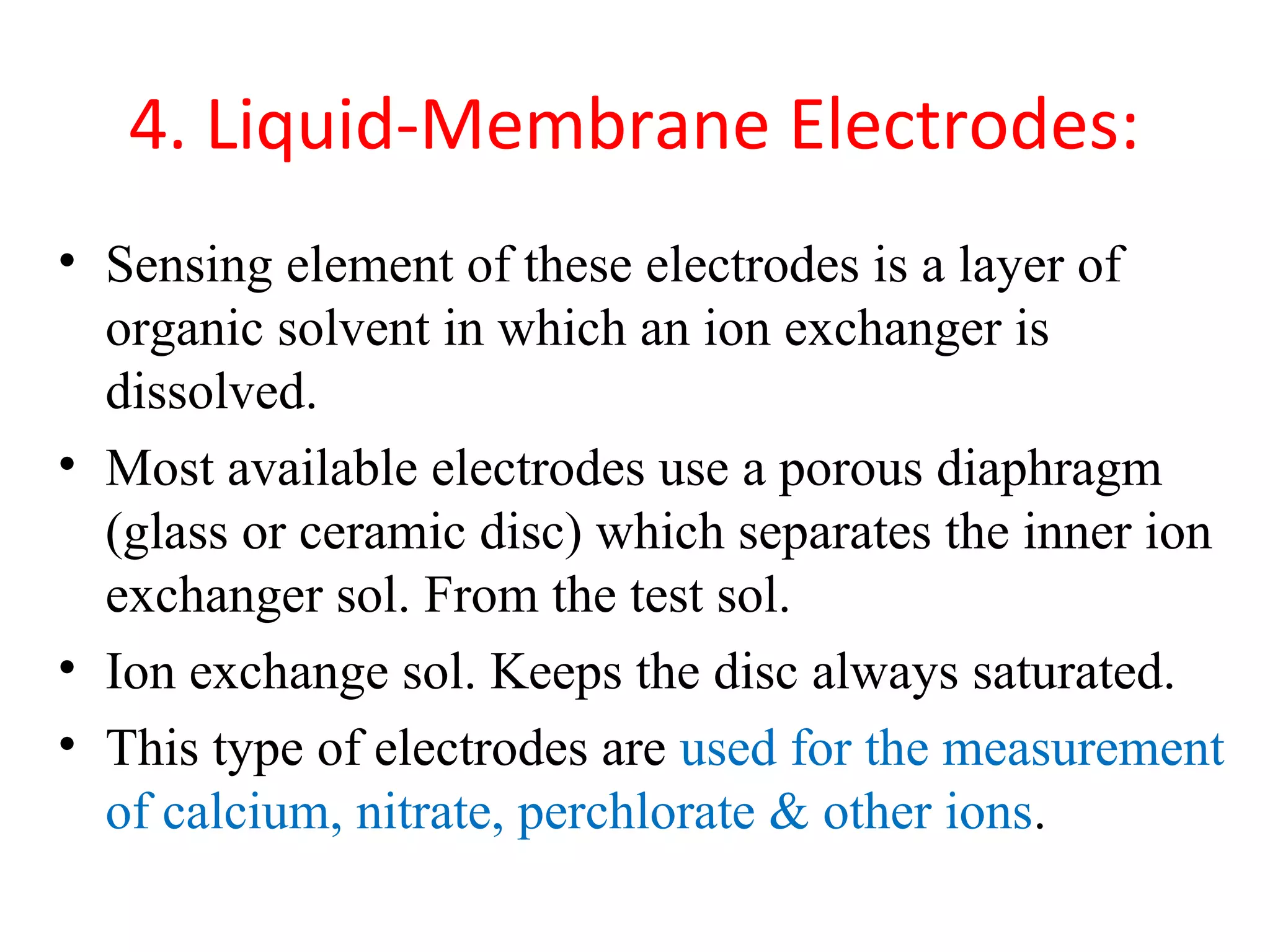
4. Liquid-Membrane Electrodes:
• Sensing element of these electrodes is a layer of
organic solvent in which an ion exchanger is
dissolved.
• Most available electrodes use a porous diaphragm
(glass or ceramic disc) which separates the inner ion
exchanger sol. From the test sol.
• Ion exchange sol. Keeps the disc always saturated.
• This type of electrodes are used for the measurement
of calcium, nitrate, perchlorate & other ions.
Interferences
 2 main types of interferences are
encountered by ISEs. They are-
1.Method interference
2.Electrode interference
1. Method interference:
 It can occur when either or all of such factors at the pH,
ionic strength or temp. of the sample being tested are not
properly mixed.
 Thus, while measuring fluoride ions, a low pH might
give very low values for the activity of this ion.
 This is so since fluoride ions form complexes with the
hydrogen ions and consequently lose their measurable
activity.
 The method interference can therefore be done away
with by fixing the measurement conditions diligently.
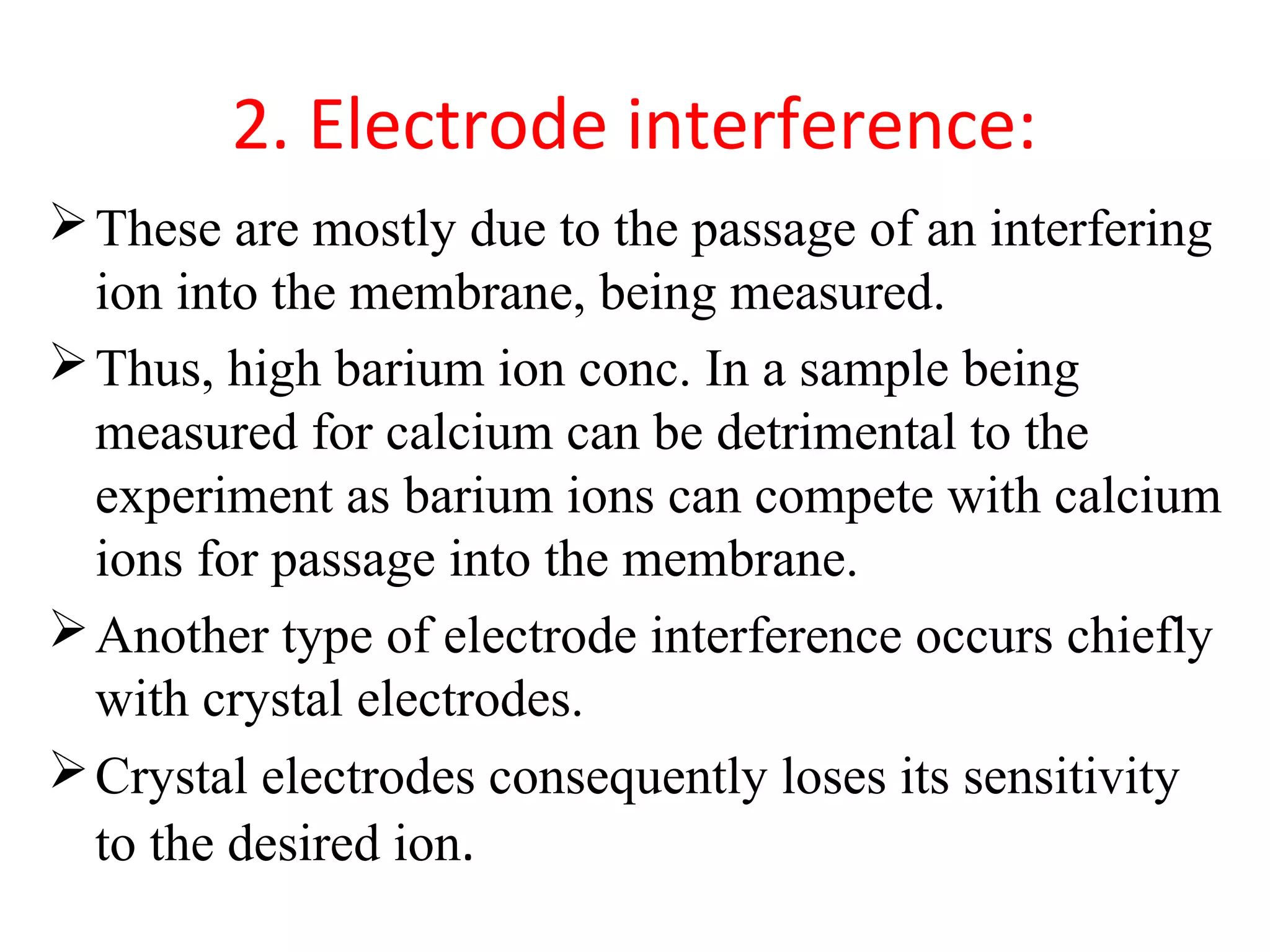
2. Electrode interference:
These are mostly due to the passage of an interfering
ion into the membrane, being measured.
Thus, high barium ion conc. In a sample being
measured for calcium can be detrimental to the
experiment as barium ions can compete with calcium
ions for passage into the membrane.
Another type of electrode interference occurs chiefly
with crystal electrodes.
Crystal electrodes consequently loses its sensitivity
to the desired ion.
Applications of ISE
Activity measurements are valuable because
the activities of ions determine rates of
reactions and chemical equilibria.
Ion electrodes have been used for predicting
corrosion rates, extent of precipitation,
degree of acidity , formation of complexes,
solution conductivities and effectiveness of
electroplating bath solutions.
Contd…
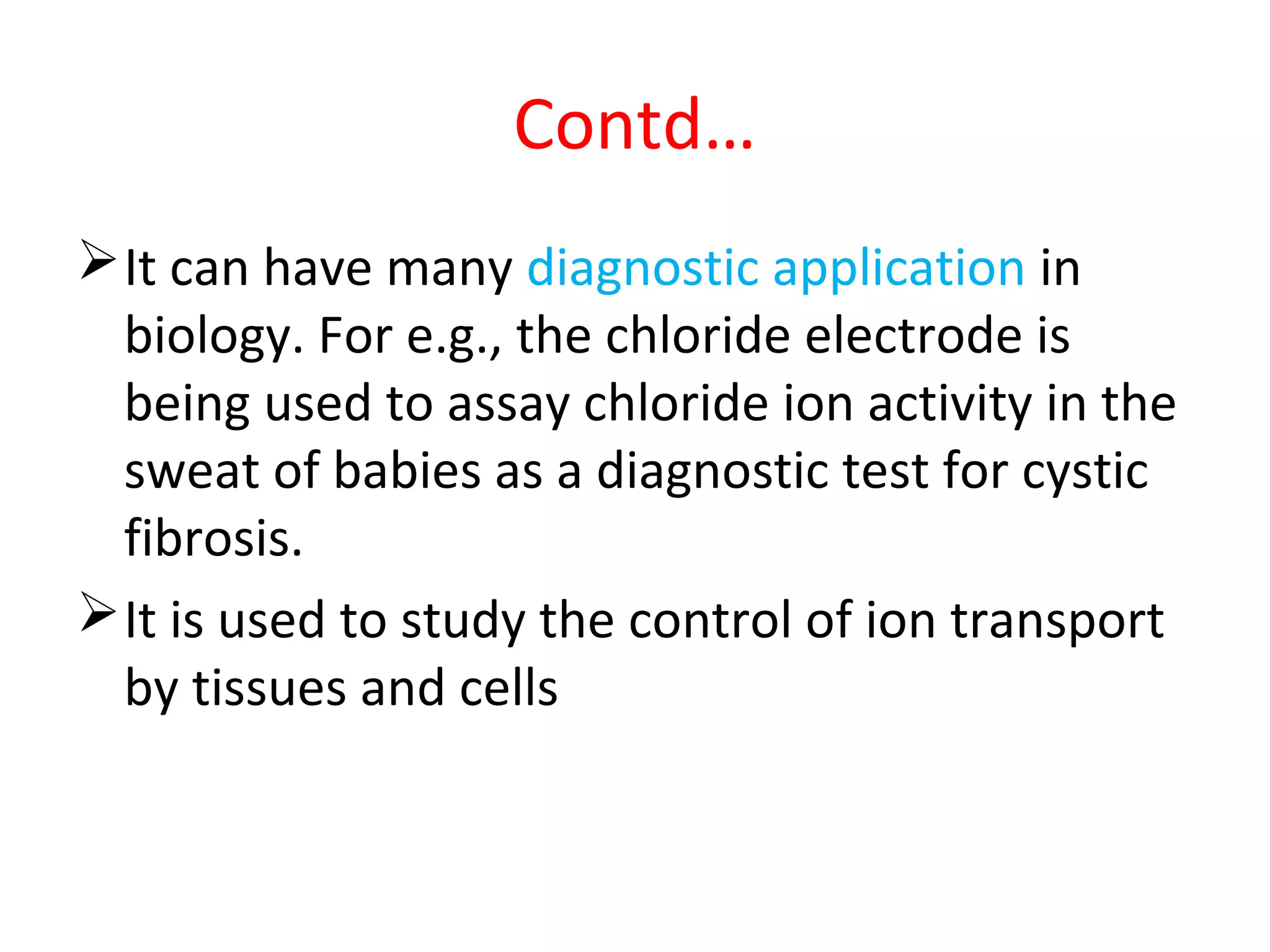
It can have many diagnostic application in
biology. For e.g., the chloride electrode is
being used to assay chloride ion activity in the
sweat of babies as a diagnostic test for cystic
fibrosis.
It is used to study the control of ion transport
by tissues and cells
Contd…
• Stimulating biological application of ion
selective electrodes is that they can be
converted into enzyme electrodes.
• These electrodes can be measure the activity
of an enzyme in a given sample
• For e.g., the ammonium ion electrode can be
converted into an enzyme electrode
measuring the activity of ureas.
Advanteages
- Exhibit wide response
- Exhibit wide linear range
- Low cost
- Color or turbidity of analyte does not affect results
- Come in different shapes and sizes
ION-SELECTIVE ELECTRODES (ISE)
- Made from an ion-conducting membrane
(ion-exchange material that allows ions of one electrical
sign to pass through)
- Reference electrode is inbuilt
- Internal solution (solution inside electrode) contains ion of
interest with constant activity
- Ion of interest is also mixed with membrane
- Membrane is nonporous and water insoluble
ION-SELECTIVE ELECTRODES (ISE)
- Selective (preferential) ion is C+
- Membrane is made of poly(vinyl chloride) (PVC)
- Membrane is impregnated with nonpolar liquid
- Membrane contains ligand L (ion-selective ionophore)
- Membrane contains the complex LC+
- Membrane contains hydrophobic anion R-
(ion exchanger)
ION-SELECTIVE ELECTRODES (ISE)
- Responds preferentially to one species in solution
Internal reference
electrode
Ion-selective membrane
Internal (filling)
solution
ION-SELECTIVE ELECTRODES (ISE)

Ion specific electrodes

  • 1.
    Ion specIfIc electrodes TapeshwarYadav (Lecturer) BMLT, DNHE, M.Sc. Medical Biochemistry
  • 2.
    Ion Selective Electrodes •It is a well known fact that metal ions have a profound effect on cellular processes • The importance or the role that ions play in cellular activity can be gauged by the fact that most cells maintain a very critical Na+ & k+ balance between the extracellular and the intracellular spaces. • Any distribution in this critical balance is to the cellular metabolism through a drastic change in the osmotic pressure resulting in cellular swelling.
  • 3.
    ISE • Another metalions, Ca2+ is known to act as a minatory intracellular message stimulating such diverse process as  Insulin secretion Chemotaxis Endocytosis Cellular proliferation
  • 4.
    Basic principles • AnISE operates an exactly the same principles as a PH electrode In fact, a PH electrode is a type of ion selective electrode sensitive to hydrogen ion. Just like a PH electrode, the electrode body contains a reference solution and an metal reference electrode
  • 5.
    Contd… On to thiselectrode body is sealed an ion selective membrane which act as the ion sensor Four different types of ion selective membranes are in use They are:- 1.Specially formulated glass 2.An ion exchanger dispersed in an innert matrix
  • 6.
    Contd… 3. A crystal 4.A liquid ion exchanger The external reference electrode is either a calomel or a Ag/Agcl electrode The potential developed a cross the ion selective electrode can be measured on a milli volt scale available in a PH meter.
  • 7.
    Contd… This is proportionalto the activity of ion in the sample More sophisticated instruments employ specific ion meters (high impedance mill volt meters) which have readout scales directly calibrated in concentration.
  • 8.
    Types of ISE 1.Glass membrane electrodes 2. Solid-state ion exchanger electrodes 3. Solid-state crystal electrodes 4. Liquid-membrane electrodes
  • 9.
    1. Glass membraneelectrodes • Glass electrode consists of a stem of non-cation responsive, high resistance glass on which is fused a thin walled bulb of cation responsive glass. • Selectivity of a glass electrode is a function of the comp. of the glass. • 3 subtypes: i. Type : pH ii. Type : Cation sensitive iii.Type : Sodium sensitive Note: 2nd two subtypes are in general responsive to monovalent cations and are more or less unresponsive to anions.
  • 10.
    Contd… • Appropriate adjustmentsof glass composition change the degree of electrode selectivity. • Thus, glass can be made more responsive to cations by adding to it elements which have co- ordination numbers greater than oxidation numbers to alkali metal-silicate glasses (20% Na2O – 10% CaO – 70% SiO2). • It usually imparts an excessive negative change to the glass making it suitable to attract cations having a proper charge-size ratio.
  • 11.
    Contd… • Glasses witha composition of 27% Na2O – 15% Al2O3– 68% SiO2 show a general cation response. • If the above composition is modified to 11% Na2O – 18% Al2O3– 71% SiO2 , the glass becomes highly sodium selective as compared to other alkali metal ions.
  • 13.
    Applications of Glasselectrodes: Measurement of sodium, lithium, or silver ions because of their high specificity for these ions. Due to its relative inertness it can be used in non-aqueous media, organic solvents & also in the presence of lipid soluble or surface active molecules.
  • 14.
    2. Solid-State IonExchange Electrodes • In these electrodes, the glass membrane is replaced with a solid-state ionically conducting membrane. • Ion responsive material is an insoluble or sparingly soluble salt dispersed in an inert matrix. • Often used inert matrices include silicon rubber, polyvinyl chloride & other polymeric materials.
  • 15.
    Contd… • Membrane havegood mechanical properties and give reproducible potentials. • The membrane so prepared is then cemented to a glass or epoxy resin electrode body. • The body holds an internal-reference solution and a reference electrode . • Sometimes, the back of an ion responsive membrane is coated with mercury and platinum wire is connected to it which works as the reference electrode.
  • 16.
    Contd… Solid-state ion exchangerelectrodes have 2 drawbacks: 1.Relatively short working life. 2.Concerns itself with the extremely high resistance of silicone robber & other matrices.
  • 18.
    3. Solid-State CrystalElectrodes: • Crystal of an insoluble salt can act as ion sensitive elements operating in much the same way as the salt dispersed in an inert matrix. • Crystal should not have high resistance. • Eg. Lanthanum fluoride electrode:- measures fluoride Silver chloride electrode:- measures chloride These electrodes have a life of about 1-2 years. However, if used at high temp., their life gets shortened considerably 1-3 months
  • 20.
    4. Liquid-Membrane Electrodes: •Sensing element of these electrodes is a layer of organic solvent in which an ion exchanger is dissolved. • Most available electrodes use a porous diaphragm (glass or ceramic disc) which separates the inner ion exchanger sol. From the test sol. • Ion exchange sol. Keeps the disc always saturated. • This type of electrodes are used for the measurement of calcium, nitrate, perchlorate & other ions.
  • 22.
    Interferences  2 maintypes of interferences are encountered by ISEs. They are- 1.Method interference 2.Electrode interference
  • 23.
    1. Method interference: It can occur when either or all of such factors at the pH, ionic strength or temp. of the sample being tested are not properly mixed.  Thus, while measuring fluoride ions, a low pH might give very low values for the activity of this ion.  This is so since fluoride ions form complexes with the hydrogen ions and consequently lose their measurable activity.  The method interference can therefore be done away with by fixing the measurement conditions diligently.
  • 24.
    2. Electrode interference: Theseare mostly due to the passage of an interfering ion into the membrane, being measured. Thus, high barium ion conc. In a sample being measured for calcium can be detrimental to the experiment as barium ions can compete with calcium ions for passage into the membrane. Another type of electrode interference occurs chiefly with crystal electrodes. Crystal electrodes consequently loses its sensitivity to the desired ion.
  • 25.
    Applications of ISE Activitymeasurements are valuable because the activities of ions determine rates of reactions and chemical equilibria. Ion electrodes have been used for predicting corrosion rates, extent of precipitation, degree of acidity , formation of complexes, solution conductivities and effectiveness of electroplating bath solutions.
  • 26.
    Contd… It can havemany diagnostic application in biology. For e.g., the chloride electrode is being used to assay chloride ion activity in the sweat of babies as a diagnostic test for cystic fibrosis. It is used to study the control of ion transport by tissues and cells
  • 27.
    Contd… • Stimulating biologicalapplication of ion selective electrodes is that they can be converted into enzyme electrodes. • These electrodes can be measure the activity of an enzyme in a given sample • For e.g., the ammonium ion electrode can be converted into an enzyme electrode measuring the activity of ureas.
  • 28.
    Advanteages - Exhibit wideresponse - Exhibit wide linear range - Low cost - Color or turbidity of analyte does not affect results - Come in different shapes and sizes ION-SELECTIVE ELECTRODES (ISE)
  • 29.
    - Made froman ion-conducting membrane (ion-exchange material that allows ions of one electrical sign to pass through) - Reference electrode is inbuilt - Internal solution (solution inside electrode) contains ion of interest with constant activity - Ion of interest is also mixed with membrane - Membrane is nonporous and water insoluble ION-SELECTIVE ELECTRODES (ISE)
  • 30.
    - Selective (preferential)ion is C+ - Membrane is made of poly(vinyl chloride) (PVC) - Membrane is impregnated with nonpolar liquid - Membrane contains ligand L (ion-selective ionophore) - Membrane contains the complex LC+ - Membrane contains hydrophobic anion R- (ion exchanger) ION-SELECTIVE ELECTRODES (ISE)
  • 31.
    - Responds preferentiallyto one species in solution Internal reference electrode Ion-selective membrane Internal (filling) solution ION-SELECTIVE ELECTRODES (ISE)