1
Electrochemical
Machining (ECM)
2
Electrochemical Machining
Nontraditional machining
process of removing metal
from extremely hard
materials using a high
current between the
electrolyte (tool piece) and
work piece.
3
Electrochemical Machining
Uses an electrolyte and electrical current to ionize
and remove metal atoms
Can machine complex cavities in high-strength
materials
Leaves a burr-free surface
Not affected by the strength, hardness or
toughness of the material
4
Electrochemical Machining
5
Operating Principle
 In the actual process, the
cathode is tool-shaped, more or
less like the mirror image of the
finished work piece.
 The electrolysis process that
takes place at the cathode
liberates hydroxyl ions
(negatively charged) and free
hydrogen. The hydroxyl ions
combine with the metal ions of
the anode to form insoluble
metal hydroxides and the
material is thus removed from
the anode. & this process
continues
6
Operating Principle
 A constant gap between Tool & work Piece is
maintained with Constant Tool Feed Rate.
 Conventional machines may be easily changed
to an ECM and is a common practice.
7
Operating Principle
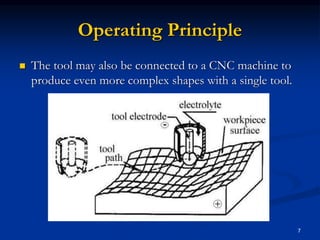
 The tool may also be connected to a CNC machine to
produce even more complex shapes with a single tool.
8
Main Subsystems
 The power supply.
 The electrolyte circulation system.
 The control system.
 The machine.
9
ECM Components
(Power)
 The power needed to operate the ECM is
obviously electrical.
 The current density must be high.
 The gap between the tool and the work piece
must be low for higher accuracy.
 The voltage must below to avoid a short circuit.
 The electric current is of the order of 50 to
40000 Ampere at 5 to 30 V D.C. for a current
density of 20 to 300 Ampere/Square cm, across
a gap of 0.05 to 0.70 mm between the tool and
the work piece.
10
ECM Components
(electrolyte circulation system)
 The electrolyte must be injected in the gap at high
speed (between 1500 to 3000 m/min).
 The inlet pressure must be between 0.15-3 MPa.
 The electrolyte system must include a fairly strong
pump with stored tank.
 System also includes a filter, sludge removal system,
and treatment units.
 The electrolyte should posses good electrical
conductivity, non-toxicity, chemical stability, non-
corrosive property, low viscosity, and high specific heat.
 Common electrolytes are NaCl, sodium nitrate,
potassium chloride, NaOH, sodium fluoride, sulfuric
acid, and sodium chlorate.
11
ECM Components
(control system)
 Control parameters include:
 Voltage
 Inlet and outlet pressure of electrolyte
 Temperature of electrolyte.
 The current is dependant on the above
parameters and the feed rate.
12
ECM Components
(Machine)
 The machine is a major subsystem of the ECM.
 It includes the table, the frame, work enclosure
(prevents the electrolyte from spilling), the work head
(where the tool is mounted)
 The tools (electrodes) are also part of the machine &
should be
 A good conductor of electricity.
 Rigid enough to take up the load due to fluid pressure.
 Chemically inert to the electrolyte.
 Easily machinable to make it in the desired shape.
 Cu, Brass, Titanium, Copper-Tungsten, and Stainless
steels are commonly used electrode when the electrolyte
is of sodium or potassium. Other materials are Al,
graphite, bronze, platinum, and tungsten carbide.
13
Advantages
 There is no cutting forces therefore clamping is
not required except for controlled motion of the
work piece.
 There is no heat affected zone.
 Very accurate.
 Relatively fast
 Can machine harder metals than the tool.
14
Advantages over EDM
 Faster than EDM
 No tool wear at all.
 No heat affected zone.
 Better finish and accuracy.
15
Disadvantages
 More expensive than conventional machining.
 Need more area for installation.
 Electrolytes may destroy the equipment.
 Not environmentally friendly (sludge and other
waste)
 High energy consumption.
 Material has to be electrically conductive.
16
Applications
 The most common application of ECM is high
accuracy duplication. Because there is no tool wear, it
can be used repeatedly with a high degree of accuracy.
 It is also used to make cavities and holes in various
products.
 Sinking operations (RAM ECM) are also used as an
alternative to RAM EDM.
 It is commonly used on thin walled, easily deformable
and brittle material because they would probably
develop cracks with conventional machining.
17
Economics
 The process is economical when a large number
of complex identical products need to be made
(at least 50 units)
 Several tools could be connected to a cassette to
make many cavities simultaneously. (i.e. cylinder
cavities in engines)
 Large cavities are more economical on ECM and
can be processed in 1/10 the time of EDM.
18
Products
 The two most common products of ECM are
turbine/compressor blades and rifle barrels. Each of
those parts require machining of extremely hard metals
with certain mechanical specifications that would be
really difficult to perform on conventional machines.
 Some of these mechanical characteristics achieved by
ECM are:
 Stress free grooves.
 Any groove geometry.
 Any conductive metal can be machined.
 Repeatable accuracy of 0.0005”.
 High surface finish.
 Fast cycle time.
19
Safety Considerations
 Several sensors are used to control short circuit,
turbulence, passivation, contact and overcurrent
sensors. In case of contact, immense heat would
be generated melting the tool, evaporating the
electrolyte and cause a fire.
 The worker must be insulated to prevent
electrocution.
 The tool and the work piece must be grounded
before any handling is performed.
20
Safety Consideration
 Hydrogen gas emitted is very flammable, so it
should be disposed of properly and fire
precautions should be taken.
 The waste material is very dangerous and
environmentally unfriendly (metal sludge) so it
must be recycle or disposed of properly.
 Electrolyte is highly pressurized and worker
must check for minor cracks in piping before
operating.
Thank you students
21

ECM

  • 1.
  • 2.
    2 Electrochemical Machining Nontraditional machining processof removing metal from extremely hard materials using a high current between the electrolyte (tool piece) and work piece.
  • 3.
    3 Electrochemical Machining Uses anelectrolyte and electrical current to ionize and remove metal atoms Can machine complex cavities in high-strength materials Leaves a burr-free surface Not affected by the strength, hardness or toughness of the material
  • 4.
  • 5.
    5 Operating Principle  Inthe actual process, the cathode is tool-shaped, more or less like the mirror image of the finished work piece.  The electrolysis process that takes place at the cathode liberates hydroxyl ions (negatively charged) and free hydrogen. The hydroxyl ions combine with the metal ions of the anode to form insoluble metal hydroxides and the material is thus removed from the anode. & this process continues
  • 6.
    6 Operating Principle  Aconstant gap between Tool & work Piece is maintained with Constant Tool Feed Rate.  Conventional machines may be easily changed to an ECM and is a common practice.
  • 7.
    7 Operating Principle  Thetool may also be connected to a CNC machine to produce even more complex shapes with a single tool.
  • 8.
    8 Main Subsystems  Thepower supply.  The electrolyte circulation system.  The control system.  The machine.
  • 9.
    9 ECM Components (Power)  Thepower needed to operate the ECM is obviously electrical.  The current density must be high.  The gap between the tool and the work piece must be low for higher accuracy.  The voltage must below to avoid a short circuit.  The electric current is of the order of 50 to 40000 Ampere at 5 to 30 V D.C. for a current density of 20 to 300 Ampere/Square cm, across a gap of 0.05 to 0.70 mm between the tool and the work piece.
  • 10.
    10 ECM Components (electrolyte circulationsystem)  The electrolyte must be injected in the gap at high speed (between 1500 to 3000 m/min).  The inlet pressure must be between 0.15-3 MPa.  The electrolyte system must include a fairly strong pump with stored tank.  System also includes a filter, sludge removal system, and treatment units.  The electrolyte should posses good electrical conductivity, non-toxicity, chemical stability, non- corrosive property, low viscosity, and high specific heat.  Common electrolytes are NaCl, sodium nitrate, potassium chloride, NaOH, sodium fluoride, sulfuric acid, and sodium chlorate.
  • 11.
    11 ECM Components (control system) Control parameters include:  Voltage  Inlet and outlet pressure of electrolyte  Temperature of electrolyte.  The current is dependant on the above parameters and the feed rate.
  • 12.
    12 ECM Components (Machine)  Themachine is a major subsystem of the ECM.  It includes the table, the frame, work enclosure (prevents the electrolyte from spilling), the work head (where the tool is mounted)  The tools (electrodes) are also part of the machine & should be  A good conductor of electricity.  Rigid enough to take up the load due to fluid pressure.  Chemically inert to the electrolyte.  Easily machinable to make it in the desired shape.  Cu, Brass, Titanium, Copper-Tungsten, and Stainless steels are commonly used electrode when the electrolyte is of sodium or potassium. Other materials are Al, graphite, bronze, platinum, and tungsten carbide.
  • 13.
    13 Advantages  There isno cutting forces therefore clamping is not required except for controlled motion of the work piece.  There is no heat affected zone.  Very accurate.  Relatively fast  Can machine harder metals than the tool.
  • 14.
    14 Advantages over EDM Faster than EDM  No tool wear at all.  No heat affected zone.  Better finish and accuracy.
  • 15.
    15 Disadvantages  More expensivethan conventional machining.  Need more area for installation.  Electrolytes may destroy the equipment.  Not environmentally friendly (sludge and other waste)  High energy consumption.  Material has to be electrically conductive.
  • 16.
    16 Applications  The mostcommon application of ECM is high accuracy duplication. Because there is no tool wear, it can be used repeatedly with a high degree of accuracy.  It is also used to make cavities and holes in various products.  Sinking operations (RAM ECM) are also used as an alternative to RAM EDM.  It is commonly used on thin walled, easily deformable and brittle material because they would probably develop cracks with conventional machining.
  • 17.
    17 Economics  The processis economical when a large number of complex identical products need to be made (at least 50 units)  Several tools could be connected to a cassette to make many cavities simultaneously. (i.e. cylinder cavities in engines)  Large cavities are more economical on ECM and can be processed in 1/10 the time of EDM.
  • 18.
    18 Products  The twomost common products of ECM are turbine/compressor blades and rifle barrels. Each of those parts require machining of extremely hard metals with certain mechanical specifications that would be really difficult to perform on conventional machines.  Some of these mechanical characteristics achieved by ECM are:  Stress free grooves.  Any groove geometry.  Any conductive metal can be machined.  Repeatable accuracy of 0.0005”.  High surface finish.  Fast cycle time.
  • 19.
    19 Safety Considerations  Severalsensors are used to control short circuit, turbulence, passivation, contact and overcurrent sensors. In case of contact, immense heat would be generated melting the tool, evaporating the electrolyte and cause a fire.  The worker must be insulated to prevent electrocution.  The tool and the work piece must be grounded before any handling is performed.
  • 20.
    20 Safety Consideration  Hydrogengas emitted is very flammable, so it should be disposed of properly and fire precautions should be taken.  The waste material is very dangerous and environmentally unfriendly (metal sludge) so it must be recycle or disposed of properly.  Electrolyte is highly pressurized and worker must check for minor cracks in piping before operating.
  • 21.