


LENDI INSTITUTE OF ENGINEERING
AND TECHNOLOGY
PRODUCTION TECHNOLOGY
COURSE CODE: C211
REGULATION: R19
2nd BTECH 2nd SEM
PREPARED BY :
POLAYYA CHINTADA M.TECH,M.B.A,(PhD)
ASSISTANT PROFESSOR
TOPIC:
PATTERN ALLOWANCES
PRODUCTION TECHNOLOGY
SYLLABUS
UNIT 1:
Introduction: Importance and selection of manufacturing processes.
Casting Processes: Introduction to casting process, process steps; pattern: types, materials and
allowance; Cores: Types of cores, core prints, principles and design of gating system; Solidification
of casting: Concept, solidification of pure metal and alloy; Special casting processes: Shell casting,
investment casting, die casting, centrifugal casting, casting defects and remedies.
provide insight into Working
principles of different metal casting
processes and gating system
COURSE OBJECTIVE: COURSE OUTCOMES:
Explain different metal
casting processes and
gating systems. (L2)
APPLICATIONS:
Identify different patterns
and their allowances (L3)
1. Heavy Equipment : Construction, farming
and mining
2. Defence : Vehicles, artillery, munitions,
storage and supporting equipment
3. Hardware : Plumbing industry pipes,
joints, valves and fitting
Identify the various
casting defects. (L3)
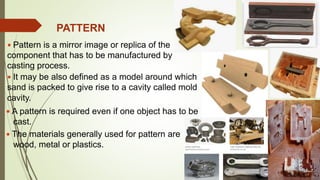
PATTERN
 Pattern is a mirror image or replica of the
component that has to be manufactured by
casting process.
 It may be also defined as a model around which
sand is packed to give rise to a cavity called mold
cavity.
 A pattern is required even if one object has to be
cast.
 The materials generally used for pattern are
wood, metal or plastics.
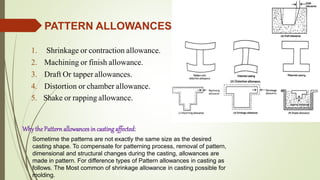
PATTERN ALLOWANCES
1. Shrinkage or contraction allowance.
2. Machining or finish allowance.
3. Draft Or tapper allowances.
4. Distortion or chamber allowance.
5. Shake or rapping allowance.
Why the Pattern allowancesin castingaffected:
Sometime the patterns are not exactly the same size as the desired
casting shape. To compensate for patterning process, removal of pattern,
dimensional and structural changes during the casting, allowances are
made in pattern. For difference types of Pattern allowances in casting as
follows. The Most common of shrinkage allowance in casting possible for
molding.
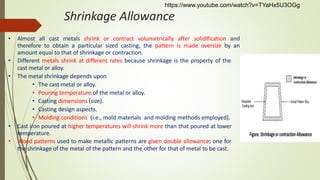
Shrinkage Allowance
• Almost all cast metals shrink or contract volumetrically after solidification and
therefore to obtain a particular sized casting, the pattern is made oversize by an
amount equal to that of shrinkage or contraction.
• Different metals shrink at different rates because shrinkage is the property of the
cast metal or alloy.
• The metal shrinkage depends upon
• The cast metal or alloy.
• Pouring temperature of the metal or alloy.
• Casting dimensions (size).
• Casting design aspects.
• Molding conditions (i.e., mold materials and molding methods employed).
• Cast iron poured at higher temperatures will shrink more than that poured at lower
temperature.
• Wood patterns used to make metallic patterns are given double allowance; one for
the shrinkage of the metal of the pattern and the other for that of metal to be cast.
https://www.youtube.com/watch?v=TYaHx5U3OGg
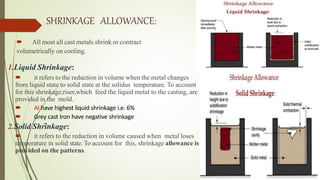
SHRINKAGE ALLOWANCE:
 All most all cast metals shrink or contract
volumetrically on cooling.
1.Liquid Shrinkage:
 it refers to the reduction in volume when the metal changes
from liquid state to solid state at the solidus temperature. To account
for this shrinkage;riser,which feed the liquid metal to the casting, are
provided in the mold.
 Al have highest liquid shrinkage i.e. 6%
 Grey cast Iron have negative shrinkage
2.Solid Shrinkage:
 it refers to the reduction in volume caused when metal loses
temperature in solid state. To account for this, shrinkage allowance is
provided on the patterns.
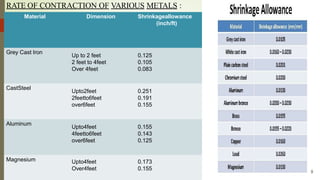
Material Dimension Shrinkageallowance
(inch/ft)
Grey Cast Iron
Up to 2 feet
2 feet to 4feet
Over 4feet
0.125
0.105
0.083
CastSteel
Upto2feet
2feetto6feet
over6feet
0.251
0.191
0.155
Aluminum
Upto4feet
4feetto6feet
over6feet
0.155
0.143
0.125
Magnesium Upto4feet
Over4feet
0.173
0.155
RATE OF CONTRACTION OF VARIOUS METALS :
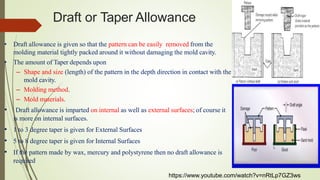
Draft or Taper Allowance
• Draft allowance is given so that the pattern can be easily removed from the
molding material tightly packed around it without damaging the mold cavity.
• The amount of Taper depends upon
– Shape and size (length) of the pattern in the depth direction in contact with the
mold cavity.
– Molding method.
– Mold materials.
• Draft allowance is imparted on internal as well as external surfaces; of course it
is more on internal surfaces.
• 1 to 3 degree taper is given for External Surfaces
• 5 to 8 degree taper is given for Internal Surfaces
• If the pattern made by wax, mercury and polystyrene then no draft allowance is
required
https://www.youtube.com/watch?v=nRtLp7GZ3ws
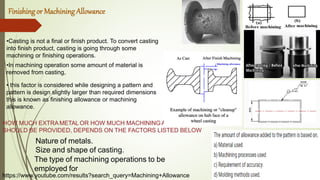
Finishing or Machining Allowance
•Casting is not a final or finish product. To convert casting
into finish product, casting is going through some
machining or finishing operations.
•In machining operation some amount of material is
removed from casting,
• this factor is considered while designing a pattern and
pattern is design slightly larger than required dimensions
this is known as finishing allowance or machining
allowance.
:
Nature of metals.
Size and shape of casting.
The type of machining operations to be
employed for
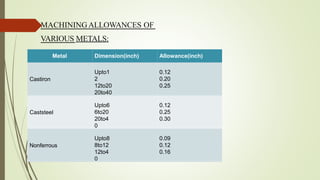
HOW MUCH EXTRAMETAL OR HOW MUCH MACHININGALLOWANCE
SHOULD BE PROVIDED, DEPENDS ON THE FACTORS LISTED BELOW
https://www.youtube.com/results?search_query=Machining+Allowance
Metal Dimension(inch) Allowance(inch)
Castiron
Upto1
2
12to20
20to40
0.12
0.20
0.25
Caststeel
Upto6
6to20
20to4
0
0.12
0.25
0.30
Nonferrous
Upto8
8to12
12to4
0
0.09
0.12
0.16
MACHININGALLOWANCES OF
VARIOUS METALS:
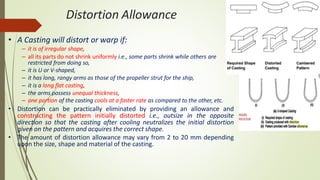
Distortion Allowance
• A Casting will distort or warp if:
– it is of irregular shape,
– all its parts do not shrink uniformly i.e., some parts shrink while others are
restricted from doing so,
– it is U or V-shaped,
– it has long, rangy arms as those of the propeller strut for the ship,
– it is a long flat casting,
– the arms possess unequal thickness,
– one portion of the casting cools at a faster rate as compared to the other, etc.
• Distortion can be practically eliminated by providing an allowance and
constructing the pattern initially distorted i.e., outsize in the opposite
direction so that the casting after cooling neutralizes the initial distortion
given on the pattern and acquires the correct shape.
• The amount of distortion allowance may vary from 2 to 20 mm depending
upon the size, shape and material of the casting.
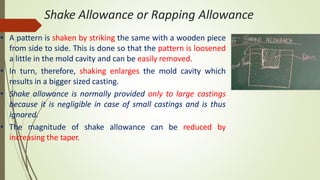
Shake Allowance or Rapping Allowance
• A pattern is shaken by striking the same with a wooden piece
from side to side. This is done so that the pattern is loosened
a little in the mold cavity and can be easily removed.
• In turn, therefore, shaking enlarges the mold cavity which
results in a bigger sized casting.
• Shake allowance is normally provided only to large castings
because it is negligible in case of small castings and is thus
ignored.
• The magnitude of shake allowance can be reduced by
increasing the taper.
Yours:
POLAYYA CHINTADA M.TECH,M.B.A,(PhD)
ASSISTANT PROFESSOR
https://www.slideshare.net/hareeshang/introduction-to-
manufacturing-process

PATTERN ALLOWANCES IN CASTING CLASS: BY POLAYYA CHINTADA

  • 1.
    LENDI INSTITUTE OFENGINEERING AND TECHNOLOGY PRODUCTION TECHNOLOGY COURSE CODE: C211 REGULATION: R19 2nd BTECH 2nd SEM PREPARED BY : POLAYYA CHINTADA M.TECH,M.B.A,(PhD) ASSISTANT PROFESSOR TOPIC: PATTERN ALLOWANCES
  • 2.
    PRODUCTION TECHNOLOGY SYLLABUS UNIT 1: Introduction:Importance and selection of manufacturing processes. Casting Processes: Introduction to casting process, process steps; pattern: types, materials and allowance; Cores: Types of cores, core prints, principles and design of gating system; Solidification of casting: Concept, solidification of pure metal and alloy; Special casting processes: Shell casting, investment casting, die casting, centrifugal casting, casting defects and remedies. provide insight into Working principles of different metal casting processes and gating system COURSE OBJECTIVE: COURSE OUTCOMES: Explain different metal casting processes and gating systems. (L2) APPLICATIONS: Identify different patterns and their allowances (L3) 1. Heavy Equipment : Construction, farming and mining 2. Defence : Vehicles, artillery, munitions, storage and supporting equipment 3. Hardware : Plumbing industry pipes, joints, valves and fitting Identify the various casting defects. (L3)
  • 3.
    PATTERN  Pattern isa mirror image or replica of the component that has to be manufactured by casting process.  It may be also defined as a model around which sand is packed to give rise to a cavity called mold cavity.  A pattern is required even if one object has to be cast.  The materials generally used for pattern are wood, metal or plastics.
  • 4.
    PATTERN ALLOWANCES 1. Shrinkageor contraction allowance. 2. Machining or finish allowance. 3. Draft Or tapper allowances. 4. Distortion or chamber allowance. 5. Shake or rapping allowance. Why the Pattern allowancesin castingaffected: Sometime the patterns are not exactly the same size as the desired casting shape. To compensate for patterning process, removal of pattern, dimensional and structural changes during the casting, allowances are made in pattern. For difference types of Pattern allowances in casting as follows. The Most common of shrinkage allowance in casting possible for molding.
  • 5.
    Shrinkage Allowance • Almostall cast metals shrink or contract volumetrically after solidification and therefore to obtain a particular sized casting, the pattern is made oversize by an amount equal to that of shrinkage or contraction. • Different metals shrink at different rates because shrinkage is the property of the cast metal or alloy. • The metal shrinkage depends upon • The cast metal or alloy. • Pouring temperature of the metal or alloy. • Casting dimensions (size). • Casting design aspects. • Molding conditions (i.e., mold materials and molding methods employed). • Cast iron poured at higher temperatures will shrink more than that poured at lower temperature. • Wood patterns used to make metallic patterns are given double allowance; one for the shrinkage of the metal of the pattern and the other for that of metal to be cast. https://www.youtube.com/watch?v=TYaHx5U3OGg
  • 6.
    SHRINKAGE ALLOWANCE:  Allmost all cast metals shrink or contract volumetrically on cooling. 1.Liquid Shrinkage:  it refers to the reduction in volume when the metal changes from liquid state to solid state at the solidus temperature. To account for this shrinkage;riser,which feed the liquid metal to the casting, are provided in the mold.  Al have highest liquid shrinkage i.e. 6%  Grey cast Iron have negative shrinkage 2.Solid Shrinkage:  it refers to the reduction in volume caused when metal loses temperature in solid state. To account for this, shrinkage allowance is provided on the patterns.
  • 7.
    Material Dimension Shrinkageallowance (inch/ft) GreyCast Iron Up to 2 feet 2 feet to 4feet Over 4feet 0.125 0.105 0.083 CastSteel Upto2feet 2feetto6feet over6feet 0.251 0.191 0.155 Aluminum Upto4feet 4feetto6feet over6feet 0.155 0.143 0.125 Magnesium Upto4feet Over4feet 0.173 0.155 RATE OF CONTRACTION OF VARIOUS METALS :
  • 8.
    Draft or TaperAllowance • Draft allowance is given so that the pattern can be easily removed from the molding material tightly packed around it without damaging the mold cavity. • The amount of Taper depends upon – Shape and size (length) of the pattern in the depth direction in contact with the mold cavity. – Molding method. – Mold materials. • Draft allowance is imparted on internal as well as external surfaces; of course it is more on internal surfaces. • 1 to 3 degree taper is given for External Surfaces • 5 to 8 degree taper is given for Internal Surfaces • If the pattern made by wax, mercury and polystyrene then no draft allowance is required https://www.youtube.com/watch?v=nRtLp7GZ3ws
  • 9.
    Finishing or MachiningAllowance •Casting is not a final or finish product. To convert casting into finish product, casting is going through some machining or finishing operations. •In machining operation some amount of material is removed from casting, • this factor is considered while designing a pattern and pattern is design slightly larger than required dimensions this is known as finishing allowance or machining allowance. : Nature of metals. Size and shape of casting. The type of machining operations to be employed for HOW MUCH EXTRAMETAL OR HOW MUCH MACHININGALLOWANCE SHOULD BE PROVIDED, DEPENDS ON THE FACTORS LISTED BELOW https://www.youtube.com/results?search_query=Machining+Allowance
  • 10.
  • 11.
    Distortion Allowance • ACasting will distort or warp if: – it is of irregular shape, – all its parts do not shrink uniformly i.e., some parts shrink while others are restricted from doing so, – it is U or V-shaped, – it has long, rangy arms as those of the propeller strut for the ship, – it is a long flat casting, – the arms possess unequal thickness, – one portion of the casting cools at a faster rate as compared to the other, etc. • Distortion can be practically eliminated by providing an allowance and constructing the pattern initially distorted i.e., outsize in the opposite direction so that the casting after cooling neutralizes the initial distortion given on the pattern and acquires the correct shape. • The amount of distortion allowance may vary from 2 to 20 mm depending upon the size, shape and material of the casting.
  • 12.
    Shake Allowance orRapping Allowance • A pattern is shaken by striking the same with a wooden piece from side to side. This is done so that the pattern is loosened a little in the mold cavity and can be easily removed. • In turn, therefore, shaking enlarges the mold cavity which results in a bigger sized casting. • Shake allowance is normally provided only to large castings because it is negligible in case of small castings and is thus ignored. • The magnitude of shake allowance can be reduced by increasing the taper.
  • 13.
    Yours: POLAYYA CHINTADA M.TECH,M.B.A,(PhD) ASSISTANTPROFESSOR https://www.slideshare.net/hareeshang/introduction-to- manufacturing-process