Click to edit Master title style
1
LASER BEAM MACHINING
B Y:
J . A B H I S H E K ( 1 AT 1 8 M E 0 2 2 )
K O W N A I N A H M E D ( 1 AT 1 8 M E 0 2 4 )
I M B A R A S U ( 1 AT 1 8 M E 0 2 1 )
K E S A N U PA L L I A N I L K U M A R ( 1 AT 1 8 M E 0 2 3 )
K U M M E T H A S A I T E J A ( 1 AT 1 8 M E 0 2 2 )
COURSE COORDINATOR:
ANJAN KUMAR D
ASSISTANT PROFESSOR , M.E DEPT
ATRIA INSTITUTE OF TECHNOLOGY
Click to edit Master title style
2
DEFINITION:
2
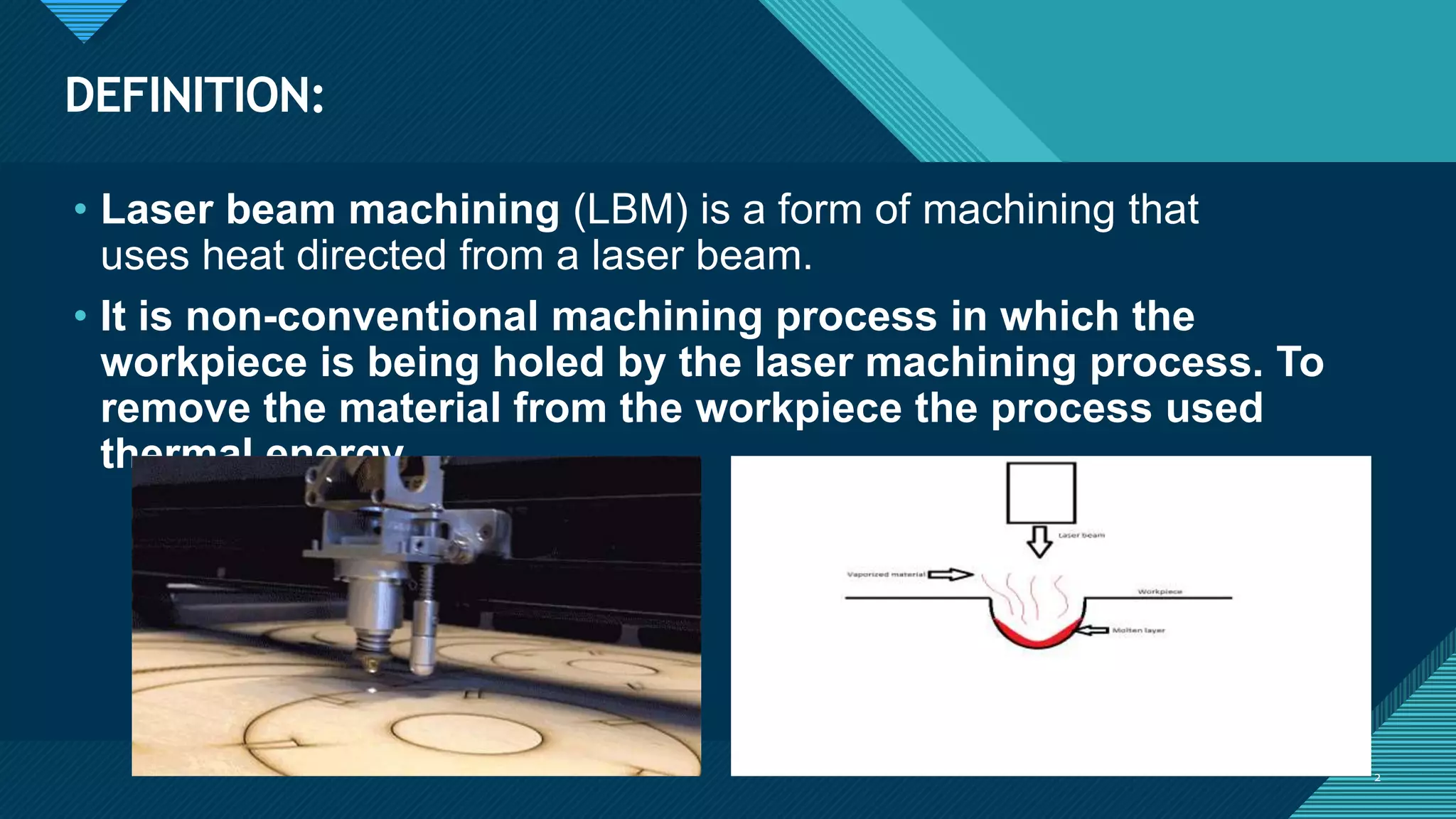
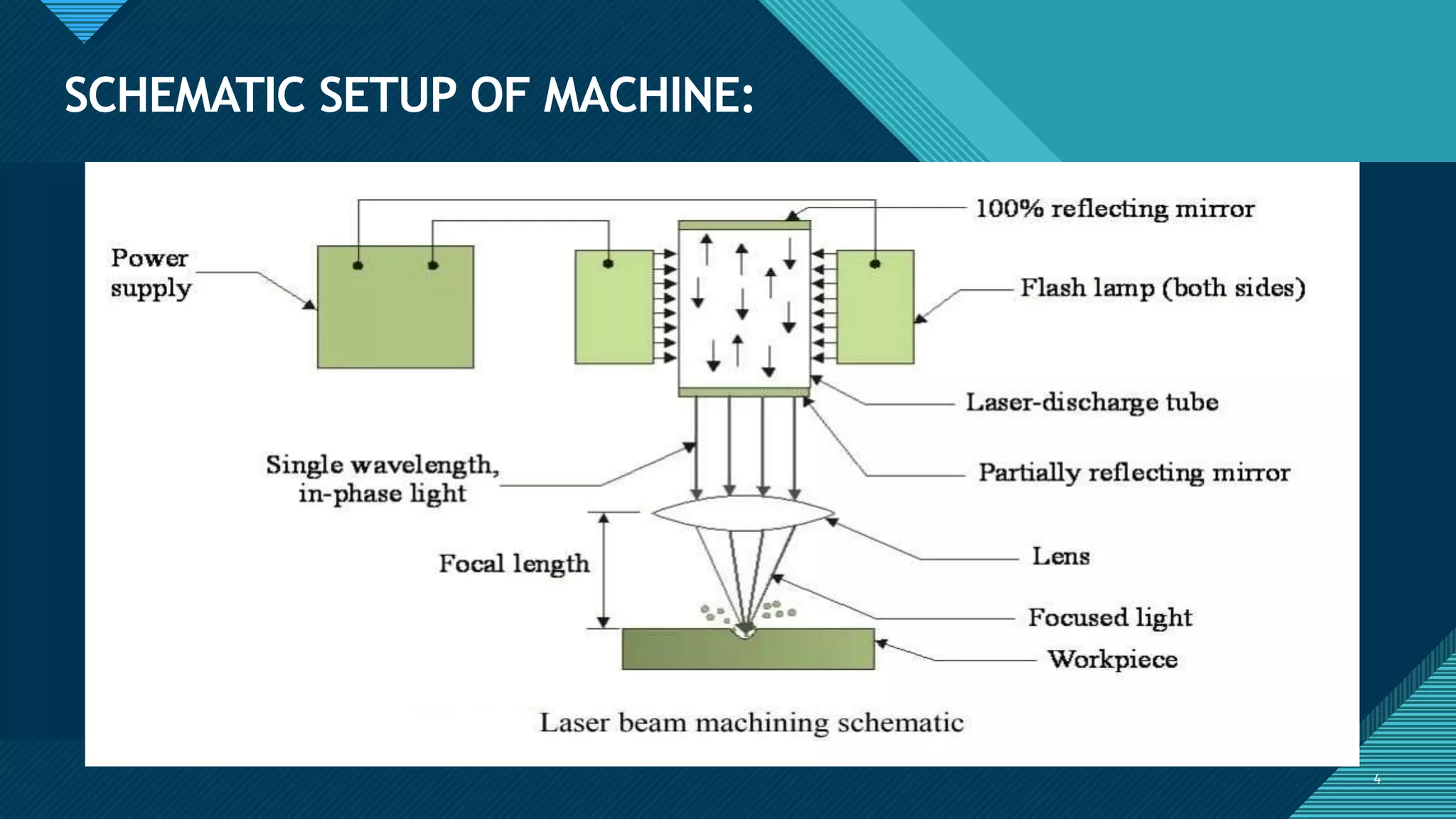
• Laser beam machining (LBM) is a form of machining that
uses heat directed from a laser beam.
• It is non-conventional machining process in which the
workpiece is being holed by the laser machining process. To
remove the material from the workpiece the process used
thermal energy.
Click to edit Master title style
3
WORKING PRINCIPLE:
3
• Laser Machining is based on the LASER and conversion or process
of Electric Energy into Light Energy and into Thermal Energy.
• Negatively charged electrons in the atomic model rotate around the
positively charged nucleus in orbital paths. It depends on the
number of electrons, electron structure, neighboring atoms, and the
electromagnetic field.
• An atom is considered to be at ground level at absolute zero
temperature at this, all electrons all electron occupy their lowest
potential energy.
• The electrons at the ground state move to a higher state of energy
by absorbing energy like an increase in electronic vibration at
elevated temperatures.
Click to edit Master title style
4
SCHEMATIC SETUP OF MACHINE:
4
Click to edit Master title style
5
LASER BEAM MACHINING PARTS & ITS FUNCTIONS:
5
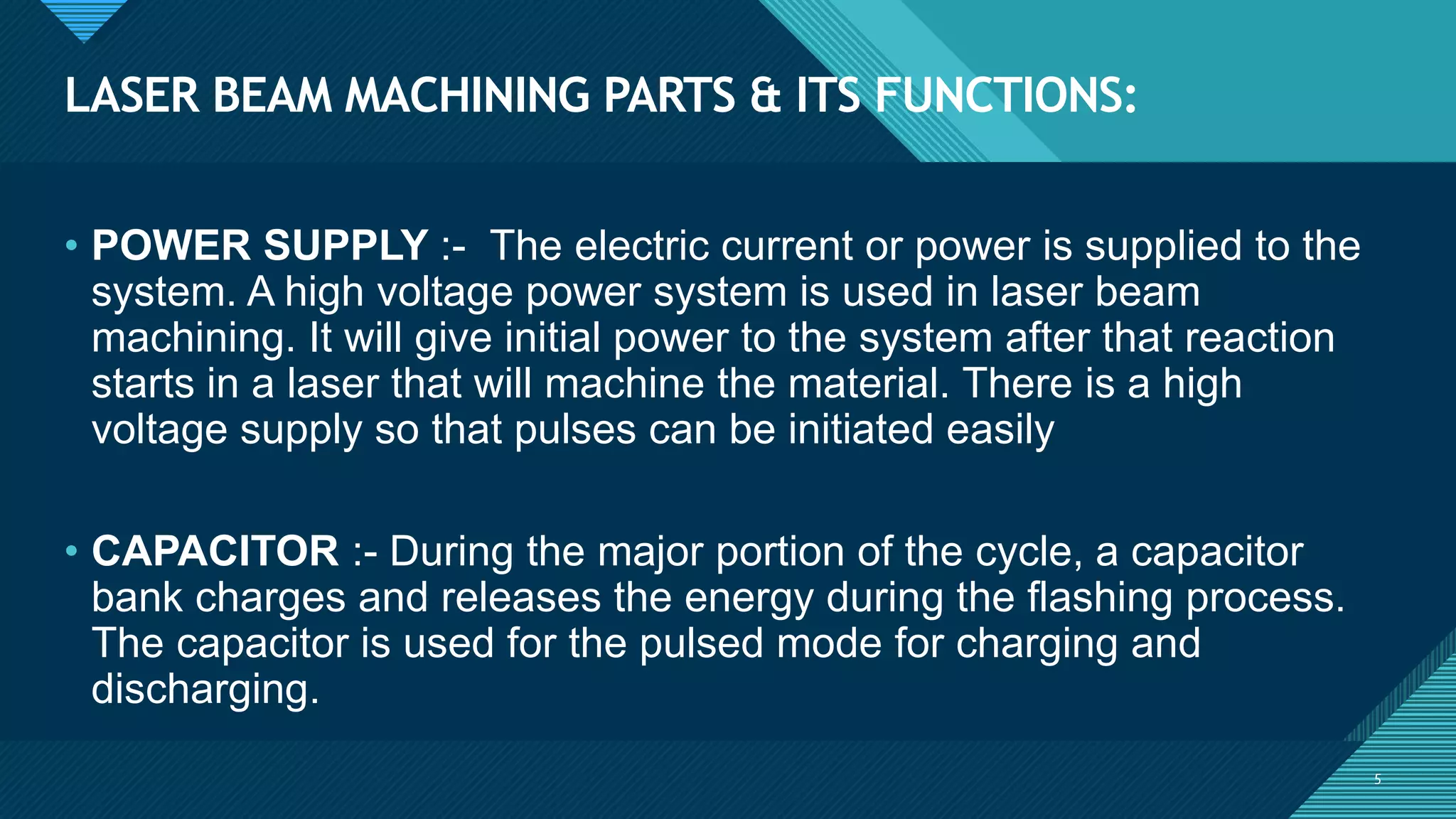
• POWER SUPPLY :- The electric current or power is supplied to the
system. A high voltage power system is used in laser beam
machining. It will give initial power to the system after that reaction
starts in a laser that will machine the material. There is a high
voltage supply so that pulses can be initiated easily
• CAPACITOR :- During the major portion of the cycle, a capacitor
bank charges and releases the energy during the flashing process.
The capacitor is used for the pulsed mode for charging and
discharging.
Click to edit Master title style
6 6
• FLASH LAMPS :- It is the electric arc lamp that is used to produce
extremely intense production of white light which is a coherent high-
intensity beam. It is filled with gases that ionize to form great energy
that will melt and vaporizes the material of the workpiece.
• REFLECTING MIRROR :- Reflecting Mirror are two main types of
internal and external. Internal mirrors also called a resonator that is
used to generate maintain and amplify the laser beam. It is used to
direct the laser beam towards the workpiece.
• LASER LIGHT BEAM :- It is the beam of radiation produced by the
laser through the process of optical amplification based on the
coherence of light created by the bombarding of active material.
Click to edit Master title style
7 7
• RUBY CRYSTAL :- Ruby laser produces a series of coherent
pulses which is deep red in color. It achieves by the concept of
population inversion. It is a three-level solid-state laser.
• LENS :- Lenses are used to focus the laser beam onto the
workpiece. First laser light will enter into the expanding lens and
then into the collimating lens which makes the light rays parallel and
the expanding lens expands the laser beams to the desired size.
• WORKPIECE :- The workpiece can be metallic or non-metallic. In
this machining process, any material can be machined.
Click to edit Master title style
8
PROCESS PARAMETERS:
8
• LBM processes to a great extent depend on the workpiece
properties, laser intensity and interaction time. For every material
there is a threshold intensity that needs to be achieve for
evaporation to occur.
Click to edit Master title style
9 9
• All conventional LBM processes are located slightly above melting
line that enables melting and then evaporation.
• Process employing ultrashort pulsed lasers are situated well above
situated well above melting line, therefore it is more likely to
evaporate material minimising the stage of melting
Click to edit Master title style
10
ADVANTAGES:
10
• In Laser Beam Machining any material including non-metal also can
be machined.
• Extremely small holes with good accuracy can be machined.
• The tool wear rate is very low.
• There is no mechanical force on the work.
• Soft materials like plastic, rubber can be machined easily.
• Laser Machining gives a very good surface finish.
• It is a very flexible and easily automated machine.
• The heat-affected zone is very small.
Click to edit Master title style
11
LIMITATIONS:
11
• Laser Machining cannot be used to produce a blind hole and also
not able to drill too deep holes.
• The machined holes are not round and straight.
• There is a problem with safety hazards.
• The overall efficiency of the Laser beam machining is low.
• It is limited to thin sheets.
• The metal-removing rate is also low.
• The flash lamp life is short.
Click to edit Master title style
12
APPLICATIONS:
12
• The laser beam machining process is used for making very small
holes.
• Mass macro machining production.
• LBM is used in surgery.
• Selective heat treating of materials.
• Complicated welding of non-conductive and refractory materials.
• Micro-drilling operation.
• Photography in medical science.
• Spectroscopic Science.
Click to edit Master title style
1313
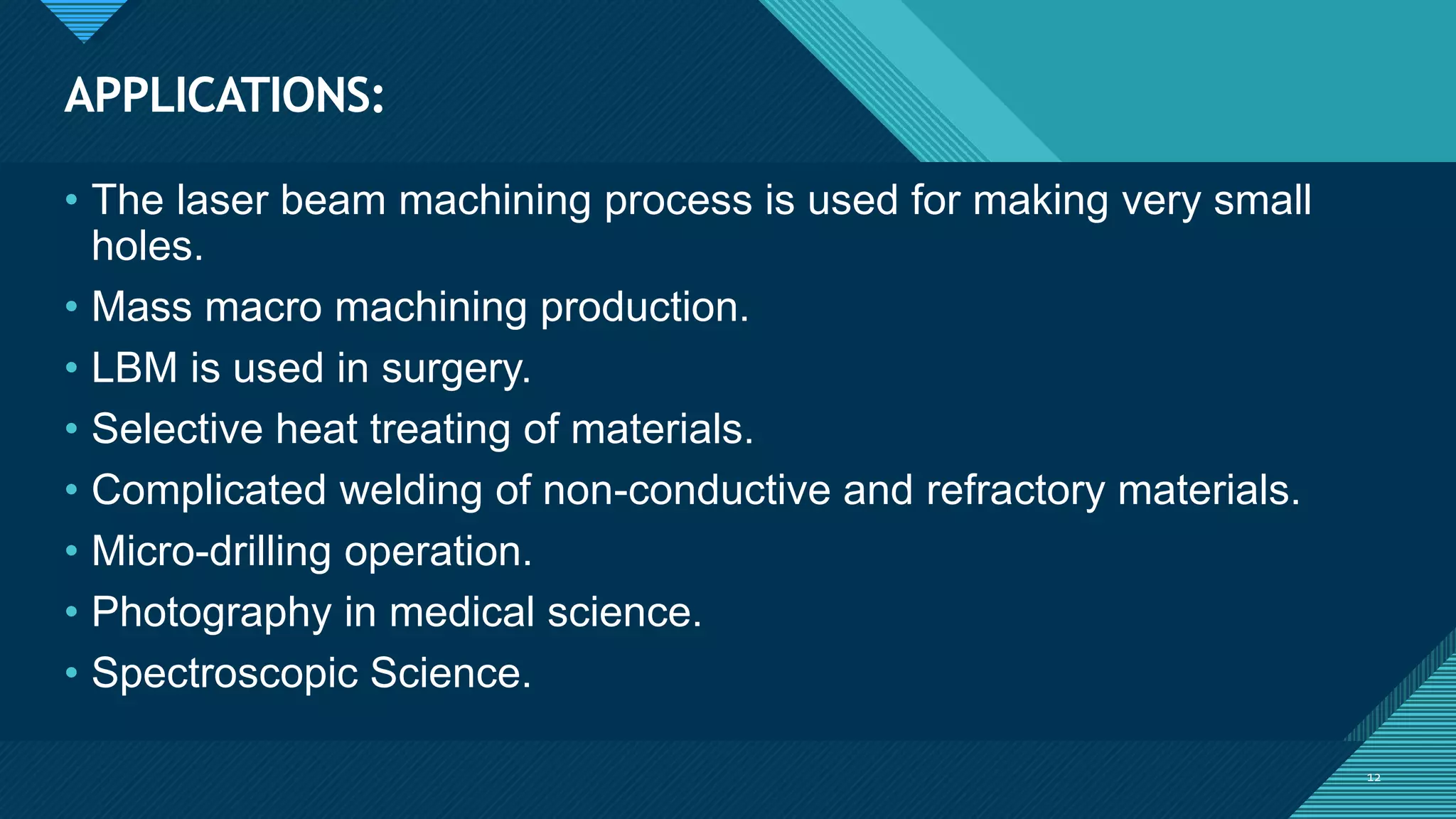
The laser used for making small holes Laser beam used in cladding
Click to edit Master title style
14
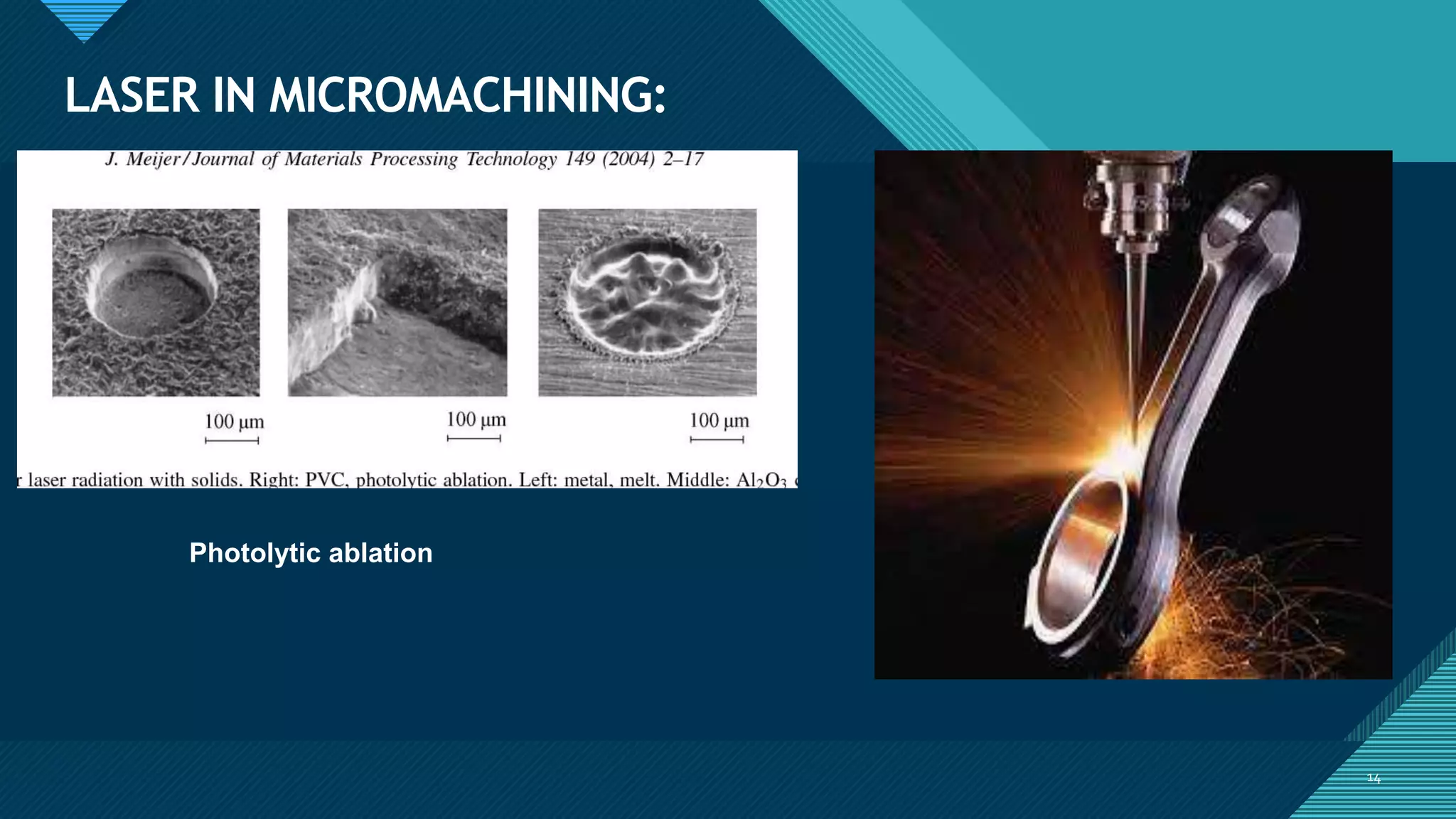
LASER IN MICROMACHINING:
14
Photolytic ablation
Click to edit Master title style
1515
Diesel injection nozzle drilled by CVL
Click to edit Master title style
16
REFERENCES:
16
• Dubey, Avanish (May 2008). "Laser beam machining—A
review". International Journal of Machine Tools and Manufacture.
• Kalpakjian; Schmid (2008). Manufacturing Processes for
Engineering Materials (5 ed.). Prentice Hall.
• J. Berkmanns, M. Faerber (June 18, 2008). Laser cutting.
LASERLINE Technical.
YOUTUBE LINKS:
• https://youtu.be/s3gYgMJkKMc

Laser beam machining

  • 1.
    Click to editMaster title style 1 LASER BEAM MACHINING B Y: J . A B H I S H E K ( 1 AT 1 8 M E 0 2 2 ) K O W N A I N A H M E D ( 1 AT 1 8 M E 0 2 4 ) I M B A R A S U ( 1 AT 1 8 M E 0 2 1 ) K E S A N U PA L L I A N I L K U M A R ( 1 AT 1 8 M E 0 2 3 ) K U M M E T H A S A I T E J A ( 1 AT 1 8 M E 0 2 2 ) COURSE COORDINATOR: ANJAN KUMAR D ASSISTANT PROFESSOR , M.E DEPT ATRIA INSTITUTE OF TECHNOLOGY
  • 2.
    Click to editMaster title style 2 DEFINITION: 2 • Laser beam machining (LBM) is a form of machining that uses heat directed from a laser beam. • It is non-conventional machining process in which the workpiece is being holed by the laser machining process. To remove the material from the workpiece the process used thermal energy.
  • 3.
    Click to editMaster title style 3 WORKING PRINCIPLE: 3 • Laser Machining is based on the LASER and conversion or process of Electric Energy into Light Energy and into Thermal Energy. • Negatively charged electrons in the atomic model rotate around the positively charged nucleus in orbital paths. It depends on the number of electrons, electron structure, neighboring atoms, and the electromagnetic field. • An atom is considered to be at ground level at absolute zero temperature at this, all electrons all electron occupy their lowest potential energy. • The electrons at the ground state move to a higher state of energy by absorbing energy like an increase in electronic vibration at elevated temperatures.
  • 4.
    Click to editMaster title style 4 SCHEMATIC SETUP OF MACHINE: 4
  • 5.
    Click to editMaster title style 5 LASER BEAM MACHINING PARTS & ITS FUNCTIONS: 5 • POWER SUPPLY :- The electric current or power is supplied to the system. A high voltage power system is used in laser beam machining. It will give initial power to the system after that reaction starts in a laser that will machine the material. There is a high voltage supply so that pulses can be initiated easily • CAPACITOR :- During the major portion of the cycle, a capacitor bank charges and releases the energy during the flashing process. The capacitor is used for the pulsed mode for charging and discharging.
  • 6.
    Click to editMaster title style 6 6 • FLASH LAMPS :- It is the electric arc lamp that is used to produce extremely intense production of white light which is a coherent high- intensity beam. It is filled with gases that ionize to form great energy that will melt and vaporizes the material of the workpiece. • REFLECTING MIRROR :- Reflecting Mirror are two main types of internal and external. Internal mirrors also called a resonator that is used to generate maintain and amplify the laser beam. It is used to direct the laser beam towards the workpiece. • LASER LIGHT BEAM :- It is the beam of radiation produced by the laser through the process of optical amplification based on the coherence of light created by the bombarding of active material.
  • 7.
    Click to editMaster title style 7 7 • RUBY CRYSTAL :- Ruby laser produces a series of coherent pulses which is deep red in color. It achieves by the concept of population inversion. It is a three-level solid-state laser. • LENS :- Lenses are used to focus the laser beam onto the workpiece. First laser light will enter into the expanding lens and then into the collimating lens which makes the light rays parallel and the expanding lens expands the laser beams to the desired size. • WORKPIECE :- The workpiece can be metallic or non-metallic. In this machining process, any material can be machined.
  • 8.
    Click to editMaster title style 8 PROCESS PARAMETERS: 8 • LBM processes to a great extent depend on the workpiece properties, laser intensity and interaction time. For every material there is a threshold intensity that needs to be achieve for evaporation to occur.
  • 9.
    Click to editMaster title style 9 9 • All conventional LBM processes are located slightly above melting line that enables melting and then evaporation. • Process employing ultrashort pulsed lasers are situated well above situated well above melting line, therefore it is more likely to evaporate material minimising the stage of melting
  • 10.
    Click to editMaster title style 10 ADVANTAGES: 10 • In Laser Beam Machining any material including non-metal also can be machined. • Extremely small holes with good accuracy can be machined. • The tool wear rate is very low. • There is no mechanical force on the work. • Soft materials like plastic, rubber can be machined easily. • Laser Machining gives a very good surface finish. • It is a very flexible and easily automated machine. • The heat-affected zone is very small.
  • 11.
    Click to editMaster title style 11 LIMITATIONS: 11 • Laser Machining cannot be used to produce a blind hole and also not able to drill too deep holes. • The machined holes are not round and straight. • There is a problem with safety hazards. • The overall efficiency of the Laser beam machining is low. • It is limited to thin sheets. • The metal-removing rate is also low. • The flash lamp life is short.
  • 12.
    Click to editMaster title style 12 APPLICATIONS: 12 • The laser beam machining process is used for making very small holes. • Mass macro machining production. • LBM is used in surgery. • Selective heat treating of materials. • Complicated welding of non-conductive and refractory materials. • Micro-drilling operation. • Photography in medical science. • Spectroscopic Science.
  • 13.
    Click to editMaster title style 1313 The laser used for making small holes Laser beam used in cladding
  • 14.
    Click to editMaster title style 14 LASER IN MICROMACHINING: 14 Photolytic ablation
  • 15.
    Click to editMaster title style 1515 Diesel injection nozzle drilled by CVL
  • 16.
    Click to editMaster title style 16 REFERENCES: 16 • Dubey, Avanish (May 2008). "Laser beam machining—A review". International Journal of Machine Tools and Manufacture. • Kalpakjian; Schmid (2008). Manufacturing Processes for Engineering Materials (5 ed.). Prentice Hall. • J. Berkmanns, M. Faerber (June 18, 2008). Laser cutting. LASERLINE Technical. YOUTUBE LINKS: • https://youtu.be/s3gYgMJkKMc